
US Spectrum Policy Reform Needs - 1: End 5G Tunnel Vision
The Trump Administration exacerbated a previous problem with too much focus on 5G issues to the detriment of all other spectrum policy issues - even one that did not compete with 5G's spectrum band appetite and did not pose either interference threats or market threats to cellular carriers.
Specific suggestions:
- As presently organized, WTB has 4 deputy bureau chiefs. Designate one of these with responsibility for spectrum policy decisions other than 5G that do not adversely affect 5G and give that deputy delegated authority to make decisions on WTB on such issues on a "manage by exception " basis with respect to the bureau chief - including authority to send agenda items to the Commission.
Unlicensed Spectrum Provisions in 2018 Omnibus Spending Bill
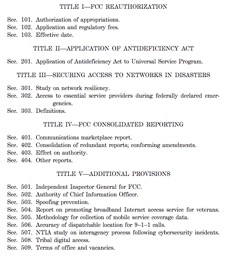
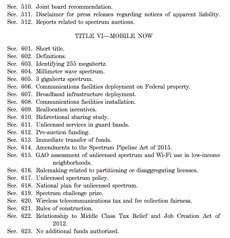
On March 23 POTUS signed into law the 2018 Omnibus Spending Bill. As a public service, we are providing to the telecom community the sections that deals with telecom issues so readers don't have to plow through all 2000 pages. The index of the telecom provisions is given above.
Since CTIA and NAB will quickly tell their members about the sections that direction affect them - while they claim credit for these provisions, we will not address such issues here. Rather we will focus here on the unlicensed spectrum issues in the new law.
SEC. 603. IDENTIFYING 255 MEGAHERTZ
This section requires NTIA and FCC to identify "identify a total of at least 255 megahertz (sic) of Federal and non-Federal spectrum for mobile and fixed wireless broadband use." It further specifies that "100 megahertz below the frequency of 8000 megahertz shall be identified for use on an unlicensed basis" and that "55 megahertz below the frequency of 8000 megahertz shall be identified for use on either a licensed or unlicensed basis, or a combination of licensed and unlicensed." Thus 100 -155 MHz of spectrum will become available for unlicensed uses, presumably from spectrum used in whole or part by federal users, in the next few years.
SEC. 611. UNLICENSED SERVICES IN GUARD BANDS
This provision states:
After public notice and comment, and in consultation with the Assistant Secretary of Commerce for Communications and Information and the head of each affected Federal agency (or a designee thereof), with respect to frequencies allocated for Federal use, the Commission shall adopt rules that permit unlicensed services where feasible to use any frequencies that are designated as guard bands to protect frequencies allocated after the date of enactment of this Act by competitive bidding under section 309(j) of the Communications Act of 1934 (47 U.S.C. 309(j)), including spectrum that acts as a duplex gap between transmit and receive frequencies.
Two comments here:
- It is unclear whether the requirement for FCC to consult not only with NTIA but also "each affected Federal agency" is a practical requirement here. It is bad enough that the US has 2 parallel agencies in charge of spectrum policy, but here it appears that Congress may not trust the agency that regulates federal spectrum use on behalf of POTUS.
- It is unclear why this provision was even needed since FCC and NTIA already had the legal authority to do this. So rather than enabling anything, this provision might actually slow it down. Time will tell!
SEC. 615. GAO ASSESSMENT OF UNLICENSED SPECTRUM AND WI-FI USE IN LOW-INCOME NEIGHBORHOODS
(GAO) shall conduct a study to evaluate the availability of broadband Internet access using unlicensed spectrum and wireless networks in low-income neighborhoods.
A odd provision! For example, what does "wireless networks " mean here? In general today's use of "wireless" seems to be the services that members of "CTIA-The Wireless Association" offer. Or perhaps the services regulated by FCC's Wireless Telecommunications Bureau. Neither of which seem to include Wi-Fi®.
"Wi-Fi®", as the ® indicated, is a certification mark of the Wi-Fi Alliance. It would be odd if Congress passed a bill on the availability of Xerox® brand copiers in low income neighborhoods. So why did Congress use "Wi-Fi" here?
Then in Sec. 615(a)(2) the bill requires GAO to "consider and evaluate both "the availability of wireless Internet hot spots and access to unlicensed spectrum in low-income neighborhoods, particularly for elementary and secondary school-aged children in such neighborhoods" as well as "any barriers preventing or limiting the deployment and use of wireless networks in low-income neighborhoods"
While many unlicensed Wi-Fi® networks are free to the users, that is not a requirement of FCC rules. The law is unclear then if both free networks and fee-based subscription networks are intended.
Finally, in the 5 GHz band, the impact of LTE-U on Wi-Fi® networks is not going to be positive, but will be very contentious. Is GAO supposed to reopen this can of worms?
SEC. 617. UNLICENSED SPECTRUM POLICY
Even though the whole concept of "unlicensed spectrum" has a foggy foundation in present law and appears to be a contrition of Sec. 301, this prevision tries to build a better foundation for unlicensed while not explicitly saying it is authorized. The bill states
(a) STATEMENT OF POLICY—It is the policy of the United States— (1) to maximize the benefit to the people of the United States of the spectrum resources of the United States; (2) to advance innovation and investment in wireless broadband services; and (3) to promote spectrum policy that makes available on an unlicensed basis radio frequency bands to address consumer demand for unlicensed wireless broadband operations.(b) COMMISSION RESPONSIBILITIES—The Commission shall ensure that the efforts of the Commission related to spectrum allocation and assignment made available on an unlicensed basis radio frequency bands to address demand for unlicensed wireless broadband operations if doing so is, after taking into account the future needs of homeland security, national security, and other spectrum users— (1) reasonable; and (2) in the public interest
We are troubled by the requirement to take "into account the future needs of homeland security, national security, and other spectrum users". While CTIA is now supporting the use of 6 GHz C band spectrum for unlicensed use, perhaps in exchange for the unlicensed community supporting their access to the 4 GHz part of the band, we are aware of no previous occasion when CTIA has every supported the designation of ANY spectrum for unlicensed use. Indeed, BOTH CTIA and NAB have consistently opposed any new unlicensed bands for decades! After NAB and friends said no new spectrum was needed for the ATSC 3.0 transition, they are now trying to slow down for the umpteenth time TV white space implementation so they can simulcast - something their original petitions said was no necessary! So we are not sure if ANY new unlicensed spectrum could pass the test of not impacting "future needs of homeland security, national security, and other spectrum users". Where the "the public interest" stand with respect to these incumbents?
SEC. 618. NATIONAL PLAN FOR UNLICENSED SPECTRUM
The "plan" is introduced here:
NATIONAL PLAN—Not later than 18 months after the date of enactment of this Act, the Commission, in consultation with the NTIA, shall develop a national plan for making additional radio frequency bands available for unlicensed or licensed by rule operations.
This plan can identify new bands that meet the policy statement in Sec. 617, above, including the issue of the needs "of other spectrum users". Interestingly Sec. 618 (c)(2)(D) then states that new bands must "not significantly impact homeland security or national security communications
systems" — oddly leaving out the phrase "other spectrum users" included in Sec. 617. Does this really mean that NAB and CTIA can object on the basis of their "future needs" but not on the basis of "significant impact". VERY ODD! Possibly a drafting error in a smoke filled room late at night.
CONCLUSIONS
Congress did a lot in this legislation. Much of it was already within the legal jurisdiction of FCC and NTIA. Unless Congress wants to revise such issues ever few years, perhaps it should ask the more basic question as why much of this legislation was needed. Perhaps Congress should be more explicit in telling FCC and NTIA what there general goals and priorities are, and let the agencies implement them subject to oversight.
In general, the spectrum policy resources of BOTH FCC and NTIA are too meager considering the $300+B contribution of spectrum related activities to the GDP. FCC and NTIA spectrum activities cost about $200M annually. Both agencies are user fee supported and there is virtually no opposition among their users to the current fee levels. Whether you want to believe Comm. Rosenworcel's off stated number that Wi-Fi® contributes more than $240 B of economic benefits annually, clearly the FCC's Docket 81-413 decision has had huge economy benefit even though it was almost universally opposed at the time. The "killer app" specific suggestion to use the ISM band for unlicensed use came from an FCC-funded study by MITRE Corp. that cost $56k. The plain truth is that neither FCC nor NTIA have this type of funding any more for independent study of spectrum policy issues although its UK counterpart Ofcom does.
Thus it is not clear if the requirements of this legislation, absent a resource increase for both FCC and NTIA spectrum activities, will result in a net gain of spectrum productivity productivity or just drain resources from other important spectrum efforts.
Congress Changes FCC IG Structure
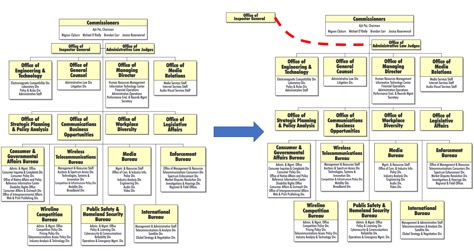
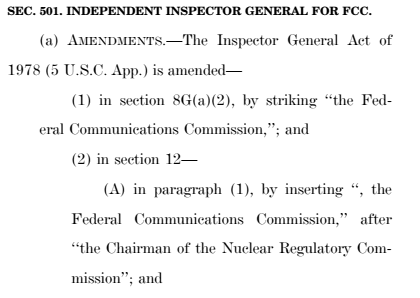
There has been a lot of press on the $1.3T spending bill that POTUS signed on March 23rd. However, there has been little press on the telecom provisions that are included in this 2000+ page bill. One that was particularly gratifying to your blogger was Sec. 501, Independent Inspector General for FCC. (p. 1869)
(As a public service, SpectrumTalk is providing a link here to the telecommunications provisions of the spending bill.)
Long time readers may recall we have been pointing out for 6 years the failures of the structure of the current FCC IG office. All the FCC IGs since the position was created in 1989 have been FCC insiders who were well known to the 8th Floor leadership and unlikely to ask too many questions. This has been true under both parties. So while the FCC IG has the same exact oversight duties as the IG at larger agencies under the IG Act, the FCC IG has consistently spent nearly all his resources, now 50+ FTEs, looking an noncontroversial issues like USF fraud. The overall effectiveness of FCC seemed of little interest. In addition, the lack of an effective IG made FCC as a whole less credible as there was no way to investigate suspicious of improper conduct on policy in a timely credible way.
Your blogger was complexly surprised by the passage of this provision and did not know it was under active consideration. We hope our repeated blogging on the issue was a positive factor in Congress recognizing this problem and correcting it.
The new FCC IG will be nominated by POTUS and subject to senate confirmation and congressional oversight.
An Open Letter to David Redl Upon His Confirmation as NTIA Administrator

Congratulations on your appointment and confirmation as Assistant Secretary of Commerce for Communications and Information/NTIA Administrator! NTIA has many responsibilities, but this post will focus on its spectrum management ones - a key issue in our increasingly spectrum-dependent world. On behalf of the President, NTIA administers his jurisdiction for use of the spectrum by federal agencies. But in reality the "elephant in the room" is the Interdepartment Radio Advisory Committee (IRAC) whose origin goes back to the 1920s.
While Title IX of the Communications Act which codifies NTIA's establishment barely mentions IRAC, the role of IRAC is as mysterious are the role of the Politburo in the former Soviet Union. Does IRAC "advise" NTIA or does IRAC actually make most of the decisions with occasional oversight from NTIA when either Congress gets interested or a private sector entity has enough political power?
I would urge you to read Nobelist Ronald Coase's report "Problems of Radio Frequency Allocation" which was written in the early 1960s but suppressed for about 30 years. In particular, I suggest you review the IRAC and FCC discussion on p. 44-72 (pdf p.52-80). While this material was written decades before the creation of NTIA and several years before even the creation of the former OTP, where the late Justice Scalia served, to many of us it is the best description of IRAC practices that exists in the public domain. The report has citations to hearing and reports on spectrum management going back to WWII. It reveals (p. 59, pdf. p. 66) that as early as 1950 legislation was introduced to create an independent agency in the federal government to "formulate plans and policies for the utilization of spectrum".
I was privileged to have a discussion with the late Justice Scalia about 5 years ago on how federal spectrum management worked in OTP days. (There are a few other OTP veterans still active in the field, so I urge you to reach out to them for insight.) While OTP Director Whitehead let IRAC handle many functions, he was willing to and actually did intervene much more than NTIA has in recent decades. In particular, he was willing to call cabinet members directly to get them to reverse positions their agencies had taken in IRAC - generally without knowledge of top agencies officials in a "deep state"-like arrangement.
Of course, Whitehead's White House phone number helped a lot! While the 2012 PCAST spectrum report may be falling out of favor in the current Administration, I urge you to review Section V which is not controversial and particular Recommendation 5.1 on increasing the White House role in spectrum policy:

After the PCAST report there was a slightly increase spectrum policy presence in the White House with the detail of an NTIA middle manager to OSTP. Due to budget constraints, this OSTP specialist was actually paid by NTIA and was expected to return there. The White House needs more of a point person on spectrum policy and this is important enough that person should be independent of BOTH FCC and NTIA.
The NTIA spectrum staff seem to think that they can't really regulate other federal agencies and that no other agency can regulate such agencies in any matter. Let me point out some examples:
- EPA regulates pollution from federal agency activities
- OSHA regulates federal workplace safety
- GSA regulates federal real property (e.g. buildings and land)
- NRC regulates nonweapons related federal use of radioactive material
- OPM regulates federal personnel policies
- NSA regulates federal agency use of encryption
Early in my FCC career I used to periodically attend IRAC meetings and as well as meetings of an interagency committee at NSA that dealt with federal encryption equipment and its use. In both cases the groups were discussing policies that would apply to the agencies present. The key different was that IRAC thought they could make decisions based solely on the consensus of those present and that that broader "public interest" did not explicitly matter since the IRAC members were all public employees! In the NSA group it was clear that NSA was in charge and had a charter from POTUS but wanted to hear and consider the views of affected agencies. BIG DIFFERENCE!
Both NTIA and FCC really are understaffed with people who can do independent technical review of spectrum sharing issues, particularly novel ones. Thus you might want to consider this recommendation from IEEE-USA on creating a new advisory committee to both FCC and NTIA of technical experts without industry ties who can look independently at technical issues of spectrum sharing and interference and suggest possible solutions to difficult problems to both agencies. Since the physics is the same from both G and NG radio signals it makes sense to have on committee serve both and would save money since nonindustry advisory board members must get paid for their time..
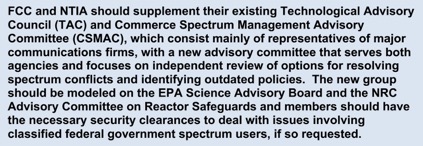
(Note that since this was drafted last year the EPA SAB has changed significantly and has become controversial.
However, the NRC group still has the same structure.)
So Mr. Redl, congratulations and let's hope that you can take an open minded approach to finding a new clarification on the relative roles of IRAC and NTIA in managing spectrum.


 (Does not include readers using RSS feeds.)


![[Valid RSS]](valid-rss-rogers.png "Validate my RSS feed")


