
Tom Hazlett's The Political Spectrum Now Available

Former FCC Chief Economist Tom Hazlett's new book The Political Spectrum: The Tumultuous Liberation of Wireless Technology, from Herbert Hoover to the Smartphone has now been published. Here is the Amazon description of it:
Popular legend has it that before the Federal Radio Commission was established in 1927, the radio spectrum was in chaos, with broadcasting stations blasting powerful signals to drown out rivals. In this fascinating and entertaining history, Thomas Winslow Hazlett, a distinguished scholar in law and economics, debunks the idea that the U.S. government stepped in to impose necessary order. Instead, regulators blocked competition at the behest of incumbent interests and, for nearly a century, have suppressed innovation while quashing out-of-the-mainstream viewpoints.
Hazlett details how spectrum officials produced a “vast wasteland” that they publicly criticized but privately protected. The story twists and turns, as farsighted visionaries—and the march of science—rise to challenge the old regime. Over decades, reforms to liberate the radio spectrum have generated explosive progress, ushering in the “smartphone revolution,” ubiquitous social media, and the amazing wireless world now emerging. Still, the author argues, the battle is not even half won.
A review will be coming shortly on this blog. But those of us who know Tom can easily say he is an excellent writer with a rather humorous style especially considering the nature of the topic here. Your blogger is also mentioned several times in the book - all the more reason to buy it!
For your convenience, here is a link for ordering the book. Tom would be pleased if you use it since at this time the $25.06 price is less than the book store price and Amazon Prime members get free shipping as well as great marketplace alternatives to spectrum-based over-the-air TV.
Federal Spectrum Reform in the Next Administration
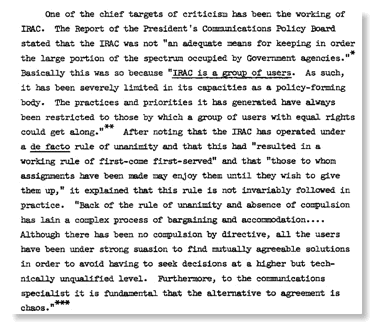
In practice, IRAC has had a major role in federal spectrum policy development and the top leadership of NTIA rarely overrules its decisions. Indeed, having sat in on may IRAC meetings it is clear that in the view of many IRAC members, NTIA is the law firm that represents their views to FCC and Congress and its not a regulatory agency. These members also tend to view the NTIA Office of Spectrum Management as the "IRAC Secretariat" -implementing the will of IRAC and recording the spectrum assignments that it has approved. Indeed a review of the spectrum report coauthored by Nobel laureate Ronald Coase in the early 1960s, "Problems of Radio Frequency Allocation" shows not much has changed int eh decades since it was written. In particular, the section entitled "The Work of the Interdepartment Radio Advisory Committee" may be the most accurate description of how IRAC worked publicly available although there have been some minor changes over the decades. Here is a section from the Coase report:
.
Would the pending MOBILE NOW Act and previously congressionally mandated reallocations of federal spectrum to nonfederal use have been necessary of NTIA and FCC had been working together in the national interest? Do the delays and uncertainties of needing Congress to act on these impose real costs on economic growth? While the cellular industry has the political influence to get legislative support for such reallocations, other spectrum users may not - particularly those in the early stages of their business plans - do not have enough political influence but may have significant economic potential.
The irony is that the congressionally mandated reallocations of the past 2 decades have resulted in antagonisms against reallocation of federal spectrum to non federal government users so requests for access to federal spectrum from less politically connected parties tend to get at best a slow response from NTIA.
I even had a client who was a military contractor who requested brief access to passive spectrum near 100 GHz that had no interference risk to any actual passive systems and the initial application was rejected by NTIA because one IRAC member did like the idea of it. It took a month of a DoD IRAC member beating up on the objecting IRAC member before be finally relented and dropped his objection. It did not appear that during this pendency any NTIA employees ever asked the objecting agency for a "reality check" to see if there was any technical merit to their objection. If this is how they handle requests of military contractors, imagine how privately funded research from non-CTIA members is handled?
TPRC Paper on FCC Spectrum Policy Throughput

On Thursday 9/17 TRDaily, a prominent communications policy newsletter, published an article about your blogger's paper for next weekend's 2015 TPRC | 43rd Research Conference on Communications, Information and Internet Policy (formerly Telecommunications Policy Research Conference). The previous link goes to the paper that can be downloaded for free.
The paper does not criticize any specific FCC decisions, rather it is concerned about the speed and transparency of such decisions. The concerns raised in the paper are not due to any one chairman or one party, rather they are issues that have developed in the past 20-30 years under multiple leaders.
Here is the abstract:
Today’s FCC is not as well structured to handle the reality of its spectrum policy workload as the early Commission was and may not be even keeping up with workload. Indeed, there is increasing evidence that “triage” is a key issue in spectrum policy. That is the nontransparent decision to even address an issue is a major determinant of its outcome. This could be both deterring capital formation for new spectrum technology R&D as well as creating real risks for incumbent licensees since emerging interference issues that need rulemaking or nonroutine action are not getting resolved in a timely way.
In 1934, the new FCC took a page from the structure of the ICC, one of its predecessors, and divided the then 7 commissioners into 3 “divisions” that could operate independently in the police areas of telephone, telegraph, and radio. There was no Administrative Procedures Act (“APA”) so rule deliberations were far simpler than today. The maximum frequency in routine use was 2 MHz and the modulation choices were just AM and radiotelegraphy. In the early days, a few of the commissioners had technical experience in spectrum issues.
Today we have the APA and nearly 70 years of court decisions than make rulemaking much more complicated. We have 5 commissioners that only make decisions en banc with virtually no §5(c) delegation to staff on emerging issues. Allocations go to 275 GHz, but service rules have been stuck at a 95 GHz limit since 2003. The selection process for commissioners appears to be focused on nonspectrum and nontechnical issues.
The result of all these factors is long drawn out deliberations on both new technology issues and on resolution of merging interference issues. While the US’ economic competitor nations often use “state capitalism” as a key issue in spectrum policy by subsidizing chosen new technologies and then cooperating to remove national and international spectrum policy limits for them, US entities in spectrum R&D often face both a lack of funding and an indifferent FCC (as well as NTIA - if access to G or G/NG spectrum is at issue).
The paper looks at a variety of spectrum policy issues FCC had dealt with since 2000 and examine the delays involved and their impacts. The issues consider include new technology issues such as the TV White Space, the FWCC 43 GHz petition and the Battelle 105 GHz petition as well as emerging interference issues such as police radar detector/VSAT interference, cellular booster-related interference, and FM broadcast/700 MHz LTE interference. The time lines of such deliberations will be reviewed as well as the likely impact of these timelines on the business plans of FCC regulatees.
Finally possible options to improve FCC throughput that are both feasible within existing legislation and consider approaches successfully used in foreign spectrum regulators will be discussed.
FCC Transparency & Spectrum Policy Productivity: How Many Spectrum Issues are Resolved by Letting Them Become "Dormant"?
The Chairman’s testimony is here. Here are some observations:
- The Chairman starts off with “The American people expect the Commission - and all federal agencies - to carefully consider and decide matters in a fast, fair, and effective manner.” (emphasis added) A basic problem is that spectrum policy at FCC is not “fast, fair, and effective manner” unless you are the cellular industry and even they can only get attention for megaissues like more spectrum for themselves. Even the cellular industry had to wait 10 years for FCC to act on the cellular booster interference issues in Docket 10-4 and is still waiting for more than 2 years on the FM/LTE interference issue that FCC has not publicly acknowledged. (Perhaps we should mention the police radar detector/VSAT interference issue/Docket 01-278 that also took more than a decade to address and for which FCC covered up the delay in official documents?)
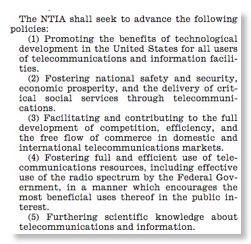
- What about the continued inattention to the statutory requirements of 47 USC 157, admittedly not the most brilliantly written piece of legislation, but the “law of the land” for 30+ years. An FCC insider tells me that the view of the Chairman’s Office is that the provision of 47 USC 155(a) giving the Chairman the power “generally to coordinate and organize the work of the Commission in such manner as to promote prompt and efficient disposition of all matters within the jurisdiction of the Commission” overrides the specific language of §7 that gives deadlines for certain new technology actions. Your blogger did not go to law school and the FCBA directory has a large “N” next to his name to warn others not listen to his legal opinions, but this nonpublic interpretation of the primacy of §5 over specific statutory time limits seems a little strange! Perhaps other commissioners or the House committee could ask the Chairman to clarify how he interprets §7. (Although his interpretation is probably no different than he predecessors who have all tried hard to avoid compliance with this provision.)
- What ever happened to Docket 09-157, introduced with great fanfare to stimulate “wireless innovation”? Is it being resolved in a “fast, fair, and effective manner”? Or will it just gather dust? The Chairman brags in his testimony (p.3) that “(l)ast year, we closed more than 1,500 dockets that were dormant”. Will this be the fate of 09-157? Keep ignoring it year after year and then dismiss it as “dormant”? What about the FWCC request for new E band antenna standards that has been pending since 2012? What about the Battelle petition for 102-109.5 GHz rulemaking, a band that presently lacks any FCC rules. Indeed, all spectrum above 95 GHz lack FCC licensed or unlicensed service rules, with the minor exception of a few amateur and ISM bands. What about the 2013 IEEE-USA petition to declares spectrum above 95 GHz that have no FCC rules as “new technology”?
- These problems were not created by the current Chairman or the current commissioners, they have evolved over a long time. But it is time for the Commission to face up to that fact that its Title III productivity as presently structured and operating is not enough. It is troublesome that several commissioners think there is too much delegated authority to the staff. Some recent actions on delegated authority raise some real questions. Yet, the only way to increase productivity on Title II is to have more delegated authority that is accountable to the 8th Floor!
- Let us compare Ofcom with FCC on spectrum policy. At Ofcom there is a Board of political appointees: “ Ofcom's main decision making body is the Board, which provides strategic direction for the organisation.” The Board does not make every decision, it sets “strategic direction” and oversees Executitve Committee which is “ Ofcom's senior executive team. It meets each month (except August) and is responsible for setting Ofcom's direction and overseeing the management of the organisation.” FCC has enough flexibility under §5(c) to change its spectrum policy deliberation procedures to approach those of Ofcom if the commissioners recognize there is a real productivity shortfall right now and it is affecting US competitiveness.
- On October 17, 2014 FCC adopted the 14-177 NOI on 5G above 24 GHz. Ofcom followed on January 16, 2016 with its corresponding “Call for Input”. While FCC is still dithering with its NOI and its maze of 170+ questions, Ofcom moved ahead on April 15 with both a initial decision on “Laying the foundations for next generation mobile services: Update on bands above 6 GHz” and a contractor study on 5G candidate bands. While a 1980 FCC contractor study was key to FCC’s later actions in creating the ISM bands for Wi-Fi and Bluetooth 30 years ago, the budgetary reality is that FCC spectrum management does not have money for outside studies on topics of other than key 8th Floor interests.
- Spectrum requirements for drones have been a recurring topic in this blog, although we have advocated no specific position and have no clients in that area. Certainly the growing commercial interest in drones has been all over the place in the news in the past year. But drone proponents are not traditional players at FCC and FCC has been completely silent on drone spectrum issues, except for public safety drones. If FAA ever finishes its drone policy issues next FCC will be the roadblock! Is this a “fast, fair, and effective manner”?
If FCC had $745,603 for a contractor for a management review of spectrum enforcement, perhaps it could spend a comparable amount of money studying how it might improve its productivity in spectrum policy that in turn will stimulate the US economy and is already a major part of GDP?
If FCC acknowledges (at least internally) a Title III productivity shortfall, it might wish to consider the suggestions of IEEE-USA on “Improving U.S. Spectrum Policy Deliberations in the Period 2013-2017” that have attracted little interest in the Commission so far.
Maybe FCC is as “fast, fair, and effective” in spectrum policy as possible given the current FCC resource level appropriated by Congress. But if the endless delays that most non-CTIA related spectrum policy issues (and even many CTIA-related issues) at FCC face is adversely affecting both US spectrum technology competitiveness and the large part of the GDP impacted by mobile ICT, the Commission should tell Congress that it is now resource limited. Given the ongoing net neutrality controversy, Congress may be unwilling to give FCC a resource blank check, but maybe someway can be found to make additional resources available only for noncontroversial Title III issues.
Summarily closing thousands of dockets and enforcement cases after years of inaction is not good productivity, it is fudging the data - not unlike the actions of the Phoenix VA Hospital and their waiting list data. “Fast, fair, and effective” action would involve resolving these issues in a timely way not by letting them die a natural bureaucratic death!
.
IEEE-USA Petition to FCC on Speeding >95 GHz Deliberations Under Terms of 47 USC 157
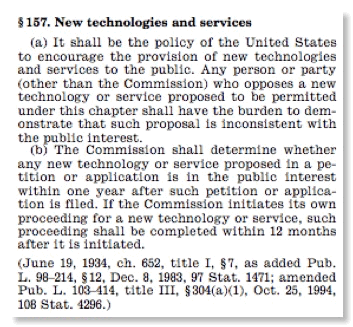
Section 7 of the Communications Act, shown above, was passed by Congress in 1983 and signed by President Reagan. It was then ignored in a bipartisan way by all FCC chairmen and virtually all commissioners for nearly 30 years. As reported here almost a year ago, it was “rediscovered” by Comm. Ajit Pai and was the focus of a speech he gave at Carnegie Mellon University on July 18, 2012.
On July 1, IEEE-USA, the US arm of the multinational engineering society filed at FCC a petition to ask to a declaratory ruling by the Commission that technology above 95 GHz presumptively qualifies at new technology under Section 7. Why 95 GHz? That is the upper limit for both licensed radio systems and unlicensed use under present rules.
(Part 18 ISM equipment may operate at 2 narrow bands above 95 GHz and Amateur Radio Service licensees have access to 3 bands above 95 GHz as well as “above 275 GHz”. Neither of these exceptions will stimulate a market for commercial products.)
The IEEE-USA petition seeks to have FCC presumptively declare that technology above 95 GHz is “new technology” in the context of Section 7 and thus entitled to the “burden” test if Section 7(a) and the timeliness requirement of Section 7(b).
mmW antennas & a dime

But the real issue here is uncertainty about FCC policy and the resulting regulatory risk that discourages capital formation for innovative technology. In the past few months I asked 5 prominent lawyers who specialize in spectrum issues how long it would take to a developer of >95 GHz technology to get FCC rules in place for normal sale and licensing (or unlicensed use) of the technology. One said 2 years, the other 4 said 4-5 years based on recent FCC performance in proceedings like UWB, AWS-3, and LightSquared.
Venture capitalists and “angels” have many people seeking funding for innovative technologies, most of whom are not subject to the regulatory uncertainties of FCC wireless technology regulation. These other technologies are therefore much more attractive to such capital than innovative wireless technology.
Furthermore, our major international competitor countries have a “state capitalism” viewpoint of wireless technology and regulation where the government “encourages” investment in chosen technologies, in some cases with government-controlled funding and coordinates spectrum policy to match the investments.
That is not the US system and probably should not be the US system. But it puts our technology developers, as well as our international competitiveness, at a real disadvantage if FCC does not consider such innovative technology in a timely way.
Hopefully FCC will request public comment on this petition quickly.
vox populi, vox dei
Dueling Spectrum Charts - Part 2
Fred Campbell, who during the Chmn. Martin era was the chairman’s wireless advisor and then Chief of WTB, has written a blog post on the new FCC spectrum chart report. Fred questions the consistency of the new data with earlier FCC statements in the merger context:
“It appears that the FCC considers the entire 194 MHz of licensed spectrum in the 2.5 GHz band as available for mobile broadband in the US when the ratio of licensed to unlicensed spectrum and international pride are at stake, but only 55 MHz is available when the FCC considers the impact of licensed spectrum aggregation on mobile competition. If the 139 MHz of spectrum the FCC excludes from its calculations when considering mergers is excluded from the international comparison in Table 1 of the report, the total licensed spectrum in the US that is available for mobile broadband drops from 608 to 469 MHz.”
Fred ends his post with
An exercise for readers is to decide whether the Martin chairmanship was any better on being “focused . . . on facts and data”.An agency that is truly “focused . . . on facts and data” would not pretend otherwise by manipulating facts and data to satisfy its desired results. Sadly, over the last three years, the FCC has demonstrated it is no such agency.
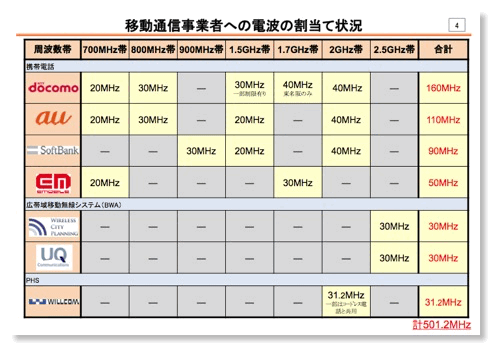
Your blogger was in Japan last week for some speaking engagements. In a talk at ARIB he pointed out the inconsistency of the FCC’s number for Japanese mobile spectrum (500 MHz) and CTIA’s number (347 MHz) and asked which was correct. Fortunately ARIB had just finished a report, in Japanese only, on wireless spectrum use in Japan. The key chart from that report is shown below and indicates 501.2 MHz of commercial mobile spectrum at the moment. So on this point, score 1 for FCC.
On Fred Campbell’s point, I don’t follow merger issues too closely so I would welcome input from others on who is correct.
(I would be glad to share the ARIB report with others who are interested and can digest the Japanese in it.)
UPDATE
Pierre de Vries, in his Deep Freeze 9 blog, has expanded on this post with respect to alternative ways to quantify spectrum use.
Dueling Spectrum Charts
Like the “dueling banjos” scene in Deliverance, we now have dueling spectrum charts with the release this week of the FCC White Paper The Mobile Broadband Spectrum Challenge: International Comparisons, produced jointly by WTB and OET.
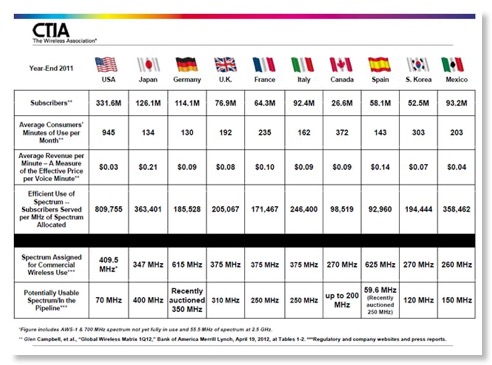
Reader may recall the recent criticism here of CTIA’s long used chart shown below:
Now FCC has answered back with its own accounting of international mobile spectrum use:
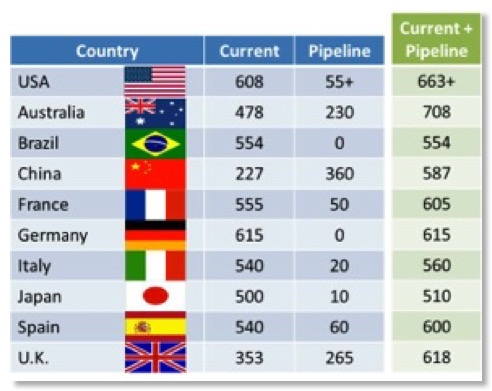
Now FCC does not use the absurd CTIA metric of “subscribers served per MHz of spectrum allocated” previously discussed here. And FCC adds data on unlicensed spectrum, often used by the cellular establishment for offloading traffic and thus improving service but almost always opposed by the cellular industry.
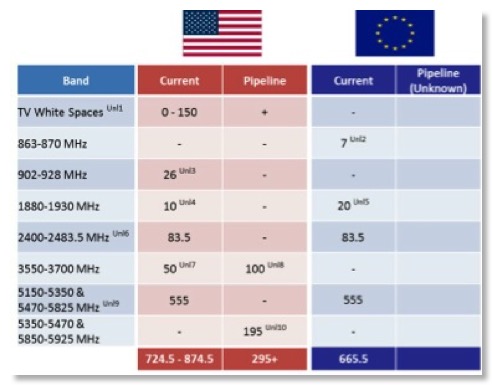
Clearly there are some major difference between CTIA’s accounting and FCC’s. For example FCC finds 608 MHz of “mobile broadband” spectrum now in the US, while CTIA can only find 409.5 MHz of “spectrum assigned for commercial wireless use”. At least in the UK the numbers are closer, FCC finds 353 MHz while CTIA finds 375 MHz. In the case of Japan, FCC finds 500 MHz of spectrum while CTIA can only find 347 MHz.
Hopefully both sides will explain what exactly they added up to get to the bottom of this disagreement. However, in the country with the world’s largest most information intensive military and with a severe post 9/11 public safety problem, it should not be surprising that less spectrum is available for commercial wireless then in, say, Brazil. If the cellular community was more open to spectrum sharing, rather than just trashing the PCAST report sharing recommendations, we could have more commercial wireless use as well as public safety/defense use.
That CTIA Flag Chart
For at least 2 years CTIA has been using the above chart, including minor variations, as part of its justifications for more allocations for cellular licensees. Your blogger does not disagree with the basic need for such allocations.
But it is interesting to look at the logic of this chart. Note the 3rd row “Efficient Use of Spectrum -- Subscribers Served per MHz of Spectrum Allocated”. In the US the value is 809,722 while in Spain it is on 92,960. Wow, Spain must be a great place!
Now let’s extend this logic. Let’s take the CIA World Factbook as a source of population data. Vatican City has a population 826 and has the same 375 MHz cellular allocation as Italy, so it has an “Efficient Use of Spectrum” of 825/375 or 2.2. They must have great cellular connectivity! Cellular nirvana.
How about San Marino, population 32,140 with an “Efficient Use of Spectrum” of 85.7 Supernirvana!
Click map to enlarge

The real point is that spectrum efficiency really is important. But spectrum lobbyists are reducing arguments to absurdity by trivializing technical issues in the high stakes game of spectrum allocations. It is amazing that CTIA has used this nonsensical metric for so long and it reflects on both CTIA and many of the government officials they deal with that they have been able to use such garbled thinking for so long.
Spectrum efficiency is generally thought of including more than population and amount of spectrum, area is a key issue. Frankly, it doesn’t make much sense to deal on spectrum efficiency with a country as a whole, since demand varies greatly in different areas in countries larger than Vatican City. A much better metric is peak population/area/MHz.
Now maybe this is too confusing for spectrum lobbyists and the officials that they deal with, but misleading information like the “flag chart” detracts from the real issues.
Can’t we have a spectrum dialogue with real facts, not phony metrics made up by spectrum lobbyists and PR firms?
Silicon Flatirons Spectrum Conference Papers Available
Also Paper on FM/ILS Controversy
 The position papers of many of the speakers at the recent Silicon Flatirons “Looking Back to Look Forward: The Next Ten Years of Spectrum Policy” conference are now available, including your blogger’s. Here are the titles and authors:
In U.S. Spectrum Policy: The Way Forward, Kathryn C. Brown and Charla Rath
Beyond Kolkata: Delivering on the Fundamental Goals of the Communications Act, Michele C. Farquhar
Not A Zero Sum Game - Why Objections To The PCAST Report Make No Sense, Harold Feld
The Stunted Public Interest Vocabulary in the Broadcast Spectrum Auction, Ellen P. Goodman
U.S. Spectrum Policy - When the Rubber Meets the Road, Kathleen Ham and Sara Leibman
The Promise and Problems of Strategic Plans, Charles L. Jackson
The Promise and Problems of Strategic Plans: From the Spectrum Policy Task Force to the PCAST Report, Michael J. Marcus
The View Ahead: Technology Opportunities, Preston Marshall
The Wireless Data Demand: Technology and Spectrum Implications, Edward G. Tiedemann, Jr.

However, there are lessons to be learned from this long simmering dispute: Receiver standards often have economic externalities - those who pay the cost are not the same as those who get the benefits. If we do not recognize this issue and find a way to deal with them there will be no progression this area.
Instrument Landing System Receiver Standards:
A Case Study of Receiver Regulation and Its Difficulties
The Instrument Landing System (ILS), used worldwide by aviation users, has two bands, one of which is just above the FM broadcast band at 108.1 -112 MHz. This safety-related landing system has been standardized by both FAA and ICAO, the ITU’s aviation counterpart. Unfortunately the adjacency to the FM broadcast band results in a possible vulnerability to receiver-generated intermodulation interference. This vulnerability was confirmed in FCC Lab measurements.(1 2) FAA and FCC have had a long standing disagreement on the best public policy approach to prevent such interference and NTIA has generally taken a neutral role with respect to this issue and has not been directly involved.
ICAO adopted immunity standards for ILS receivers that were effective international in 1998. (Those stands are mentioned by NTIA on p. 29 of its receiver standards compilation; The specifics of the ICAO regulation can be found in this document from the South African FAA counterpart.) FAA has implemented the ICAO regulation but still allows use of the previous generation of receivers and uses its powers under the Airways Facilities Act to threaten new or modified FM broadcast facilities for “hazard determinations” if they apply for a location, frequency, or power that would cause interference to the earlier generation receivers as projected by a FAA computer model that was not adopted in a “notice and comment” proceeding.
FCC proposed in 1993 to require only ICAO-complaint receivers in all US aircraft after the 1998 effectiveness date. (the NPRM was in response to this petition from broadcast interests.) This NPRM was opposed by aviation interests that felt they should not be burdened with replacing receivers in order to facilitate the use of broadcast spectrum (1 2 3). FCC took no further action on this NPRM until the docket was closed in a 2002 housekeeping action for being “stale”.
It is generally felt that airliners and corporate jets are not affected by this issue since, for practical purposes, they must be equipped to fly outside the US and therefore have ICAO-complaint receivers. However, there are small general aviation aircraft that are not actually required to be ILS-equipped that may well have the previous generation receivers and their trade association, AOPA, has vociferously objected to a mandated upgrade. (It is thought that all ILS receivers made anywhere in the past 20 years comply with the ICAO standard so that any noncompliant receiver in present use is likely 20+ years old.)
This receiver standard issue is a classic economic externality. The aviation users who would incur the cost of a new receiver would get no direct benefit. The benefits would accrue to broadcasters who could modify their facilities to better serve the public though power or siting changes and to the public that would receive addition FM stations if present FAA objections to some new allotments were dropped.
As in the GPS/LightSquared issue, this also falls squarely on the FCC/NTIA jurisdictional fault line, although complicated by the role of FAA and its partially overlapping jurisdiction.
Developing receiver standards is a technically complex issue. But in this case there is a specific international standard that was developed with participation of all affected parties. The US ambivalence towards receiver standards has left that standard in limbo in the US in the 2 decades since it was developed and has limited the utilization of FM broadcast spectrum in order to avoid putting any increased regulatory burdens on an ever decreasing number of small aircraft with obsolescent receivers that could not be used in most other countries.
It is not clear how this issue can ever be resolved due to the jurisdictional issues unless the Executive Branch takes a more holistic approach to such spectrum issues.
Looking Back to Look Forward: The Next Ten Years of Spectrum Policy
Looking Back to Look Forward: The Next Ten Years of Spectrum Policy
Tuesday, November 13, 2012; 1:00 - 6:00 PM
@ Pew Research Center, Washington, DC
Co-Sponsored by Silicon Flatirons Center - A Center for Law, Technology, and Entrepreneurship at the University of Colorado, CTIA - The Wireless Association and Public Knowledge
In Cooperation With the Federal Communications Bar Association and IEEE-USA
The regulatory foxtrot - slow, slow, quick, quick, slow - means that participants in the spectrum policy dance need to keep an eye both their current and future partners. Multiple cycles line up this year: it's a century since the sinking of the Titanic and the 1912 Radio Act, ten years since the FCC Spectrum Policy Task Force Report (SPTFR), and the end of a four-year Administration that saw the FCC's National Broadband Plan, a Presidential Memorandum calling for 500 MHz of spectrum to be found for wireless broadband use, and a report of the President's Council of Advisors on Science and Technology (PCAST) about realizing the full potential of government-held spectrum.
It is a time when pressure on spectrum allocations keeps growing due to the drumbeat of new broadband wireless applications, a crowded dance floor with a growing diversity and density of conflicting radio operations, and a crescendo of technologies such as smarter radios and heterogeneous networks. This presents an opportunity to look back at lessons learned, and prepare for challenges of the next four and ten, if not a hundred, years.
Panel 1: The Promise and Problems of Strategic Plans: From the Spectrum Policy Task Force to the PCAST Report
A decade ago, an intensive multi-disciplinary review culminated in ground-breaking staff report that is still often quoted. Recent years have seen similarly ambitious strategic plans from the FCC and the White House: the National Broadband Plan, the President's Memo, and the PCAST report. What lessons can be learned about strategic spectrum planning from the impact and unfinished business of the SPTFR? How should these lessons be applied to the current crop of recommendations?
Panel 2: Reforming US Spectrum Management: Sharing, Reallocation and Other Options
The FCC's National Broadband Plan and the President's spectrum initiative laid out aggressive goals for spectrum reallocation to commercial mobile broadband, and the PCAST report recommended sweeping, long-term reforms of government spectrum management. Sharing has become a serious option. What are the strengths and weaknesses of these proposals; what needs to be added or taken away? What are the prospects for improving the transition from old to new ways of using spectrum for federal and non-federal users.
Panel 3: The View Ahead: Technology opportunities
Regulatory discussions are informed by technology trends, and wireless research continues to open up new policy possibilities. What are the long-term technology trends and constraints that will drive spectrum policy over the next ten years? This panel will lay out what to expect, and when, as we move to ever-denser packing of bands.
[Your blogger is speaking on Panel 1]
Spectrum Policy for National Government Users: A Worldwide Policy Challenge

National governments around the world are generally large scale spectrum users for their military and civil governmental operations. Today, many governmental functions are spectrum intensive due to the increasing mobility and use of information in today’s societies and economies. The civil functions range from air traffic control to public safety operations to fixed and mobile wireless networks to support other functions that are key to toady’s societies. The spectrum resources that are used for such governmental functions are generally not available for private sector users, although some sharing is possible in classic spectrum policy. National government spectrum use is a difficult regulatory issue because the very same national government that is using such spectrum includes the regulator that sets the rules for private sector use. In many countries military authorities play a key role in national spectrum management.
Spectrum is generally fungible for national government and private sector use and is a key input to wireless systems that have a large impact on national economic growth which in turn impact national government revenues. This article will explore the policy challenge of regulation national government spectrum use and discuss a recent US report on the issue.
Different countries have chosen different mechanisms for balancing national government and private sector spectrum use. In Japan, the Ministry of Internal Affairs and Communications (MIC) is the unitary regulator of all spectrum use and consistent with the Japanese style of government deals with other agencies on a somewhat distant basis. In the US, spectrum policy responsibility is split between the independent Federal Communications Commission (FCC) with jurisdiction over private sector and local government use and the executive branch’s National Telecommunications and Information Administration (NTIA) with jurisdiction over national government use. In the United Kingdom the Office of Communications (Ofcom) has responsibility for the “communications sector” while the national government, acting through a little known official committee of the Cabinet Office, the UK Spectrum Strategy Committee (UKSSC), has responsibility for national security and public safety spectrum use.
In the UK, the government has stated that “public bodies will acquire spectrum through the market, with administrative assignment by Ofcom only being made in exceptional cases” and that “(t)he Government is committed to paying administered incentive pricing (AIP) on its spectrum holdings”. (AIP is an estimate of spectrum value based on spectrum scarcity and other factors. ) In the US and some other countries, national government spectrum users pay a small fee for spectrum use that is calculated only on NTIA’s administrative costs and is independent of free market spectrum value. Thus the UK is unique in the world for its progress in treating spectrum use by the national government basically on the same economic terms as private sector use. While this may seem unusual to people who have dealt with spectrum for a long time, national governments around the world generally pay market prices from other key resources and products they use ranging from electricity to fuel to vehicles to land.
In July 2012 the US President’s Council of Advisors on Science and Technology (PCAST) released a report on national government spectrum use policy entitled “Report to the President: Realizing the Full Potential of Government-held Spectrum to Spur Economic Growth” . Parts of this report has been very controversial within the US because it advocates limiting previously planned reallocations of national government spectrum to commercially-operated mobile broadband systems and focusing on accommodating commercial spectrum use on increased sharing of spatial and temporal bands by national government users and private sector users. But in addition to this controversial recommendation there are several other recommendations that have received little attention and may be applicable to situations in other countries.
The report finds that “(t)here is no incentive system today for Federal (national) Government agencies to be efficient in their use of spectrum or to share spectrum allocated to them with the non-Federal (private/local government) sector” and recommends that the “essential element of this new Federal spectrum architecture is that the norm for spectrum use should be sharing, not exclusivity.” Because much national spectrum use is different in temporal and geographic characteristics than much of the other use, it finds that sharing will be possible in many cases with the provision that non-national government users must change their spectrum use temporarily when and where there is a surge of national spectrum use, for example during military training exercises.
The report recommends that national government agencies using spectrum should be given incentives to decrease their spectrum use because increased spectrum availability for the private sector has real economic benefit. Generally government entities are subject to strict budget constraints that make it difficult to impossible to explore system design changes to existing systems that could lower their spectrum requirements. While US already now provides for agencies to be reimbursed for the cost of moving to new bands, the cash flow of agency expenditures to plan and implement such a change and the reimbursement to the agency do not match well in terms of timing and amounts.
The report suggests creating a revolving Spectrum Efficiency Fund that “recycles private sector payments for use of Federal spectrum into reimbursements to Federal agencies for investments that facilitate spectrum sharing and enhance spectrum efficiency. Congress should allow the Fund to reimburse qualifying costs by any Federal service, not just those in revenuegenerating bands.”
The new fund would not have the cash flow limitations of the present scheme that discourage agency investments in planning studies and small scale tests of new technology since they can not be reimbursed presently until the spectrum has been auctioned to private users – possibly years later. The report goes further in recommending a major accounting change to facilitate agency changes that make more spectrum available to others:
“Spectrum currency is our name for a synthetic currency that would give agencies a means to identify the opportunity costs associated with their use of spectrum and to obtain benefits by sharing or vacating some parts of their assigned spectrum and provide a way for them to “buy” their spectrum usage rights and reduce their spending by improving spectrum efficiency…To turn their gains in efficiency to practical advantage, agencies desiring to accelerate their transition to the new scheme could use their spectrum currency to bid every year for equipment credit from the Spectrum Efficiency Fund … that would enable them to increase their service quality.”
The UK has led the way in holding national government spectrum users more accountable for their spectrum use through the pricing of spectrum for most government and private spectrum users. The recent US PCAST report explores new options to try to balance the equities of national government and private sector spectrum use. These will generally be controversial in each country and it is important that the technical wireless community become familiar with the issues involved in order to contribute to national deliberations on what is the best approach for each country.
On Moving the Upper Frontier of Commercial Spectrum Use

In the August 2012 issue of IEEE Wireless Communications is the above article by your blogger. The article starts
International spectrum allocations of the International Telecommunications Union (ITU) now go to an upper limit of 275 GHz. The upper limit of actual production commercial equipment appears to be in the 80 GHz range in the millimeterwaves or “mmW” region (30-300 GHz). While these upper frequencies have been often associated with fixed and satellite uses, the emergence of IEEE 802.11ad/WiGig mobile standards at 60 GHz and interest in broadband mobile applications above 100 GHz shows that many different uses may now be possible.
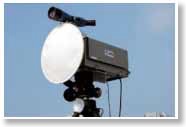
The initiation last year of the new IEEE Transactions on Terahertz Science and Technology shows that basic technology is moving on somewhat independent of lagging spectrum regulation. In addition, a technical highlight of the 2008 Beijing Olympics - ignored by the general press - was the use of 120 GHz point-to-point terrestrial links for high definition video distribution from venues to a central site and showed the potential for commercial spectrum use in presently virgin upper spectrum.
120 GHz Japanese system used at Beijing Olympics
Isn’t it time FCC start removing at >95 GHz such barriers to innovation and the necessary capital formation for it?
There are some valid issues of sharing these bands with existing passive allocations for radio astronomy and remote sensing as well as active federal government systems, but these make it more important that FCC give guidance to industry on how to commercialize these bands while protecting the other allocations. The nature of propagation at these bands as well as the ease at which narrow beam antennas can be used means that the concepts of spectrum regulation used at lower bands are not necessarily applicable and sharing is much more feasible.
Olympic News: Wireless Mics Work Well in a Marketplace Environment!
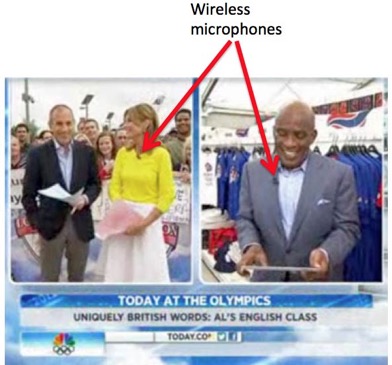
Watching the Olympics, you might not have noticed an interesting spectrum policy point: Wireless microphones (mics) are being used widely without any technical problems in a spectrum policy environment very different from the US: wireless mic users like most other spectrum users in the UK (including military users) are paying for spectrum access!
As we enter the era of incentive auctions, one of the issues people in Washington do not want to talk about is the future of wireless mics and their current spectrum. Clearly wireless mics are a socially constructive and economically important use of spectrum for the entertainment industry, conference facilities, and other applications. But wireless mics developed in the US on the assumption that interstitial use of “vacant” TV channels was a “free good”. Under NTSC analog technology with the UHF taboos resulting from poor TV receiver technology, or at least poor predictions of TV receiver technology, this was mostly true. Of course, the questionable large scale marketing by companies like Shure, Inc. of wireless mics to users not legally eligible to use them only complicated the issue.
Similarly the unwillingness of the entertainment users of wireless mics to confront the legal contradictions of using the technology as a key building block of their shows until Docket 04-186 showed up was also irresponsible, (One wonders about Walt Disney Co. with respect to its dual roles as a TV broadcasters with multiple licenses and the owner of Broadway shows that violated the Communications Act through their illegal use of wireless mics until recently. Had their lawyers done a risk analysis of this issue?)
It does not take much of a crystal ball to see that in the long term wireless mic use of UHF-TV spectrum will become questionable as this spectrum is in greater and greater demand. While mire less mics are important, their use is very sparse in space and time and normal allocation models are not a good match.
In the UK, Ofcom’s “dedicated band manager” for “programme-making and special events”/PMSE is JFMG, which is now owned by Arqiva, the company that actually owns and operates broadcast transmitters in the UK - operated on behalf of the programming originators. JFMG buys spectrum at market prices and then leases it for PMSE uses such as wireless mics to users who pay according to the amount of resources they use.
As we have seen in the Olympics it works! I suppose NBC would have preferred the US system where spectrum access is free. But why is that so important? While marketplace forces do not work all the time for all applications, the UK-style system is probably a better way to handle the wireless mic problem and will ease the inevitable transition to new technologies in various bands. Does anything think FCC really has the patience to handle that well?
Battling Spectrum Reports: Mobile Future vs. PCAST
On Sunday 7/15 Mobile Future released a report entitled “Spectrum Sharing: The Promise and The Reality”, almost certainly in anticipation of the final PCAST report that was released on Friday 7/20 as had been previously announced. The PCAST report was discussed here previously when a public briefing discussed its basic findings. A year ago we introduced readers to Mobile Future in a post entitled “New Cellular Advocacy Group Trivializes Spectrum Policy Issues”. Mobile Future’s membership includes Alcatel-Lucent, AT&T, Ericsson, Qualcomm, and T-Mo but not VZW and Sprint.
Mobile Future 2011 video
The cellular industry was angry at the staffing of the PCAST report because they saw it as stacked with Silicon Valley interests. However the 21 “invited experts” (p. xvii-xviii) included Dale Hatfield, who is clearly on close terms with the cellular industry, the former R&D chief of Motorola, and Tom Wheeler, former head of CTIA. It also included 13 individuals with academic affiliations, a ratio common on Japanese government advisory committees but previously unheard of in the FCC/NTIA cases.
A July 5 article in Bloomberg BNA Telecommunications Law Resource Center™ , “Despite Calls for Spectrum Sharing, Technological, Regulatory Questions Linger” contained the basic points that the Mobile Future/Rysavy report elaborated on:
While the concept has been embraced by the FCC, NTIA, and PCAST, the chief concern of the wireless industry is that spectrum-sharing technologies might not be ready for commercial application until 2020 at the earliest.
“If you come out and start saying, 'let's share spectrum,' and there's not a means for doing spectrum sharing, you've compounded the problem,” Randall Stephenson, chairman, chief executive, and president of AT&T Inc., told reporters following remarks at a Washington event in June.
Since May, Stephenson has publicly suggested twice that spectrum-sharing technology is not ready for “prime time,” while giving his general support for the idea pending the resolution of many “what ifs.”
Note that AT&T is a member of Mobile Future and you see the connection.
The Mobile Future members want sole focus of spectrum deliberations to be on reallocation to them and view sharing as academic illusion that isn’t ready for prime time. Of course, while the industry see spectrum sharing as an unimplemented illusion, it also sees 700 MHz LTE systems for nationwide public safety voice and data with priority and preemption as a straight forward engineering task. It would be interesting if Mr. Stephenson could comment on why one is so risky and the other so straight forward.
So with all this preliminary effort the final PCAST report came out today. As Mobile Future feared, it emphasizes sharing spectrum, not reallocating it entirely to the cellular industry. This is a terrible blow to the Chinese electronics industry because it means that world wide standard equipment can not be used in all bands in the US. However, the usual Chinese made equipment will still work in many bands including all the present ones. In many cases the nonstandard features to deal with sharing spectrum will be in the base stations NOT the handsets so the CTIA membership will still be able to fill their stores with Chinese products.
Rather than focusing on the inevitable bad news about sharing, the cellular industry and other nonfederal government spectrum users show focus on and praise the first real proposals in a long time to reform federal spectrum management and create the right incentives for managing the spectrum in the national interest, not in the parochial interest of IRAC members.
I suggest that the cellular industry carefully read the following recommendations of the PCAST report and realize that for the first time (since Nixon’s OTP) they offer the hope of creating a real national spectrum management system that focuses on the national interest:
Finding 5.1: There is no incentive system today for Federal Government agencies to be efficient in their use of spectrum or to share spectrum allocated to them with the non-Federal sector.
Finding 5.2: A public private partnership (PPP) is the best mechanism to ensure that optimal use is made of the Federally-held spectrum and of related investments in spectrum research and testing.
Finding 5.3: International harmonization of spectrum policies is essential to product innovation, interoperability and roaming, spectrum efficiency, and cross-border frequency coordination.
Recommendation 5.1: PCAST recommends that the White House Chief Technology Officer (CTO) with senior officials at an equivalent level from the National Security Staff (NSS), the Office of Management and Budget (OMB), and the National Economic Council (NEC) formalize a Spectrum Management Team (SMT) to work with the National Telecommunications and Information Administration (NTIA), the Federal Communications Commission (FCC), and the
major Federal agencies that use spectrum to carry out the President’s directive.
Recommendation 5.2: PCAST recommends that the NTIA, working with the SMT and Federal agencies, reexamine the partitioning of Federal spectrum usage in light of current and emerging technology. One objective of this reexamination is to aggregate current spectrum partitions to create substantial frequency blocks in order to facilitate sharing through common technical use rules.
Recommendation 5.3: PCAST recommends that the President indicate that all Federal agencies should cooperate with the SMT and NTIA to establish and implement a government-wide process and mechanism to share Federally-held spectrum. Within one year, the SMT working with the NTIA should formulate concrete 5 year and 10year goals for Federal spectrum sharing opportunities in order to recommend to the President how to appropriately update his 2010 goal of making 500 MHz of Federal and nonFederal spectrum available over the next 10 years.
Recommendation 5.4: PC
AST recommends that OMB, working with the SMT and NTIA, take steps to implement a mechanism that will give Federal agencies incentives to share spectrum. Such a mechanism would accurately internalize the opportunity cost of Federal spectrum resources and manage them over long time horizons using a “currencylike” accounting, allocation, and incentive system (“Spectrum Currency”).
Recommendation 5.5: PCAST recommends that OMB should implement a sustainable funding mechanism to foster a Federal spectrum sharing system. The existing Spectrum Relocation Fund should be redefined as a revolving “Spectrum Efficiency Fund” that recycles private sector payments for use of Federal spectrum into reimbursements to Federal agencies for investments .
UPDATE
Trade press reports on PCAST report:
Wireless Week
FerceBroadband Wireless
GigaOm
Comm. Pai's First Public Speech Hits the Bull's Eye on Innovation
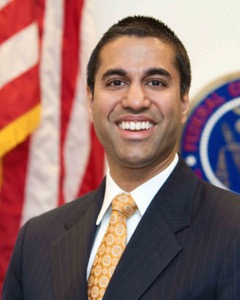
In his first major speech as a member of the Federal Communications Commission (FCC), Ajit Pai on Wednesday proposed the creation of an office for expediting the reviews of new technologies and services. In the speech at Carnegie Mellon University in Pittsburgh, Commissioner Pai, a Republican who joined the FCC in May, accused his agency of moving too slowly and stifling growth in the communications industry.
In the speech at CMU also talked at length about Section 7 of the Communications Act, a section so rarely mentioned at FCC that your blogger was seriously wondering whether it was redacted from all copies of the Act at FCC. While ignored consistently at FCC, Section 7 has been a recurring topic on this blog and there are indications that Comm. Pai’s interest might have been influenced by the discussion here.
Here is Comm. Pai’s discussion of Section 7 in case you are rusty on the details:
Now, you might be wondering: What is Section 7 of the Communications Act? You’re not alone; many communications lawyers don’t know what it is.
Let me quote the important part of Section 7, the neglected stepchild of communications law: “The Commission shall determine whether any new technology or service proposed in a petition or application is in the public interest within one year after such petition or application is filed.”
Looking at that provision, the message from Congress is clear: The Commission should make the deployment of new technologies and new services a . a priority, resolving any concerns about them within a year.
Comm. Pai proposes a new “Office of Entrepreneurial Innovation” for FCC although he suggests that this might be done by transforming the present the Office of Strategic Planning and Policy Analysis.
He states
(I)f we create an Office of Entrepreneurial Innovation, shepherding proposals for new technologies or services through the FCC will become an institutional priority and send the right signals to the marketplace. Entrepreneurs need an advocate at the FCC—one that will hold us accountable if we delay, rather than decide. And if OEI succeeds in its mission, we will see faster innovation, greater investment, and more job creation.
Finally on more general spectrum policy issues, Comm. Pai says
When it comes to spectrum policy, I believe in an “all of the above” approach. Does the FCC need to make available more spectrum bands for wireless broadband? Yes. Do we need to reform the federal government’s management of its spectrum so that more can be made available for private-sector use? Yes. Does the FCC need to expedite its review of secondary market transactions? Yes. Is there a place for geographic spectrum sharing? Yes. Is there a place for unlicensed use? Yes. Do we need to do more to promote the efficient use of spectrum? The answer, again, is yes.
A virtuoso performance! However, many incumbents with good access to 8th Floor decision making probably don’t agree that innovation, other than their own innovation, is a great idea. During its heyday as the dominant mobile radio manufacturer, the old Motorola maintained its market hegemony in Part 90 (private land mobile) market by manipulating FCC rules to keep out innovation that would disrupt their market share out of the marketplace. Indeed, this is the very reason Section 7 was passed in 1983 after Motorola and its allies in the Part 90 user community derailed a new land mobile radio technology (ACSB) from a new entrant!
The speech ended with these impressive words,
Finally, the agenda that I have described today is a work in progress. This speech should be the beginning of a conversation, not the end of one. If you have thoughts on how the FCC can help accelerate economic growth and job creation, tell me. If you have a new idea for how the FCC can become more nimble, promote investment, or allocate additional spectrum for mobile broadband, let me know. Please do not hesitate to contact my office. We have an open-door policy, and we encourage you to take advantage of it. You can even reach out to me on Twitter; my handle is @ajitpaifcc. It doesn’t matter whether you represent a Fortune 500 company, a start-up with three employees, a public interest group, or just yourself. A good idea is a good idea, and I want to hear as many of them as possible.
Although our nation has been going through tough times these last few years, I am confident that our economy will rebound strongly, and that the ICT sector can help lead the way. We see a glimpse of that future here in Pittsburgh. And if we pursue the right policies in Washington, DC, we can remove barriers to investment and innovation and unleash a wave of economic growth and job creation all across the country. Working together, I know we can make it happen. Thank you very much.
Docket 10-4: 6+ Years of FCC Inaction Turns an Emerging Interference Issue into a "Lose/Lose" Situation
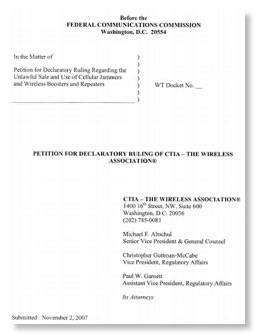
On November 2, 2007, CTIA, the Wireless Association (CTIA) filed a Petition for Declaratory Ruling (CTIA Petition) regarding the proper use of signal boosters in Commercial Mobile Radio Services (CMRS).
Hence there was no explanation for the over 2 year delay in responding to this petition from a very powerful trade association. If a trade group as powerful as CTIA can be ignored for 2+ years, one wonders how much attention a mere startup company would get? Since the 1st Amendment guarantees the right “to petition the Government for a redress of grievances” and the APA reiterates this right, "Each agency shall give an interested person the right to petition for the issuance, amendment, or repeal of a rule" (5 USC 553(e)), it is puzzling that FCC in recent decades have given most petitions such little attention. When Bob Foosaner was head of WTB’s predecessor in the 1980s, he argued pragmatically that petitions had to be either dismissed or put out for public comment in about a month, for otherwise the embarrassment of inaction impacts the real options.
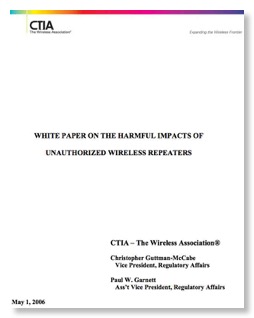

Unfortunately CTIA’s documents failed to recognize that although early amplifiers sometimes caused interference, they were also of real benefit to consumers who suffered from marginal cellular coverage especially in rural areas. They also were very popular among public safety users, although they also complained about interference from early models (still permitted due to the impasse in this proceeding). Thus the total prohibition of amplifiers that CTIA sought was unreasonable, although it took a long time for key CTIA members to come to this realization.
We have argued here previously that emerging interference issues are inevitable in the dynamic wireless area and need to be addressed and “nipped in the bud” before they get worse. The 10+ year delay of dealing with police radar detector interference to VSAT terminals is an example of ignoring a problem until it becomes unmanageable and then putting burdens on all involved to solve it. (FCC has never even acknowledged publicly that it was aware of this problem for 10+ years before taking action!)
So what has happened in the 6+ years since CTIA’s white paper was filed? Since there has been no regulation adopted to address the issue of amplifiers that oscillate like PA systems with a microphone too close to the speaker, low end manufacturers still sell such amplifiers in the US market and presumably continue to cause interference. High end US-based manufacturers have switched to designs that are protected from oscillations and do not cause this interference - although the present designs they might cause much less frequent problems through more obscure mechanisms. However, due to regulatory inaction by FCC, low end manufacturers can continue to sell early generation units that can and do oscillate and cause interference to cellular systems.
So,
- Cellular operators continue to get interference from existing and new amplifiers that come from low end manufacturers and which continue to be legal in the current regulatory impasse.
- Legitimate amplifier manufacturers with updated designs that don’t oscillate suffer price competition from low end makers who undersell them with equipment that threatens cellular systems AND during the pendency of this rulemaking have limited access to new capital for improved equipment design due to regulatory uncertainty during the tendency of this proceeding. At least one of these manufacturers actually makes the units in a small US town in a “red state”. One new US entrant who contacted me several years ago about entering the market with an oscillation-protected design never got the financing he needed - probably due to regulatory uncertainty.
A true “lose/lose” situation! Due to the deadlock both sides (as well as the public) suffer!
Meanwhile the CTIA membership can’t make up its mind what the powerhouse should press for and meanders like a rudderless ship. A recent filing has a table summarizing the positions of the various carriers with respect to the “Joint Proposal” of Verizon Wireless and Wilson Electronics for reasonable regulation of amplifiers.
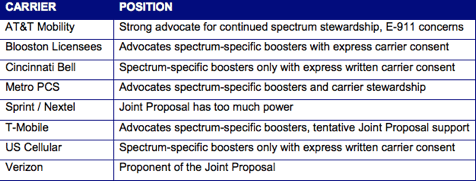
Comparison of carrier positions from Millard/Raines Partnership 5/12 filing
What is needed here is some real leadership either in the cellular industry or at FCC. While reasonable people can disagree on the best solution, most will agree that a solution is in everyone’s interest. Perhaps FCC should send an ultimatum to the industry to come up with a unified position within 2 months or else FCC will moved directly to a decision based on the current record.
It is nice to try to be everyone’s friend, but that is not a good way to run a regulatory agency in a fast moving technical area. Some times you just have to make a decision and move on.
It has been over 6 years since CTIA said

Now is the time for action! This problem is not “rocket science”, rather the impasse reflects a basic problem in FCC spectrum policy: an unwillingness to tackle basic Title III issues that are part of the Commission’s basic charter.
If the FCC IG had a good understanding of his role, he would investigate how this mess developed at FCC so the Commission can learn from these events. Don’t hold your breath, though.
So let me make a modest suggestion to resolve this impasse:
In effect the Commission is now using an informal nontransparent version of negotiated rulemaking (neg/reg) to resolve this problem. It is waiting for the parities to reach consensus - they aren’t.
As I indicated previously, while neg/reg has been successful in Executive Branch agencies, it has never been successful at FCC. I believe the reason is that neg/reg depends on a fear by all affected parties involved that the agencies will quickly make its own decision if negotiations fail to reach a consensus. In a multimember commission like FCC the parties generally feel they can just take an impasse to the 8th Floor and start all over again. Thus I propose that the Commission quickly convert this proceeding to a formal negotiated rulemaking one with a short time frame, say 60 days AND delegate, pursuant to Section 5(c) of the Communications Act, the authority to issue an NPRM and a Report & Order to one commissioner who is solely responsible for the negotiated rulemaking. Thus the neg/reg committee members will see that escalating the issue to 8th Floor politics is pointless and it is time to make real concessions while the issue is under their control. Hopefully just deciding to act this way may pressure the parties involved to reach a timely consensus without the formality of neg/reg and lead directly to timely resolution of these issues.
This type of issue should not take more than 6 years to resolve! The delay highlights a major problem in Title III policy development at FCC: an unwillingness to make timely decisions on the bread and butter issues that are necessary for efficient spectrum policy. If the commissioners would like to spend their time on grander issues, they should develop alternatives to deal with these issues. Section 5(c) gives they great flexibility in improving FCC throughput. Resolving all issues with 5 presidential appointees is not really practical in today’s complex environment.
When FCC first met in 1935, it created 3 parallel committees of (the then 7) commissioners (called “divisions” at the time) so the 3 committees could work in parallel. Today’s industry and technology is much more complex than in 1935 and the 1946 APA makes decision making much more complex. The delay in this proceeding shows that the present structure just isn’t working and all parties are suffering as a result.
IIT's Spectrum Observatory: Some Questions Its Data Could Answer
While traveling this week I visited the Illinois Institute of Technology in Chicago and met with Dennis Roberson, an old acquaintance who had invited me to give a seminar. Dennis showed me around the beautiful Mies van der Rohe-designed campus and kindly arranged that the seminar be given in S. R. Crown Hall , a National Historic Landmark designed by van der Rohe.
I was particularly fascinated by the NSF-supported Spectrum Observatory that Dennis has described as follows:
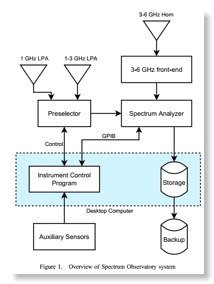
Spectrum is a scarce natural resource that we depend on to an ever increasing degree for our social interactions, our protection and emergency services at the national and global level and the efficient conduct of business both here and around the world. This resource is extremely valuable commanding prices in the U.S. in the range of $250,000,000 per MHz for prime spectrum property. Even the President has become directly involved in an effort to move 500 MHz of spectrum to commercial broadband providers (usually cell phone service providers) in an attempt to spur economic growth, create jobs and to help to resolve the Federal Budget deficit. Given its value and importance, surprisingly little is really known about the current usage and the trends in the spectrum occupancy in the various geographies in the U.S. and around the world. To help resolve this issue, Illinois Institute of Technology through its Wireless Network & Communications Research Center (WiNCom) developed a Spectrum Observatory to monitor the spectrum occupancy in the "Loop," the business center of the City of Chicago.
225-400 MHz Band Data. Some data in the DySPAN paper shows occupancy in the 225-406 MHz band. A previous post here reviewed NTIA’s disinterest in reviewing occupancy of this band although it has reviewed occupancy of nearby federal bands. 225-400 MHz is mostly a military aeronautical mobile band. There are some other things in it including mobile satellite links that go back to the Cold War.
There is a military base in downtown San Diego that uses this band, but not in other urban areas where there are a real spectrum shortages. Shared use of 225-400 MHz, perhaps on an interruptible spectrum basis, could help add spectrum to meet real US needs. NTIA’s reluctance to explore this by collecting data shows the basic problem of US spectrum policy in the current arrangements and the need for the recent PCAST federal spectrum recommendations. But to explore the feasibility of shared use we need real data on its present use and the IIT data is a great step in the right direction. Preliminary analysis in the DySPAN paper shows that for the period 2008 - 2010 the occupancy of 225-406 MHz had a maximum less than 20%. This initial analysis could be a good starting point for more detailed analysis by FCC and NTIA of this NSF-funded data collection.
Estimating Radio Noise Trends. Another interesting question that might be addressed from this unique data source is long range trends in spectrum noise. There is anecdotal evidence that it is increasing, but no real data. TV channel 37, 608-614 MHz, is a primary radio astronomy allocation and is basically unused - although this is some minimal licensed use for critical care medical telemetry in hospitals. A long term examination of this or other channels that should not be used in Chicago could reveal hard data on whether background noise is urban areas is changing.
===
The IIT Radio Observatory is a unique resource and kudos to IIT for proposing and operating it and to NSF for funding it. Unfortunately it is not that well known despite several published papers. Hopefully better understanding of this resource can lead to more informed spectrum policy decisions. But then again I once had a boss at FCC who was head of OET who said “Never ask a question unless you are prepared to hear the answer.”
UPDATE
See http://www.marcus-spectrum.com/Blog/files/SpecMeasCorr414.html
Sen. Grassley: Your Recent "Marimba Moment" Was Not All Your Fault - Your friends in the Cellular Industry Made It Inevitable
In January, this blog had a post entitled “Is the Cellular Industry ‘Tone Deaf’ ”? It described a 1/12/12 New York Philharmonic concert of Mahler’s 9th Symphony that was interrupted by an iPhone Marimba ringtone from a front row seat.
At the time I wrote:
The cell phone industry is united against legalizing jamming, but seems unable to do anything about antisocial cell phone usage that inevitably leads to interest by concert halls and restaurants in cellular jamming. As previously stated here, French national law explicitly permits cellular jamming in concert halls. While jamming in such urban locations inevitably will cause other problems and is thus a bad idea (as opposed to jamming in isolated maximum security prisons where the geometry is very different), there seems to have been little interest in the cellular industry in alternative approaches to minimize the antisocial aspects of cell phone use.
The cell phone industry is usually a positive contributor to US society and the US economy. But it continues to have some blind spots as outlined in the previous New Year's Resolutions post here. Maybe it should address them? Maybe FCC leadership should politely point out these issues from time to time and mention the possible impact of neglect?
In my New Year’s Resolutions for the Cellular Industry post I wrote
That post’s 7 issues attracted NO inquiries from the cellular industry which apparently is focusing all its efforts on its appetite for spectrum, not social harmony resulting from its products and services. (In fairness one high CTIA official did reply to an e-mail from me about the post and seemed puzzled why people had trouble turning off their ringers.)2. Social harmony and cell phone use. Does the cellular industry ever wonder why the public rose up in force against the Docket 04-435 proposals to allow cellphones in airplanes or why there is a market for (presently) illegal cell phone jammers? The reason is that there is a lot of obnoxious cellphone use in this country! Airplanes are one of the few places without it and the public outcry was to preserve that. There is an interesting essay by Don Norman that was prepared for a 2005 Motorola Research Visionary Board meeting entitled “Minimizing the annoyance of the mobile phone: The Annoyance, Irritation, and Frustration of The Mobile Phone -- A Design Challenge” that starts off with the quote “Nearly one in three (30%) adults say the cell phone is the invention they most hate but cannot live without”.
What is the industry doing about this? Are they trying to increase sidetone levels so people don’t shout when using cell phones? Are they trying to make it easier to switch the ringer to a vibrate only/ “manners mode” as in Japan where all carriers have voluntarily agreed that a press of the “#” key toggles the unit to and from vibrate only mode? Are they researching ways for theaters and restaurants where people really want a semblance of quiet to use Bluetooth or a similar link to switch phones automatically to vibrate only? Kudos to Motorola for inviting Dr. Norman to talk on this issue. How much of this type of dialogue is going on now in the industry?

Senator Grassley, don’t feel bad about the incident. These types of things happen all the time because there is no consistent simple way to turn off the ring tone of US cell phones as there is in Japan. The cellular industry is much too busy grabbing spectrum to care about such issues of “unintended consequences”. It feels it can use its position of political strength to stop the sale of cellular jammers which people use illegally in selfdefense of obnoxious cell phone use.
In order to keep this “clear bright line” on jamming in effect, the industry even fights the use of cell phone jammers in isolated prisons where they could be a cost-effective option to enhance public safety. But apparently the cellular industry has never learned from the War on Drugs: to defeat a serious contraband issue you must address BOTH supply and demand. FCC may go through the appearances of being active against the selling of cell phone jammers, but the small and dispirited Enforcement Bureau technical staff doesn’t stand a chance against Chinese Internet marketing unless the demand is moderated also.
Sen. Grassley, at least you handled your moment much better than Sen. McCain handled his a few years ago on the Senate floor:
NAB: Cognitive Radio is Effective Enough to Allow Sharing of Critical Government Frequencies - But Not Good Enough to Protect Broadcast TV
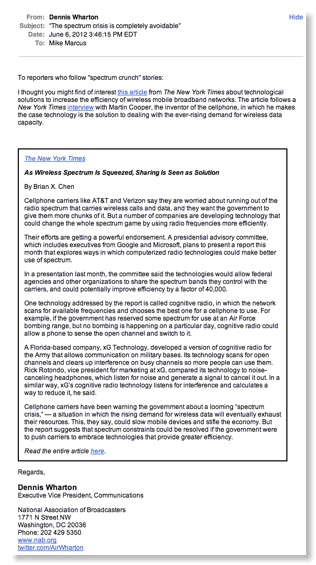
So you can see how surprised and excited I was to get the e-mail shown at left from Dennis Wharton, Executive Vice President of Communications at NAB, with the subject line “The spectrum crisis is completely avoidable”. We certainly want to avoid this crisis and I was delighted to read what NAB’s new solution was. The message begins with “I thought you might find of interest this article from The New York Times about technological solutions to increase the efficiency of wireless mobile broadband networks.” The Times article was mainly about the PCAST spectrum report that SpectrumTalk readers read about here on May 28th. In the article Mr. Wharton was kind enough to recommend was a discussion of how effective cognitive radio technology now is and the statement “For example, if the government has reserved some spectrum for use at an Air Force bombing range, but no bombing is happening on a particular day, cognitive radio could allow a phone to sense the open channel and switch to it.”
Mr. Wharton, let me explain why it is much easier for a cognitive radio to sense in TV white space whether there are usable TV signals than the case of sensing the presence of military signals:
- TV signals are generally on 24/7, they do not turn on and off at random times as military signals do.
- TV transmitters are firmly bolted to the ground in well defined locations.
- TV signals have a very precisely defined (in a public documentation) 6 MHz wide waveform with very precise frequency stability and timing. It is almost as if they were designed to be detected at much greater sensitivity than a consumer receiver. Indeed, FCC testing showed that they could be detected at a power level 35 dB less than the sensitivity of a TV receiver and better detectors are possible. In general military signals do not have waveforms that are known to the public. Thus the U-NII cognitive radio rules in 47 CFR 15.407(h)(2) require a “Radar Detection Function of Dynamic Frequency Selection” that knows nothing about the radar signal it is trying to detect since the military would no divulge the specific technical details of the radars in the band - a far cry from the well known ATSC signal in the TV band!
- If interference is caused to TV reception, it may be unfortunate but there are no permanent negative consequences - like death or injury. If there is interference to a military system the consequences could me more severe.
Based on the above, cognitive radios in the TV band raise far fewer issues than cognitive radios that try to detect the presence of military signals.
Since Mr. Wharton has concluded that cognitive radio technology has now advanced to the point that it can reliably detect the presence of military signals to allow broadband use of military bands when and where they are not in use, I assume that NAB must now endorse the technically simpler case of using of cognitive radios in the TV bands under similar terms.
I hope Mr. Wharton comes to the DySPAN 2012 Conference in Bellevue WA in October and explains NAB’s new view on cognitive radio. I’m sure he’ll get a standing ovation!
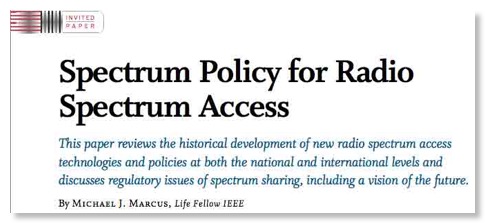
Proceedings of the IEEE Paper on Radio Spectrum Access Published
“A special 13 May centennial issue, published as the thirteenth issue of 2012, reviews 19 key technologies from three perspectives: the past, the present, and prospects for developments in the future. ”
The article is available for free to subscribers to IEEE Xplore. Here is the abstract:
Here also are the conclusions of the article:Classic spectrum management policies and regulations focused on unique frequency assignments for users to avoid intersystem interference. The growing demand for wireless communications along with the recognition that classic spectrum management leads to underutilized spectrum in time and spacehas resulted in interest in radio spectrum access techniques. Since spectrum use is highly regulated at the national and international levels, the status of regulatory policies is key to the implementation of new access technologies.
The major obstacle to RSA use has been incumbent users who fear interference and in some cases newcompetition. At times, RSA advocates have not been sensitive enough to these concerns and pragmatic in dealing with them. Incumbent spectrum users both have a significant stake in spectrum use as well as major influence in national and international policy fora. Spectrum policies that reward incumbents for supporting more intense use ofspectrum may be one method of making the interests of incumbents better aligned with goals of more intense spectrum use. While passive monitoring systems for determining spectrum availability are possible in some applications, active engagement of incumbents in realtime determination of spectrum availability will result in cooperative systems that both decrease incumbents’ legitimate concerns as well as maximize the amount of spectrum available for RSA for a given interference risk probability.
It is difficult to build cooperative systems as modifications to incumbent systems designed for exclusive spectrum use. Thus, standards and regulatory policies that encourage spectrum users to make data available on instantaneous spectrum use and expected changes in use would facilitate cooperative RSA systems and also help protect incumbent use.
If incumbent opposition can be moderated through cooperative RSA systems or if national and international regulators take a bolder approach in maximizing public interest in spectrum by insisting on spectrum access techniques that use the resource more intensively, then RSA will serve a key role in facilitating more intense spectrum use and its economic and societal benefits.
The 700 MHz LTE Public Safety Plan: Some Concerns

For all its flaws, the European nations now have TETRA as their public safety network core. But the previous Motorola so thoroughly orchestrated the dissing of TETRA in favor of their preferred P25 in order to maintain market hegemony , that the US ended up with neither system. (At one point Motorola - not really the same company that exists today with that name - even tried to use its ownership on a patent used in TETRA to prevent any use of TETRA in USA. The ongoing Docket 11-69 deals with the issue of any future use of this technology in the US, not just public safety.)
Two issues dealing with 700 MHz LTE for public safety don’t get much discussion, so I will review them here:
1) 700 MHz This band is comparable to one of the frequencies used for cellular telephony since the 1980s. Many of us think of cellular service as


Now the nationwide public safety system could supplement the 700 MHz LTE systems with a more limited capability satellite (MSS) systems that provides connectivity where 700 MHz isn’t available. For example, the recently announced DeLorme inReach device uses the Iridium network and shows that limited emergency capability in isolated areas is available now at modest cost. But I have not seen any discussion about supplementing 700 MHz coverage with alternative media, such as MSS, for public safety agencies that will never have ubiquitous 700 MHz coverage in their territory. So how will the 15,849 present 30-50 MHz public safety licensees transition to the new 700 MHz system?
2) Voice over LTE Voice is an integral part of public safety communications now and in the foreseeable future. While using voice on an LTE system appears technical possible, it is not an operational reality. Last month, NetworkWorld quoted Verizon Vice President of Network Hans Leutenegger as saying that VZW “won't be deploying any voice over LTE (VoLTE) services on its network until late next year at the very earliest.” Public safety networks need not only voice, but voice with special features such as priorities, preemption, and network control by the commanders of first responders. These features are not operational as yet and it is not clear if the resources programmed for their development and testing are really adequate for the task - given the high reliability we owe our public safety officers.
More than a decade ago, the public safety community was greatly indebted to the old Motorola who invented this technology and shepherded it introduction into the public safety. Groups like APCO in the past showed their appreciation by allowing Motorola to manipulate their spectrum policy positions before FCC and they consistently opposed technical evolutions much more modest than which is involved here. Indeed, the fact that we are only now finishing the 20 year narrowband transition shows the effectiveness of this Motorola “partnership” with public safety that slowed technical progress while maintaining Motorola’s market share. The present Motorola Solutions no longer has the control of the old Motorola and others entities are trying to manipulate the public safety community for their own gains.
The fact that the public safety community generally seems happy with the present plan may indicate that the new manipulators have successfully filled the power vacuum left when Motorola was restructured. Hopefully the public safety community will become more cynical about being manipulated in the corporate interests of others and they will aggressively make sure their own interests are pursued in the development of the national wide interoperable system that is so critically needed.
White House Advisory Committee Recommends Major Changes to Federal Spectrum Use
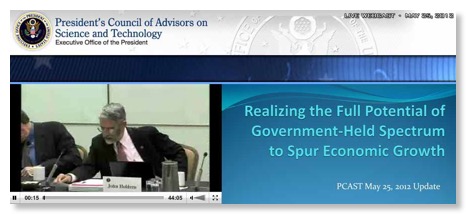
At its May 25th meeting the President’s Council of Advisors on Science and Technology, a White House advisory committee of top technical experts, endorsed a report from a subcommittee entitled “Realizing the Full Potential of Government-Held Spectrum to Spur Economic Growth”. The text of of the report has not been released to the public pending final editing and delivery to the President. However, there was a presentation at the PCAST meeting and below are two “slides” from the presentation.
The first slide to be discussed is below:
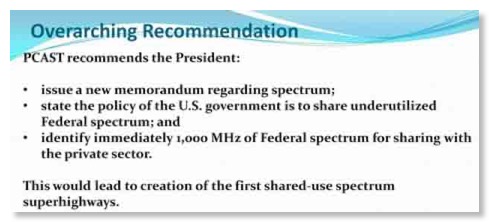
Its second point is to “state the policy of the U.S. government is to share underutilized spectrum”. It is pretty clear that that is not the present policy. I recall that during the drafting of the Spectrum Policy Task Force Report the NTIA staff had a temper tantrum on even mentioning that “interruptible spectrum” sharing of low average utilization federal spectrum might be considered. All reference to the topic in the context of federal spectrum was scribed from the report!
IRAC traditionalists will also not be very pleased with the 3rd point on sharing 1000 MHz with the private sector. I hope the report indicates that this can not be resolved by sharing 97-98 GHz!
Clay T. "Tom" Whitehead
The report recommends creating a “White House-based Spectrum Management Team” of senior Administration officials to work with NTIA. This would be a move in the right direction to give real Silicon Vally-style “adult supervision” to IRAC - the group that makes most spectrum management decisions without much accountability to anyone.
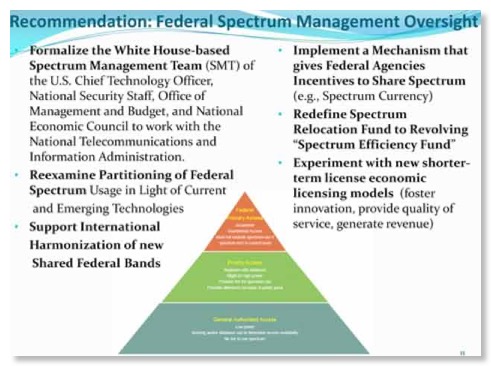
The report also recognizes the at present agencies have no incentive to cooperate with sharing and to be early adopters of sharing concepts. Thus it proposes to reward such early adopters in the budget process.
The report seems very promising and we look forward to seeing the actual text. Hopefully it won’t get lost in election year politics.
Spectrum Policy Issues in Wireless Education Programs
Spectrum policy issues can have a major impact on the practical aspects of which wireless technologies move from the pages of IEEE journal articles to operational systems. Just because technology “X” can be physically built to operate in frequency band “Y” does not mean that it can be practical in non-experimental use or within the professional career lives of those developing it. In all countries, for better or for worse , spectrum use is probably the most highly regulated technology of all the technologies within the IEEE community . Wireless regulations can have just as large an impact on system design as Maxwell’s Equations — although wireless regulations can be changed over time and Maxwellian constraints are more binding. Exposing wireless technology students to these issues is thus a valid goal in undergraduate and graduate programs in the wireless area.
The article reviews options for including spectrum policy issues in wireless education either as supplementary material in mainstream courses or as a stand alone course. Recently your blogger was invited to the University of Notre Dame’s Wireless Institute to explore this topic.
For the next month or two the article is available at the IEEE Wireless Communications website, after that it will be available on the IEEE Xplore site for a fee if you are not a subscriber.
Contrarian Spectrum News in Major Papers
To reporters who follow "spectrum crunch" stories:
I thought you might find of interest this article from The New York Times that quotes cellphone inventor Martin Cooper questioning wireless carriers' claims of a "spectrum crisis." Cooper says that wireless carriers are exaggerating their need for more spectrum and newer technologies can ease the demand for airwaves.
Cooper's statements follow others who are questioning the "spectrum crisis" notion in media outlets such as GigaOM and DSL Reports, as well as others who have proposed solutions wireless carriers can adopt to resolve network congestion issues. Last April, former FCC official Uzoma Onyeije released a paper detailing many of the same alternate solutions Cooper provides for wireless carriers to alleviate mobile broadband congestion.
Oddly, Mr. Wharton did not send me a copy of today’s Washington Post article entitled in the print edition “Regulators debate the future of broadcast” and on the website “As users flock to iTunes, Hulu and Netflix, TV stations struggle to survive”. The article starts off,
As the audience for free television fades, federal regulators are wrestling over the future of the government-mandated broadcasts, which were originally intended to knit the nation’s disparate communities together.
Today, only 10 percent of the nation relies on free, over-the-air TV, which was created by the Telecom Act in the 1930s. To get a license, broadcasters had to offer local, educational and political programming, and to make it widely available to rich and poor alike...
And as fewer people rely only on broadcast television, stations around the nation are struggling to survive even as some rural residents, elderly and the poor continue to rely on free TV..
(The Post included a “photo gallery” with their article, but did not provide embedding code like NYT did.)
I am puzzled why the Post’s Ms. Kang, who usually writes knowledgeably about FCC uses the phrase “federal regulators are wrestling”, when the reality is that they are trying as hard as they can to avoid the issue. Readers may recall my January post here about the quote from Justice Alito:
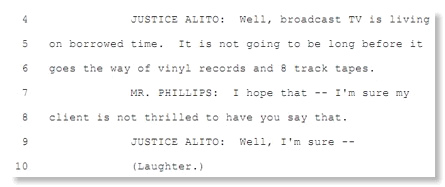
The truth in both cases is that official Washington is spending far to much time kowtowing to the alarmist and conflicting demands of BOTH NAB and CTIA.
The Times and Post articles are rare breaths of fresh air that one rarely hears from our government officials, Justice Alito excepted.
Vote for Susan Ness! A Tribute to a Former Commissioner Who Really Cared About Spectrum
J
Susan Ness served as an FCC commissioner from May 1994 to May 2001. She is the only commissioner within recent memory who had a strong interest in spectrum policy - although Chmn. Powell certainly also had a special interest in the topic. She hired as an adviser David Siddall, an OET staffer who had previously worked on the Hill. While Dave is not an engineer by training, his excellence in working at OET and with Comm. Ness on spectrum policy issues shows that what is essential in technical policy is a real interest in the topic as well as a willingness to learn.
Here is her official FCC bio:

Susan Ness was appointed to the Federal Communications Commission by President Clinton in 1994. She chaired the Federal-State Joint Board charged with addressing universal telephone service issues, and served as the FCC's senior representative at the 1995, 1997, and 2000 World Radiocommunication Conferences.
Commissioner Ness promoted measures to advance competition domestically and globally, spur new technologies and services, expand economic opportunities, eliminate unnecessary regulation, and reduce regulatory uncertainty. She played a key role in shaping policies for efficient management of the radio spectrum and was a lead member on international matters. She helped forge agreement on the digital television standard and on guidelines to improve the quality and quantity of children educational television programming. She worked to facilitate delivery of advanced telecommunications services to the classroom and community libraries, so that every child -- urban and rural, rich and poor -- can participate in the telecommunications and information revolution.
In recognition of her achievements, Commissioner Ness was chosen as one of four 1999 recipients of the International Radio and Television Society Foundation Award, received the Consumer Electronics Association 2000 Digital Television Leadership Award, and was selected as one of Electronic Media's "12 to Watch in 1997." She has also been honored by Women of Wireless and by the American Women in Radio and Television for her efforts on behalf of women. Rutgers University inducted her into its Hall of Distinguished Alumni in 1998, and Douglass College selected her as a member of the Douglass Society.
Prior to her FCC appointment, Commissioner Ness was a senior lender to communications companies as a group head and vice president of a regional financial institution. She served as Assistant Counsel to the Committee on Banking, Currency and Housing of the U.S. House of Representatives, and she founded and directed the Judicial Appointments Project of the National Women's Political Caucus.
Commissioner Ness is a member of the National Association of Regulatory Utility Commissioners' Committee on Communications, the Federal Communications Bar Association, and Leadership Washington (Class of 1988). Before she joined the FCC, she served in many civic leadership roles, including chair of the Montgomery County, Maryland, Charter Review Commission; vice chair of the Montgomery County Task Force on Community Access Television; and president of the Montgomery County Commission for Women.
Commissioner Ness is a graduate of Douglass College, where she received her Bachelor of Arts degree. There she served on the board of directors of WRSU Radio (Rutgers University). She received a Juris Doctor, cum laude, from Boston College Law School, and a Masters in Business Administration from The Wharton School of The University of Pennsylvania.
Commissioner Ness is married and has two school-aged children.
From 2005 to 2007, she was the founding president and CEO of GreenStone Media, LLC, which produced talk programming targeting women for syndication on radio and other platforms.
She is a member of the J. William Fulbright Foreign Scholarship Board, having been appointed to that position by President Barack Obama in September 2011. She serves on the board of Vital Voices Global Partnership, a nonprofit organization that identifies and invests in extraordinary women worldwide. She is a Senior Fellow at the Center for Transatlantic Relations at Johns Hopkins School of Advanced International Studies (SAIS), and an affiliated expert of the Information Technology and Innovation Foundation (ITIF).
She was Distinguished Visiting Professor of Communication at the University of Pennsylvania’s Annenberg School for Communication, where she taught graduate seminars on domestic and global communications policy, and was Director of Information and Society at the Annenberg Public Policy Center. She is a member of the board of Gannett Co., Inc, (NYSE-GCI). Previously, she served on the corporate boards of LCC International, a global technology firm, and on the post-bankruptcy petition board of Adelphia Communications Corporation. She is vice chair of the J. William Fulbright Foreign Scholarship Board, which oversees the Fulbright scholarship program. She also serves on the board of Vital Voices Global Partnership, an NGO that identifies and invests in extraordinary women worldwide.
Susan, you are missed at FCC and I hope whoever wins the election this year will appoint more people like you to FCC. Maybe as a convention delegate you can add that to the platform!
A Tribute to Sen. Snowe - A Supporter of Rational Spectrum Policy
“As I have long said, what motivates me is producing results for those who have entrusted me to be their voice and their champion, and I am filled with that same sense of responsibility today as I was on my first day in the Maine House of Representatives. I do find it frustrating, however, that an atmosphere of polarization and ‘my way or the highway’ ideologies has become pervasive in campaigns and in our governing institutions.
“With my Spartan ancestry I am a fighter at heart; and I am well prepared for the electoral battle, so that is not the issue. However, what I have had to consider is how productive an additional term would be. Unfortunately, I do not realistically expect the partisanship of recent years in the Senate to change over the short term.”
As a former “Massachusetts moderate Republican” myself, I will miss this breath of fresh air that is increasingly rare in today’s politics.
Sen. Snowe has been very active in promoting spectrum legislation. She introduced incentive auction legislation in March 2011. In July 2010 she introduced the Spectrum Measurement and Policy Reform Act. In March 2011 she introduced a bill to allow commissioners to appoint technical advisers and require the National Academy of Sciences to study the FCC's technical policy and policymaking decisions and the personnel available to inform those decisions. She also was active on legislation to limit taxes on cell phone use.
One of Sen. Snowe’s great contributions to spectrum policy deliberations was having a knowledgeable staffer, Matt Hussey, who spent a lot of time on spectrum issues and was very accessible to a wide range of people as he sought out a variety of viewpoints for her office.
Sen Snowe contributed greatly to spectrum policy issues and will be missed. Here is a great interview with her on a wide number of issues, unfortunately not including spectrum:
Spectrum Provisions in P.L. 112-96
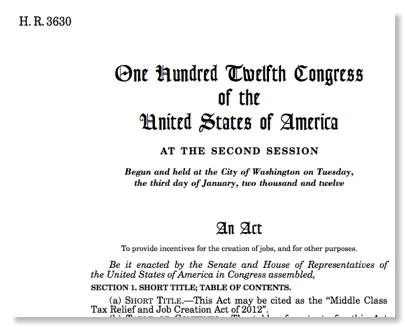
On February 22 President Obama signed the Middle Class Tax Relief and Job Creation Act of 2012 (P.L. 112-96) into law. Despite its name, this 101 page bill is one of the more significant pieces of legislation in the spectrum area in several years.
While trying to solve the budget crisis and the economy, Congress could time to give gifts to its favorite industries. One provision that has attracted little attention is Section 6409 which Don Evans at CommLawBog describes as
a small measure of relief in the on-going struggle to get tower modifications approved and constructed. Buried in a collection of odds and ends dumped, seemingly as afterthoughts, at the end of the law, Section 6409 requires state and local governments to approve modifications of wireless towers and base stations as long as those modifications don’t substantially change the dimensions of the existing structures.
As Don points out, this section has little legislative history and deals with preemption issues that raise serious constitutional issues. Nevertheless, local zoning and permitting issues have slowed tower construction and put excess pressure on spectrum as the only solution. Of course, the cellular industry could have tried to hire engineers and architects to develop new tower designs more acceptable to neighbors, but in this case chose back room deals on Capitol Hill. I hope it works out well for them.
GAO is given some new temporary roles in the new legislation. In Section 6408 GAO is told “ to consider efforts to ensure that each transmission system is designed and operated so that reasonable use of adjacent spectrum does not excessively impair the functioning of such system.” This task is explicitly supposed to consider receiver standards, use of adjacent spectrum, and use of guardbands. Perhaps GAO will be able to address the issue of receiver standards that FCC and NTIA have been unable to deal with. In Section 6412 GAO is also told to study the rejection of FCC licenses in the 11, 18, and 23 GHz bands.
Sect 6201-6303 deal with first responder networks and hopefully will break the impasse in this area which has endangered public safety for decades.
Sect. 6403 has the TV incentive auction favored by CTIA and condemned by NAB, presumably with compromises to try to pacify both. The mysterious “unlicensed auction” has disappeared.
Sec. 6406 requires an NTIA study to determine if the U-NII band can be expanded to cover 5350–5470 MHz and 5850–5925 MHz .
Sect. 6601 and 6002 end the odd saga of the Telecommunications Development Fund which was created in the Telecommunications Act of 1996, 47 USC 614, to fund private sector telecom R&D projects with revenue that was a byproduct of FCC auctions. While perhaps a good idea, TDF was implemented badly with declining transparency. For example, search the FCC website for information on it and see how information has decreased over the years to almost no new information. TDF itself seems to be in a serious state of denial about where its funding came from - federal resources. The presence of an FCC-appointed board member at TDF has created serious appearances of conflict of interest and it is just as well that Congress is ending federal funding and granting in dependence to this group. Spectrum Bridge is a recipient of TDF funding and that creates an appearance that it gets unequal treatment from FCC.
Section 6701 expands the role of OMB in federal spectrum management which is a major improvement since the current legislation under which NTIA functions creates a basic conflict about whether NTIA is supposed to focus on the public interest in the needs of the federal spectrum users. There are created within NTIA 2 new entities: the “Technical Panel” and the Dispute Resolution Panel” to deal with federal spectrum relocation issues. Both panels have 3 members: one appointed by FCC, NTIA, and OMB. There is no requirement that they be federal employees, but there is also no pay for these positions. Guess what will happen? In any case, it is a move in the right direction.
"Broadcast TV is living on borrowed time" -- Justice Alito
JUSTICE ALITO: Well, broadcast TV is living on borrowed time. It is not going to be long before it goes the way of vinyl records and 8 track tapes.
MR. PHILLIPS: I hope that -- I'm sure my client is not thrilled to have you say that.
JUSTICE ALITO: Well, I'm sure -
(Laughter.)
JUSTICE ALITO: I'm sure your clients will continue to make billions of dollars on their programs which are transmitted by cable and by satellite and by internet. But to the extent they are making money from people who are using Rabbit ears, that is disappearing. Do you disagree with that?
MR. PHILLIPS: No, I -- it would be -- you know, obviously not, because that's why we are not uniquely accessible or uniquely pervasive.
JUSTICE ALITO: Yeah. So why not let this die a natural death? Or why do you want us to intervene -
(Laughter.)
The two mentions of “laughter” in the transcript clearly show the crowd was enjoying this line of discussion at the usually staid Supreme Court. Perhaps only a judge with lifetime tenure - as long as Newt Gingrich or Rick Perry don’t change the Constitution - could say something like this. FCC commissioners and members of Congress are clearly too intimidated by the broadcast lobby to even raise the issue.
Consider the following goal statement from the National Broadband Plan:
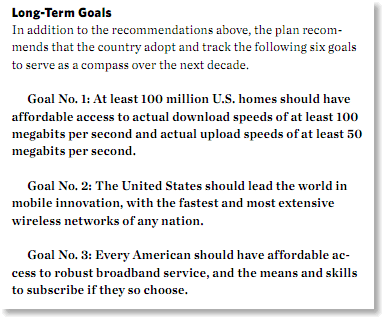
This establishes as a long term goal that “at least 100 million U.S. homes should have affordable access to actual download speeds of at least 100 megabits per second.” Essentially Title II universal service goes from being a “black phone” to 100 Mbps broadband for at least a third of the population. For reference, over-the-air HDTV is 18 Mbps per channel although a given video signal is less since the bandwidth usually is shared with more than 1 video stream. If everyone in an area had 100 Mbps service with “affordable access”, why do we need over-the-air TV with “rabbit ears”?
Now NAB would quickly say we need “rabbit ears” to serve poor people who can’t afford MVPD. This assumes that MVPD has the same pricing model it has today which of necessity would change in the NBP-envisioned universal service. For example, the money raised from recycling the VHF and UHF spectrum, “digital dividend” in Eurospeak, could be used to endow low cost or free broadband service to the economically disadvantaged. Alternatively, MVPDs could switch to a “freemium” pricing model with present over-the-air channels free and charge for the traditional cable channels.
What is truly amazing is the unwillingness of public officials, except Justice Alito, to talk about these long term options.
FCC Proposes New 78 - 81 GHz Rules: "It was the best of times; It was the worst of times"
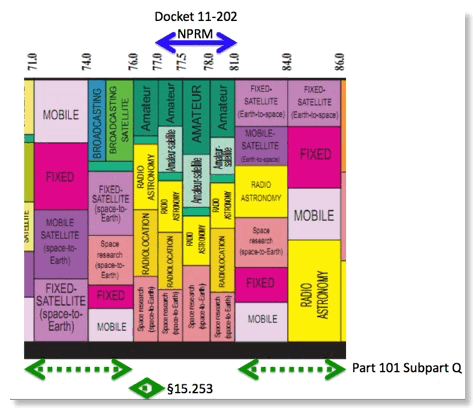
On December 20, 2011 the FCC released the NPRM in Docket 11-202 dealing with adopting rules to permit non-Federal Government use of the 78-81 GHz band for the first time. (My thanks to Mitch Lazarus at FHH CommLawBlog who made a post on this action before I noticed it.)
For reference, the amount of spectrum involved here is 3 GHz of bandwidth, or 6 times what is being sought for new mobile use in the national Broadband Plan. So if this band ends up only being used for the requested use and some passive scientific uses, that is a lot of spectrum “off the table”.
Normal (non experimental) commercial use of a band requires two basic FCC actions: An allocation which is consistent with the basic desired use (e.g. fixed or mobile) and service rules that describe the terms of use (e.g. bandwidth, power, modulation, etc.) and eligibility for a license or perhaps makes the band unlicensed. All spectrum up to 275 GHz has allocations of some kind. But the service rules at the upper end of the spectrum are spotty. As shown in the top chart, 71-76 and 81-86 GHz have service rules for “licensed light” fixed service use in Subpart Q of Part 101. 76-77 GHz is used for automotive radars authorized under §15.253. There is another Part 101 Subpart Q band at 92-95 GHz, but these are the only service rules above the 57-64 GHz unlicensed band of §15.253.
Real investors in the real world hesitate to invest in products that need non routine FCC approvals. Thus there is 120 GHz technology developed in Japan that was used in the Beijing Olympics and has no counterpart in the US, even though the US has been the leader in millimeter wave technologies:
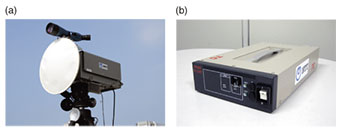
Uncertainties in FCC spectrum policies discourage this type of R&D investment and affect US technological competitiveness.
This NPRM was stimulated by the development by Trex Enterprises Corporation of an “foreign object debris”/“FOD” detection system to meet an urgent FAA requirement for airports. The “foreign” in FOD does not mean non-US, but rather any debris on a runway that could cause damage to aircraft such as nuts and bolts and tools. The NPRM would permit use of the Trex system and similar systems.
The key issues in the NPRM are stated in para. 3 as:
“(W)e seek comment on a proposal by Trex to amend Part 90 of our rules to permit non-Federal radiolocation operations, including Trex’s FOD radar detection technology, in the 78-81 GHz band and to impose a specific assignment limitation to protect radio astronomy service operations in this band from harmful interference. We also seek comment on whether we should instead amend Part 15 to open the band to non-Federal radiolocation operations (including FOD detection devices) on an unlicensed basis. And we seek comment on whether we should amend Part 90 to permit use of the 78-81 GHz band by FOD detection devices at airports on a licensed basis, while permitting other uses on an unlicensed basis pursuant to Part 15 of our Rules.”
Kitt Peak National Observatory AZ

The radio astronomy community and the passive sensing community that both have allocations in and near their bands did a major study of their spectrum management issues in 2010 that are published in a report front eh national Research Council entitled Spectrum Management for Science in the 21st Century. Pages 186-187 of this report explore the feasibility of “cooperative spectrum sharing” as a way to share spectrum between active users and the scientific passive users in a “win/win” way.
The glib talk in the NPRM of possibly using this 3 GHz wide band only for ground focused FOD detectors at a few hundred airports and ruling out any other transmitters in this band to protect a handful of radio astronomy locations indicates perhaps a perfection of classic spectrum management philosophy, but is out of touch with modern thinking in spectrum management where one tries to use dynamic spectrum access techniques to get the most out of every Hz for both its contribution to GDP and for it scientific potential. Classic spectrum management was a “zero sum game” for participants. At these upper frequencies in virgin bands, we can do much better.
Your blogger would like to work with interested parties to prepare comments in the next month that use this band for multiple uses and encourage the capital formation needed for technical innovation. If interested, contact me here.
Some Possible New Year's Resolutions for the Cellular Industry
As we approach the New Year, here are some constructive suggestions for the cellular industry to think about as New Year’s resolutions. Long time readers will recognize that many have been discussed before in other contexts. Let me state first that I am a long time admirer of the cellular industry, its dynamic growth, and its general record of technical innovation. The cellular industry has also done much to improve public safety through its support for E-911, Amber Alerts, and programs to provide cell phones for domestic violence victims. But this industry has several blind spots as it has accumulated political power and FCC influence comparable to the power formerly held by entities such as the pre-divestiture AT&T, NAB, or the pre-1990 Motorola. sic transit gloria mundi
The purpose of this post is to point out constructively some of these blind spots that appear not to be in basic conflict with the fundamental goals of the industry in the hope that they may reconsider their positions in at least some of these areas. I note that while the main cellular players once were in strong opposition to the bidirectional amplifier/BDA issues now in Docket 10-4, they have moderated their position and appear to be working with responsible BDA manufacturers on technical standards for BDAs that control interference. I hope that similar reexamination is possible in the areas below:
1. Wireless technology innovation. The focus of the cellular industry is that innovation is good, but that the key to innovation is more licensed spectrum for their industry. They are happy with the current level of regulation so everyone should be also. This is clear from CTIA’s comments and reply comments in the Wireless Innovation NOI. They see no need to expedite deliberations of new technology, saying “Simply put, even for good ideas with broad appeal, resolution unfortunately can take a long time notwithstanding the desire of parties to speed the process along”. The fact that the endless drawn out FCC spectrum deliberations stifle capital formation for technical innovators is no concern for mainstream CMRS players with positive cash flow.
But Qualcomm was once a startup in an era when it got its key regulatory decision in 2 years after formation. The CDMA technology that this startup pioneered supplies a major fraction of the 2G market (VZW and Sprint) and is the core of all world’s 3G systems. But this type of disruptive wireless innovation os getting to be impossible due to regulatory stagnation but for the cellular industry and for other spectrum users that compete for cross elastic spectrum. Sadly, the cellular industry is firm with the status quo here.
Wa - harmony (Japanese)

What is the industry doing about this? Are they trying to increase sidetone levels so people don’t shout when using cell phones? Are they trying to make it easier to switch the ringer to a vibrate only/ “manners mode” as in Japan where all carriers have voluntarily agreed that a press of the “#” key toggles the unit to and from vibrate only mode? Are they researching ways for theaters and restaurants where people really want a semblance of quiet to use Bluetooth or a similar link to switch phones automatically to vibrate only? Kudos to Motorola for inviting Dr. Norman to talk on this issue. How much of this type of dialogue is going on now in the industry?
UPDATE
Suggested reading for cellular industry managers: “Wild Night at Philharmonic After Phone Interruption” describing a January 10 incident “in one of the quietest parts of the final movement of a gorgeous New York Philharmonic performance of Mahler's Ninth”.
3. Cell phones use in vehicles. Technology should improve life, not threaten it. In September 2011 NTSB recommended a ban on cell phone use in commercial vehicles (trucks and buses) after investigation of a Kentucky crash that killed 11 people. The industry was silent except for an e-mail message to your blogger saying “The wireless industry … does not oppose legislation that restricts the use of wireless communication by drivers." (This quote was never printed or posted anywhere else as far as can be determined.)
Then in December 2011 NTSB recommended to “ban the nonemergency use of portable electronic devices (other than those designed to support the driving task) for all drivers”. This time CTIA was no longer silent, saying “ As far as talking on wireless devices while driving, we defer to state and local lawmakers and their constituents as to what they believe are the most appropriate laws where they live.” This is not leadership, this is non opposition. If I was involved in a product or service that resulted in death on a regular basis as an unintended byproduct I would be a lot more concerned. Especially since talking in cars is not the main use of cell phones.
The NTSB recommendations are not perfect. For example they do not deal with new technology since all NTSB can do is investigate past accidents. Why doesn’t the industry do something more proactive like start a standards committee, or encourage DOT to start one, that can certify which technologies are safe enough for use in vehicles?
(But kudos to Sprint for breaking with the crowd and being a cosponsor of Oprah’s Oprah’s No Phone Zone website and its “No Phone Zone Pledge”.)
4. RF safety. Most of the cellular industry thinks that the public should be happy with their statements that cellphones meet FCC standards and are therefore safe. A decade ago, the industry fought FCC over the proposal to stop hiding SAR ratings for cell phone models in an obscure unmanageable database. As a previous blog post here has as a headline, “CTIA: Maybe Your RF Safety PR Strategy Isn't Working?” The past year has seen CTIA boycott San Francisco and got to court (with an initial partial victory) over a local ordinance requiring point of sale disclosure of SAR data. (The same data that Verizon Wireless openly discloses on their website for models they sell.)
Perhaps the industry does not want you to know about the secret of OETB65C. Stalin once said, “The people who cast the votes decide nothing. The people who count the votes decide everything.” So the SAR standards for cellphones in Sections 2.1091 and 2.1093 were subject to a notice and comment rulemaking that made 1.6 W/kg the SAR limit. But how is that really determined? In practice through the procedures of OETB65C which gives the manufacturers a lot of leeway as to what spacing from the simulated body they can use for measurements in the body, even if they do not provide a holder that would implement that distance and even if they don’t warn users not to put the device in their pocket. Both Time magazine and your blogger have written about this issue, but there seems denial at both FCC and industry on the issue.
There is no proof that cell phone radiation is dangerous. Indeed, some of the brain cancer claims made as clearly outrageous. (Considering there is no proof that cell phone radiation causes any pathology, why the focus on brain cancer - except that it is a very scary diagnosis.) But the web site of CTIA’s French counterpart is a lot more pragmatic than US industry sites on the risks and unknowns as well as the fact that some users may want to take extra precautions. The Swiss counterpart of EPA also has a site with pragmatic and practical information lacking in industry and government sites in the US.

This month’s IEEE Spectrum reports on a UK design contest for power pylons sponsored by a major electric utility, a national government agency, and the architect’s professional society, which resulted in several novel designs including the one above. Why can’t the US cellular industry help sponsor a similar contest for bold new ideas in base station design? The cost would be small compared to what they are spending on they lobbying war with the broadcasters as present.

6. “Spectrum scoring” or “How to count to 500”. The cellular industry originally demanded 800 MHz of new spectrum for CMRS although they are now accepting of the 500MHz NBP goal. But what spectrum counts towards the 500 MHz goal? Does every single Hertz have to be only in spectrum that meets standards developed in Europe to be manufactured in China? There are many types of wireless innovation other than making iPhone and iPad clones. Some of them involve using spectrum more efficiently. The focus on meeting international standards means that only innovators who want to plow through the complex international standards process can get market access in the US. Actions like PacTel’s decision to go with CDMA in the 1980s apparently is beyond consideration now.
While your blogger has no views against giving more spectrum to CMRS, many of us think the 500 MHz goal is impossible under the conditions for “counting” that the cellular industry has implicitly set with factors like nationwide 24/7 1000 ms/s access and in 3GPP specified bands. Although LTE systems can use unpaired spectrum, most of the spectrum on their wish list appears to be paired and symmetric. If FCC and NTIA come up with spectrum that doesn’t that meets all these criteria, does it “count”?
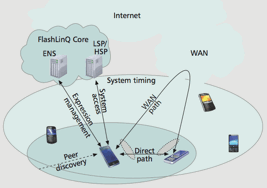
But here is another viewpoint: Some niche markets compete for spectrum at FCC that is the same or comparable spectrum to what the cellular industry seeks. For example the medical community is clearly seeking more spectrum for short range applications. It is clear to many of us, even some in FCC, that the existing use of wireless microphones in UHF TV band “white space” is not sustainable in the long term except perhaps for uses involving only a few microphones like small churches and conference rooms - not theaters and major concerts. This is because of cellular industry pressure for UHF incentives auctions that will eventually tie up the same spectrum.
In the past, there was no alternative for the CMRS industry to serve these and other wireless niches. However, with the spectrum leasing provisions of Subpart X of Part 1 and today’s femtocell technology it is possible for cellular carriers to lease short range spectrum to users with other than standards cellular modulations/physical layers and without connection to the public network. A good example is the Qualcomm FlashLinq™ technology that will allow users to connect directly to each other with non standards modulations on spectrum leased from and under the control of a CMRS carrier. Maybe the specifics of FlashLinq™ are not perfect for the CMRS community, but it clearly shows the feasibility of new types of spectrum use in CMRS spectrum. Even if it is not a billion dollar market, its ability to “soak up” other spectrum uses that would otherwise compete for spectrum might make it attractive to openminded CMRS firms.
Until recently, the largest prepaid operator, TracFone, allowed users to activate a phone bought anonymously and “skip” the step to report name and address. However, the option of buying with cash bagfuls of prepaid phones at Walmart, activating them over the web with a false name and address, and selling them for criminal use is still quite real. Isn’t it odd that we more concerned about over-the-counter sales of Sudafed and Plan B than we are about bagfuls of anonymous cellphones?
Many countries require some identification before prepaid phones can be activated. This is a complex issue both because of the size of the market and the appeal of prepaid phones to market sectors who need them for legitimate economic and safety-related reasons but, as we know from the voter ID controversy, may lack or be unwilling to identify themselves in the standard ways. While I sincerely hope we never have a cellphone-related IED attack in this country, such an event would force a PATRIOT Act-like knee jerk reaction that could be more draconian that a deliberate process now to address the situation.
UPDATE
For those of you who wonder about the temerity of an industry outsider raising such questions about the cellular industry, let me point out the Verizon $2 “payment fee“/“convenience charge” kerfuffle that started just as this blog was first posted and ended a day later. Clearly, VZW, the largest cellular carrier in the US was out of touch with its customers on this issue and had to beat a hasty retreat. Perhaps the industry is also out of touch on the above issues?
UPDATE 2
On 1/7/12 CNN posted an article by bestselling author Bob Greene entitled “Is 2012 the year to hang up the phone?”
Story highlights:
There is growing chorus of officials, employers urging less cell phone useHe says NTSB warns against use in cars; bosses pushing back on personal calls at workHe says cell-phone distractions even affect surgeons and nurses; cut productivityIt may be impossible to take people's freedom of cell use away from them
So your blogger is not the only one seeing cell phone use backlash. Perhaps if the industry was more sensitive to the concerns listed above it might be in their own interest?
H.R. 3010 and its Likely Impact on Wireless Innovation
“The current regulatory system has become a barrier to economic growth and job creation. Federal regulations cost our economy $1.75 trillion each year. Employers are rightly concerned about the costs these regulations will impose on their businesses. So they stop hiring, stop spending and start saving for a bill from Big Brother. But rather than burdening businesses with more regulations, we need to free up employers so they can create jobs for American workers. The Regulatory Accountability Act does just that. It places permanent restrictions on regulatory agencies and restores accountability by requiring openness and transparency in the regulatory process. This is a bipartisan, bicameral bill that both parties, both houses of Congress and the President should support.”
The CRS summary of RAA states,
“Regulatory Accountability Act of 2011 - Amends the Administrative Procedure Act to revise and expand the requirements for federal agency rulemaking by requiring agencies, in making a rule, to base all preliminary and final determinations on evidence and to consider the legal authority under which the rule may be proposed, the specific nature and significance of the problem the agency may address with the rule, any reasonable alternatives for the rule, and the potential costs and benefits associated with such alternatives.
Requires agencies to publish advance notice of proposed rulemaking for major rules and for high-impact rules (rules having an annual cost on the economy of $100 million or $1 billion or more, respectively), which shall include a written statement identifying the nature and significance of the problem the agency may address with a rule, the legal authority under which the rule may be proposed, and a solicitation for written data and comments from interested persons.
Sets forth criteria for issuing major guidance (agency guidance that is likely to lead to an annual cost on the economy of $100 million or more, a major increase in cost or prices, or significant adverse effects on competition, employment, investment, productivity, innovation, or ability to compete).
Expands the scope of judicial review of agency rulemaking by allowing immediate review of rulemaking not in compliance with notice requirements and establishing a substantial evidence standard for affirming agency rulemaking decisions.
Thus the basic presumption of RAA is that ALL federal regulations add new burdens on industry and that Congress needs to make a major change to the 1946 Administrative Procedures Act to slow new regulations. While this is certainly true for many regulations from many agencies and also the reason why EPA is called by some the “employment prevention agency”, new FCC Title III technical regulations almost always have the impact of allowing for the first time new technologies and new products and contributing to economic growth and national competitiveness.
RAA would subject FCC to the provisions of Clinton-era EO 12866 including OMB review of new rules. It would also expands the grounds for judicial review - another sure way to slow down innovation.
In the Wireless Innovation NOI, the speed of FCC deliberations was raised as an impediment to technical innovation and the capital formation that it needs. Mitchell Lazarus, a well known lawyer who often is involved in innovative wireless technologies stated in his personal comments,
“The Commission's Rules are based largely on the technologies in place when they were written. New radio-based technologies often fail to satisfy those rules. The more novel an innovation, the less likely it is to comply. In consequence, a new wireless technology may need a Commission rulemaking or a waiver before it can reach the market. Technical proceedings in general, including those to authorize new technologies, have been dismayingly slow”
Lazarus ends with the recommendation that to speed wireless innovation FCC should have an exemption from the Administrative Procedures Act burdens that have accumulation in 65 years of case law and only be bound by the original statutory provisions. The RAA is above in the opposite direction and may well worsen the existing gridlock on innovative technology. Perhaps the provisions of RAA would be helpful at most other agencies and maybe even in much of FCC’s jurisdiction. But their application to technical Title III rule makings at FCC could have a disastrous implication for technical innovation and national competitiveness.
Of course, broadcast and cellular incumbents are the “haves” today and might welcome a slowdown in technical innovation that might encroach on their spectrum. Readers who think this might be reasonable are encouraged to read the previous blog entry about Ofcom’s CEO’s views on innovation and its impact.
But to say something good about RAA, § 553(f)(2) has the following provision that could help consideration of technical issues at FCC:‘‘The agency shall adopt a rule only on the basis of the best reasonably obtainable scientific, technical, economic, and other evidence and information concerning the need for, consequences of, and alternatives to the rule.” Of course, NTIA is subject to similar terms under existing Executive Branch policy on scientific integrity and it is not clear if they have had much impact there.
Ofcom Chief on Spectrum in an Age of Innovation

I’m going to begin with a quote, and I’d like to see if you can place it:
“Wireless communication is plagued by a shortage of space for new services. As new regions of the radio spectrum have been opened to practical operation, commerce and industry have found more than enough uses to crowd them.”
Any guesses?
It is fact a direct quote from a report of the United States Joint Technical Advisory Committee of 1952.
So we see that spectrum shortages are not a new issue although the FCC of 1952 might have been better structured to deal with them than today’s FCC.
I want to suggest today that the rapidly increasing rate of change in spectrum use – the dynamism in innovation, technology and in market demand – has injected a new urgency into the need to manage spectrum effectively.I’ll argue that, while in general we need greater use of market mechanisms to produce more efficient use, we also need to be both strategic and sometimes straightforwardly pragmatic in our approach.
I was impressed with he parallel treatment of “innovation, technology and in market demand” as well as the point that economics is important, but pragmatism is also key.
The way that spectrum has been allocated and assigned reflected the view that the overall range of use could be relatively easily foreseen and was likely to be fairly settled, with new uses eased in and conflicts managed away over many decades.
Yes, the central planning era of spectrum has left a large impact. Remember that eh Soviet Union was also big into central planning. The fall of that government was not due to a modern day Thomas Jefferson and a band of revolutionaries, rather it was due to total economic failure in a planned economy even it it had the resources of a large nation!
.But public spectrum holdings were until recently largely exempt from any such (economic) pressures, and that imbalance – where one sector faces increasingly clear economic incentives and the other does not – means that the balance between public and private holdings is likely to be far short of optimal. Even with an increasing and very welcome focus from the UK government in addressing this, the incentives for public bodies, agencies and government departments to rationalise their spectrum holdings remain variable
While the US focuses on more spectrum for public safety, this blunt talk admits the fact that the public sector in the UK probably has too much spectrum and is a statement that we are unlikely to hear from the FCC Chairman or NTIA Administrator.
It has been very disappointing to witness the extent to which the incumbent mobile operators have chosen to entangle ... (realignment of mobiles bands) in litigation or threats of litigation.We recognise, of course, the need for companies to defend their commercial interests and to have recourse to the law in order to do so.
If a regulator or any other public authority makes a decision that is either procedurally or substantively flawed, the right of appeal is there to ensure good decisions replace bad ones.But when litigation becomes essentially strategic rather than based on objective grounds, and when it has the effect of holding back innovation and hampering growth, it is legitimate to ask whether the overall legislative framework fully supports the public interest in this increasingly vital area.
A democracy with the rule of law allows litigation to review regulatory decisions. But sometimes this also has an adverse impact on innovation.
The need for change also extends to those who use spectrum adjacent to the new services. In the (U.K.) case of 800MHz that includes Digital Terrestrial Television. For 2.6GHz, it is air traffic control radars. In the past, the response to the huge planning and mitigation issues that arise from this might have simply prompted the conclusion that it was all too hard to fix.
We no longer have that luxury. It would not be in consumers’ interests or in the interests of the wider economy. And it would not reflect the new realities of a world in which even very important and long established spectrum users may have to adapt to the arrival of new and different neighbours.
Is the “public interest” always absolute protection of incumbents? A thought one rarely hears in Washington from public officials.
Finally, Mr. Richards ends with
In the past, spectrum was assigned to users in the expectation that it would be effectively held in perpetuity. This has led consumers to a commensurate expectation about the lifecycle of their equipment. Now, in this new phase, more frequent change may well be necessary to promote more efficient outcomes for everyone.
In spectrum matters, straightforward long range planning will be replaced by adjustment and adaptation to the dynamism of technology and markets, combined with clear strategic coordination and pragmatism in delivery. As we look ahead, these will be the defining characteristics of successful spectrum management.
Doug Sicker:
FCC -> NTIA
Douglas Sicker, Chief Technology Officer and Senior Advisor for Spectrum
Douglas Sicker is NTIA’s Chief Technology Officer and Senior Advisor for Spectrum. He is also an endowed professor in the Department of Computer Science at the University of Colorado at Boulder, with a joint appointment in the Interdisciplinary Telecommunications Program.
Dr. Sicker has held various positions in academia, industry, and government. Before joining NTIA, he was the Federal Communications Commission’s Chief Technologist. Previously, he served as a senior advisor on the FCC National Broadband Plan and, before that, as Director of Global Architecture at Level 3 Communications, Inc.
Earlier still, Dr. Sicker served as Chief of the FCC’s Network Technology Division. After leaving this agency, he served as Chair of the Network Reliability and Interoperability Council steering committee, an FCC federal advisory committee that focuses on network reliability, wireline spectral integrity and Internet peering and interconnection. He also served on the Technical Advisory Council of the FCC. In addition, he has also held faculty and industry positions in the field of medical sciences.
Dr. Sicker is a senior member of the IEEE, as well as a member of the ACM and the Internet Society. He has chaired and served on the program committees of numerous technical conferences including IEEE, DySPAN, ISART and TPRC. His research interests include network and wireless systems, network security, and telecommunications policy. He has research funded through the NSF, DARPA, the Internet Society and the Federal Aviation Administration. He holds a Ph.D. from the University of Pittsburgh. A full CV is available on his faculty page at the University of Colorado at Boulder.

FCC Forum on Indoor Deployments of Small Cell Sites
On October 28, 2011 FCC held a Public Forum on Indoor Deployments of Small Cell Sites in the Commission Meeting Room with live video online. The forum was organized by the Wireless Telecommunications Bureau, in conjunction with the FCC's Technical Advisory Committee (TAC) Small Cell working group and Spectrum Task Force. I have been somewhat critical of how little the TAC has been asked to do and how little it has accomplished since its formation, but this was certainly a positive move and the FCC staff and the TAC members certainly deserve credit for bringing public attention to this important issue.
The FCC PN on the event said,
Recent developments in technology offer an increasingly wide array of products to provide wireless coverage and capacity in limited or confined areas. Together, they offer potentially useful solutions to addressing the exploding demand for spectrum that is being driven by the exponential growth in wireless data services. The forum will provide an overview of small cell technologies currently available or soon to come on line, including software defined radios and enhanced Wi-Fi in both licensed and unlicensed spectrum. In addition, panelists will explore the business opportunities and challenges involved in expanding wireless data coverage. Finally, the forum will assess the potential economic impact of small cell deployments, particularly with respect to job creation, and explore possible policy approaches.
That is what was basically discussed and the forum dealt with both femtocells that act as tiny base stations for cells phones indoors and then connect to the network over the internet - effectively limiting CMRS spectrum use to very short distances - and Wi-Fi base station that extend the network to phones and smart phones that have both Wi-Fi and the more usual CMRS modulations. The cellular industry’s love/hate relationship with unlicensed in general and Wi-Fi will be the subject of a future post here - stayed tuned!
What was interesting to your blogger was also what was not discussed. This fell into two basic categories. Will the growth of indoor small cells impact the voracious demand for spectrum of the CMRS gang? Although the official CTIA party line is that spectrum is the only way to solve the “shortfall” and this is dutifully echoed in the FCC’s recent “infographic” , it would appear that the technologies discussed at the forum would also have an impact on spectrum needs. As we have stated before here, wireless capacity is a function of 3 factors: spectrum, technology, and infrastructure. The speakers successfully evaded this issue.
A second issue is whether femtocell technology should only be used for connections to the public switched network or Internet using standard CMRS modulations. Today’s cellular industry is focused on “killer apps” like iPhone that can affect there bottom line in massive ways and has little or no interest in niche markets. For several years your blogger has been trying to interest cellular carriers and manufacturers in using variants of femtocell technology to meet niche applications that otherwise would require dedicated bands.
Independently, Qualcomm began and R&D project exploring such an complementary use of cellular spectrum and earlier this year announced it as FlashLinq™which “operates in licensed spectrum as a managed service”. This is an example of using short distance links in CMRS spectrum to meet needs not served by traditional CMRS services such as short range communications. While unlicensed spectrum might be used for such uses, CMRS spectrum under carrier control offers the potential of much higher reliability. It would both fill the “white space” that is inevitable in an operational cellular spectrum and created new revenue for the carriers. Services that might be provided include wireless microphone services where a high density is required such as in theaters and concerts and medical information in hospitals where great reliability is needed. But such niche services are not “killer apps” in the eyes of the CMRS top leaders.
Well, here is another way to look at it: Niche markets like wireless microphones and medical uses all have as their preferred solution dedicated exclusive spectrum. We have seen more medical allocations in the US in recent years and other countries have dedicated wireless mic bands. Maybe the leaders of the CMRS community should not look at these applications and innovative technology such as FlashLinq not as a modest revenue source but as a way to eliminate spectrum competitors who are competing at FCC’s trough for the same spectrum the CMRS community seeks. So it may not matter if such applications are not “killer apps” if serving them in existing CMRS spectrum eliminates another roadblock to increased CMRS spectrum.
Regulatory Uncertainty and Investment in Wireless R&D

On the question of why wealth is not creating new jobs, Ryan stated the causes were
(U)ncertainty on taxes, uncertainty on regulation, uncertainty on debt, and therefore borrowing costs, interest rates and things like that. there is so much government induced uncertainty that it is putting a massive chilling effect on growth. I think that is something we can fix. That is something we can be focusing on as public policy leaders to fix one of the sources of instability, of uncertainty, of one of the depressors of economic growth. (0:50 - 1:26)
Businesses need to have to have some degree of certainty if they are going to plan and take a risk. We want to encourage risk taking. We want to encourage people to take their capital and put it to work, not put it in a bank, not put it in a bond, put it in a factory, put it in a business plan that increases employment. (1:50 - 2:10)
Similarly, the FCC’s longstanding de facto policy of indecision and delay on deliberations on new spectrum policy or whether new technology would cause ”harmful interference” on incumbent licensees results in huge regulatory uncertainty for capital formation in innovative wireless technology. Coupled to this is the Commission’s continual denial that Section 7 is part of the “law of the land”, a repeated topic on this blog. (Section 7 is not a perfect piece of legislation. But if the Commission feels it is unworkable as written, the proper procedure is to request repeal or modification -- not ignore it.)
Wireless R&D is not the only thing a tech savvy investor can invest in. There are less regulated fields like semiconductors, display technology, energy technology, and even biotech - many investors would prefer FDA-regulated technology over FCC-regulated wireless technology because FDA despite its many problems is more transparent that FCC Title III technical regulation! FCC uncertainty and delay adds to other investment risks and may make wireless technology R&D too risky for any rational investor.
While this discussion focuses on technological innovators and incumbents are sitting “fat and happy” with their ability to delay and tilt FCC new technology deliberations in their favor, they also face a risk that capital markets might someday realize that the huge value of their Title III licenses depends on the “metes and bounds” of these assets and in the present nontransparent system this raises regulatory uncertainty for the incumbents and hence increase investment risk. Increased transparency may be more credible to investors than K Street law firms on retainer to defend against innovators.
Spectrum Wars Heat Up
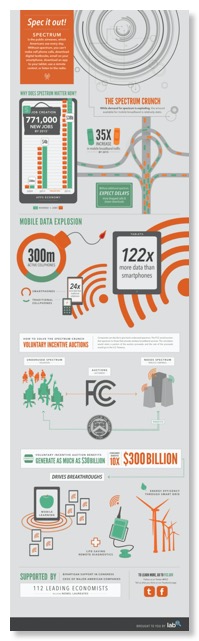
Although I agree with much of what is said in the Infographic, this is the most complex piece of graphic design I have ever seen at FCC and may be the triumph of form over substance. It appears to have been contracted for with an outside design house, Lab42, which states on its website:
Behind every great infographic is great data, which is where Lab42 excels. The infographics we create are powered by the data collected from our very own market research studies, meaning each of our infographics is unique. If you choose to work with Lab42, you can be sure that your one-of-a-kind infographic will be customized to meet your needs and the data behind it will be exclusively yours.
The Infographic starts with this statement:
It then goes on to say:S P E C T R U M is the public airwaves, which Americans use every day. Without spectrum, you can’t make cell phone calls, download digital textbooks, email on your smartphone, download an app to your tablet, use a remote control, or listen to the radio?
Without additional spectrum EXPECT DELAYS more dropped calls & slower download
Under “What does spectrum matter” it states that there will be 771,000 jobs created by 2015, crediting a “study by Deloitte” that is not cited further either on the Infographic or the accompanying PN, so we can’t see what the assumptions were.
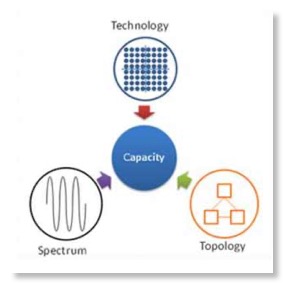
What the digital economy needs is not spectrum but capacity furnished in a cost-effective manner. Now new spectrum for the CMRS crowd may well be part of the solution, but it is not necessarily the whole solution. The above chart points out that spectrum, technology, and topology (infrastructure) are all contributors to capacity. The CMRS crowd has a single minded focus on the spectrum issue and the new Infographic seems to have the FCC following hook line and sinker. The FCC’s apparent indifference to wireless innovation, as shown by the 4+ years it fussed with AWS-3 without even reaching a conclusion on the technical issues and its inaction on its own Wireless Innovation NOI will probably guarantee that capital formation for such wireless innovation in this country will dry up so the CMRS crowd can focus on equipment designed in Europe and manufactured in China.
The Coalition For Free TV and Broadband is “a group of television broadcasters, concerned organizations, and individual citizens and has formed to ensure the survival of free television and to offer solutions to the nation for better, cheaper wireless broadband utilizing the broadcast industry.” Although Sinclair Broadcasting does not appear to be a member of this group, its executives are clearly speaking in favor of it. In the past Sinclair has been critical of the ATSC VSB technology for DTV and favored the European-like OFDM alternative.
White details of the Coalition proposal are somewhat vague, they describe it as follows:
With regulatory changes that would be trivial to implement, broadcasters could deliver a substantial and perpetual revenue stream to help offset budget deficits while alleviating the most significant cause of mobile broadband congestion. The driving factor of the looming spectrum crisis is the rapid growth in use of mobile video services. Projections of a spectrum shortage assume that all mobile video will be provided on a “point-to-point” basis: more than half of all mobile data traffic is expected to be video services. Today, if 100,000 people watch a football game, wireless carriers must provide 100,000 separate streams. The same game provided by a broadcast architecture would require only one stream – every user can access the same stream. The spectrum efficiency gains of broadcast for video delivery, as compared to individual streams on wireless networks, are vast.
If broadcasters are permitted to enhance their technology to seamlessly integrate with mobile devices, vast amounts of mobile data demand can be offloaded from the wireless networks. And the revenue generated from ancillary data services can generate far greater receipts to the Treasury than a one-time auction.
Of course, the claimed efficiency depends critically on whether people want to use their cell phones to watch real time programming simultaneously or want to watch video on demand. The Coalition proposal has some similarity to the late Qualcomm MediaFLO system that was a commercial failure.
The Coalition gives the following advantages for their plan:
I can not find a public statement by CTIA on this plan although Broadcasting & Cable found an NAB quote merely saying ”it is studying the Coalition proposal, which offers interesting ideas worth reviewing.”If embraced by Congress and the FCC, the Coalition Plan would:
•Avert a spectrum shortage by providing a vastly more efficient way to deliver the bandwidth-intensive broadband traffic
•Lead to lower prices for mobile broadband data while improving service quality
•Eliminate the need for incentive auctions, protecting Americans who rely on full power and low power broadcast television from loss of service.
•Provide more than $60 billion in new revenue to the U.S. Treasury in the first fifteen years, far more than the projected net proceeds from incentive auctions.
•Provide a perpetual revenue stream that could be worth as much as $216 billion to the U.S. Treasury.
UPDATE
A Tweet from CTIA announces “Study confirms spectrum crunch for wireless” and points to this report from the Global Information Industry Center at the University of California, San Diego. But in in line with the Ofcom report on the 3 building blocks of wireless capacity, the cited report also points out:
Enable deployment of supporting infrastructure.
Mobile services require towers and other support structures for antennas, lines and microwave dishes to “backhaul” the traffic from the cell site to the central network and switches, power, and secure locations for the equipment. Installing these facilities requires permits, construction and community support. The more we consume wireless data, the higher the number of cell sites will be needed to increase the capacity and improve reliability. If we want to continue to have access to reliable wireless services, we must be willing to support this construction. This needs to be an explicit choice made by the community.
Headline: NAB and CTIA Agree on Something!
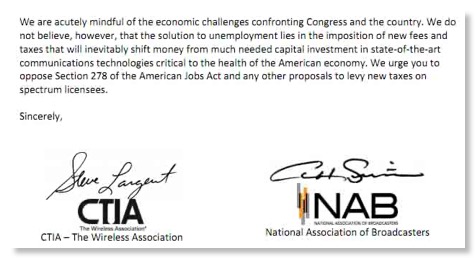
An e-mail from NAB arrived today with the letter which ends as shown above. My first thought: Wow! NAB and CTIA actually agree on something! After feuding all year on the silly issue of FM receivers in cell phones as a way to settle an NAB/RIAA squabble, not to mention the incentive auction legislation, they are finally in agreement and both million dollar CEOs signed the same document!
Readers may recall that I introduced the spectrum provisions of the Obama Jobs Bill last month. Although incentive auctions got all the attention, there are a number of other provisions. The White House summary I cited, has the following description of the Section 278 that the Goliath’s fear so much:
“Subparagraph (A) requires the FCC to conduct a rulemaking to establish a fee methodology and a fee collection schedule. The FCC is directed to develop a fee methodology consistent with the public interest, convenience, and necessity requirement, which is found throughout the Communications Act. The FCC is expected to undertake a multi-stage rulemaking during which fees for different classes of spectrum licenses or construction permits may be developed and phased-in over time, consistent with sound spectrum management principles. It is expected that fees would encourage efficient allocation and use of the radio spectrum, as the opportunity cost of spectrum resources would be reflected to commercial license holders that did not receive authorizations through competitive bidding...Subparagraph (E) provides an exemption from spectrum licensing fees for holders of licenses for broadcast television and public safety radio services.”
So what NAB and CTIA both agree upon, with SIA, NRB, and PCIA, is they don’t want to pay more fees for their spectrum that wasn’t obtained by auction. Presumably this is the same CTIA that was opposed to M2Z getting a license without auction but with a major free service requirement.
But, I guess nobody likes to pay more taxes!
NAB vs. CTIA: Citigroup Report
[Note: As of 10/7/11 NAB has removed this link to the report from their website. We have asked NAB for an explanation.]
Last week we mentioned how CTIA and NAB were fussing at each other over the relatively minor issue of FM receivers in cell phones. (An issue where this blog has consistently supported the CTIA viewpoint.) But this week the inter trade organization feud has escalated to the big issue: spectrum. With their million dollar CEOs, these 2 goliaths are out for blood to impress their memberships. Now NAB isn’t exactly up to date with the today’s nonbroadcast media. Their Policy Blog’s last entry was July 11 and has only had 5 posts this year! (CTIA’s blog by contrast has almost daily posts and sometimes 2/day.
(NAB’s use of Wordpress’ domain rather than their own domain for the blog is something a web savvy high school student would be embarrassed about. Poor NAB, the obvious Twitter name , @NAB, was already taken by National Australia Bank, but CTIA was able to get @CTIA for themselves. NAB was able to get #NABShow and statements from NAB appear from @NAB Newsroom, and @AirWharton in case your Twitter feed needs more input.)
NAB sent the news media the Citigroup report whose front page is shown above but as of this writing has not said anything on their own website about it. Wireless Week published a post with the eye catching headline: “Citigroup Report Discredits Spectrum Crunch; CTIA Fires Back”. They go on to write,
Citigroup says the U.S. wireless industry isn't facing a spectrum shortage and needs to do a better job managing the bandwidth it already has.
The report claims that wireless operators and other spectrum holders like cable operators are using only a portion of their spectrum to provide wireless services.
Citigroup's analysis was made public by the National Association of Broadcasters, which has been at odds with the wireless industry over an FCC proposal to auction off additional television airwaves for mobile broadband service.
Here are Citigroup”s conclusion (p.27)
•Mixed Signals — Robust Smartphone and tablet sales suggest wireless demand is growing rapidly. And, the FCC suggests the US faces a long-term spectrum shortage. However, several new wireless carriers - Clearwire, LightSquared and Dish - have been slow to light-up their spectrum suggesting excess supply. So, who's right? Isthere a spectrum shortage or not?
•Spectrum Availability High, Use Low — Today, US carriers have 538MHz of spectrum. And, additional 300MHz of additional spectrum waiting in the wings. But, only 192MHz is in use today. And 90% of this in-use spectrum is allocated to 2G, 3G and 3.5G services. As such, we estimate carriers can only offer average wireless speeds of 0.5-1 mbps during the peak busy hour.
•But, Spectrum Is in the Wrong Hands — Too much spectrum is controlled by companies that are not planning on rolling out services or face business and financial challenges. And, larger carriers cannot readily convert a substantial portion of their spectrum to 4G services, because most existing spectrum provides 2G-3.5G services to current users.
•Full 4G Can Deliver 5Mbps — 100% conversion of 538MHz allows carriers to offer 5Mbps with 10% simultaneous usage during peak busy-hour. This speed allows for very robust mobile use and limited home use. However, it is not sufficient for in-home replacement capable of large screen HD video streaming.
•Bottom Lines — We do not believe the US faces a spectrum shortage. However, unless incumbent carriers accelerate their 4G migration plans, or acquire more underutilized spectrum, upstart networks – like Clearwire, LightSquared and Dish – could have a material speed advantage over incumbent carriers provided that they can clear meaningful hurdles for funding and distribution
While NAB has no statement as yet on the report, CTIA certainly does:
“As we have said multiple times in the past, and has been recognized by a bipartisan group of lawmakers in the House and the Senate, the President, and the Chairman of the FCC, there is a need to bring additional spectrum to market to fuel what is one of the country’s key industries. Other countries have recognized the need to fuel their mobile ecosystems and have identified hundreds of megahertz of spectrum for mobile use. Our member companies would not be lining up to spend billions of dollars at auction for the right to use this spectrum if there was not explosive consumer demand for mobile broadband services.
“We need to move past NAB’s efforts to attack what everyone around the world already knows – that mobile broadband usage is exploding, and more spectrum is needed to continue to drive benefits for citizens that even five years ago were unimaginable.
“This time, NAB points to a report to conclude that there is no spectrum shortage. Aside from our concerns with several of the data points in the report, the most amazing element of the report that NAB fails to consider is that the authors of the study INCLUDE 120 MHz of reallocated broadcast spectrum in their analysis, when they talk about spectrum availability being ‘high.’ Page 2 of the report says that an additional 300 MHz of spectrum is ‘waiting in the wings,’ and 120 MHz of which is the very broadcast spectrum that the FCC has proposed to reallocate and that Congress is considering for incentive auctions. CTIA looks forward to working with Congress to ensure that there is in fact sufficient spectrum brought to market.”
And CTIA also has 2 recent tweets proclaiming the need for more mobile spectrum. So while we will not take this opportunity to take sides, it is clear that CTIA is the master of the new media for getting their word out!
UPDATE
So NAB did not release publicly any comment on the Citigroup report, just posted it on its website although now even that is gone!
However, an e-mail yesterday from NAB revealed their latest actions in this area: a letter from NAB President and CEO Gordon Smith to members of the Joint Select Committee on Deficit Reduction regarding the conclusion of a Citigroup study that there is no spectrum shortage affecting the wireless industry. In addition, an ad regarding the study in Capitol Hill publications.
Here is CTIA’s response released publicly on their website and blog:
"If this is how the NAB is showing their support for voluntary incentive auctions, then I would be fascinated to see how they'd respond if they opposed the idea. Frankly, I would imagine their messaging would look and sound like this letter. To be clear, ALL the proposals on incentive auctions are voluntary.
"Throughout this process, the NAB has consistently misrepresented the facts, with their efforts becoming more desperate as time goes on. The looming spectrum crisis is a fact that has been acknowledged by the president, members of Congress and the FCC Chairman and his colleagues. It has been acknowledged by foreign governments. The only people on the planet who consistently fail to acknowledge its existence work at the NAB.
“The fact is, America’s future is wireless. Consumers want the products and services they want, when they want them. This is a scheme that reflects the wireless broadband model far more closely than it reflects the broadcast television model, which is essentially the same as it was when Philo Farnsworth invented the TV in 1929.
“For the good of our members, American consumers and the American economy, Congress must act this year to make additional spectrum available for wireless broadband services.”
So we can see that CTIA is more transparent about their lobbying while NAB prefers to work in the shadows.
FURTHER UPDATE
CTIA bog post: Citigroup vs. Engineering: I’ll Take Engineering
TPRC 2011 Spectrum Sessions

Below are titles and links to all the spectrum related papers. The whole program is here.
Broadband Metrics: Wireless and Society
Moderator: Katie Shilton, University of Maryland
- Compensating Commercial Carriers for Public Safety Use: Pricing Options and the Financial Benefits and Risks - Ryan Hallahan, Jon Peha - Carnegie Mellon University
- Social Emergency Response Technology Policy - Joe Treglia, Syracuse University, Lee McKnight, Syracuse University, Murali Venkatesh, Syracuse University, Tamal Bose, Virginia Tech, Haris Volos, Virginia Tech, Jan Van Aardt, Rochester Institute of Technology, Don McKeown, Rochester Institute of Technology, Sumita Mishra, Rochester Institute of Technology, Myung Lee, City College of New York
- The Central Role of Wireless in the 21st Century Communications Ecology: Adapting Spectrum and Universal Service Policy to the New Reality - Mark Cooper, Fordham University and University of Colorado
Broadband Adoption: Spectrum Markets
Moderator: Matthew Hussey, The Office of Senator Snowe
- Tradeable Spectrum Interference Rights - Martin B. H. Weiss, Liu Cui - University of Pittsburgh
- Spectrum Aggregation Technology: Benefit-Cost Analysis and Estimation of its Impact on Spectrum Value - Mohammed Alotaibi, Carnegie Mellon University, Marvin A. Sirbu, Carnegie Mellon University
- Incentive Auctions - Coleman Bazelon, Charles Jackson, Giulia McHenry - Brattle Group
Evaluating Broadband Policy 1: Radio Regulations
Moderator: Michael Marcus, Marcus Spectrum Solutions, LLC
- Exclusion Principles and Receiver Boundaries on Spectrum Resources - Sarah Oh, George Mason University
- Wireless Technology Prospects and Policy Options: Results from a National Academies Study - Jon Eisenberg, National Research Council, David Liddle, National Research Council
- A Cross-national Analysis of the Effect of Spectrum Management Policy on the Deployment of 3G Technology - Moinul I. Zaber, Technical University of Lisbon, Marvin Sirbu, Carnegie Mellon University
Broadband, Business and Jobs: Spectrum Sharing
Moderator: Jon Eisenberg, National Academy of Sciences
- The Cost of Knowing: An Economic Evaluation of Context Acquisition in DSA Systems - Martin Weiss, University of Pittsburgh, Mohammed Altamaimi, University of Pittsburgh
- Mobile Broadband Growth, Spectrum Scarcity, and Sustainable Competition - John Chapin, William Lehr, Massachusetts Institute of Technology
- ‘Use it or Share it’: Opening Unused Spectrum Capacity by Building on the TV Bands Database - Michael Calabrese, New America Foundation
Gen. Shelton in the News Again on GPS/LightSquared
The hearing got off on an odd note with this statement by the committee chair:
That said, I have the unfortunate responsibility to inform the subcommittee that Federal Communications Commission (FCC) Chairman Genachowski refused to appear today. I must also make clear that I consider the Chairman’s failure to show up today to be an affront to the House Armed Services Committee.
Throughout the hearing there was endless ambiguity over whether the GPS receivers possibly threatened by the LightSquared system were military systems or private sector systems. Shelton stated at the hearing:
“Based on the test results and analysis to date, the LightSquared network would effectively jam vital GPS receivers. And to our knowledge thus far, there are no mitigation options that would be effective in eliminating interference to essential GPS services in the United States.”
FoxNews added to the confusion by stating:
The Virginia-based satellite and broadband communications company has plans to build a nationwide, next-generation, 4G phone network that many, including Shelton, think would seriously hinder the effectiveness of high-precision GPS receiver systems, a product used most commonly by the United States military.
A former high level GPS program official recently pointed out to me that the alleged threat to military GPS users is truly bizarre. The proposed terrestrial base stations now are 20 MHz outside the GPS band and are of modest power. A US adversary of even modest means would be capable of building GPS jammers closer to or within the GPS band and with a power much higher than what LightSquared is planning for its terrestrial network.
The Washington Post reported,
“But the new plan, Shelton said, will require billions of dollars in fresh testing of antennas and receivers that could take as long as a decade.”(emphasis added)
Furthermore, such an adversary could also chose a jamming signal more optimized for GPS disruption than the LTE signal proposed by LightSquared. Is this all it takes to disrupt the military’s multibillion dollar critical investment in GPS that is so critical to our national security? If so, there is an urgent problem at hand and it is not just the LightSquared issue, it is the extreme fragility of military GPS systems! More likely, however, is that the proposed system will have no impact on military users but that the whole GPS community is “circling the wagons” in an “all for one, one for all” strategy to protect a few GPS manufacturers who made odd design decisions in their receivers, such as the Deere receiver whose front end covers 3 bands: MSS, GPS, and GLONASS. A strong signal in any of these bands then blocks the receiver.
There was repeated discussion at the hearing of the need for precision GPS receivers to receive “GPS harmonics” for optimal performance. As a service to readers, here is a repeat of the spectrum GPS uses:
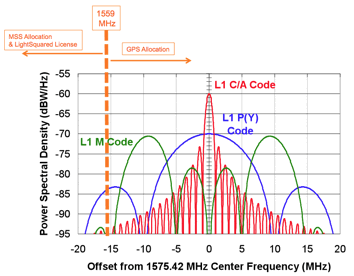
There is some GPS signal power outside the allocated L1 spectrum that ends at 1559 MHz, but not 20 MHz away! At a previous hearing before the House Science Committee, US Geological Survey complained about impact of LightSquared base stations on plate tectonic monitoring receivers. USGS was vague about the bandwidth of this receivers, but it is reported that it is significantly greater than the bandwidth of any usable part of the GPS signal.
Perhaps as indication that the hearing was orchestrated by a PR agency working for commercial GPS interests, it even went into a recent ad by LightSquared in Politico . No mention was made of unreasonable alarmist statements by GPS interests. It became apparent during UWB deliberations that the GPS industry and FAA had a codependency and were willing to do policy favors for each other. Hence FAA took the lead trying to block UWB even though even NTIA readily agreed that none of the UWB emission levels under consideration at the time posed a risk to aviation uses of GPS. Now it looks like Gen. Shelton has slid into the FAA’s former role as defender of GPS commercial interests, this time by blurring the distinction between military uses and commercial uses.
Do we really need this type of codependency?
Prepared Statements
Complete Video of 9/15/11 Hearing
Spectrum Provisions in the Obama "Jobs Bill"
The other spectrum provisions are nowhere as controversial as incentive auctions or the $300+ billion in spending or the tax provisions of the bill so are unlikely to get much attention in the general media. As a service to readers, here is a link to the spectrum provisions of the bill and White House analysis of these provisions.
The part of greatest interest to your blogger is Section 272 – “Clarification of Authorities to Repurpose Federal Spectrum for Commercial Purposes”. Current law allows auction revenues to reimburse federal agencies for relocation costs when they move out of a band to allow nonfederal use of the band. However, in practice the current provisions are too restrictive and lead to valid concerns by federal users and resistance to reallocations. In general costs can only be used for actual relocation to comparable facilities after the auction is completed. This prevents such spending for long range planning costs and purchase of equipment that has long lead times because it must be designed from scratch for a new band.
Here is the White House analysis of these provisions:
Subsections (a) and (b) permit Federal agencies to be fully reimbursed through the Spectrum Relocation Fund (SRF) for relocation costs (including planning costs that occur before an auction), to better enable agencies to evaluate the cost and scheduling implications of relocation activities, and thereby facilitate both an improved auction and relocation process while ensuring the continuity of agency missions. Also, subsection (b) allows for support of costs incurred by Federal agencies to allow shared and unlicensed use of spectrum assigned to agencies.
Subsection (c) permits Federal agencies to be reimbursed for costs incurred in accommodating additional non-Federal access to their frequencies, as well as for studies related to sharing bands among Federal users. Reimbursable costs to enable sharing are consistent with system modifications made in the context of relocation.
In addition, subsection (c) clarifies that the agencies are permitted to acquire state of the art replacement systems under the current-law standard of comparable capability of systems. Section 101(c) also permits agencies to hire term-limited civil servant and contractor support staff to implement relocation projects, and provides further authority for expenditures related to planning in advance of an auction. Subsection (c) furthermore clarifies that the SRF can be used to reimburse agencies for the cost of using commercial services, if these services are the most cost effective way of vacating Federal frequencies while maintaining agency missions. Subsection (d) allows Federal agencies to enter into sharing arrangements with non-Federal entities, upon approval of NTIA and the Office of Management and Budget (OMB).
Subsection (e) provides authority to the Director of OMB to transfer amounts from the SRF for the costs of activities (including planning) directly attributable to relocation of Federal systems. This section also extends the period of funds availability in the SRF from 8 to 15 years, and provides additional flexibility beyond that period upon notification of the Congress. Furthermore, subsection (e) provides that up to 20 percent of the revenue from the auction of licenses associated with frequencies vacated by Federal agencies, or made available through sharing, may be used to enhance agency communications, radar and other spectrum using capabilities; this funding availability for enhancements would be in addition to the relocation costs covered under the current authorities, which provide for maintaining comparable capability for agencies. Use of funds for enhancements, like current authorities for relocation cost reimbursement, would be subject to notification of the appropriate Congressional committees.
In addition to the above mentioned 2 provisions, the bill has the following interesting sections:
- Section 274 – This section would require the FCC to recover a significant portion of the value of new terrestrial broadband deployment rights in certain spectrum frequencies that were originally set aside for satellite services either through competitive bidding procedures or spectrum fee authority. This appears to be aimed at ATC users such as LightSquared.
- Section 277 – This section requires certain spectrum assigned to Federal agencies or in FCC inventories to be identified by NTIA and auctioned by the Commission.
- Section 278 – This section provides the FCC with authority to assess fees for initial spectrum licenses and construction permits that were not assigned by auction and for modifications or renewals of initial licenses and other authorizations, whether granted through competitive bidding or not, based upon public interest principles (for example, if a modification increases the value of a license).
- Section 281 – This section would reallocate the D block for use by first responders and other public safety uses.
- Section 283 – This section would grant the Public Safety Broadband Corporation, created under the bill, the license for the D block of spectrum in addition to certain spectrum held for public safety use by broadband technologies.
- Section 297 – This section establishes the Public Safety Trust Fund with proceeds from certain spectrum auctions. This section provides $7 billion to build and operate the nationwide public safety broadband network as well as conduct research to develop standards for the network.
I will not go into the merits of the provisions in general, but I think the section on federal spectrum and the Spectrum Relocation Fund is a home run and addressees in a pragmatic ways some of the major problems in facilitating sharing and transfer of federal spectrum.
Ten Years After 9-11, Still No Public Safety Network -- Wireless Week

This blog has reported repeatedly on the issue and made suggestions. So you don’t have to hear my viewpoint this time, I strongly recommend a Wireless Week interview with Gregg Riddle, who advocates for public safety workers from his post as president of APCO International, the major trade association in the public safety area. I do not always agree with APCO, but what he says in this interview makes a lot of sense.
Here is a brief excerpt:
WW: How robust are the nation's public safety networks right now? If we had another terrorist attack, would we see the same breakdown in communications we did 10 years ago?
Riddle: It's very possible because we have not addressed the interoperability concern. Public safety operations today are spread out over multiple portions of the spectrum - VHF, UHF, 700 MHz, 800 MHz and low band. They all have their own interoperability capabilities, but when you have public safety utilizing multiple portions of the spectrum, they're not easily interoperable, which was demonstrated on Sept.11, 2001.
Interoperability is critical. It was one of the Sept. 11 Commission's report items that's not been met after 10 years – interoperability for public safety. We're still struggling to meet the goal as described in the report.
There is more than enough blame to go around here both in government entities who played political games and turf battles and corporate interests who wanted to use this situation for market hegemony and their financial benefit. But this is not the time for a postmortem on who has responsibility for this mess. Rather it is the time to remember the spirit of national unity that existed 10 years ago and use it to come up with a consensus solution and adopt it.
Radio Spectrum Institute: A New Source for Spectrum Policy Training

Your blogger has joined forces with four other spectrum policy veterans with experience both inside and outside the key agencies of FCC and NTIA to offer courses on spectrum policy as the Radio Spectrum Institute. The other instructors are Andrew Clegg, Roger LeClair, Nelson Pollack, and Leslie A. Taylor.
The first course, entitled Spectrum Management Boot Camp will be a one day course, given on November 16th in Arlington VA. Spectrum Management Boot Camp combines six Radio Spectrum Institute classes into a complete practical introduction to international and U.S. spectrum management. The emphasis is on the key regulatory aspects that impact the use of the radio spectrum to meet industry or government mission requirements. Important technical considerations are simplified and accessible to the layperson. Spectrum Management Boot Camp is targeted at professionals who must quickly come up to speed on the diverse requirements of modern spectrum management, or current wireless professionals who desire a broader understanding of the radio spectrum management landscape.
For more information, surf over to the RSI website.
Petition Filed to Stop Contraband Cellphone Use in Prisons
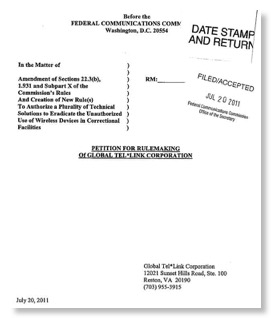
The topic of illicit cellphone use in prisons has been a recurring topic here even though there has been no explicit FCC action on the topic other than a workshop almost a year ago. Indeed, while FCC waited over 2 years to ask for any public comment on CTIA’s November 2, 2007 petition on cellphone jamming and customer-owned bidirectional amplifiers, it has so far ignored all the jamming issues in that petition - both prison-related and otherwise. (The Docket 10-4 public notice seeking comment on this and other petitions avoids all mention of jamming issues of any type and focuses solely on the amplifier section of the petition.) But FCC is being somewhat even handed here: They have ignored both CTIA’s attempt to have all jammers declared illegal and the July/August 2009 petition of the South Carolina Department of Corrections and 30 other states to allow jamming in prisons to control illicit cellphone use. Except for the above mentioned workshop, FCC has taken no visible action to control cell phone use in prisons. (Of course, being caught between the powerful CTIA and state governments is not a desirable place to be.)

Carl Lackl, Jr. (l) a Baltimore witness murdered as a result of a prison cell phone call.
Capt. Robert Johnson (r) South Carolina Department of Corrections, shot 6 times
at his home as a result of a prison cell phone call.
The GTL petition addresses both jamming and “managed access” - interception and blocking of calls based on their location and possibly with a “green list” of cellphones that may make calls at or near prison property. The petition states,
“Managed access systems are generally favorably viewed, yet they are too costly for most deployments and complicated to authorize given the need to negotiate spectrum sublease agreements with multiple wireless telecommunications carriers. This petition presents a proposal to amend the Commission’s rules to streamline the spectrum lease process so that spectrum lease agreements, when needed, are obtained in a shorter period of time.”
It also seeks to clarify the obligations of a managed access system with respect to E-911 services and involve the local PSAP operator in determining what is appropriate for a given area.
Finally it asks the Commission to finally act on determining whether CTIA’s interpretation of Section 333 (that the Commission does not have the authority to permit jamming by non-federal entities) is consistent with the statute. It argues that FCC should consider the legislative history of Section 333 as well as the plain reading of the Communications Act that whatever Section 333 means it must apply equally to both FCC and NTIA since it does not differentiate between the two agencies. (Section 305 exempts the President and NTIA from Sections 301 and 303, but not from the rest of the Communications Act. Also, Section 333’s contemporary on satellite jamming, 18 USC 1367, specifically excludes “any lawfully authorized investigative, protective, or intelligence activity of a law enforcement agency or of an intelligence agency of the United States” while Section 333 is silent on this point.)
Let’s hope that FCC finds this petition in its inbox and takes some action on this important issue that has been ignored for so long. Sources in FCC report that there is no centralized tracking of petitions that are received but have not been put out for public notice. So even the 8th Floor may not be aware of this petition and its issues.
UPDATE
On 9/6 CellAntenna Corporation filed a related petition with FCC. So FCC now has 3 petitions dealing with various aspects of contraband cellphone use in prisons, ALL without any action.
The CellAntenna petition would “require CMRS carriers to do their part and suspend service to any wireless device reported to be operating in a correctional facility within one hour after receipt of notice from a Warden”. Of course, this approach could allow any smuggled cellphone to be used at least once and would be a boon to contraband smugglers.
So isn’t it time for FCC to at least put some of these petitions on public notice for comment?
How Do You Count to 500?
On February 24, 2010 Chairman Genachowski announced in a speech at the New America Foundation:
“First, we are going to announce a gameplan to unleash more spectrum for mobile broadband. The National Broadband Plan will set a goal of freeing up 500 Megahertz of spectrum over the next decade. We will work closely with NTIA to do so.”
CTIA had previously stated
So the 500 MHz no doubt was a compromise number that attempted to address reality.“we need at least another 800 MHz within six years to meet the increasing consumer demand whether it's for mobile Internet, mHealth, smart grids, or a number of other wireless uses that change the way we live and work."
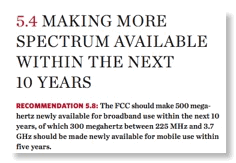
Traditionally the cellular industry has used full duplex symmetrically pair spectrum. Thus the cellular 800 MHz band is 824-849 MHz (mobile-to-base) paired with 869-894 MHz (base-to-mobile). The same type of symmetric pairing was used for PCS and 3G in high bands. This was clearly necessary when the predominant use of cellular was 2-way voice which has little tolerance of time latency/delay. But the rapid expansion of mobile communication volumes predicted by CTIA and the NBP are not 2 way voice, rather they are Internet and video related - categories that are asymmetric in information flows and more tolerant in time latency. Many of these flows are also highly intermittent as compared to voice, with high peak to average data rates. Is the traditional type of allocations the best way or the only way to handle this type of growth?
Your blogger has no objection to the reallocation of 500 MHz of spectrum for the traditional paired symmetric use, but it is becoming increasingly clear to all involved that finding 500 MHz of such spectrum will be in the extremely difficult to nearly impossible range. In addition, the major need for spectrum is in major metropolitan areas and the focus on nationwide availability of spectrum ignore options. From what I have heard, the cellular establishment wants FCC and NTIA to find it spectrum that has all the following characteristics:
- Nationwide full time availability
- Paired
- In large contiguous blocks
- Consistent with international allocations and international standards (note that this is not a legal requirement except near borders with Mexico and Canada absent a bilateral agreement)
So isn’t it time to start thinking of Plan B? If 500 MHz of spectrum meeting the cellular establishment’s 4 conditions can not be found with politically acceptable impact on other federal and nonfederal uses, how would “noncomplying” spectrum count towards the 500 MHz goal? Maybe for tactical reasons the cellular establish doesn’t want to consider this possibility, but to many of us it is a quite real possibility as none of the “spectrum haves” are anxious to release their part of the 500 MHz or have any impact from its altered use, e.g. GPS/LightSquared problem.
CBO knows how to “score” budget proposals, should FCC and NTIA start thinking about how to “score” spectrum reallocations with respect to the 500 MHz goal?
[I help my international neighbors by reading in English to their 4 year old. While I was writing this post, one of the books he selected was this one.I recommend it!]
U-NII/Weather Radar Interference Update
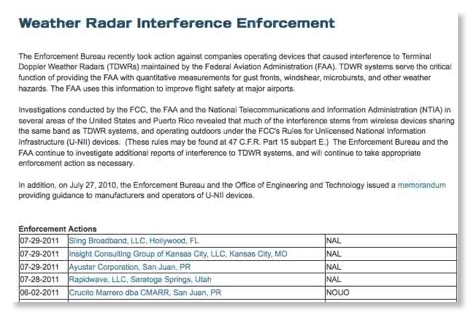
The FCC/EB webpage linked to the picture above now lists 17 FCC enforcement actions related to U-NII interference to FAA TDWR weather radars since 2007. For those not familiar with the jargon here, a March post here reported how 5 GHz unlicensed U-NII equipment operating in the 5.47-5.725 GHz band are required to have dynamic frequency selection (DFS) as defined by 15.407(h), basically a listen-before-talk (LBT) cognitive radio system, in order to avoid interference to several types of federal government radar systems that operate in the same band. The Terminal Doppler Weather Radar, an FAA weather radar near airports, has been receiving interference in several cases despite this requirement. The big question - Why?
(One)U-NII device was tested against FCC DFS certification waveforms and it did not detect any. It also failed to detect any emulated TDWR waveforms. The device, however, was FCC certified, meaning it had passed these same tests when the FCC laboratory tested its DFS performance. A firmware update from the manufacturer eventually rectified this problem, illustrating how firmware upgrades can lead to DFS non-compliance.
This strongly implies that the manufacturer changed the firmware after FCC approval. While the original FCC software defined radio (SDR) rules would have made such a software change a Class 3 Permissive Change and required regulatory review, the softening of the rules in Docket 03-108 and deletion of the former 2.932(e) gave a green light to such software changes.
Two March 2010 enforcement actions seem to confirm this. These involved Airspan and Motorola. Airspan agreed in a consent decree as follows:
Remedial Measures. Airspan has developed and distributed to its United States MicroMAX customers a software upgrade for its MicroMAXdevice that prevents users from disabling the DFS radar detection mechanism and varying any other operating parameters of the device.
Thus they were selling a unit where the users could turn off the required DFS capability needed to protect safety-related FAA radars! Airspan agreed to make a $10,000 “voluntary payment” to the Treasury as part of the consent decree.
Motorola agreed to a $9,000 “voluntary payment” but their consent decree is more cryptic than the one for Airspan or a similar one for Axxcelera Broadband Wireless, Inc. that appears to be based on a hardware component issue not a software change. The Airspan consent decree has clearly stated “remedial measures” that says what they will correct, Moto gets off with a $1,000 small “voluntary payment” (trivial to what this must have cost in legal fees), a vague agreement to train their employees better:
Motorola will train and provide materials concerning Section 302(b) of the Act and Parts 2 and 15 of the Rules pertaining to U-NII devices and the requirements of the Consent Decree to those of its employees who are involved directly in the development and marketing of U-NII devices imported, marketed and sold by Motorola in the United States.
Cryptically the consent decree states
On April 20, 2009, the Bureau issued an LOI (letter of inquiry) to Motorola. The LOI directed Motorola to submit a sworn written response to a series of questions relating to the marketing and selling of U-NII devices. Motorola responded to the LOI on May 20, 2009.
The content of Moto’s response to the LOI indicating how this happened is not on the public record. This is reminiscent of the “professional courtesy” Moto used to get from FCC when it was the dominant player in the mobile radio field and contrasts with how the lesser firms, Airspan and Axxcelera, were treated - they both paid a greater “voluntary payment” and had their violation more explicitly reported. Moto’s failings are not given in the public document, only in the referenced in the publicly unavailable 5/20/09 LOI response.
The coddling and preferential treatment of Motorola was common in the past but neglects the fact that it may have contributed to Moto’s lack of competitiveness and its ultimate demise as the top mobile radio firm. In the past Moto may have stressed its regulatory prowess over its technical prowess and was not prepared for the level playing field that cellular presented with new competitors. As Trefis reported
Motorola’s market share is expected to decline from a high of 22% in 2006 to 2.8% in 2010, [3] and could continue to decline to 1.6% by the end of Trefis forecast period(2011).
UPDATE
You blogger has filed a FOIA request for the above mentioned Motorola response to the FCC letter of inquiry (LOI) and will publish here the text when received. Today, the following interim response from FCC was received:
Your Freedom of Information Act ("FOIA") request dated August 11, 2011, was assigned to the Commission's Enforcement Bureau. You seek the response to a Letter of Inquiry ("LOI") issued in the Enforcement Bureau's investigation of Motorola, Inc. ("Motorola") (EB-09-SE-064). Motorola responded to the LOI on May 20, 2009. This email is to inform you that Motorola filed a request for confidential treatment of most of its LOI response pursuant to 47 C.F.R. § 0.459 of the Commission's rules. Since the confidentiality request is pending, pursuant to Section 0.461(d)(3) of the Commission's rules, we will serve Motorola with a copy of your FOIA request and afford them 10 calendar days to respond. Motorola also is required to serve you with a copy of its response.
The criteria for withholding such information is given in 47 CFR 0.457(d) . We patiently await word from Motorola if it is willing to let the world know why its equipment violated FCC rules or whether they will fight the release of any substantive information.
Spectrum Innovation Act of 2011:
Will the "unlicensed auction" provisions lead to another "D Block Auction" fiasco?
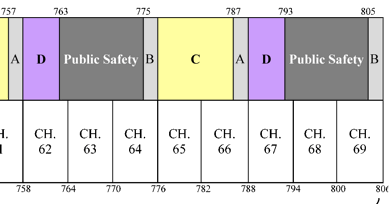
What if they had an auction and no one came? This is basically what happened in the 2008 D block auction where FCC declared, “The provisionally winning bid for the D Block license, however, did not meet the applicable reserve price and thus did not become a winning bid.”
Of course in reality only one firm bid showing essentially zero interest in the package offered. Why? The basic reason was that the package that was up for sale was so poorly defined that a potential bidder with an MBA on his staff could not possibly estimate either potential costs or possible income. It was unclear what level of service the D block owner had to provide to public safety community and it was unclear if he would get any income from public safety use of D block spectrum that would, in effect, deny commercial use for a period. Could the licensee charge for public safety use of D block in excess of x% occupancy? At the time of the auction no one knew.
FireceWireless described the new legislation as follows:
The proposal to require unlicensed spectrum to be auctioned is drawing fire from the tech community. In essence, companies that might be interested in building products to work on unlicensed spectrum would be required to pay for the spectrum despite the fact that they wouldn't receive any exclusive rights to it. Confusingly, if the total value of all bids for such spectrum were to exceed the highest single bidder, the spectrum would then become unlicensed. If, however, a single bidder sought exclusive use of the spectrum and outbid other bidders wanting the spectrum to be unlicensed, the spectrum would then go to the single bidder. (emphasis added)
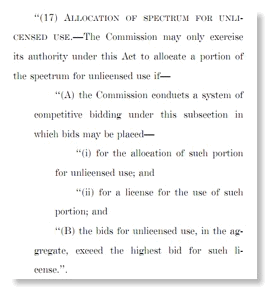
People opposed to this provision also compare it to the Unlicensed PCS (U-PCS) rules the Commission adopted in 1993 and which were a dismal failure. Opponents blame the fiasco over the user fees for equipment in the band which would have been about $5/unit.
These rules, adopted at the request of industry that drafted them were amazing complex and included provisions for both “isochronous devices” and “asynchronous devices” as requested by the commenting parties. My personal view on the failure of these rules is that they were much too complex, totaling over 3800 words and the parties requesting them did not realize that once they were enshrined in 47 C.F.R. any changes to them were protected by both the full faith and credit of the APA and the Commission’s long standing near indifference to technical rulemakings - especially when it gets distracted by “sexier” things such as DTV and broadband. By comparison, the original ISM band rules that spawned both Wi-Fi and Bluetooth consisted of exactly 398 words! I think a key factor of U-PCS’ failure was the extreme complexity and inflexibility that was demanded by the petitioners and FCC acceded to.
Given that most unlicensed bands are “damaged goods” as previously stated, and that most unlicensed bands are really very specific provisions for narrow spectrum slivers, e.g. 15.233, requiring auctions for any new unlicensed band seems like regulatory overkill. On the other hand allowing such type of auctions and giving guidances of what considerations should be used in deciding on them might be constructive.
Spectrum Innovation Act of 2011:
Will the Party in Favor of Section 104 Please Stand Up?
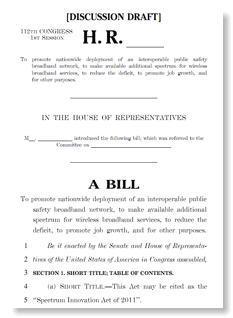
The draft deals with several topics. FastNetNews published a Republican staff memo which is a good summary. The Republican staff summarizes the bill’s contents as:
The first is a discussion draft that authorizes an as yet unspecified amount for construction of an interoperable public safety network on the 24 MHz of spectrum cleared for public safety by the 2005 DTV legislation, creates a governance structure for construction and operation of the public safety network, and authorizes incentive auctions.
However, what got a lot of attention at Thursday’s meeting was Section 104 which the staff described as follows:
Requires that any spectrum made available for commercial use must be done so through auction, regardless whether the spectrum is to be made available on a licensed or unlicensed basis. If the sum of the bids of the parties that prefer unlicensed use of particular spectrum exceeds the highest individual bid for licensed use, the spectrum will be made available on an unlicensed basis. This approach is modeled after FCC Office of Strategic Planning Working Paper No. 43. This section also requires new unlicensed devices to coordinate with a database to determine which spectrum bands are available for operation..
CTIA is rumored to be the proponent of this provision, but CTIA’s Christopher Guttman-McCabe’s testimony on Friday never mentions “unlicensed” at all. Indeed, it isn’t clear if anyone is publicly in favor of this provision, yet it somehow appeared in the bill. Would whoever is in favor of Section 104 please stand up and tell us why it is a good idea?
Note that the legislation would apply to ALL new unlicensed bands. It assumes that all bands are the same and could be equally used for licensed or unlicensed use. Note that for the case of the ISM bands used for Wi-Fi and Bluetooth, the band use is secondary to both ISM devices (e.g. microwave ovens), military radars, and amateur radio use. Not much demand for licensed use here is there! The 57-64 GHz band is shared with federal government use and is subject to odd radio propagation due to absorption by oxygen molecules that limits useful ranges to less than a mile. Again not a hotbed of licensed interest. So why is this a good idea for all unlicensed bands?
Most unlicensed bands are really “damaged goods”. The unlicensed community has made something useful out of bands where they had great technical flexibility to innovate. While giving the FCC the option of use auctions in making licensed/unlicensed decisions might be a good idea for bands that are not damaged goods, requiring it in all cases is really a bad idea.
If the committee is so interested in “innovation”, why doesn’t it ask why Section 7 is broken?
UPDATE
GigaOm has a piece on the topic of Section 104 with the title “How Congress’ spectrum bills hurt the tech community”. The URL implies a stronger viewpoint: http://gigaom.com/broadband/how-congress-spectrum-bills-screw-the-tech-community/ It includes this interesting observation:
There’s another wacky issue with unlicensed spectrum — all of the airwaves would be auctioned off in geographic blocks which means that there would be no nationwide unlicensed spectrum block created. So even if local communities or corporate entities interested in promoting unlicensed spectrum bought out the airwaves, they’d only have access to the ones in their local areas. This is how wireless providers buy their spectrum, and it can lead to some operators having a hard time covering certain markets. And while a local municipality might want to buy unlicensed spectrum to offer its citizens Super Wi-Fi or another service over those airwaves, getting low-cost devices for only one area would be a challenge. Device makers can’t provide cheap electronics for smaller markets.
GigaOm, with its much greater resources than your blogger, also doesn’t know who is pushing this bill.
Another viewpoint: A GOP Own-Goal on Spectrum Policy from Forbes blog
Radar/Communications Spectrum Sharing: ISART 2011
On July 27-29 NTIA will host the 12th Annual International Symposium on Advanced Radio Technologies (ISART) at its Boulder, CO Institute for Telecommunications Sciences. The theme this year is “Developing Forward-Thinking Rules and Processes to Fully Exploit Spectrum Resources” with a special focus on radar bands.
For the third time since his retirement from FCC, NTIA was kind enough to invite your blogger to speak at this important meeting, but due to a conflicting family event, he is unable to attend. However, in view of the importance of this issue, he volunteered to produce a written paper on the topic to help stimulate discussion. Here is a link to that paper.
The paper starts by stating the need for new spectrum to speed economic growth which is important for both our society and for national security. Spectrum allocation should not be viewed as a zero sum game, but it is critical to develop innovative sharing techniques to get the maximum use of this limited resource. Since radar systems are a large user of spectrum and are difficult to share with using conventional approaches, this is a very timely conference.
TDWR
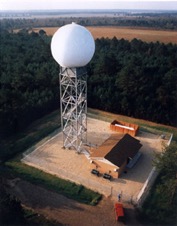
The main part of the paper advocates joint design of new radar systems with communications experts in order to maximize spectrum sharing and consider financial cost sharing of features that facilitate sharing subject to the radar mission needs. Just as the stealth bomber design involved a unique team of aeronautical engineers and EEs who could trade off flying issues with radar visibility issues, joint design of radar/comm systems may well result in sharing breakthroughs. While current legislation does not allow this type of cost sharing, it is not beyond the reach of new legislation that has been discussed. The paper points out that while full duplex paired spectrum with “24/7 and 1000 ms/ 1 s” time availability has been the norm for commercial systems, the decline of voice minutes and the domination of packetized traffic means that partial time availability, synched with radar rotation, could result in productive access to radar spectrum. While nonmilitary backlobe radio have not improved in 40+ years, advances in radio astronomy antennas indicate that new designs can significantly decrease backlobe levels and facilitate sharing. Such designs are expensive, but cost sharing could address that.
if you are interested, here, again, is the link.
"Transmitters Don't Use Up Spectrum, Receivers Do!"
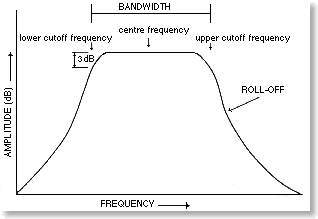
The title of this post is an old truism in spectrum policy. It is also something your blogger never heard until he started working at FCC, so it is probably not discussed much outside some groups in FCC and NTIA. The basic point is shown in the the old analog TV allotment table (47 C.F.R. 73.606) which shows what TV channels could be used in each city for NTSC. Excerpts for SF and Dallas are shown below:
.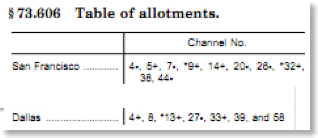
Note the UHF channels (>14) . For SF, the city that CTIA is boycotting, the channels are 14, 20, 26, 32, 38, and 44 - the same analog channels as the Washington DC area. For Dallas they include 27, 33,and 39. See the pattern? In a given city, the UHF TV channels were spaced 6 channels apart. (Someone might point out that Washington has channel 22, between channels 20 and 26. True in a way, but it is not in Washington, it is actually in Annapolis.)
Each analog TV channel took one 6 MHz channel. The increment of 6 was to protect the mediocre TV receivers that were expected when UHF TV was authorized in 1952 “Sixth Report and Order”. They are a direct result of the channel separations mandated by “UHF taboos” in Table II of 73.698 which in turn resulted from assumptions of the ability of TV receivers to reject nearby signals and limits on how much they would unintentionally radiate internal signals that might interfere with neighbor’s reception. Again, these were all 1952 estimates - certainly based on earlier data since the FCC decision was made in 1952. A sad observation on the state of spectrum management at FCC in the past is that FCC never had the resources and courage to change this misuse of UHF spectrum as radio technology was revolutionized during the period 1952 - 1986. I cut off at 1986 because that was around the time that that HDTV came to center stage and DTV started looking feasible. Only the arrival of DTV finally removed the limitation on using only every 6th UHF channel. It is clear, to your blogger at least, that technology was available by the 1970s to have receivers with more robust interference immunity to allow more intense use of UHF TV even without DTV, yet the FCC did not have the political will to do so as it would have infuriated the TV interests that dominated FCC spectrum policy deliberations at that time.
12. Include receiver tolerances in regulation (either through (1) additional incentives, (2) mandates, or (3) some combination of incentives and mandates) to be used until can migrate to “interference temperature” regulatory scheme and to be used for the long term where use of interference temperature would be inapplicable; e.g., for systems in which licensees do not have control over receivers.
14. Issue Notice of Inquiry to characterize current and future receiver environments and to explore issues to consider, such as, performance parameters and protection for legacy receivers.
A key problem in spectrum innovation is that endless FCC deliberations discourage investment in wireless R&D and a key issue in such endless deliberations is differing expectations about receiver performance by incumbents and potential entrants. (“Harmful interference” is also an ill defined issue at FCC that extends deliberations and is usually related to receiver performance.)
Both the lengthly and inconclusive AWS-3 controversy and the current GPS/LightSquared controversy (not to mention the PCS H block issue) have at their root the issue of receiver performance expectation. Reasonable people could disagree about what are appropriate expectations for T-Mobile’s cell phone receivers - in the AWS-3 case - and GPS receivers - in the LightSquared case - with respect to adjacent band signal rejection. As in the case of harmful interference, NTIA and FCC need to develop a way to resolve receiver expectation issues in a timely way if they want to encourage technical innovation and the capital formation that is an integral part of it. Such resolutions need not make every party - or even any party - happy, but they are essential to maintain US leadership in both wireless technology and wireless services. The above SPTF recommendations would be a good place to start!
New Cellular Advocacy Group Trivializes Spectrum Policy Issues
A new group, Mobile Future,
is dedicated to educating the public and key decision makers on innovations in the wireless industry that have transformed the way Americans work and play and to advocate continued investment in wireless technologies. We look forward to keeping you in the loop about our news and events.
It apparently is trying to do this by producing PR that trivializes key spectrum issues, rather than encouraging productive dialogue on the issue or even improving the governmental decisionmaking process.
Mobile Future is a mixture of cellular industry groups that partially overlaps the CTIA membership and some public interest groups. The industry membership includes AT&T, T-Mobile, Alcatel-Lucent, Qualcomm, Cisco, and Ericsson but does not include Sprint, Verizon, Nokia, or Motorola. Other members include Black College Communication Association, Labor Council for Latin American Advancement, National Gay and Lesbian Chamber of Commerce, and the National Association of Neighborhoods. You can be pretty sure that the first group of members named above are paying the bills and the second groups is there for “window dressing”.

Note that the “pie” shown here, only includes spectrum used by the sponsors with the except of “radio and TV” - would that spectrum management be so simple. In reality there is military use, there is FAA use, there is local, state, and federal public safety use. There is even amateur radio use, not to forget radio astronomy.
But is mobile capacity really proportional to available spectrum? We will not here get into the previously reported NAB and CTIA battling reports. Your blogger is closer to CTIA on that issue than NAB. But the Mobile Future viewpoint is just too much to swallow.
Ofcom, FCC’s well respected UK counterpart, released in January a report entitled 4G Capacity Gains. The study starts with a bold and simple statement that is usually fuzzified in the US cellular industry’s presentations:
- Technology – the cell spectrum efficiency that can be realised by a given feature set
- Spectrum – the bandwidth allocated to a network
- Topology – the mixture of cell sizes and local environments in the network
The report concludes,
“ technology improvements alone will not meet forecast demand increases and that a mixture of changes in topology and spectrum will be required to meet this increase in demand. It is recommended that previous studies into the dimensioning of future spectrum requirements for 4G networks are revisited with the revised cell spectrum efficiency results recommended by this study in mind.”
Thus spectrum alone is not enough to solve the problem, changes in “topology” or number of cells is critical to meet capacity goals.
How is the US doing in this area? A topic the mainstream cellular industry doesn’t like to talk about. Here is one observer’s viewpoint.
FastNetNews reports
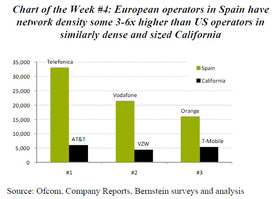
Yes, the cellular industry need more spectrum. But a singular focus on spectrum ignores the need for more infrastructure and improved technology. Indeed, the Commission’s sometimes indifferent view towards new technology and the capital investment needed to develop it is also a detriment to more wireless services to serve society and help the economy. Finally, the singular focus on spectrum is leading to more and more “food fights” over spectrum that FCC (and NTIA) is/are unable to resolve in a timely way.
UPDATE
Apparently, the real CTIA is perfectly capable of trivializing spectrum policy also. here is a tweet that CTIA sent out several times on July 22:
New GAO Report on NTIA & Federal Spectrum Management
Here is GAO’s summary of what they found:
NTIA is responsible for governmentwide federal spectrum management, but its efforts in this area have been limited. In 2003, the President directed NTIA to develop plans identifying federal and national (both federal and nonfederal) spectrum needs, and in 2008, NTIA issued the federal plan. GAO found this plan has several limitations, does not identify governmentwide spectrum needs, and does not contain key elements and best practices of strategic planning. NTIA has yet to issue the national plan. Furthermore, NTIA’s primary spectrum management operations do not focus on governmentwide needs. Instead NTIA depends on agency self-evaluation of spectrum needs and focuses on interference mitigation, with limited emphasis on holistic spectrum management. Lacking a strategic vision, NTIA cannot ensure that spectrum is being used efficiently by federal agencies. Additionally, NTIA’s data management system is antiquated and lacks internal controls to ensure the accuracy of agency-reported data, making it unclear if decisions about federal spectrum use are based on reliable data. NTIA is developing a new data management system, but full implementation of the system is years away.
Federal agencies use spectrum for many purposes such as emergency communications and national defense, and NTIA requires the agencies to periodically evaluate their current and future spectrum needs. Agencies are supposed to ensure spectrum assignments fulfill established mission needs; however, NTIA does not have specific requirements for agencies to justify their spectrum assignments or validate data used for these evaluations. Consequently, NTIA has limited assurance that the data used to make spectrum management decisions are accurate. Federal agencies rely heavily on their program offices to obtain data for the required evaluations and often face challenges, such as resource constraints and staff turnover, when coordinating with field program staff. Given that validating spectrum assignments could require significant agency resources, it would be beneficial for NTIA to consider options for a different approach to obtain and validate critical spectrum assignment information from the agencies, such as requiring agencies to conduct site surveys or attest to the accuracy of data they submit.
In response to recent initiatives, NTIA has taken steps to identify spectrum that could be made available for broadband use. First, NTIA evaluated various spectrum bands and identified 115 megahertz of spectrum that could be made available for broadband within the next 5 years based on criteria it developed. Second, NTIA developed an initial plan and timetable for evaluating and repurposing additional spectrum for broadband use in 10 years. Affected federal agencies—that is, those agencies operating devices in the spectrum bands being evaluated—encountered difficulties providing NTIA with the necessary data and analyses during the most recent evaluation. For example, according to the affected agencies, they were required to analyze and submit a significant amount of detailed impact analyses that were not readily available. Agencies will likely continue to face challenges providing such analyses to NTIA in the future as NTIA begins evaluating a larger number of spectrum bands for possible broadband use in the next 10 years.
The basic problem is the first few words above - “NTIA is responsible for governmentwide federal spectrum management”. This is not reality under our current system. The Carter era approach of making NTIA give orders to much larger Executive Branch agencies about how to spend their own money and manage their own systems is just unrealistic in the Federal Government. In January, I quoted an FAA Federal Register document that stated that federal spectrum management is “an existing process involving several Federal agencies with an interest in spectrum use, which NTIA oversees under the Department of Commerce.” This is the reality of the present system. I believe that it will only change for the better when key players realize that the present charter of NTIA is unrealistic and move much of the President’s 47 USC 305 power back to the White House. Most of the NTIA staff can stay in Commerce as the “IRAC Secretariat” - which is what they really do. The key decision makers should be back in the White House where they were until 1978. In this case, oddly, Nixon got the organization right and Carter messed it up with well intentioned but ineffective change.
FCC Issues 3 Bold Spectrum Notices
At its Nov. 30 meeting, FCC adopted 3 bold notices which reverse many years of inaction and apparent 8th floor disinterest in spectrum policy.
The NPRM in ET Docket No. 10-235 “take(s) preliminary steps to enable the repurposing of a portion of the UHF and VHF frequency bands that are currently used by the broadcast television service, which in later actions we expect to make available for flexible use by fixed and mobile wireless communications services, including mobile broadband.”
MSTV has made no public statement yet, but NAB President and CEO Gordon Smith said:
"NAB has no quarrel with incentive auctions that are truly voluntary. Going forward, we believe policymakers have an obligation to maintain digital TV services currently provided by broadcasters and to allow free TV viewers to benefit from DTV video innovations.
"NAB will oppose government-mandated signal strength degradations or limitations, and new spectrum taxes that threaten the future of free and local broadcasting."
CTIA’s Steve Largent said
“We applaud the FCC for opening a proceeding to explore options for freeing up valuable spectrum in the broadcast TV bands for mobile broadband services. Today’s action is another important step to ensuring that we can meet America’s growing demand for mobile Internet access at anytime and anywhere.”
The ET Docket No. 10-237 NOI looks at how to encourage dynamic spectrum access, nee cognitive radio. It raises a whole laundry list of questions including: Interference Suppression, Propagation Models and other Technical Considerations, Policy Radios, Certification, Authorization, Compliance, and Enforcement. To many of us, these are quite familiar issues. But the real problem in encouraging DSA is speedier decision making at FCC. The endless saga of Docket 04-186 with its 6 years to resolution(?) and no products yet approved or even capable of being approved is a huge disincentive to capital formation for DSA research or possibly any innovative wireless technology.
Finally, the ET Docket No. 10-236 NPRM deals with Part 5 experimental licenses. It includes proposals to:
(1) create new opportunities for universities and researchers to use a wide variety of radio frequencies for experimentation under a broad research license that eliminates the need to obtain prior authorization before conducting individual experiments;
(2) empower researchers to conduct tests in specified geographic locations with pre-authorized boundary conditions through the creation of new “innovation zones”;
(3) promote advancement in the development of medical radio devices by creating a medical experimental authorization that would be available to qualified hospitals, Veterans Administration (VA) facilities, and other medical institutions;
(4) broaden opportunities for market trials by revising and consolidating our rules;
(5) promote greater overall experimentation by consolidating and streamlining our existing rules and procedures; and
(6) open new opportunities for experimentation by making targeted modifications to our rules and procedures.
Some observations: The feature proposed in (1) has already been in effect for certain large industrial R&D labs but without any transparency. Codifying such provisions is a good move to implement better transparency.
The VA provisions in (3) are puzzling as the Commission acknowledges in para. 50 with respect to the FCC/NTIA dichotomy.
(4) has been in the rules for a long time, but in practice has been problematical due to abuse and the general disinterest in Title III enforcement on the 8th floor. Thus there has been a real fear at the staff level to allowing marketing trials. Hopefully more explicit rules here will improve things.
Wireless Innovation and Interference
The Unfinished Radio Revolution:
New Approaches to Handling Wireless Interference
cosponsored by Silicon-Flatirons, IEEE-USA, CTIA, New America Foundation, and FCBA.
Innovative wireless communications is important not just for wireless operators and manufacturers, but also for firms in other industries that depend on the latest technology for improving their productivity and for new non-telecom firms such as Amazon, E-bay, Netflix that are enabled by cutting edge technology. It is key to the health of the US economy.
Most other industrialized nations use a state capitalism form of spectrum management and wireless industrial policy that uses Soviet-style economic planning
In contrast, since late 1970s FCC spectrum policy has focused on technical deregulation and market forces to stimulate innovation and growth. This year is the 25th anniversary of both Qualcomm’s founding and the regulatory basis for Wi-Fi and Bluetooth – all products of this deregulatory ferment.
Spectrum deregulation has a core goal of interference prevention:
- Assuring incumbents of realistic expectations so as to stimulate their investment AND
- Assuring innovators and entrepreneurs a transparent and timely red light/green light system for determining if innovative systems will cause “harmful interference”
FCC got it right in the Wireless Innovation NOI when it said
The viability of spectrum access for new radio services often centers on whether the new service may cause harmful interference to incumbent services. This can lead to delays through protracted rule making proceedings that can create uncertainty and discourage investment.
In the Northpoint/MVDDS, UWB, and AWS-3 proceedings we saw deliberations of harmful interference that not only violated the timeliness requirement of Section 7 of the Act but were totally inconsistent with any plausible business plan of a startup entrepreneur. Today’s capital markets make investments for such innovative technology almost impossible due to the excessive regulatory risk resulting from FCC’s slow deliberations.
Qualcomm got its key regulatory decision for CDMA 2 years after its founding. Such decisiveness in innovative spectrum policy is impossible today
Spectrum policy determination by fiscal exsanguination of entrepreneurs is both ineffective and inconsistent with our form of government.
If we can’t get spectrum deregulation and interference policy correct, the USA might be better off just joining CEPT and taking an active role in their spectrum management system - based on Soviet style economic planning.
Basic technical Issues in defining radio rights or interference
Receiver Standards
Explicitly stated expectations for adjacent channel rejection and intermodulation vulnerability, e.g. 3rd order intercept point, are urgently needed for each radio service in order to resolve harmful interference issues in a timely way. These standards should not be mandatory - which is just as well since FCC in general does not have such jurisdiction at present.
I/S Protection at Receiver
Made simpler by digital convergence. In most cases I/S of - 6 to -10 db is adequate, former mixed analog environment was more complex. However, CDMA systems have more complex concerns since interference translates into capacity. But environment noise levels set a natural baseline
I/S Field Strength at the Antenna vice I/S Power at the Receiver
MIMO technology is increasingly practical so in many cases some rejection by antennas should be considered
Propagation Models
Much of the controversy over TV white space results from the use of a 1966 precomputer age propagation model that FCC itself has said has severe limitations in its applicability. While propagation is an esoteric field, inappropriate models can warp any spectrum rights regime
MCL vice Stochastic Modeling
Incumbents prefer that the worst case MCL (minimum coupling loss) scenario is decisional. While FCC has a limited record of using stochastic modeling , both FCC and NTIA have no clear policy in this key area. However, in Europe, stochastic modeling is often used
Acceptable Interference Statistics
How much interference is acceptable? In the MVDDS decision FCC used naturally occurring rain outages as a baseline and decided to accept a 10% theoretical increase – something not noticeable in practice. FCC and NTIA should consider the general issue that naturally occurring outages in space and time should be considered as a reference point although the allowed increased should be determined on a case by case basis
Who should make detailed spectrum rights proposal for public consideration?
It is key that FCC and NTIA work in parallel here to develop consistent policies
Doubtful that present FCC or NTIA can develop a level playing field interference protection scheme that deals with both incumbents and new entrants fairly
In the 1970s, FCC - like other federal regulatory agencies with key long term technical policy dilemmas - asked National Academy of Sciences/National Research Council to propose regulatory framework for what later became Parts 25 and 68 – at the time exceedingly controversial issues opposed by powerful interests. The resulting C band terrestrial/satellite sharing and telephone interconnection resulted in tremendous economic growth and were emulated all over the world.
FCC and NTIA should consider asking NAS/NRC to repeat its past role – and the role it regularly plays for other agencies – to draft a specific framework for determining interference rights that balances all interests. It will never be an objective definition, but a framework that speeds up the present process will increase certainty for BOTH incumbents and innovators.
Your blogger’s detailed paper on this topic
Next Commission Meeting Has Unusual Spectrum Focus
I can not recall a previous meeting solely focusing on spectrum. Some cynics argue that the Chairman’s Internet agenda is going nowhere so he is now focusing on spectrum as an area to leave his mark.
Here are the items scheduled for the meeting:
• TV Spectrum Innovation NPRM: A Notice of Proposed Rulemaking seeking comment on rules to facilitate the most efficient use of the UHF and VHF TV bands. These proposals, an important step toward the agency’s spectrum goals as outlined in the National Broadband Plan, would remove a host of obstacles to mobile broadband use within spectrum currently reserved for use by TV broadcasters, including through innovations such as channel sharing and generating increased value within the VHF band.
• Experimental Licensing NPRM: A Notice of Proposed Rulemaking seeking comment on proposed rules to facilitate greater experimentation in the wireless space. The NPRM suggests making the Commission’s experimental licensing rules more flexible, including by easing testing restrictions on universities, research organizations, and other institutions that are developing new wireless services and devices. The goal is that the resulting testbeds would encourage innovation and help speed the time to market for new technologies.
• Opportunistic Use NOI: A Notice of Inquiry seeking comment on ways to accelerate “opportunistic use” of underdeveloped spectrum in both licensed and unlicensed bands, including how technological innovations can effectively foster secondary markets.
Spectrum on Spectrum: Mitch Lazarus Writes About "The Great Radio Spectrum Famine"
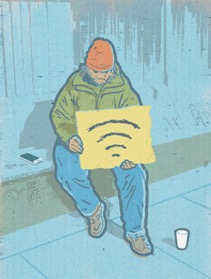
In the article, Mitch compares the technological evolution and spectrum efficiency improvements of fixed microwave, TV, cellular, and private land mobile spectrum. TV spectrum had a huge increase with the DTV transition, called “digital dividend” for good reason in Europe. Similarly, the cellular crowd has had tremendous efficiency improvements also. Fixed microwave, Part 101, once had an mandatory efficiency requirement of 1 b/s, but now has minimum data rates of 2.5 to 4.5 b/s . Private land mobile, Part 90, is stagnating by comparison:
Not until 1992 did the FCC launch a "refarming" program to cut the standard 25-kHz bandwidth to 12.5 kHz, with plans for a further trimming to 6.25 kHz. Twenty years later a lot of 25-kHz equipment is still in use, and the FCC-required implementation of 6.25-kHz equipment is still years away. Users, happy with their inefficient radios, resist government efforts to take them away. In the meantime, the goals of the program have been overtaken by technology. Doubling and quadrupling capacity may have been worth the effort in 1992, but such a target seems almost pointless today. Cellphone systems can carry 10 to 100 times the amount of voice traffic in the same amount of spectrum by using a dense network of towers and taking advantage of digital encoding and data compression.
Part 90 improvement has always been slow because local government licensees are always strapped for funds and use political pressure to press for myopic policies. The spectrum community has been unable to come up with realistic policies that compensate Part 90 users for increased spectrum efficiency in exchange for access to spectrum freed up.
Mitch offers a novel suggestion to break the logjam:
Any solution ultimately has to identify the least efficient or least critical services and redesign them to use less spectrum. Consider, for example, the current situation with two-way radios: 12.5 kHz for a one-way voice channel, with many channels vacant at any given moment. Such radios are indispensable to police, firefighters, and other emergency responders, as well as utility workers, taxi drivers, plumbers, construction crews, and many others. But their collective traffic could be handled in far less spectrum than is being used today. Unfortunately, there's no practical way to improve these devices on their present frequencies, beyond the long-awaited halving of their bandwidth.
We need to offer these people a more efficient alternative while making it more costly for them to use their old equipment. Suppose the FCC gave a nonprofit industry group a few megahertz in which to provide efficient, digital, two-way radio service on an at-cost basis. To be sure, many users would prefer to keep their existing radio gear. But the FCC could make their licenses more expensive and equipment requirements more demanding, while pointing users to the new collective service as a better option.
TV White Space Decision is Released
The FCC discussed and approved this morning the above 2nd Memorandum Opinions and Order resolving questions from the TV white space decision of almost 2 years ago. Oddly, if was released under the hyperbole “FCC Frees Up Vacant TV Airwaves For "Super Wi-Fi" Technologies and Other Technologies”. The document is 79 pages without commissioners’ statements.
Chmn. Genachowski oddly said in his statement, “Today’s Order marks the Commission’s first significant release of unlicensed spectrum in 25 years.” Apparently he overlooked the release of 5 GHz in the 59-64 GHz band (later increased to 7 GHz in 57-64 GHz) in the 12/15/95 Report and Order in Docket 94-124 during his first tenure at the Commission under Chairman Hundt.
The new decision removes the sensing requirement from devices that have geolocation and database access to determine spectrum availability. It keeps the archaic R-6602 definition of where a TV signal is present saying “The current method of calculating TV station contours in Section 73.684 of the rules using the FCC curves in Section 73.699 of the rules is straight forward, well understood and has proven sufficiently accurate over time.” (para. 21) So cities like Monterey, California that are within multiple grade B contours but get little real over-the-air TV service are just out of luck.
It did ease use restrictions near the Canadian and Mexican borders in deference to Native American groups.
It guaranteed at least 2 TV channels in every area for wireless mic use and allows extra use for “Broadway-like” shows and special events if they can show their are no other options.
In response to demands by wireless mic advocates that they get even more spectrum, the Commission stated,
We disagree with those who argue that more spectrum should be reserved for wireless microphones. We observe that wireless microphones generally have operated very inefficiently, perhaps in part due to the luxury of having access to a wealth of spectrum. While there may be users that believe they need access to more spectrum to accommodate more wireless microphones, we find that any such needs must be accommodated through improvements in spectrum efficiency.
NYT: 9 Years After 9/11, Public Safety Radio Is Not Ready
Adm Barnett is quoted telling a Congressional hearing
“For a brief moment in time, a solution is readily within reach. Unless we embark on a comprehensive plan now, including public funding, America will not be able to afford a nationwide, interoperable public safety network.”
Previously, we have described here the analogy to the Eisenhower-era Interstate Highway System where a common network of roads was built by providing federal funding and basic design controls. States did not have to accept the money and hence retained their 10th Amendment rights.
Lest you think I am unkind criticizing industry manipulation of public safety officials, the Times has this quote from Deputy Chief Charles F. Dowd of the New York Police Department’s communications division,
We recently discussed here the media campaign of the National Sheriff’s Association and questioned whether it had a grass roots base or just a few corporate supporters.“The history of public safety is one where the vendors have driven the requirements. We don’t want that situation anymore. We want public safety to do the decision making. And since we’re starting with a clean slate, we can develop rules that everybody has to play by.”
The article ends,
(T)he window to plan a next-generation broadband system is starting to close. “There is nothing that is inevitable about having a nationwide, interoperable system,” Mr. Barnett told Congress this summer. “Indeed, the last 75 years of public safety communications teaches us that there are no natural or market forces” that will make it happen.
This is too important an issue to drag one for another decade or too or to pander to selfserving corporate interests and their pawns in the public safety area.
New GAO Report on Wireless
Noting that FCC already does an annual Wireless Competition Report and has been changing its structure to keep up with the times, GAO also suggests:
FCC could do more to examine whether or not there is effective competition in the wireless industry. By collecting and analyzing more detailed data on industry inputs and outputs that reflect industry dynamics, FCC could better assess competition conditions throughout the industry. Specifically, FCC could collect more detailed data on such issues as prices, special access rates, and capital expenditures and include analysis of that information in its annual report. These metrics help measure the competitiveness of small and regional carriers, can shed light on the impact of switching costs for consumers, and are, therefore, relevant to monitoring competition in the industry. Despite challenges and costs in gathering these data, such information could help FCC better fulfill statutory reporting requirements. With consumers increasing reliance on wireless services as their primary telephone and Internet connection, more is needed to ensure that FCC and the Congress have sufficient information to make policy decisions concerning the wireless industry.
Long time readers may recall multiple discussions here about the need to radically change cellular carrier’s approach to antenna design to make suburban antennas more compatible with their environments. GAO comments on this general topic:
According to many national wireless carriers, tower companies, and other stakeholders with whom we spoke, the most common barrier to building out a wireless network is local zoning policies and procedures which can delay or otherwise hinder the physical construction and improvement of wireless networks. Wireless carriers must generally obtain state and local zoning approvals before building wireless towers or attaching equipment (co-location) to preexisting structures. Although these zoning processes do not always pose a challenge to wireless carriers and tower companies, in some instances they can encumber buildout by denying zoning permits or by making the process for constructing cellular towers and antennas cost prohibitive. Many stakeholders with whom we spoke said that in California, for example, there continues to be significant public concern over the aesthetic and health impacts of wireless infrastructure. As a result, locating wireless facilities can be challenging in cities such as San Diego and San Francisco. Other stakeholders told us that, as wireless networks have expanded into residential areas, residents have raised concerns about aesthetics and safety, making it difficult to provide the capacity necessary to serve the growing demand for wireless services. Washington, D.C., and other cities with unique or historic buildings and skylines can also impose limitations on network build out, such as height restrictions on towers.
Local governments and wireless entities have generally been able to reach agreements on the conditions of wireless network construction, despite the challenges noted above. Some local jurisdictions have developed ordinances specifically for wireless infrastructure in order to make their preferences and requirements clear to carriers and tower companies. Carriers have also developed and adopted a variety of disguising or “stealthing” technologies that help mask towers and other infrastructure. Figure 14 shows a stealth tower in Eureka, California, where the antennas were hidden inside a bell tower on church grounds. In San Francisco, to avoid aesthetic concerns and procedural challenges, wireless carriers have developed Distributed Antenna Systems in recent years. Instead of using large towers or antennas on buildings, these systems involve a series of small antennas, deployed low to the ground, often on utility poles, that together provide wireless coverage.
The NTIA CSMAC Interference Report: An Embarrassment to the President's Spectrum Policies
For reasons discussed below this report is, or at least should be, a major embarrassment to NTIA as it is inconsistent with both the President’s spectrum policies and the charter of the committee. It both evades some major issues and pushes the parochial agendas of some committee members without trying to relate them to the broader public interests.
The White House has said
“(N)ew technologies have the potential to free up spectrum from many of its existing uses. In combination with regulatory changes, new and emerging technologies can facilitate the repackaging, reallocation, and even sharing of spectrum. Reallocating spectrum to its most valuable use promises to be a win-win effort – creating value that not only spurs new innovations and creates new jobs, but also benefits existing spectrum users by allowing them to raise funds for transformative new investments.
This CSMAC report repeatedly takes a negative view towards all innovation and an absolute priority on protecting incumbents. For example on p. 7 it says, “If an incumbent service makes changes to its system’s architecture or modulation technique that results in new interference, then the spectrum to be used to establish any guardband protections should be provided by the service making such changes.” So no matter how outdated an incumbent’s equipment is, no matter how inefficiently an incumbent uses spectrum, no matter how lightly loaded an incumbent’s band is, the burden of protecting the incumbent always falls entirely on the new comer in the mind of CSMAC - which just happens to be dominated by incumbents.
Much of the report echoes the broadcast industry’s view on the database approach to TV whitespace, Docket 04-186. Perhaps not surprising since MSTV’s David Donovan, a lawyer, chaired this group. In private discussions, many CSMAC members observed that much of the long database discussion in the report was aimed at the FCC rulemaking and was irrelevant to the NTIA issues.
One might think that the “Interference Subcommittee” might spend some effort discussing what is “interference”? They dismiss this topic quickly:“Because of the different policy concerns, the Subcommittee makes no judgment as to the appropriate definition of interference that would trigger legal action. Accordingly, we use the term “interference’ in its generic sense.” (p.16)
Hey guys, maybe defining interference in detail is beyond your scope, but how about a few words on whether the current 47 CFR 2.1 definition is workable? What about the FCC view in the Wireless Innovation NOI:
“The viability of spectrum access for new radio services often centers on whether the new service may cause harmful interference to incumbent services. This can lead to delays through protracted rule making proceedings that can create uncertainty and discourage investment. Are there ways the Commission can improve upon this process?” (para. 34)
Does this issue apply to NTIA processes also? Are NTIA harmful interference determinations any faster or more transparent than FCC ones? Will sharing of Government spectrum by technical innovators be that much more attractive than allocations in NG spectrum? CSMAC - the world wonders?
The report was not content at sniping at the TV WSD intruders, it appears Mr. Donovan gave “professional courtesy” to his peers in the cellular establishment since cellular carriers and their allies were also well represented amount the committee members. Thus the report also took a cheap shot at the AWS-3 proceeding saying
•There is widespread consensus on the mechanisms and dangers of creating interference when licensing services that employ different duplexing technologies in adjacent spectrum.
•Industry stakeholders recently demonstrated the risks associated with plans to permit TDD operations in AWS-3 spectrum, without adequate allowances to protect adjacent AWS-1 FDD operations. (emphasis added)
Note the use of the word “stakeholders” here rather than “incumbents”. Don’t the stakeholders in FCC proceedings include also the public who could benefit from new service and the advocates of new service? The use of “stakeholders” in the report draft clearly shows the consistent bias in favor of incumbents. In any case, the demonstration was that referred to is controversial and the issue has not been resolved by FCC almost 2 years later.
Does the Interference Committee have any views at all on whether intersystem interference should be judged always on worst case/“minimum coupling loss” geometry or whether in some circumstances stochastic/probabilistic modeling should be used as it is from time to time in CEPT and ITU studies?
Filters have a big impact on all types of interference other than cochannel interference. Does the committee have any thoughts on whether filters are getting better and how that might impact sharing and guardbands?
Many types of wireless equipment now have a service life of a few years. Should this be taken into account in sharing and guardband determinations as the major cellular carriers have argued that PCS H block entrants can use increased power after existing handsets are replaced with newer models with better intermodulation immunity?
Finally, since this is a report on both interference and DSA, shouldn’t it at least mention the observation of Preston Marshall, formerly of DARPA, that cognitive radios could be designed to select not just idle frequencies but idle frequencies that will not cause interference to receivers with limited interference rejection capabilities that are nearby in frequency and space ?
John Muleta, former Chief of FCC/WTB, and I wrote a statement on this for the CSMAC that received little interest at the meeting in the rush to approve the flawed report. Readers might want to compare it with the report draft and draw their own conclusions. Please tell us what you think.
We will post a link to the final version of the report when it is released.
[MSS has done work for M2Z Networks and Adaptrum, Inc., but this post is not part of that work and is solely the view of MSS.]
Snowe/Kerry Spectrum Bill


U.S. Senators Olympia J. Snowe (R-Maine) and John Kerry (D-Mass.) today introduced the Spectrum Measurement and Policy Reform Act, comprehensive spectrum reform legislation to modernize the nation’s radio spectrum planning, management, and coordination activities.
“This legislation will lay the groundwork to develop a strong and effective 21st century comprehensive spectrum policy that will provide consumers with additional choices, greater innovation, lower prices and more reliable services,” said Senator Snowe. “Our nation’s competitiveness, economic growth, and national security demand that we allocate the necessary attention to current policy shortcomings, and enactment of this vital legislation will help avert the looming spectrum crisis and allow us to continue to enjoy the boundless benefits of spectrum-based services.”
“Our nation’s airwaves are finite resources, and we need to use them as efficiently as possible,” Senator Kerry said. “This analysis will help us empower innovation, encourage competition, and lower prices for emerging technologies nationwide. Steps like this are essential to expanding broadband internet access while providing a platform where entrepreneurs can create new services and generate jobs. We can and should know how our spectrum is being used and do more to encourage more efficient and productive use. We look forward to working with the Administration and the communications community to move forward with this important legislation.”
Senators Snowe and Kerry, senior members of the Senate Committee on Commerce, Science, and Transportation and longtime champions of spectrum reform, designed the bipartisan measure to complement the Federal Communications Commission's (FCC) National Broadband Plan in promoting more efficient use of spectrum and ensuring that the proper framework is in place to meet the future telecommunications needs of the nation. Specifically, the Spectrum Measurement and Policy Reform Act tasks the FCC and the National Telecommunications and Information Administration (NTIA) to perform much needed spectrum measurements to determine actual usage and occupancy rates. This data will assist policymakers and the public in making informed decisions about future spectrum uses. In addition, the bill requires greater collaboration between the FCC and NTIA on spectrum policy and management related issues, implementation of spectrum sharing and reuse programs, as well as more market-based incentives to promote efficient spectrum use; and, sets a deadline for the creation of the National Strategic Spectrum Plan, which will provide a long-term vision for domestic spectrum use and strategies to meet those needs.
----------
Section 4(b)(1) 0f the bill requires NTIA and FCC to identify based on actual surveys:
(A) 120 megahertz below 4 gigahertz worth of close proximity electromagnetic spectrum that is most feasible for spectrum sharing opportunities for commercial and government users;
(B) 120 megahertz below 4 gigahertz worth of close proximity electromagnetic spectrum that is most feasible for spectrum reuse opportunities for commercial and government users;
(C) 120 megahertz below 4 gigahertz worth of electromagnetic spectrum that is most feasible for temporary or dynamic short-term assignment and use;
(D) 120 megahertz below 4 gigahertz worth of close proximity electromagnetic spectrum that is most feasible for spectrum layering opportunities for commercial and government users.
Section 6(b)(2) lets NTIA withhold spectrum from federal users, charge federal users an annual fee based on market value, and allows incentive awards for agencies that allow their spectrum to be auctioned
Section 6(g) creates an IRAC “shot clock” to require IRAC to “ act within 30 days” on certain items.
My sometimes clients at New America Foundation commented:
"We applaud Senators Kerry and Snowe for their forward-looking efforts to promote spectrum access and mobile broadband innovation," said Michael Calabrese, who directs the New America Foundation's Wireless Future Program. "The Kerry-Snowe bill maps a path to opening enormous amounts of grossly underutilized spectrum, especially federal government bands, for licensed, unlicensed and shared access by the private sector."
The more establishment trade organizations have not commented yet on the bill. I will add this comments when available.
FCC and NTIA Leadership BOTH Send Evasive Letters on Key Spectrum Issues
On July 2, Asst. Sec. Strickling replied to IEEE-USA’s May 6 letter urging FCC and NTIA to work together to clarify what is “harmful interference” since this phrase is used repeatedly in the Communications Act and the only formal definition is one recycled for the ITU that is murky in many practical situations. (FCC has not yet responded to this letter.) In practice, drawn out harmful interference determinations by both NTIA and FCC have significantly delayed access to spectrum for new technologies.
Asst. Sec. Strickling seems to agree with the basic premise of the IEEE-USA letter, saying
“NTIA currently works to establish spectrum rights and responsibilities for all spectrum users, particularly with respect to interference and interference protection, whenever, possible and practical. When we are able to do so, the time taken by long drawn-out interference disputes is shortened or eliminated without detrimentally affecting reasonable expectations of all interested parties, promoting greater access to, and more efficient use of spectrum.
But the letter then goes on to reference an NTIA report that is almost 5 years old: Interference Protection Criteria: Phase 1 - Compilation from Existing Sources, NTIA 05-432, Oct 2005 . This report is a good background study reporting mostly on ITU-R recommendations relating to well known systems. The ITU-R recommendations are not generally binding on FCC and NTIA in the usual case of a domestic system sharing with another domestic system, although they are important in the case of satellite systems and systems near the US and Canadian borders.
The report was supposed to be part of the 2 phase study. Five years ago, the report stated:
In the second phase of this study, NTIA will review the relevant federal government policies and practices regarding IPC and recommend regulatory and technical refinements that may improve IPC application’s scope, utility, clarity, or effectiveness.
That is really the question at hand. Asst. Sec. Strickling,
- Does NTIA have schedule for doing this?
- Will NTIA involve the public in this issue?
- Will it work jointly with FCC on this issue?
We are writing to urge you to immediately begin a comprehensive inventory of the use o f radio spectrum by non-federal government licensees and users under the Federal Communications Commission's jurisdiction.
Radio spectrum is a scarce, but valuable resource. As more and more of our communications take place using wireless technology, it is vitally important for us to understand how spectrum is allocated and used. Indeed, gaining a better understanding of how we use spectrum is the first step toward identifying how we can use this resource most efficiently to carry out critical government missions and to help bring more advanced communications services to consumers across the country.

“the general public with access to information about various spectrum bands, including usage and licensee information, mapping and analysis tools, and the ability to browse and download data.”
Chmn. Genachowski,
- Will the “usage” information include information based on any actual observations or just the reformatting of data presently in FCC databases?
- Since cellular carriers do not now report cell site location and coverage data, how will you present CMRS information?
- Current broadcast contours used for Part 73 licensing and used for protection of broadcast spectrum in some contexts are based upon Part 73 propagation models that assure “administrative certainty” for broadcasters but do not realistically portray their actual coverage, will broadcast spectrum use be presented based on these traditional models or based on contemporary readily available propagation models?


 (Does not include readers using RSS feeds.)


![[Valid RSS]](valid-rss-rogers.png "Validate my RSS feed")


