
An Open Letter to David Redl Upon His Confirmation as NTIA Administrator

Congratulations on your appointment and confirmation as Assistant Secretary of Commerce for Communications and Information/NTIA Administrator! NTIA has many responsibilities, but this post will focus on its spectrum management ones - a key issue in our increasingly spectrum-dependent world. On behalf of the President, NTIA administers his jurisdiction for use of the spectrum by federal agencies. But in reality the "elephant in the room" is the Interdepartment Radio Advisory Committee (IRAC) whose origin goes back to the 1920s.
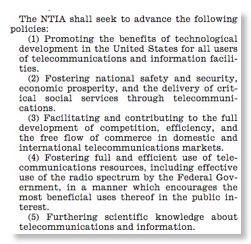
While Title IX of the Communications Act which codifies NTIA's establishment barely mentions IRAC, the role of IRAC is as mysterious are the role of the Politburo in the former Soviet Union. Does IRAC "advise" NTIA or does IRAC actually make most of the decisions with occasional oversight from NTIA when either Congress gets interested or a private sector entity has enough political power?
I would urge you to read Nobelist Ronald Coase's report "Problems of Radio Frequency Allocation" which was written in the early 1960s but suppressed for about 30 years. In particular, I suggest you review the IRAC and FCC discussion on p. 44-72 (pdf p.52-80). While this material was written decades before the creation of NTIA and several years before even the creation of the former OTP, where the late Justice Scalia served, to many of us it is the best description of IRAC practices that exists in the public domain. The report has citations to hearing and reports on spectrum management going back to WWII. It reveals (p. 59, pdf. p. 66) that as early as 1950 legislation was introduced to create an independent agency in the federal government to "formulate plans and policies for the utilization of spectrum".
I was privileged to have a discussion with the late Justice Scalia about 5 years ago on how federal spectrum management worked in OTP days. (There are a few other OTP veterans still active in the field, so I urge you to reach out to them for insight.) While OTP Director Whitehead let IRAC handle many functions, he was willing to and actually did intervene much more than NTIA has in recent decades. In particular, he was willing to call cabinet members directly to get them to reverse positions their agencies had taken in IRAC - generally without knowledge of top agencies officials in a "deep state"-like arrangement.
Of course, Whitehead's White House phone number helped a lot! While the 2012 PCAST spectrum report may be falling out of favor in the current Administration, I urge you to review Section V which is not controversial and particular Recommendation 5.1 on increasing the White House role in spectrum policy:

After the PCAST report there was a slightly increase spectrum policy presence in the White House with the detail of an NTIA middle manager to OSTP. Due to budget constraints, this OSTP specialist was actually paid by NTIA and was expected to return there. The White House needs more of a point person on spectrum policy and this is important enough that person should be independent of BOTH FCC and NTIA.
The NTIA spectrum staff seem to think that they can't really regulate other federal agencies and that no other agency can regulate such agencies in any matter. Let me point out some examples:
- EPA regulates pollution from federal agency activities
- OSHA regulates federal workplace safety
- GSA regulates federal real property (e.g. buildings and land)
- NRC regulates nonweapons related federal use of radioactive material
- OPM regulates federal personnel policies
- NSA regulates federal agency use of encryption
Early in my FCC career I used to periodically attend IRAC meetings and as well as meetings of an interagency committee at NSA that dealt with federal encryption equipment and its use. In both cases the groups were discussing policies that would apply to the agencies present. The key different was that IRAC thought they could make decisions based solely on the consensus of those present and that that broader "public interest" did not explicitly matter since the IRAC members were all public employees! In the NSA group it was clear that NSA was in charge and had a charter from POTUS but wanted to hear and consider the views of affected agencies. BIG DIFFERENCE!
Both NTIA and FCC really are understaffed with people who can do independent technical review of spectrum sharing issues, particularly novel ones. Thus you might want to consider this recommendation from IEEE-USA on creating a new advisory committee to both FCC and NTIA of technical experts without industry ties who can look independently at technical issues of spectrum sharing and interference and suggest possible solutions to difficult problems to both agencies. Since the physics is the same from both G and NG radio signals it makes sense to have on committee serve both and would save money since nonindustry advisory board members must get paid for their time..
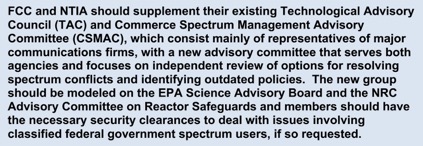
(Note that since this was drafted last year the EPA SAB has changed significantly and has become controversial.
However, the NRC group still has the same structure.)
So Mr. Redl, congratulations and let's hope that you can take an open minded approach to finding a new clarification on the relative roles of IRAC and NTIA in managing spectrum.
Federal Spectrum Reform in the Next Administration
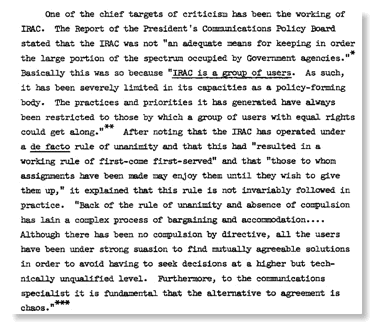
In practice, IRAC has had a major role in federal spectrum policy development and the top leadership of NTIA rarely overrules its decisions. Indeed, having sat in on may IRAC meetings it is clear that in the view of many IRAC members, NTIA is the law firm that represents their views to FCC and Congress and its not a regulatory agency. These members also tend to view the NTIA Office of Spectrum Management as the "IRAC Secretariat" -implementing the will of IRAC and recording the spectrum assignments that it has approved. Indeed a review of the spectrum report coauthored by Nobel laureate Ronald Coase in the early 1960s, "Problems of Radio Frequency Allocation" shows not much has changed int eh decades since it was written. In particular, the section entitled "The Work of the Interdepartment Radio Advisory Committee" may be the most accurate description of how IRAC worked publicly available although there have been some minor changes over the decades. Here is a section from the Coase report:
.
Would the pending MOBILE NOW Act and previously congressionally mandated reallocations of federal spectrum to nonfederal use have been necessary of NTIA and FCC had been working together in the national interest? Do the delays and uncertainties of needing Congress to act on these impose real costs on economic growth? While the cellular industry has the political influence to get legislative support for such reallocations, other spectrum users may not - particularly those in the early stages of their business plans - do not have enough political influence but may have significant economic potential.
The irony is that the congressionally mandated reallocations of the past 2 decades have resulted in antagonisms against reallocation of federal spectrum to non federal government users so requests for access to federal spectrum from less politically connected parties tend to get at best a slow response from NTIA.
I even had a client who was a military contractor who requested brief access to passive spectrum near 100 GHz that had no interference risk to any actual passive systems and the initial application was rejected by NTIA because one IRAC member did like the idea of it. It took a month of a DoD IRAC member beating up on the objecting IRAC member before be finally relented and dropped his objection. It did not appear that during this pendency any NTIA employees ever asked the objecting agency for a "reality check" to see if there was any technical merit to their objection. If this is how they handle requests of military contractors, imagine how privately funded research from non-CTIA members is handled?
Foreign Research on Spectrum Frontiers That FCC and NTIA Block Access To
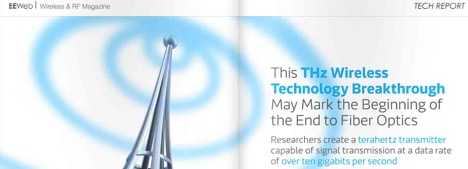
This week Wireless & RF magazine published the above article on terahertz (THz) technology R&D in Japan. While we do not necessarily believe it is now time to sell your Corning stock because fiber optic telecom is doomed, this clearly demonstrates continuing foreign interest in technology that FCC is at best apathetic about and which NTIA has allowed certain IRAC members to discourage.
While the major regulatees who routinely show up on the FCC's 8th Floor have little interest in these frequencies, these same corporations and trade association also showed little interest in Docket 81-413 that ultimately spawned Wi-Fi and Bluetooth and Docket 94-124 that stimulated the R&D that showed the surprising result that mmWave/"spectrum frontier" mobile systems were practical. Thus FCC's mainstream spectrum regulatees can sometimes be myopic and sometimes have "crystal ball" problems.
Lest you think that this article about 275+ GHz technology in Japan is isolated, here is a quote from an ETSI report last year:
“With respect to the aforementioned, the mission of ETSI ISG mWT is to promote the use of millimetre wave spectrum from 50 GHz up to 300 GHz for present and future critical transmission applications and use cases. Moreover, ETSI ISG mWT will focus on enhancing the confidence of all stakeholders and the general public in the use of millimetre wave technologies.”
Here are several other article on foreign R&D above FCC present 95 GHz service rule limit and 275 GHz allocation limit:
- Japanese 120 GHz system used at Beijing Olympics
- Japanese 72-100 GHz components
- Japanese 300 GHz receiver — Note that this article indicates that "A portion of these research results were obtained through 'R&D Program on Multi-tens Gigabit Wireless Communication Technology at Subterahertz Frequencies,' a research program commissioned by Japan's Ministry of Internal Affairs and Communications as part of its 'Research and Development Project for Expansion of Radio Spectrum Resources.' " This confirms direct involvement of the Japanese regulator as part of its "industrial policy" program.
- German 237 GHz outdoor experiment - Note that the authors of this experiment have never revealed the exact upper and lower frequency limits of their transmissions and it is likely that it intruded into a passive allocation. Certain IRAC members routinely try to block such experiments regardless of whether they actually impact passive spectrum use and NTIA has not been assertive in overview of such actions.
FCC is moving ahead on Docket 14-177 on "spectrum frontier" mobile use in 28-71 GHz and that is not an issue here. The problem is that FCC has turned its "blind eye" to all other "spectrum frontier" issues while our foreign competitors are marching full speed ahead.
It gets worse! Google "terahertz spectroscopy" and you will see that there are US made products now being sold above 95 GHz for noncommunications use. A careful parsing of §302a and §2.803 of the FCC Rules reveals that the sale of such equipment is presently legal, however the use of such equipment appears to be a violation of §301 since there are no licensed or unlicensed service rules at these frequencies. The manufacturers of such equipment presently have little concern since EB is easily distracted by other mood swings and is laying off much of its field staff. But sooner or later that will need capital access and will discover what "due diligence" means! Denying such firms capital access will not help US competitiveness. FCC outreach to them will! Do you have to presently be a multibillion dollar industry to get FCC attention? We certainly can recall when Wi-Fi was a tiny industry.
Isn't it time for FCC to pay some attention to upper spectrum especially since 275+GHz allocations are on the WRC-19 agenda?
NTIA Improves Federal Spectrum Use WebsiteBut Real Problems Remain
Check out NTIA’s new & improved spectrum compendium detailing federal spectrum uses. Now with better search tools! http://t.co/5JZ7mfXlwq
— NTIA (@NTIAgov) May 7, 2015With the above tweet NTIA announced a major improvement to its publicly available information on federal spectrum use. The information below from the new page describes the type of information now available:
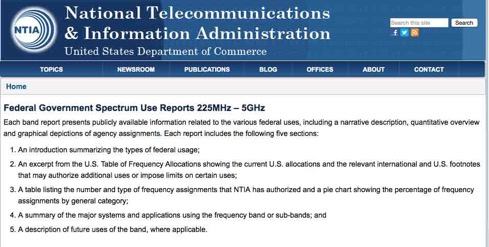
For the bands between 225 MHz and 5 GHz the new site gives details on US allocations, number of NTIA assignments for federal users, and future federal plans for the bands.
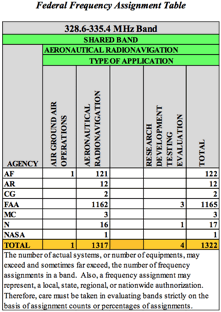
“The number of actual systems, or number of equipments, may exceed and sometimes far exceed, the number of frequency assignments in a band. Also, a frequency assignment may represent, a local, state, regional, or nationwide authorization. Therefore, care must be taken in evaluating bands strictly on the basis of assignment counts or percentages of assignments.”
The reason for this is that NTIA’s record keeping has evolved over decades and in ancient history agencies could get nationwide assignments for an unlimited amount of transmitters in an unlimited number of locations. I recall that the spectrum enforcement site of FCC, the part now slated for a huge staffing cut, has 3 UHF land mobile channels on such a nationwide basis even though I doubt it ever had 300 mobile radios. But in the early days assignments were “free” and even now agencies pay NTIA only for the number of assignments, not the number of transmitters or locations. Clearly many IRAC members do not want this to change so NTIA probably doesn’t have better information on the number of federal transmitters and it many cases does not know where that are.
It is also unclear if these numbers include classified assignments.
What is missing? Those of us who are fans of Benn Kobb’s now out of print, but available on Kindle, Wireless Spectrum Finder, will miss common names for many federal systems, although the section that includes GPS calls it “GPS”.
More importantly, there is no indication on where each assignment is used or how heavily it is used. Much federal spectrum use is outside of urbanized area where there is the greatest demand for new spectrum. Thus having some knowledge, even any knowledge of which bands are used in urban areas and which are more often used in rural areas would be very helpful.
We have criticized NTIA in the past for not publishing spectrum occupancy data in certain bands and we have also printed an apology and correction when NTIA pointed out we missed some data they had published. But the new pages do not contain any links to previously published NTIA data on band occupancy or data from any other sources like the IIT Spectrum Observatory. While it is unlikely NTIA will cite such private sector data, it is puzzling why published NTIA data is not cross-referenced.
Is “sharing is the new normal” more information on intensity of use and general geographic nature of use would be very helpful in improving national spectrum management policy.
While spectrum below 5 GHz is of prime interest in the cellular industry’s endless appetite for more spectrum, spectrum above 95 GHz that presently lacks any FCC rules for commercial use is all shared with federal users and there is no real public data on what is going on there. In order to facilitate commercial evolution in that spectrum we urge NTIA to make some information available on present and planned spectrum uses for federal users and sharing potentials.
But we congratulate NTIA on a positive step forward with the new information.
Comments on House Spectrum White Paper

Your blogger filed comments yesterday on the House Energy & Commerce Committee’s spectrum white paper.
The comments focused on FCC and NTIA reforms that might be accomplished with little or no new legislation - a likely necessity given our dysfunctional Congress now. They explained that not only is FCC slow in authorizing even noncontroversial new technology, it is slow in dealing with interference problems of major industries that need rulemaking action to resolve. They raise the hypothesis that FCC implicitly or explicitly tells even powerful regulatees that its spectrum policy resources are limited so they have to choose between getting new spectrum or getting help cleaning up existing spectrum. Shouldn’t FCC be able to do both?
But FCC probably can’t do both as long as it has only one job stream focused on the 8th Floor. Under Section 5 of the Communications Act FCC has great power to delegate authority to employees or boards of employees - as it did with the former Review Board.
The comments also raise the issue of Section 7 of the Communications Act and the 30 yeas that FCC has ignored it.
Update on PCAST Report on Federal Spectrum & Sharing
Video streaming by Ustream
On Friday, April 4, New American Foundation hosted a distinguished set of speakers on the PCAST spectrum report, including several of its authors. Here is a list of speakers:
- Jason Furman - Chair, President’s Council of Economic Advisors
- Tom Power - Deputy CTO for Telecommunications, White House Office on Science and Technology Policy
- John Leibovitz - Deputy Bureau Chief, Wireless Telecommunications Bureau and Spectrum Advisor to the Chairman, FCC
- Craig Mundie - Member, President’s Council of Advisors on Science and Technology (PCAST) and Senior Advisor to the CEO, Microsoft Corporation
- Mark Gorenberg - Member, President’s Council of Advisors on Science and Technology (PCAST) and Founder and Managing Director, Zetta Venture Partners
- Milo Medin - Vice President of Access Services, Google Inc., and Invited Expert, PCAST
Above is the video of the event. Of particular interest is the talk by Tom Power on implementation of PCAST (00:06:30 - 00:26:00) and an excellent talk by Jason Furman of the economic importance to getting spectrum policy right - a topic rarely discussed. (0:26:34 - 00:53:00).
Your blogger is humbled by the kind words of PCAST member Mark Gorenberg at 01:18:40.
2 Unsual Places Ask for Comments on US Spectrum Policy

The OSTP request was published in February in the Federal Register and announced on the OSTP website on February 14, 2014 in a blog post by Tom Power, U.S. Deputy Chief Technology Officer for Telecommunications. Also released at the same time was a report by the IDA Science and Technology Policy Institute (a “think tank dedicated to OSTP operated by your blogger’s former employer - many years ago - IDA) entitled “A Review of Approaches to Sharing or Relinquishing Agency-Assigned Spectrum”. The request comes from the White House “Spectrum Policy Team”, a sort of virtual recreation of the spectrum functions of the old White House Office of Telecommunications Policy was recommended in the 7/12 PCAST spectrum policy. The team was created by the Presidential Memorandum of 6/14/13 and consists of
The 6/14/13 memorandum told the team to “monitor and support advances in spectrum sharing policies and technologies” and told NTIA to “consult” with the team on various details of implementing the memorandum. Readers may recall that at the time of the memorandum, this blog speculated that the team might be the “adult supervision” that NTIA and IRAC have long needed (in our view) to bring federal agency spectrum policy more inline with national goals. (Up until 1978 spectrum policy oversight was based in the White House and the White House staff served as a check on whether IRAC actions really served national goals. With the creation of NTIA in 1978, the head of NTIA - an assistant secretary of Commerce - lacked the “clout” and direct access to key White House staff to reliably keep agencies in line if they became parochial.)“The Chief Technology Officer and the Director of the National Economic Council, or their designees, shall co-chair a Spectrum Policy Team that shall include representatives from the Office of Management and Budget (OMB), the National Security Staff, and the Council of Economic Advisers. The Spectrum Policy Team shall work with NTIA to implement this memorandum. The Spectrum Policy Team may invite the FCC to provide advice and assistance.”
The IDA report addresses “nine major approaches to providing incentives to Federal agencies to share or relinquish assigned spectrum”. Six of these are market-based approaches, e.g. spectrum fees or agency property rights, while the last three are directed reallocation and sharing approaches. The following chart summarizes the options:
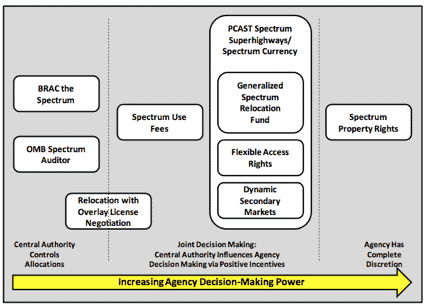
The comment date on this request has now passed and the the comments are now available here. (Due to a clerical error, when this is being posted CTIA’s comments are missing from the consolidated .pdf file this links to. OSTP is aware and working to correct this.) Basically all the comments favor the economic approaches except for Lockheed Martin, a card carrying member of the military industrial complex, who says user fees are bad idea and prefer a “Spectrum Innovation Fund for federal users and says that “incentives to share spectrum must promote the employment of innovative technologies by federal agencies”.
The House Energy & Commerce Committee, presumably the Republican majority given our dysfunctional Congress, released on 4/1/14 a white paper on spectrum policy. The Committee seeks comments saying,“(w)hile the questions posed in this white paper address specific spectrum issues, the committee encourages interested parties to comment on any aspect of spectrum policy. Responses should be submitted to CommActUpdate@mail.house.gov by April 25, 2014.” They are also using the Twitter hashtag #CommActUpdate to stimulate discussion. The white paper deals with 10 basic areas, most with 1-2 questions. Some overlap with the OSTP document, for example “What should be done to encourage efficient use of spectrum by government users?”
The IDA report and OSTP makes interesting reading and are strongly recommended. The House committee questions also are thought provoking. We hope readers will comment on them.
DoD Electromagnetic Spectrum Strategy Release
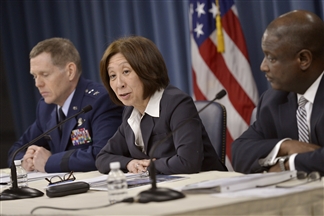
Teri Takai, center, the Defense Department's chief information officer, Air Force Maj. Gen. Robert E. Wheeler, left, the department's deputy chief information officer, and Frederick J. Moorefield Jr., right, the department's director of spectrum policy and programs, brief reporters on the department's release of its electromagnetic spectrum strategy. DOD photo by Glenn Fawcett .
On Thursday February 20, 2014 “The Department of Defense announced … the release of its Electromagnetic Spectrum Strategy (EMS) to increase available spectrum in order to meet growing demand from the commercial wireless industry while maintaining critical military capabilities.” CTIA responded almost immediately with this statement from Steve Largent:
“We agree with the DoD's conclusion that its systems must become more spectrally efficient, flexible and adaptable. In fact, these are good goals for all federal users, and CTIA looks forward to engaging with the DoD, NTIA and the whole federal user community to see how the wireless industry can help them achieve their mission objectives while ensuring that commercial users have access to the spectrum our members need to meet consumer demand and drive economic growth and innovation.”
The first thing we noticed, sort of the “elephant in the room”, was that the report that was released was dated “SEP 11 2013”:
and was actually titled “Electromagnetic Spectrum Strategy 2013 - A Call to Action”. Why this 2013 report was released more than 3 months after it was signed and dated in an unclassified form is a mystery not mentioned in any trade press coverage. Our best guess was that there are a behind the scenes disagreement somewhere within in the Executive Branch or between FCC and NTIA. CTIA’s prompt response indicates that they were not waiting for the report to appear on the DoD website.
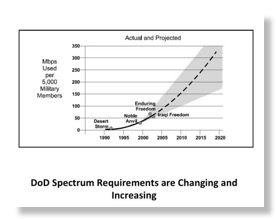
Getting to the actual report, it fully supports the reallocations ordered by President Obama in June 2010 to get 500 MHz of new spectrum to cellular carriers from existing federal and non-federal spectrum. No great surprise.
A key section says:
DoD systems must become more spectrally efficient, flexible, and adaptable, and DoD spectrum operations must become more agile in their ability to access spectrum in order to increase the options available to mission planners. (Spectrum efficiency is the use of the minimum amount of EMS resources necessary to ensure maximum operational effectiveness in fully accomplishing the required mission while taking all practicable steps to minimize impacts to other systems in the EME.Spectrum flexibility and adaptability is the capability of a spectrum-dependent system (SDS) to exploit various opportunities to access spectrum – e.g., multi-band operation, increasing the ability to share spectrum with other systems (domestic or foreign, federal, or non-federal), becoming more tolerant of interference. Agile spectrum operations will enable DoD systems to utilize their flexibility and adaptability to achieve mission success in rapidly changing EMEs.)
In the past, spectrum was a “free good” (except for minor NTIA regulatory fees) for DoD and other federal users and there was no incentive to be efficient as long as enough spectrum was obtainable. Top level attention to spectrum efficiency is thus a good move in the right direction and hopefully NTIA will extend this to other agencies. But the focus in this discussion is making military systems more agile so they can access more bands as they operate around the world.
What is missing is what NTIA Chief Larry Stickling said a few months ago, “sharing is the new normal”. While DoD is implementing White House orders to make spectrum available for the politically (and economically) powerful cellular industry, will DoD be more receptive to sharing proposals in other bands and be less likely to automatically stonewall? We have repeatedly pointed out that 225-400 MHz military use generally is very different geographically than civil use (San Diego being a notable exception) and that with new technology it could be made available to civil users on an “interruptible spectrum” basis, not unlike what is being considered for the 3550-3650 MHz band. Will DoD be receptive to such creative sharing proposals? We hope so but the new policy statement is silent on the issue.
We hope DoD and NTIA will clarify the issue of what is meant by “sharing is the new normal” and specifically whether this is a one way street with respect to military spectrum use in US territory.

Will spectrum sharing in US territory be a one way street for DoD?
UPDATE
See http://www.marcus-spectrum.com/Blog/files/SpecMeasCorr414.html
Sharing Federal Spectrum - New Report

Of particular interest to your blogger was Section VII. Facilitating Sharing: Incentivizing Federal Users. Federal users currently pay a small fee that supports the costs of the NTIA spectrum office. But the fee structure is not well known and is about $150/NTIA assignment. An assignment might be a 25 kHz channel in one city, a communications satellite, or a nationwide system. The fee is the same as NTIA has never been able to work out with the IRAC a better system.
Here is the description of Section VII from the executive summary of the report:
It is widely accepted that until Federal users internalize the costs associated with their spectrum use, they have little incentive to use spectrum more efficiently or support proposals to share their spectrum. If federal users paid for spectrums use, they would internalize the cost associated with holding spectrum assignments that prevent other productive uses of the frequencies.
Recognizing the costs of spectrum through a federal fee would incentivize federal users to adjust their usage to reduce costs. While there are limitations to a fee-based approach, it would require government users to incur some cost for spectrumusage. By imposing a spectrum based fee, the cost of spectrum based services for federal users will reflect the use of this scarce resource. The question is: what should the fee be tied to?
Consistent with the principle that government spectrum users should consider the forgone economic value of spectrum deployed for their services, we suggest that a federal user fee should be based on the commercial value of spectrum. By tying the fee for federal spectrum to spectrum’s commercial price, federal users would be incurring the foregone economic value or opportunity cost of the spectrum in deploying these federal services. A fee based on the commercial value of spectrum would require that federal users at least acknowledge this opportunity cost of the spectrum use and publicly argue that the value of their use of the spectrum exceeds this opportunity cost.
MS Spectrum Observatory: Seeing Things NTIA Doesn't Want to See

In August 2010 we published a post here entitled “Does NTIA Have the Bureaucratic Courage to Measure Occupancy of 225-400 MHz?” At the time we used the following chart to show bands NTIA had measured and publicly reported on and the middle band they had carefully ignored.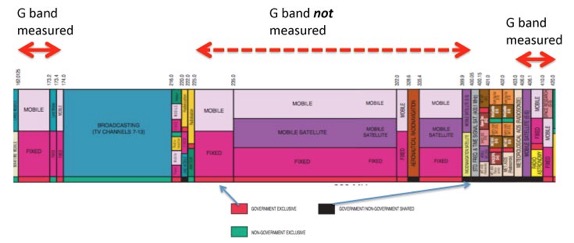
The 225-400 MHz band is home to many federal systems, but is best known for military aircraft communications. In other countries it is used for civilian aircraft communications and in countries where the US has bases, e.g. Japan and NATO countries, there is tenuous sharing. A fact of US geography is that with the notable exception of San Diego there are no large military airfields in major cities. Thus in geography military spectrum use in this band is generally orthogonal to civil needs for spectrum - that is you rarely see a heavy demand for both military aircraft spectrum and civil spectrum users in the same place.
Long time readers may recall that your blogger has been advocating “interruptible spectrum” use here for a long time. Interruptible spectrum is similar to interruptible electricity. One has access to the resource, but can be preempted from time to time when there is great demand for the resource from users with higher priority.
If your view of cellular communications is people calling 911 then this doesn’t make much sense. But all voice communications is a shrinking faction of cellular traffic and 911 traffic must be microscopic. The great growth in demand for mobile broadband is basically for discretionary services, not safety related services. While the cellular community would like to guarantee all users a high quality of service, there frankly isn’t the spectrum available to do so. Other utilities offer pricing schemes to affect demand with approaches like peak pricing in addition to offering interruptible service at a discounted price. The cellular industry just hasn’t been thinking this way.
But similarly NTIA has not been thinking “out of the box” about efficient use of the natural resource at 225-400 MHz despite new White House thinking. The June 14, 2013 Presidential Memorandum -- Expanding America's Leadership in Wireless Innovation stated:
“Although existing efforts will almost double the amount of spectrum available for wireless broadband, we must make available even more spectrum and create new avenues for wireless innovation. One means of doing so is by allowing and encouraging shared access to spectrum that is currently allocated exclusively for Federal use. Where technically and economically feasible, sharing can and should be used to enhance efficiency among all users and expedite commercial access to additional spectrum bands, subject to adequate interference protection for Federal users, especially users with national security, law enforcement, and safety-of-life responsibilities.”
Does 225-400 MHz meet this test of economic and technical feasibility? The lack of official data on its occupancy discourages commercial interest. (Of course the cellular industry’s impossible goal of only getting spectrum that is available 24/7 in all US territory and can use Chinese-made electronics also discourages interest .) There has been some data available in public reports from Shared Spectrum for several years. (See Note 1 below)The following plot was in an early post here.
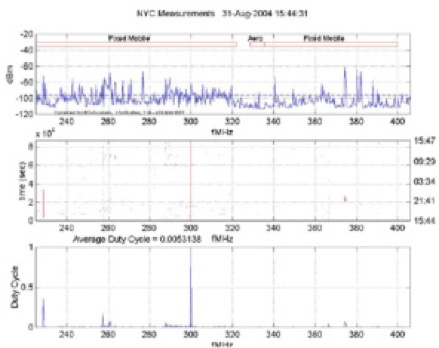
In case the August 2004 date doesn’t ring a bell, this data was taken during the 2004 Republican Convention in New York City 3 years after 9/11 when an unprecedented federal law enforcement and military presence was there to protect national leaders. The third plot shows that spectrum use in 225-400 MHz was negligible despite this high federal presence. Other Shared Spectrum publicly available measurements are at their website and show a similar pattern.
There is also data available from the IIT Spectrum Observatory in Chicago which has been making observations since 2007 and storing them. Unfortunately there is not a simple way for researchers to access this data without making detailed arrangements with IIT.
We recently became aware of another resource, the Microsoft Spectrum Observatory which makes observation between 30 and 6,000 MHz in Brussels, Redmond, Seattle, and Washington DC. Unlike the IIT measurements, these are available for online access to anyone!
So how busy is 225-400 MHz in Washington DC and Seattle? In the 2 charts below I picked for the whole day of 1/21/13 in DC, the day of President Obama’s second inauguration and an exceptionally high federal presence. In the case of Seattle I picked 6/4/13, a day I happened to have been there for a conference which I recall was a bright warm sunny day unlike what one expects in Seattle.
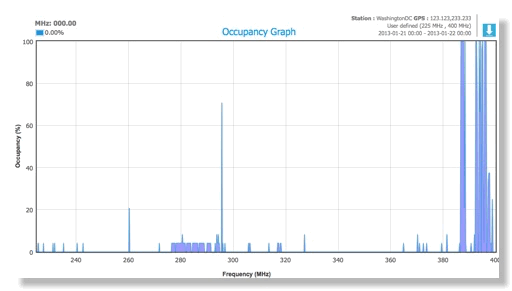
Spectrum Occupancy Washington DC 1/21/13 24 hour data (225-400 MHz)
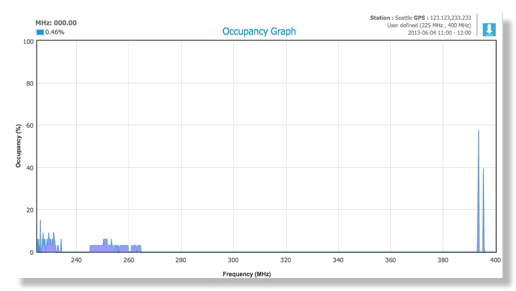
Spectrum Occupancy Seattle WA 6/4/13 1100-1200 (225-400 MHz)
So the cellular industry is not interested in this band because it wants 24/7 nationwide access and the ability to use Chinese-made electronics that meet global standards. Why isn’t FCC and NTIA interested? Repeatedly the problem I hear is that it would complicate the job for DoD spectrum managers stationed overseas who have to explain to our allies why dedicated military channels are needed in this band. The fear is that if DoD doesn’t need 24/7 access to this band in the US, why do they need access in Japan and Europe? This is a real issue but I think it is time to stop holding US spectrum use hostage in order to simplify the job of DoD spectrum managers overseas. The issue here is not reallocating this spectrum to 24/7 commercial use and not using it for 5GHz-like “dynamic spectrum access” that depends on sensing, but rather have a dynamic database system that updates cellular base station in real time which frequencies can be used on a fail-safe basis. Normally base station would have access to much of the band, but as military traffic start building up in an area, blocks would be cleared in anticipation of more traffic so the military traffic would always have what it need plus an additional block of spectrum for rapid surges.

Note 1: There is no detailed generally accepted way to measure occupancy so it is impossible to make precise comparison of measurements. Many decisions have to be made before data is collected and those decisions affect the numbers. Some possible decisions increase apparent occupancy, some decision decrease it. I vividly recall climbing Mt. Fuji in Japan about 15 years ago with my trusty 2m amateur radio. At the top of 12,388' (3,776 m) Mt. Fuji all amateur radio frequencies in the 2m band are fully occupied since the radio horizon includes most of the main island of Honshu! Similarly sensitivity/noise figure, filtering, and 3rd order intercept point decisions affect apparent occupancy. But that said, measurements with very low occupancy show that there is a real issue that should be investigated to confirm or deny whether spectrum is available. Note also that spectrum occupancy measurements usually miss satellite uplink and some downlink transmissions due to their nature. Measurements of full duplex bands with base stations also tend to see the base station downlinks and due to siting can miss the corresponding uplink traffic.
Note 2: How might 225-400 be shared with the private sector? It is clear that any use mobile-based spectrum sharing decision system is not secure enough for the national security uses of this band. Also no listen-before-talk (LBT) cognitive radio system would be reliable enough either. But a base station-based system, typical in today’s cellular systems would place the spectrum selection system in the hands of a few carriers. The carrier spectrum election system could then in turn be controlled in a fail/safe way by DoD spectrum managers to make sure that at a given moment the spectrum is adequate to handle at least (100 + x)% of the authorized DoD traffic. As the DoD traffic approaches the amount set aside for them at a given time in a given area the amount set aside should be increased to maintain a positive margin of available spectrum above demand. Some may argue that the physics of this sharing is similar to the 1755-1850 MHz sharing considered by NTIA’s CSMAC. The D/U ratios discussed there were computed using a primitive propagation that IRAC prefers because it is very conservative. A more balanced consideration of sharing issues under the terms of the 6/13 Presidential Memo would likely give differing answers.
UPDATE
See http://www.marcus-spectrum.com/Blog/files/SpecMeasCorr414.html
Efficient Use of Government Spectrum Act of 2013: NTIA Will Regret Its Silence on AWS-3

CEA immediately praised the new bill with its president and CEO Gary Shapiro, saying:
“This legislation represents an important effort in reallocating our nation’s valuable spectrum for wireless broadband, while raising much-needed funds for the U.S. Treasury. The 1755-1780 MHz band represents key spectrum that our nation’s innovators need to deploy robust mobile broadband networks for the benefit of all Americans.”
Similarly Tim McKone, AT&T Executive Vice President of Federal Relations, said
“AT&T commends Congresswoman Matsui and Congressman Guthrie for introducing legislation that would free up spectrum that is critically important for the wireless industry. While AT&T continues to work with federal agencies and industry on potential spectrum sharing scenarios of government-held spectrum, the economic benefits of an exclusive licensing framework cannot be denied. The wireless industry has invested billions of dollars in infrastructure under this framework. Making the 1755 MHz to 1780 MHz spectrum available for commercial mobile broadband use will not only spur additional investment but will further help fund our nationwide public safety network.”
Oddly, T-Mo, the most obvious beneficiary of this action has been silent to date.
[Note even though AT&T and CEA are praising the new bill, the text is not yet available to mortals such as us. A visit to THOMAS, the Library of Congress website for “the rest of us” at the time of this writing returns the following message:
“The text of H.R.2739 has not yet been received from GPO “]
But this brings to mind NTIA’s silence curing the M2Z/AWS-3 struggle in which M2Z Networks, a former MSS client, sought to solve the idle status of the 2155-2180 MHz band by using it for time division duplex (TDD) operation and leave the federal users in the lower band alone. This proposal was vilified by the cellular industry in general, except for Sprint which was supportive of TDD, and was the subject of a 4.5 year FCC deliberation that was never resolved on either the technical or nontechnical issues pending. Indeed, it ended with a phone call from an FCC staffer to M2Z’s main investor that said though even though over 4 years had elapsed FCC couldn’t decide. The Commissioners never voted on the issue.
NTIA was silent during this proceeding and now probably regrets this silence. Because had NTIA been supportive of the technical issues involved and helped show that careful TDD use of 2155-2180 MHz could have protected T-Mo from its own foolish decision to use handsets made for the European band plan for the US market, NTIA could have helped protect federal users from the hurried expulsion from this band that will result from the new bill. NTIA routinely meddles in FCC spectrum rule makings and, as was mentioned previously here, often uses vagaries of the FCC’s ex parte rules to hide its tracks.
But NTIA probably did want to rile the cellular establishment at the time so they sat idly by while TDD use of the upper band was attacked by almost everyone. Now the hens are coming home to roost and federal users should ask how they got into this hole -- something that was perfectly predictable.
UPDATE
A few days after this post, DoD threw in the towel and agreed to vacate the 1755-1780 MHz band. But, FierceWireless adds:
“However, it's unclear how workable the Pentagon's new offer of a compromise will be. The DoD said that it will cost about $3.5 billion to move its operations out of the spectrum. According to the Wall Street Journal, the Pentagon plans to compress much of its operations into the 1780-1850 MHz band, and will also move some of its operations to the 2025-2210 MHz band, which is currently used by TV broadcasters. However, the Pentagon left many details up in the air, including a timetable for moving off the 1755-1780 MHz band.”
As we pointed out in February, SECDEF Hagel had experience in the cellular industry, -- a point most of the other media outlets missed. While I don’t think Sec. Hagel favored his old comrades over national security, he probably was the first SECDEF to ask the right questions about the military’s voracious appetite for spectrum and about whether this was the band to fall on your sword for Maybe we see more in his memories in 10 years.
The text of HR 2739 is now available for “the rest of us”.
Busy Day in Federal Spectrum Management

Among the findings:
- Since 2009, the percentage of American homes reached by high-speed broadband networks have more than quadrupled (from less than 20% to more than 80%) and average broadband speeds have doubled.
- Between 2000 and 2010, the percentage of American households with a home connection to broadband has surged from 4.4% to 67%.
- Annual investment in U.S. wireless networks grew more than 40% between 2009 and 2012, from $21 billion to $30 billion.
In reply to CTIA’s accusations in dueling spectrum charts, the report makes the following statement:
In comparison to other nations, the United States ranks among the top countries in current licensed spectrum available for mobile broadband, and while we cannot predict the amount of spectrum freed by the incentive auctions, this forthcoming spectrum — combined with Federal repurposing — are likely to keep the United States well atop other nations in mobile broadband allocation.
And now the White House adds a new spectrum chart that alleges to show
USA #1!
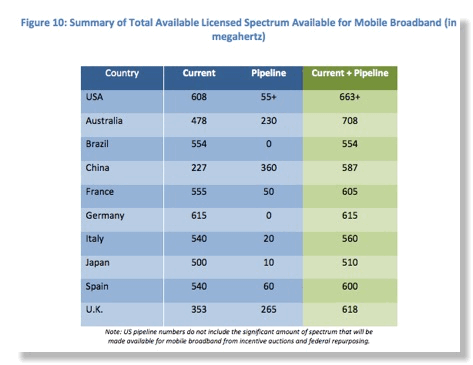
Now why does the current CTIA “flag chart” show the US as having 409.5 MHz of spectrum while the White House finds 608 MHz is a little mystery as neither side shows their raw data. A minor quip: we showed here in March raw data from Japan that added up to 501.2 MHz for Japanese commercial mobile wireless spectrum, yet the White House chart gives 500 MHz, close but not what your blogger documented with detailed data straight from Japan.
Why don’t both the WhiteHouse/FCC/NTIA and CTIA release the raw data that backs up their numerical spectrum claims? This would end the dueling spectrum chart issue so we can focus on substance.
The report also continues to talk about spectrum sharing, a topic that the cellular establishment dismisses in their quest to maximize use of Chinese electronics that meet 3GPP standards. However, most sharing mechanisms involve decision making at the base stations, NOT in the mobiles. So whatever complexity is involved is not int he mobile which is all CMRS architectures are really slaves to the orders they receive from base stations.
Also released was a Presidential Memorandum to Executive Branch agencies on “Expanding America's Leadership in Wireless Innovation”.
This memorandum creates a “Spectrum Policy Team”. The Chief Technology Officer and the Director of the National Economic Council, or their designees, will co-chair a Spectrum Policy Team that shall include representatives from the Office of Management and Budget (OMB), the National Security Staff, and the Council of Economic Advisers. The Spectrum Policy Team will work with NTIA to implement the memorandum and may invite the FCC to provide advice and assistance.
This appears to be the implementation of Recommendation 5.1 of the PCAST spectrum report that was belittled by the cellular establishment because of its sharing recommendations. (Trivia note: the PCAST report recommended a ‘Spectrum Management Team (SMT)” and we see that in the implementation it became a “Spectrum Policy Team”. Not clear if the semantic difference is important.)
Hopefully this means NTIA and IRAC will get more “adult supervision” than they have been getting in the past in order to focus on national priorities, not necessarily the priorities of the individual IRAC member agencies.
The Memorandum also directs NTIA “in consultation with the Spectrum Policy Team” to produce
“a plan directing applicable agencies to provide quantitative assessments of the actual usage of spectrum in those spectrum bands that NTIA previously identified and prioritized in its Third Interim Report and such other bands as NTIA and the Spectrum Policy Team determine have the greatest potential to be shared with nonfederal users.
As mentioned previously, NTIA and the IRAC members have zero interest in quantifying the actual use of 225-400 MHz in urban areas. We hope that the Spectrum Policy Team will include this band as one that should be quantified.
The Memorandum directs NTIA to “conduct a pilot program to monitor spectrum usage in real time in selected communities throughout the country” and “to require that each agency's regular reviews of its frequency assignments include a quantitative assessment of its actual usage of spectrum under such assignments”.
Part of the Memorandum is nonbinding “advice” to FCC, an independent agency:
Performance Criteria for Radio Receivers. The FCC is strongly encouraged, in consultation with NTIA, where appropriate, the industry, and other stakeholders, to develop to the fullest extent of its legal authority a program of performance criteria, ratings, and other measures, including standards, to encourage the design, manufacture, and sale of radio receivers such that emission levels resulting from reasonable use of adjacent spectrum will not endanger the functioning of the receiver or seriously degrade, obstruct, or repeatedly interrupt the operations of the receiver. In developing such a program, the FCC is strongly encouraged to give due consideration to existing policies and prudent investments that have been previously made in systems, including receivers. In its consultation with the FCC, NTIA shall provide information regarding Federal receiver standards and agency practices under those standards.
As previously discussed here, NTIA for over 20 years has been condoning FAA’s unwillingness to implement ICAO receiver immunity standards for ILS receivers that greatly impact FM broadcasting licensees. The hard technical part of receiver standards is creating the standard. But int he case of ILS receiver standards that was done in a multistakeholder process manage by the former CCIR (now ITU-R) and ICAO in the 1990 time frame. But the really hard part is really recognizing the economic externalities involved: in many cases the party that has to buy the improved receiver is not the one who gets the benefit. This is why AOPA vehemently opposes ILS receiver regulation.
NTIA and FAA have been publicly silent on this issue for a long time. “What’s fit for the goose, is fit for the gander.” As part of this reexamination of receiver standards FAA and NTIA should publicly state what they think the issues are with respect to implementation of the ICAO ILS receiver standard and what action, if any, they plan to take.
Finally NTIA and NIST announced plans to establish a National Center for Advanced Communications in Boulder, Colorado. The two agencies recently signed a Memorandum of Understanding (MOU) to collaborate on the establishment of the center. The MOU states that the center will leverage the “critical mass of NIST and NTIA research and engineering capabilities concentrated in Boulder” to form a “unique national asset,” and includes the infrastructure and collaborative environment needed to address a wide range of advanced communications challenges. This joint effort will increase the impact of existing efforts already under way in both agencies.
It is ironic that the present ITS was part of NIST’s predecessor, NBS, until NTIA was created in 1978. ITS, basically a contract research operation for other agencies with little funding of it own, was split from the collocated NBS/NIST in order to give a critical mass to what became NTIA when the last of the Office of Telecommunications Policy was moved out of the White House in Executive Order 12046. This with the creation of the Spectrum Policy Team and the ITS/NIST collaboration a key impact of yesterday’s actions is a move to start to undo the changes of 1978 which in retrospect were not successful.
UPDATE
On this busy day there was conference at Georgetown University entitled “"Optimal Coevolution of Mobile Broadband Technology and Spectrum Policy”. The conference was rather one sided focusing on the concerns of the cellular interests and their usual demands for more spectrum and reallocation vs. sharing. However, several of the speakers discussed the Executive Branch releases of the day. Introduction is below. All videos are here.
UPDATE 2
See http://www.marcus-spectrum.com/Blog/files/SpecMeasCorr414.html
FAA's Spectrum Management Activities May Be Getting "Adult Supervision"
If you’re sitting on a plane at the gate and reading this column on an electronic gadget, you’re about to hear eight dreaded words: “Please power down your electronic devices for takeoff.” But this time next year, you might hear something very different: “Please put your devices on ‘airplane mode’ for takeoff.”

In a phone interview, Ms. McCaskill said she had grown frustrated with the F.A.A.’s stance on devices after she learned that the agency now allows iPads as flight manuals in the cockpit and has subsequently given out devices to some flight attendants with information on flight procedures.
“So it’s O.K. to have iPads in the cockpit; it’s O.K. for flight attendants — and they are not in a panic — yet it’s not O.K. for the traveling public,” she said. “A flying copy of ‘War and Peace’ is more dangerous than a Kindle.”

Now maybe if NTIA were more aggressive with FAA in asking it to justify their spectrum management decisions this mess might never have happened. Perhaps if the recommendations of Chapter 5 of the PCAST spectrum report were implemented there would be more accountability by all federal agencies for their spectrum management decisions.
Thanks, Mr. Akin!
NY Times: "The F.A.A. has no proof that electronic devices can harm a plane’s avionics, but it still perpetuates such claims" "Dealing with the F.A.A. on this topic is like arguing with a stubborn teenager"
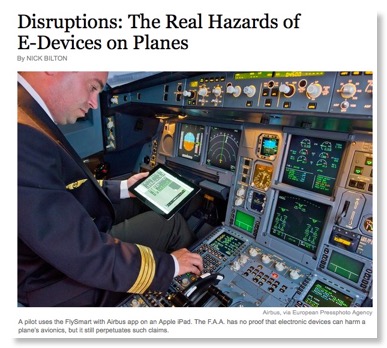
Readers may recall that SpectrumTalk has repeatedly talked about the FAA’s renegade role in spectrum management: apparently not happy that Congress has split spectrum management between FCC and NTIA (with some international issues at State), FAA likes to impose itself as another coequal player in national spectrum management. Meanwhile NTIA for decades, glowing in its power derived from Section 305 of the Communications Act, has lacked the moral backbone and institutional authority to keep FAA in line with respect to national spectrum policy issues.
Recently the NY Times published the article whose heading is shown above. Here is a quote:
Dealing with the F.A.A. on this topic is like arguing with a stubborn teenager. The agency has no proof that electronic devices can harm a plane’s avionics, but it still perpetuates such claims, spreading irrational fear among millions of fliers.
A year ago, when I first asked Les Dorr, a spokesman for the F.A.A., why the rule existed, he said the agency was being cautious because there was no proof that device use was completely safe. He also said it was because passengers needed to pay attention during takeoff.
When I asked why I can read a printed book but not a digital one, the agency changed its reasoning. I was told by another F.A.A. representative that it was because an iPad or Kindle could put out enough electromagnetic emissions to disrupt the flight. Yet a few weeks later, the F.A.A. proudly announced that pilots could now use iPads in the cockpit instead of paper flight manuals.
Now FAA likes to say that the problem is “aggregation” - the impact of many emitters operating at the same time. But the real problem of aggregation comes from faulty technical analysis of the spectrum problems.
While aggregation can happen in some scenarios, e.g. terrestrial transmitters operating cochannel with a satellite uplink, real multipath propagation - as happens in most scenarios int he real world - results in lognormal propagation path losses in one or two emitters dominating the interference scenario and the others having no impact.
The Times points out that In December both FCC Chairman Genachowski and Senator Claire McCaskill (D-MO) both urged FAA to be more rational with respect to use of devices on aircraft. Sen. McCaskill even wrote that she was “prepared to pursue legislative solutions should progress be made too slowly.” She said she was urging the agency to embrace the use of electronics, including laptop computers, e-readers, smartphones and other devices, “during the full duration of a flight.”
“The current rules are inconvenient to travelers, don’t make sense and lack a scientific basis,” she said in the letter. “Airline employees have the incredibly important job of keeping us safe in the air. Their efforts are better spent worrying about rules that actually accomplish that goal.”
FAA likes to say that it is only obsessed with safety - an admirable goal if true. However, the sordid history of the FM/ILS affair also shows that FAA is just as concerned about the proprietary interests of “its constituency” - the airlines and AOPA - than it is of safety issues. Also the FAA’s bizarre 2006 NPRM, never coordinated with either FCC or NTIA, that proposed giving the agency veto power over both federal and nonfederal spectrum use in dozens of bands shows a fundamental misunderstanding of the public interest in spectrum.
So kudos to NY Times for their great coverage of this issue. When will NTIA and Congress pressure FAA to start acting more rationally on spectrum matters?
GAO Report on Spectrum Sharing
GAO writes,
While federal spectrum users often share spectrum among themselves, they may have little economic incentive to otherwise use spectrum efficiently, including sharing it with nonfederal users. From an economic perspective, when a consumer pays the market price for a good or service and thus cannot get more of it without this expense, the consumer has an incentive to get the most value and efficiency out of the good as possible. If no price is attached to a good—which is essentially the case with federal agencies’ use of spectrum14—the normal market incentive to use the good efficiently may be muted. (p. 11)
Actually while it is true that “federal spectrum users often share spectrum among themselves”, this is mostly due to pressure from Congress and OMB, not so much from NTIA leadership or the collective interest of federal agencies who generally would just like to have their own systems regardless of financial or spectrum efficiency. But the availability of “free spectrum” has warped the decision making process in federal agencies since the marginal cost of spectrum is always less than the marginal cost of more efficient technology.
Echoing the findings of the controversial PCAST report, GAO writes
We have previously reported that to improve spectrum efficiency among federal agencies, Congress may wish to consider evaluating what mechanisms could be adopted to provide better incentives and opportunities for agencies to move toward more efficient use of spectrum, which could free up some spectrum allocated for federal use to be made available for sharing or other purposes.
The report ends with 3 recommendations for FCC NTIA action:
• Report their agencies’ views and conclusions regarding spectrum usage fees to the relevant congressional committees, specifically with respect to the merits, potential effects, and implementation challenges of such a fee structure, and what authority, if any, Congress would need to grant for such a structure to be implemented.
• Based on the findings of current research and development efforts under way, determine how the federal government can best promote federal and nonfederal investment in the research and development of spectrally efficient technologies, and whether additional spectrum is needed for testing new spectrum efficient technologies.
• Evaluate regulatory changes, if any, that can help improve and expedite the spectrum sharing process.
Will this report have a major impact on spectrum sharing? Probably not. But this report adds to the weight of the PCAST report with respect to the problems of federal spectrum management. These problems arise not from the lack of public interest in the NTIA staff and IRAC membership, rather than the fact that the present 1978 NTIA structure is unrealistic in view of the current demands for spectrum from all public and private parts of our society and economy and the new technical options for sharing that just were not even a pipe dream when the 1978 framework was put in place in the Carter Administration.
Spectrum Policy for National Government Users: A Worldwide Policy Challenge

National governments around the world are generally large scale spectrum users for their military and civil governmental operations. Today, many governmental functions are spectrum intensive due to the increasing mobility and use of information in today’s societies and economies. The civil functions range from air traffic control to public safety operations to fixed and mobile wireless networks to support other functions that are key to toady’s societies. The spectrum resources that are used for such governmental functions are generally not available for private sector users, although some sharing is possible in classic spectrum policy. National government spectrum use is a difficult regulatory issue because the very same national government that is using such spectrum includes the regulator that sets the rules for private sector use. In many countries military authorities play a key role in national spectrum management.
Spectrum is generally fungible for national government and private sector use and is a key input to wireless systems that have a large impact on national economic growth which in turn impact national government revenues. This article will explore the policy challenge of regulation national government spectrum use and discuss a recent US report on the issue.
Different countries have chosen different mechanisms for balancing national government and private sector spectrum use. In Japan, the Ministry of Internal Affairs and Communications (MIC) is the unitary regulator of all spectrum use and consistent with the Japanese style of government deals with other agencies on a somewhat distant basis. In the US, spectrum policy responsibility is split between the independent Federal Communications Commission (FCC) with jurisdiction over private sector and local government use and the executive branch’s National Telecommunications and Information Administration (NTIA) with jurisdiction over national government use. In the United Kingdom the Office of Communications (Ofcom) has responsibility for the “communications sector” while the national government, acting through a little known official committee of the Cabinet Office, the UK Spectrum Strategy Committee (UKSSC), has responsibility for national security and public safety spectrum use.
In the UK, the government has stated that “public bodies will acquire spectrum through the market, with administrative assignment by Ofcom only being made in exceptional cases” and that “(t)he Government is committed to paying administered incentive pricing (AIP) on its spectrum holdings”. (AIP is an estimate of spectrum value based on spectrum scarcity and other factors. ) In the US and some other countries, national government spectrum users pay a small fee for spectrum use that is calculated only on NTIA’s administrative costs and is independent of free market spectrum value. Thus the UK is unique in the world for its progress in treating spectrum use by the national government basically on the same economic terms as private sector use. While this may seem unusual to people who have dealt with spectrum for a long time, national governments around the world generally pay market prices from other key resources and products they use ranging from electricity to fuel to vehicles to land.
In July 2012 the US President’s Council of Advisors on Science and Technology (PCAST) released a report on national government spectrum use policy entitled “Report to the President: Realizing the Full Potential of Government-held Spectrum to Spur Economic Growth” . Parts of this report has been very controversial within the US because it advocates limiting previously planned reallocations of national government spectrum to commercially-operated mobile broadband systems and focusing on accommodating commercial spectrum use on increased sharing of spatial and temporal bands by national government users and private sector users. But in addition to this controversial recommendation there are several other recommendations that have received little attention and may be applicable to situations in other countries.
The report finds that “(t)here is no incentive system today for Federal (national) Government agencies to be efficient in their use of spectrum or to share spectrum allocated to them with the non-Federal (private/local government) sector” and recommends that the “essential element of this new Federal spectrum architecture is that the norm for spectrum use should be sharing, not exclusivity.” Because much national spectrum use is different in temporal and geographic characteristics than much of the other use, it finds that sharing will be possible in many cases with the provision that non-national government users must change their spectrum use temporarily when and where there is a surge of national spectrum use, for example during military training exercises.
The report recommends that national government agencies using spectrum should be given incentives to decrease their spectrum use because increased spectrum availability for the private sector has real economic benefit. Generally government entities are subject to strict budget constraints that make it difficult to impossible to explore system design changes to existing systems that could lower their spectrum requirements. While US already now provides for agencies to be reimbursed for the cost of moving to new bands, the cash flow of agency expenditures to plan and implement such a change and the reimbursement to the agency do not match well in terms of timing and amounts.
The report suggests creating a revolving Spectrum Efficiency Fund that “recycles private sector payments for use of Federal spectrum into reimbursements to Federal agencies for investments that facilitate spectrum sharing and enhance spectrum efficiency. Congress should allow the Fund to reimburse qualifying costs by any Federal service, not just those in revenuegenerating bands.”
The new fund would not have the cash flow limitations of the present scheme that discourage agency investments in planning studies and small scale tests of new technology since they can not be reimbursed presently until the spectrum has been auctioned to private users – possibly years later. The report goes further in recommending a major accounting change to facilitate agency changes that make more spectrum available to others:
“Spectrum currency is our name for a synthetic currency that would give agencies a means to identify the opportunity costs associated with their use of spectrum and to obtain benefits by sharing or vacating some parts of their assigned spectrum and provide a way for them to “buy” their spectrum usage rights and reduce their spending by improving spectrum efficiency…To turn their gains in efficiency to practical advantage, agencies desiring to accelerate their transition to the new scheme could use their spectrum currency to bid every year for equipment credit from the Spectrum Efficiency Fund … that would enable them to increase their service quality.”
The UK has led the way in holding national government spectrum users more accountable for their spectrum use through the pricing of spectrum for most government and private spectrum users. The recent US PCAST report explores new options to try to balance the equities of national government and private sector spectrum use. These will generally be controversial in each country and it is important that the technical wireless community become familiar with the issues involved in order to contribute to national deliberations on what is the best approach for each country.
Frequencies Above 95 GHz: Why Not Declare that Section 7 Presumably Applies in Order to Stimulate US Innovation and Economic Growth?
135 GHz antenna developed by Singapore
government lab and announced last week
(The fact that this antenna looks so unusual is an
indication that technology at this band is very
different and conventional regulatory thinking
may be inappropriate.)
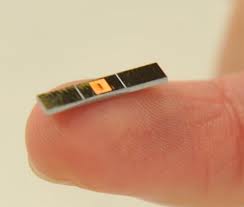
Almost on cue from my 8/25/22 post on moving the upper limit of FCC radio service rules above 95 GHz, RF Globalnet published on 8/28/12 a post entitled “A*STAR's IME Develops Smallest Antenna That Can Increase WiFi Speed By 200 Times”. A*STAR is the Singapore Agency for Science, Technology and Research, the “lead agency for fostering world-class scientific research and talent for a vibrant knowledge-based and innovation-driven Singapore” - somewhat of a combination of the US’ NSF and national laboratories (e.g. Argonne National Lab) in a state capitalism industry model. (Original A*STAR press release)
The RF Globalnet article reported (in Singapore/Commonwealth spelling):
Researchers from A*STAR’s Institute of Microelectronics (IME) have developed the first compact high performance silicon-based cavity-backed slot (CBS) antenna that operates at 135 GHz. The antenna demonstrated 30 times stronger signal transmission over on-chip antennas at 135 GHz. At just 1.6mm x 1.2mm, approximately the size of a sesame seed, it is the smallest silicon-based CBS antenna reported to date for ready integration with active circuits. IME’s innovation will help realise a wireless communication system with very small form factor and almost two-thirds cheaper than a conventional CBS antenna. The antenna, in combination with other millimetre-wave building blocks, can support wireless speed of 20 Gbps – more than 200 times faster than present day Wi-Fi, to allow ultra fast point-to-point access to rich media content, relevant to online learning and entertainment.
So the Japanese have a product prototype at 120 GHz that they used at the Olympics 4 years ago and a Singapore government lab is developing 135 GHz commercial technology. Where do US firms stand? There is some interest among US firms in this area. The US-based IWPC MoGig group includes several US entities such as AT&T and Northrop Grumman. But a rational “due diligence” assessment of regulatory risk by anyone wanting to invest in R&D in these bands would lead to great regulatory uncertainties at present:
- Only experiment licenses are possible with no guarantee of renewal or expectation of protection
- Unlicensed use is impossible
- The legality of equipment sales is questionable
- The time for FCC to respond to a waiver request or a petition for rulemaking to permit a specific product to be sold and used in these bands is in the multiyear range and the need for NTIA coordination (all these bands are G/NG shared) is complicated since there is no public information on federal government uses or requirements in these bands other than radio astronomy and passive sensing
Recall the words of Comm. Pai in his maiden speech at CMU in July:
I’ve met with those in the private sector who decide whether to make investments and to create jobs and have asked what’s holding them back. The principal answer that I have received has been remarkably consistent, and it can be summed up in two words: “regulatory uncertainty.”
Some of the factors that contribute to this uncertainty fall outside of the FCC’s jurisdiction, such as taxes, health care, and financial regulation. But concerns are expressed regarding the FCC in two general ways. The first involves inaction, or delayed action, by the Commission. At first blush, it may seem odd for those in the private sector to be complaining that its regulator is moving too slowly. Entrepreneurs are usually happy to be left alone, free to innovate without government intervention.
But the communications industry often doesn’t fit that stereotype given the FCC’s pervasive role. If a company wants to market a new mobile device, it needs the FCC’s approval. If a company wants to purchase another firm’s spectrum licenses, it needs the FCC’s approval. If a company wants to provide a new wireless service, it needs the FCC’s approval. And if a company finds that there isn’t any spectrum available and proposes the reallocation of inefficiently used spectrum, it needs the FCC’s approval.

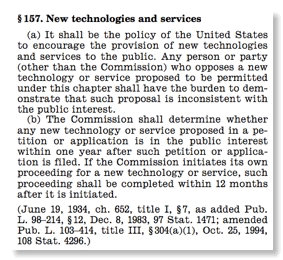
Comm. Pai has the same understanding of Section 7 that I have:
“Looking at that provision, the message from Congress is clear: The Commission should make the deployment of new technologies and new services a priority, resolving any concerns about them within a year.”
It is interesting to read Section 7(a) (47 USC 157(a)) in the light of the FCC/NTIA Section 301/305 dichotomy and in view of the fact that any action in these shared bands de facto requires NTIA concurrence. Without the benefit of any formal legal education, let me state that the policy provisions of Section 7(a) applies to both FCC and NTIA. Further, the requirement that
Any person or party (other than the Commission) who opposes a new technology or service proposed to be permitted under this chapter shall have the burden to demonstrate that such proposal is inconsistent with the public interest.
would indicate that NTIA (and IRAC) is a “person or party other than the Commission” and thus has “burden to demonstrate that such proposal is inconsistent with the public interest”.
But here is a humble suggestion:
Why don’t FCC and NTIA jointly declare that any proposed private sector use of frequencies greater than 95 GHz will be presumptively treated as a “new technology or service” and that FCC and NTIA will both strive to meet the 1 year deadline of section 7(b) and the burden tests of Section 7(a)? Further, why doesn’t FCC use the same “shot clock” for tracking such actions as it already uses for corporate mergers where there is no statutory deadline?
Benefits? Stimulating innovation and economic growth and bringing FCC into compliance with this neglected section of the Act.
On Moving the Upper Frontier of Commercial Spectrum Use

In the August 2012 issue of IEEE Wireless Communications is the above article by your blogger. The article starts
International spectrum allocations of the International Telecommunications Union (ITU) now go to an upper limit of 275 GHz. The upper limit of actual production commercial equipment appears to be in the 80 GHz range in the millimeterwaves or “mmW” region (30-300 GHz). While these upper frequencies have been often associated with fixed and satellite uses, the emergence of IEEE 802.11ad/WiGig mobile standards at 60 GHz and interest in broadband mobile applications above 100 GHz shows that many different uses may now be possible.
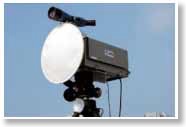
The initiation last year of the new IEEE Transactions on Terahertz Science and Technology shows that basic technology is moving on somewhat independent of lagging spectrum regulation. In addition, a technical highlight of the 2008 Beijing Olympics - ignored by the general press - was the use of 120 GHz point-to-point terrestrial links for high definition video distribution from venues to a central site and showed the potential for commercial spectrum use in presently virgin upper spectrum.
120 GHz Japanese system used at Beijing Olympics
Isn’t it time FCC start removing at >95 GHz such barriers to innovation and the necessary capital formation for it?
There are some valid issues of sharing these bands with existing passive allocations for radio astronomy and remote sensing as well as active federal government systems, but these make it more important that FCC give guidance to industry on how to commercialize these bands while protecting the other allocations. The nature of propagation at these bands as well as the ease at which narrow beam antennas can be used means that the concepts of spectrum regulation used at lower bands are not necessarily applicable and sharing is much more feasible.
IEEE-USA Harmful Interference White Paper
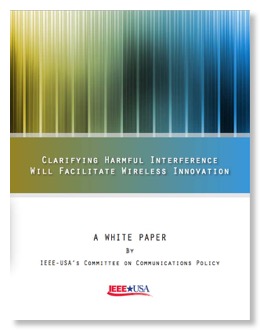
The document shown at right, a white paper entitled “Clarifying Harmful Interference Will Facilitate Wireless Innovation“, was released this week by IEEE-USA and was drafted by its Committee on Communications Policy. Here is the executive summary:
In recent years, many of the spectrum policy controversies in the United States have dealt with the basic issue of whether a proposed technology or service will cause “harmful interference” to existing spectrum users. Resolving these issues has typically taken several years in an era where technology is moving at “Internet speed.” As the Federal Communications Commission (FCC) discussed in its Wireless Innovation Inquiry, the delays and lack of transparency associated with making go/no go determinations on harmful interference may be discouraging private investment in the development of innovative wireless technology.
This White Paper reviews the background of what is harmful interference and suggests incremental ways in which the two spectrum management agencies in the United States, the FCC and the National Telecommunications and Information Administration (NTIA), could clarify the definition by giving guidance on the sub-problems associated with harmful interference determinations. Changing the definition is probably impractical, due to the long list of precedents over decades that have been built on the current definition, even though it is not established by statute.
The White Paper also suggests that establishing timeliness goals similar to those voluntarily created by the FCC for equally complex and voluminous merger and acquisition reviews could also address the disincentives for private capital formation in the wireless technology area. Such timeliness goals could create a more “level playing field,” with respect to other technical areas concerning private funding of technical development.
White House Advisory Committee Recommends Major Changes to Federal Spectrum Use
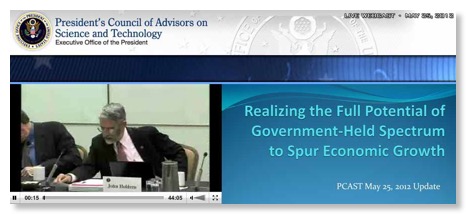
At its May 25th meeting the President’s Council of Advisors on Science and Technology, a White House advisory committee of top technical experts, endorsed a report from a subcommittee entitled “Realizing the Full Potential of Government-Held Spectrum to Spur Economic Growth”. The text of of the report has not been released to the public pending final editing and delivery to the President. However, there was a presentation at the PCAST meeting and below are two “slides” from the presentation.
The first slide to be discussed is below:
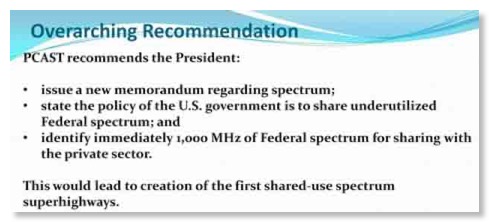
Its second point is to “state the policy of the U.S. government is to share underutilized spectrum”. It is pretty clear that that is not the present policy. I recall that during the drafting of the Spectrum Policy Task Force Report the NTIA staff had a temper tantrum on even mentioning that “interruptible spectrum” sharing of low average utilization federal spectrum might be considered. All reference to the topic in the context of federal spectrum was scribed from the report!
IRAC traditionalists will also not be very pleased with the 3rd point on sharing 1000 MHz with the private sector. I hope the report indicates that this can not be resolved by sharing 97-98 GHz!
Clay T. "Tom" Whitehead

The report recommends creating a “White House-based Spectrum Management Team” of senior Administration officials to work with NTIA. This would be a move in the right direction to give real Silicon Vally-style “adult supervision” to IRAC - the group that makes most spectrum management decisions without much accountability to anyone.
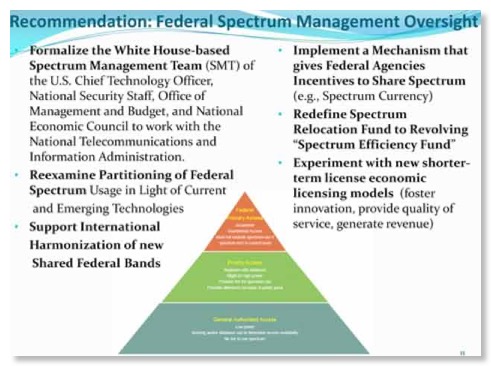
The report also recognizes the at present agencies have no incentive to cooperate with sharing and to be early adopters of sharing concepts. Thus it proposes to reward such early adopters in the budget process.
The report seems very promising and we look forward to seeing the actual text. Hopefully it won’t get lost in election year politics.
Spectrum Provisions in P.L. 112-96
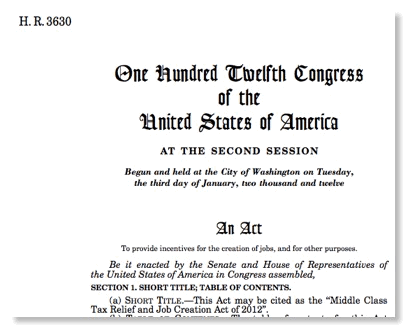
On February 22 President Obama signed the Middle Class Tax Relief and Job Creation Act of 2012 (P.L. 112-96) into law. Despite its name, this 101 page bill is one of the more significant pieces of legislation in the spectrum area in several years.
While trying to solve the budget crisis and the economy, Congress could time to give gifts to its favorite industries. One provision that has attracted little attention is Section 6409 which Don Evans at CommLawBog describes as
a small measure of relief in the on-going struggle to get tower modifications approved and constructed. Buried in a collection of odds and ends dumped, seemingly as afterthoughts, at the end of the law, Section 6409 requires state and local governments to approve modifications of wireless towers and base stations as long as those modifications don’t substantially change the dimensions of the existing structures.
As Don points out, this section has little legislative history and deals with preemption issues that raise serious constitutional issues. Nevertheless, local zoning and permitting issues have slowed tower construction and put excess pressure on spectrum as the only solution. Of course, the cellular industry could have tried to hire engineers and architects to develop new tower designs more acceptable to neighbors, but in this case chose back room deals on Capitol Hill. I hope it works out well for them.
GAO is given some new temporary roles in the new legislation. In Section 6408 GAO is told “ to consider efforts to ensure that each transmission system is designed and operated so that reasonable use of adjacent spectrum does not excessively impair the functioning of such system.” This task is explicitly supposed to consider receiver standards, use of adjacent spectrum, and use of guardbands. Perhaps GAO will be able to address the issue of receiver standards that FCC and NTIA have been unable to deal with. In Section 6412 GAO is also told to study the rejection of FCC licenses in the 11, 18, and 23 GHz bands.
Sect 6201-6303 deal with first responder networks and hopefully will break the impasse in this area which has endangered public safety for decades.
Sect. 6403 has the TV incentive auction favored by CTIA and condemned by NAB, presumably with compromises to try to pacify both. The mysterious “unlicensed auction” has disappeared.
Sec. 6406 requires an NTIA study to determine if the U-NII band can be expanded to cover 5350–5470 MHz and 5850–5925 MHz .
Sect. 6601 and 6002 end the odd saga of the Telecommunications Development Fund which was created in the Telecommunications Act of 1996, 47 USC 614, to fund private sector telecom R&D projects with revenue that was a byproduct of FCC auctions. While perhaps a good idea, TDF was implemented badly with declining transparency. For example, search the FCC website for information on it and see how information has decreased over the years to almost no new information. TDF itself seems to be in a serious state of denial about where its funding came from - federal resources. The presence of an FCC-appointed board member at TDF has created serious appearances of conflict of interest and it is just as well that Congress is ending federal funding and granting in dependence to this group. Spectrum Bridge is a recipient of TDF funding and that creates an appearance that it gets unequal treatment from FCC.
Section 6701 expands the role of OMB in federal spectrum management which is a major improvement since the current legislation under which NTIA functions creates a basic conflict about whether NTIA is supposed to focus on the public interest in the needs of the federal spectrum users. There are created within NTIA 2 new entities: the “Technical Panel” and the Dispute Resolution Panel” to deal with federal spectrum relocation issues. Both panels have 3 members: one appointed by FCC, NTIA, and OMB. There is no requirement that they be federal employees, but there is also no pay for these positions. Guess what will happen? In any case, it is a move in the right direction.
Doug Sicker:
FCC -> NTIA
Douglas Sicker, Chief Technology Officer and Senior Advisor for Spectrum
Douglas Sicker is NTIA’s Chief Technology Officer and Senior Advisor for Spectrum. He is also an endowed professor in the Department of Computer Science at the University of Colorado at Boulder, with a joint appointment in the Interdisciplinary Telecommunications Program.
Dr. Sicker has held various positions in academia, industry, and government. Before joining NTIA, he was the Federal Communications Commission’s Chief Technologist. Previously, he served as a senior advisor on the FCC National Broadband Plan and, before that, as Director of Global Architecture at Level 3 Communications, Inc.
Earlier still, Dr. Sicker served as Chief of the FCC’s Network Technology Division. After leaving this agency, he served as Chair of the Network Reliability and Interoperability Council steering committee, an FCC federal advisory committee that focuses on network reliability, wireline spectral integrity and Internet peering and interconnection. He also served on the Technical Advisory Council of the FCC. In addition, he has also held faculty and industry positions in the field of medical sciences.
Dr. Sicker is a senior member of the IEEE, as well as a member of the ACM and the Internet Society. He has chaired and served on the program committees of numerous technical conferences including IEEE, DySPAN, ISART and TPRC. His research interests include network and wireless systems, network security, and telecommunications policy. He has research funded through the NSF, DARPA, the Internet Society and the Federal Aviation Administration. He holds a Ph.D. from the University of Pittsburgh. A full CV is available on his faculty page at the University of Colorado at Boulder.

Radar/Communications Spectrum Sharing: ISART 2011
On July 27-29 NTIA will host the 12th Annual International Symposium on Advanced Radio Technologies (ISART) at its Boulder, CO Institute for Telecommunications Sciences. The theme this year is “Developing Forward-Thinking Rules and Processes to Fully Exploit Spectrum Resources” with a special focus on radar bands.
For the third time since his retirement from FCC, NTIA was kind enough to invite your blogger to speak at this important meeting, but due to a conflicting family event, he is unable to attend. However, in view of the importance of this issue, he volunteered to produce a written paper on the topic to help stimulate discussion. Here is a link to that paper.
The paper starts by stating the need for new spectrum to speed economic growth which is important for both our society and for national security. Spectrum allocation should not be viewed as a zero sum game, but it is critical to develop innovative sharing techniques to get the maximum use of this limited resource. Since radar systems are a large user of spectrum and are difficult to share with using conventional approaches, this is a very timely conference.
TDWR
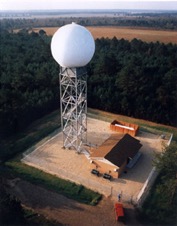
The main part of the paper advocates joint design of new radar systems with communications experts in order to maximize spectrum sharing and consider financial cost sharing of features that facilitate sharing subject to the radar mission needs. Just as the stealth bomber design involved a unique team of aeronautical engineers and EEs who could trade off flying issues with radar visibility issues, joint design of radar/comm systems may well result in sharing breakthroughs. While current legislation does not allow this type of cost sharing, it is not beyond the reach of new legislation that has been discussed. The paper points out that while full duplex paired spectrum with “24/7 and 1000 ms/ 1 s” time availability has been the norm for commercial systems, the decline of voice minutes and the domination of packetized traffic means that partial time availability, synched with radar rotation, could result in productive access to radar spectrum. While nonmilitary backlobe radio have not improved in 40+ years, advances in radio astronomy antennas indicate that new designs can significantly decrease backlobe levels and facilitate sharing. Such designs are expensive, but cost sharing could address that.
if you are interested, here, again, is the link.
New GAO Report on NTIA & Federal Spectrum Management
Here is GAO’s summary of what they found:
NTIA is responsible for governmentwide federal spectrum management, but its efforts in this area have been limited. In 2003, the President directed NTIA to develop plans identifying federal and national (both federal and nonfederal) spectrum needs, and in 2008, NTIA issued the federal plan. GAO found this plan has several limitations, does not identify governmentwide spectrum needs, and does not contain key elements and best practices of strategic planning. NTIA has yet to issue the national plan. Furthermore, NTIA’s primary spectrum management operations do not focus on governmentwide needs. Instead NTIA depends on agency self-evaluation of spectrum needs and focuses on interference mitigation, with limited emphasis on holistic spectrum management. Lacking a strategic vision, NTIA cannot ensure that spectrum is being used efficiently by federal agencies. Additionally, NTIA’s data management system is antiquated and lacks internal controls to ensure the accuracy of agency-reported data, making it unclear if decisions about federal spectrum use are based on reliable data. NTIA is developing a new data management system, but full implementation of the system is years away.
Federal agencies use spectrum for many purposes such as emergency communications and national defense, and NTIA requires the agencies to periodically evaluate their current and future spectrum needs. Agencies are supposed to ensure spectrum assignments fulfill established mission needs; however, NTIA does not have specific requirements for agencies to justify their spectrum assignments or validate data used for these evaluations. Consequently, NTIA has limited assurance that the data used to make spectrum management decisions are accurate. Federal agencies rely heavily on their program offices to obtain data for the required evaluations and often face challenges, such as resource constraints and staff turnover, when coordinating with field program staff. Given that validating spectrum assignments could require significant agency resources, it would be beneficial for NTIA to consider options for a different approach to obtain and validate critical spectrum assignment information from the agencies, such as requiring agencies to conduct site surveys or attest to the accuracy of data they submit.
In response to recent initiatives, NTIA has taken steps to identify spectrum that could be made available for broadband use. First, NTIA evaluated various spectrum bands and identified 115 megahertz of spectrum that could be made available for broadband within the next 5 years based on criteria it developed. Second, NTIA developed an initial plan and timetable for evaluating and repurposing additional spectrum for broadband use in 10 years. Affected federal agencies—that is, those agencies operating devices in the spectrum bands being evaluated—encountered difficulties providing NTIA with the necessary data and analyses during the most recent evaluation. For example, according to the affected agencies, they were required to analyze and submit a significant amount of detailed impact analyses that were not readily available. Agencies will likely continue to face challenges providing such analyses to NTIA in the future as NTIA begins evaluating a larger number of spectrum bands for possible broadband use in the next 10 years.
The basic problem is the first few words above - “NTIA is responsible for governmentwide federal spectrum management”. This is not reality under our current system. The Carter era approach of making NTIA give orders to much larger Executive Branch agencies about how to spend their own money and manage their own systems is just unrealistic in the Federal Government. In January, I quoted an FAA Federal Register document that stated that federal spectrum management is “an existing process involving several Federal agencies with an interest in spectrum use, which NTIA oversees under the Department of Commerce.” This is the reality of the present system. I believe that it will only change for the better when key players realize that the present charter of NTIA is unrealistic and move much of the President’s 47 USC 305 power back to the White House. Most of the NTIA staff can stay in Commerce as the “IRAC Secretariat” - which is what they really do. The key decision makers should be back in the White House where they were until 1978. In this case, oddly, Nixon got the organization right and Carter messed it up with well intentioned but ineffective change.
Interior Implements White House's Scientific Integrity Policy:How About FCC and NTIA?
Washington Post columnist Ed O’Keefe published an article today about the Department of Interior’s implementation of the White House’s scientific integrity policy which has been a recurring theme here.
This policy states
The public must be able to trust the science and scientific process informing public policy decisions. Political officials should not suppress or alter scientific or technological findings and conclusions. If scientific and technological information is developed and used by the Federal Government, it should ordinarily be made available to the public. To the extent permitted by law, there should be transparency in the preparation, identification, and use of scientific and technological information in policymaking. The selection of scientists and technology professionals for positions in the executive branch should be based on their scientific and technological knowledge, credentials, experience, and integrity.
Now, a lot of the FCC’s jurisdiction is nontechnical - think of the famous ‘wardrobe failure” - and even some of the technical jurisdiction in spectrum management involves trades between costs of new service with respect to technical impact on existing spectrum users and benefits of the new service. But in spectrum policy I am reminded of what a distinguished telecom lawyer once told me, “Some questions actually have (objective) answers”.
For example, as FCC and NTIA tool up for a battle over LightSquared’s ATC application, it will be very tempting for opponents of it to just say that it will cause GPS interference inevitably. Now a poorly designed MSS/ATC system in the band adjacent to the GPS L1 signal will clearly cause interference just as a poorly designed TDD AWS-3 system next an FDD AWS-2 system will cause interference. But the key policy issue is whether clever engineers can come up with a set of design details to reduce this interference to an acceptable level comparable to naturally occurring outages. This should be considered in the context of the above quote from the White House, not in smoke filled rooms without the potential for objective review of the analysis - unless it is necessary to keep certain details of the public record to protect properly classified information. But even in that case, FCC or NTIA could ask for an independent review by a contractor with clearances or could set up a technical advisory committee with cleared members similar to the Defense Science Board.
There is anecdotal evidence within FCC that the famous FleetCall waiver that allowed the creation of NEXTEL and the resulting 800 MHz interference to public safety was identified by the technical staff of WTB’s predecessor as having an interference risk and that the staff urged an explicit condition on the waiver. We now know what happened when the waiver was granted without this condition. Had a scientific integrity policy been in place at that time, the resulting public safety interference could have been resolved quickly.
So why don’t FCC and NTIA emulate the progressive move by Interior in implementing the President’s scientific integrity policy!
[Your blogger has no financial interest or relationship with LightSquared]
White House Announces
"Startup America":Maybe a Good Time for FCC to "Rediscover" Section 7 and Start Complying with it?
The White House announced today “Startup America”, “a plan for winning the future by out-innovating, out-educating, and out-building the rest of the world.”
President Obama said, “Entrepreneurs embody the promise of America: the belief that if you have a good idea and are willing to work hard and see it through, you can succeed in this country. And in fulfilling this promise, entrepreneurs also play a critical role in expanding our economy and creating jobs. That’s why we're launching Startup America, a national campaign to help win the future by knocking down barriers in the path of men and women in every corner of this country hoping to take a chance, follow a dream, and start a business.”
NTIA’s parent, the Department of Commerce seems fully committed to the program
The Department of Commerce will expand the i6 Challenge to help foster the commercialization of clean technologies, and are finalizing a plan to allow entrepreneurs to request faster review of their patents, an initiative that should lower patent pendency times overall and speed the deployment of new ideas to the marketplace.
No indication whether NTIA will be involved just as there is no indication whether NTIA will follow the President’s earlier guidance that “each agency shall ensure the objectivity of any scientific and technological information and processes used to support the agency's regulatory actions.”
Readers may recall that FCC’s long term apparent disinterest in compliance with Section 7 of the Communications Act of 1934, as amended, has been a recurrent theme here. By contrast, let’s see what Commerce’s Patent and Trademark Office is doing as part of the new program:
U.S. Patent & Trademark Office (USPTO) Gives Applicants Greater Control Over Examination Timing and Enables Fast-Track Examination Within 12 Months: The USPTO is pursuing an Enhanced Examination Timing Control Initiative (Three-track Examination) to give innovators more control over the application processing and support a more efficient market for innovation. Under this initiative, applicants would be able to request prioritized examination (Track I), obtain processing under the current procedure (Track II), or request a delay lasting up to 30 months (Track III). Entrepreneurs who are seeking capital, or accelerated market penetration, may benefit from the prioritized examination offered by the Track I option. In contrast, those entrepreneurs working to commercialize more embryonic ideas may prefer the extended timeframe associated with Track III. Another benefit to entrepreneurs will be shorter overall examination queues.
Section 7 is not a perfect piece of legislation. FCC has never implemented rules for administering it. FCC could ask Congress to amend it or even repeal it rather than just ignoring it. If anything, at present it is false hope for entrepreneurs and may discourage investment in entrepreneurial firms from VCs who get a cynical view of FCC’s treatment of startups in recent years.
But why don’t FCC and NTIA get on the President’s bandwagon and make life easier for wireless startups by promising decisions on some plausible schedule and real use of objective scientific information by NTIA in its presentations to FCC on shared spectrum - limited in public disclosure only by the need to protect properly classified information.
FAA Terminates Its "Spectrum Policy Grab" Rulemaking:
Highlights Fundamental Problem of NTIA Structural Weakness

Four years later, on July 21, 2010 the Federal Register published a Final Rule (R&O in FCC jargon) that goes into effect this week terminating this FAA rulemaking and taking no action at this time in the spectrum area. The NPRM proposed to require that anyone seeking a license or license modification in 13 different bands (some of which spanned more than one FCC allocation) must notify FAA independently of any FCC application. As the FHH CommLawBlog stated “the FAA lowered its conceit of attainable felicity a bunch, giving up on wide swaths of its 2006 proposal.”

The FAA, FCC and NTIA are collaborating on the best way to address this issue. A resolution of this issue is expected soon. Therefore, the proposals on FM broadcast service transmissions in the 88.0–107.9 MHz frequency band remain pending. The FAA will address the comments filed in this docket about the proposed frequency notice requirements and proposed EMI obstruction standards when a formal and collaborative decision is announced.
This problem has been around for at least 20 years and the FAA was so annoyed about perceived FCC and NTIA disinterest in their issues they made a successful end run around them and got some jurisdiction in this area in the Airport and Airway Safety and Capacity Expansion Act of 1987 (Pub. L. 100– 223 passed December 30, 1987) [FAA gave the legal background in p. 34030 of the NPRM, but they garbled the legal citations somewhat.]
Notwithstanding the about quote that “FAA, FCC and NTIA are collaborating” now, this whole incident shows US spectrum management policy at its worst. FCC and NTIA were both blindsided by the NPRM and it took 4 years to get any resolution, which in the end wasn’t much of a resolution. While NTIA thinks that it ”manages the Federal use of spectrum”, p. 42297 of the Final Rule states FAA’s viewpoint about “an existing process involving several Federal agencies with an interest in spectrum use, which NTIA oversees under the Department of Commerce.” So who is actually in charge?
The root cause of this problem is that FAA, which says it really cares about aviation safety where the other agencies don’t, also is caving in to pressure from the Aircraft Owners and Pilots Association (AOPA) - the “NRA” of the general aviation community. The ILS interference problems at the root of this issue are caused by “receiver-generated intermodulation” * in the ILS receiver when 2 or 3 strong FM broadcast signals are present that have a certain mathematical relationship to the ILS frequency. Both the receiver - regulated by FAA - and the FM broadcast stations are involved in the generation of the interference. Almost 20 years ago, ICAO developed receiver standards to minimize this problem.
Under pressure from AOPA, FAA has never made these ICAO receiver standards mandatory for all aircraft in the US. There is no indication that NTIA has ever pressured FAA on this issue.
NTIA has historically taken a hands off position to this problem even though NTIA claims it is responsible for “establishing and issuing policy regarding allocations and regulations governing the Federal spectrum use”. Historically, NTIA has been in favor of receiver standards for FCC-regulated services - but has been silent on other services where receiver problem impact FCC services.
So what is needed here is a real dialogue on how to split the burden of solving this problem between the FAA-regulated aircraft community and the FCC-regulated broadcast community with NTIA taken a forceful role in mediating a solution. However, the charter and legislation of NTIA dating back to the Carter Administration may make this impossible. The head of NTIA is an Assistant Secretary of Commerce and pragmatically assistant secretaries of smaller cabinet agencies do not tell other agencies how to spend their own money. This is the fundamental shortcoming of NTIA and results from its birth, not its present officials. Now many of us have observed the growth of the number of people in the Executive Office of the President with a strong interest in spectrum in the past 2 years. Hopefully this is a sign of the White House trying to exert some effective control over federal spectrum use which otherwise is mostly determined by user agency representatives meeting in secretive IRAC meetings. (They are so secretive, that I had trouble getting of minutes from a meeting that took place 25 years ago that I had attended!)
So FAA has backed off for now, but unless we get some real leadership in federal spectrum management this type of interagency problem will continue. Early in my FCC career, I both attended IRAC meetings from time to time and also represented the FCC at an interagency group on communications security (COMSEC). The Director, National Security Agency (DIRNSA in military jargon) has a national role in COMSEC that parallels NTIA’s role in spectrum policy. But the tone of the two meetings I attended was very different: DIRNSA sought the advice of federal agencies but made it clear that he was in charge and would consider the offered advice in making the final decision. By contrast, it was also clear at IRAC meeting that the various members were horse trading among themselves to decide what to tell NTIA to do. This is not leadership and spectrum is getting to be too precious to both the national economy and the national defense to base policy decisions on IRAC members horse trading among themselves for their own convenience. In Silicon Valley talk: “Adult supervision is desperately needed”.
I strongly believe that the White House needs a stronger role in spectrum policy even if it means partially undoing the creation of NTIA in 1977. I would transform the current NTIA Office of Spectrum Management into the IRAC Secretariat (which is a better description of most of its work at present) and leave most of the staff in Commerce while creating either a small decision making group in OMB or a new version of the old Office of Telecommunications Policy that reviews IRAC recommendations and has the resources to seek independent views of what is in the national interest, not the lowest common denominator of the IRAC membership.
----------
* Receiver-generated intermodulation is difficult to explain to people who are not radio techies because it is counter intuitive in many ways and can not be explained with simple analogies. It is the root cause of several complex spectrum policy issues in recent years such as the 800 MHz NEXTEL/public safety interference issue and the ongoing PCS H block controversy, WT Docket No. 04-356.
Your Blogger's Students Would Get a Failing Grade for a Statement Like This; Why is it in an NTIA/CSMAC Draft that has been Approved?
The above quote is from the draft of the NTIA Commerce Spectrum Management Advisory Committee’s Interference and Dynamic Spectrum Management Subcommittee that was approved “subject to edits” at the 7/27/10 CSMAC meeting in Boulder CO. It was also on p. 25 of the draft presented at the 5/10 meeting. (The final version of this report has not yet been posted on the CSMAC web site so more editing is possible before finalization.)
The CSMAC charter states that that the
“Committee will recommend approaches and strategies to ensure that the United States remains a leader in the introduction of new wireless technologies, while at the same time providing for the expansion of existing technologies and ensuring that the country’s homeland security, national defense, and other critical needs are satisfied.”
As we have written previously, the tone of the reports to date have focused on protecting incumbents from new entrants and putting as many burdens as possible on innovators. “Expanding new technologies” has not received much attention.
But the point of this posting is not the balance of power between incumbents and innovators. Some issues in spectrum management are subjective and reasonable people could disagree on these. Such issues include things like
- the priority of difference radio services,
- what is acceptable/harmful interference,
- what is the best propagation model for a given environment,
- minimum protection distances between systems,
- use of probabilistic interference models vice worst case (MCL) geometry, etc.
But as a prominent telecom lawyer once told me, “some problems actually have answers”. The quote above is one of those. The answer here is simple: the quote above is technical nonsense!
Your blogger has taught at George Washington U. and MIT and was recently appointed to the adjunct faculty at Virginia Tech. (More soon on the course he will teach there in the Spring Term.) Any student submitting such a statement in a term paper would fail the course.
A first clue that something is wrong can be found by just Googling “hybrid retry mechanism”, as shown below. (Bing could not find any use of this phrase either.)

Now for the ability of LTE and WiMAX to “ to operate at negative SNR” (signal-to-noise ratio) that is, where the desired signal is weaker than the background noise or interference - this is total nonsense that should be obvious to anyone who has studied communications theory in the past 30 years. LTE and WiMAX are both OFDM systems - as is the European DTV standard, DVB-T. WiMAX has several modulation schemes and picks the best one for a given location. Their performance as a function of SNR is shown below:

WiMAX bit error rate (BER) vs. signal-to-noise ratio (SNR)
All need positive SNR to meet the BER (bit error rate) target! This is not “rocket science”. This is stuff taught to undergraduate electrical engineering students (and probably should be on amateur radio tests if the testing were not controlled by Social Security recipients). If LTE and WiMAX could operated at negate SNR, wouldn’t you think that DVB-T, its technical cousin, could also? Therefore wouldn’t DVB-T be better than the US’ ATSC DTV? It really isn’t difficult to see how foolish this statement is.
Thee sentence in question was not an last minute addition to the 7/10 CSMAC draft. As stated above, it was also on p. 25 of the draft presented at the 5/10 meeting. So 2 months after this first draft was presented, the CSMAC approved the report “subject to edits” without any dissent within the committee. Does anyone read this stuff?
Your blogger has urged both FCC and NTIA to balance their advisory committee with technical people with significant peer recognition such as being IEEE fellows or members of the National Academy of Engineering. Clearly NTIA did not listen and this is an example of the result.
NTIA has to reappoint people to the CSMAC soon and FCC is still contemplating TAC nominations. Yes, the TV broadcasters and the major cellular carriers deserve a place at the table, but the price of admission should be sending someone who is technically competent in contemporary communications technology. Do we really need advisory committees made mostly of lobbyists with little or no technical background?
Spectrum policy is too important to be left mostly to lawyers.
[Note: I attempted twice to contact a senior technical staffer at MSTV,
the organization of subcommittee chairman Donovan and
“the recognized industry leader in broadcasting technology and spectrum policy
issues”, to ask about this sentence in the report.
Neither inquiry was returned.]
GNTEBHXBDBW2
The NTIA CSMAC Interference Report: An Embarrassment to the President's Spectrum Policies
For reasons discussed below this report is, or at least should be, a major embarrassment to NTIA as it is inconsistent with both the President’s spectrum policies and the charter of the committee. It both evades some major issues and pushes the parochial agendas of some committee members without trying to relate them to the broader public interests.
The White House has said
“(N)ew technologies have the potential to free up spectrum from many of its existing uses. In combination with regulatory changes, new and emerging technologies can facilitate the repackaging, reallocation, and even sharing of spectrum. Reallocating spectrum to its most valuable use promises to be a win-win effort – creating value that not only spurs new innovations and creates new jobs, but also benefits existing spectrum users by allowing them to raise funds for transformative new investments.
This CSMAC report repeatedly takes a negative view towards all innovation and an absolute priority on protecting incumbents. For example on p. 7 it says, “If an incumbent service makes changes to its system’s architecture or modulation technique that results in new interference, then the spectrum to be used to establish any guardband protections should be provided by the service making such changes.” So no matter how outdated an incumbent’s equipment is, no matter how inefficiently an incumbent uses spectrum, no matter how lightly loaded an incumbent’s band is, the burden of protecting the incumbent always falls entirely on the new comer in the mind of CSMAC - which just happens to be dominated by incumbents.
Much of the report echoes the broadcast industry’s view on the database approach to TV whitespace, Docket 04-186. Perhaps not surprising since MSTV’s David Donovan, a lawyer, chaired this group. In private discussions, many CSMAC members observed that much of the long database discussion in the report was aimed at the FCC rulemaking and was irrelevant to the NTIA issues.
One might think that the “Interference Subcommittee” might spend some effort discussing what is “interference”? They dismiss this topic quickly:“Because of the different policy concerns, the Subcommittee makes no judgment as to the appropriate definition of interference that would trigger legal action. Accordingly, we use the term “interference’ in its generic sense.” (p.16)
Hey guys, maybe defining interference in detail is beyond your scope, but how about a few words on whether the current 47 CFR 2.1 definition is workable? What about the FCC view in the Wireless Innovation NOI:
“The viability of spectrum access for new radio services often centers on whether the new service may cause harmful interference to incumbent services. This can lead to delays through protracted rule making proceedings that can create uncertainty and discourage investment. Are there ways the Commission can improve upon this process?” (para. 34)
Does this issue apply to NTIA processes also? Are NTIA harmful interference determinations any faster or more transparent than FCC ones? Will sharing of Government spectrum by technical innovators be that much more attractive than allocations in NG spectrum? CSMAC - the world wonders?
The report was not content at sniping at the TV WSD intruders, it appears Mr. Donovan gave “professional courtesy” to his peers in the cellular establishment since cellular carriers and their allies were also well represented amount the committee members. Thus the report also took a cheap shot at the AWS-3 proceeding saying
•There is widespread consensus on the mechanisms and dangers of creating interference when licensing services that employ different duplexing technologies in adjacent spectrum.
•Industry stakeholders recently demonstrated the risks associated with plans to permit TDD operations in AWS-3 spectrum, without adequate allowances to protect adjacent AWS-1 FDD operations. (emphasis added)
Note the use of the word “stakeholders” here rather than “incumbents”. Don’t the stakeholders in FCC proceedings include also the public who could benefit from new service and the advocates of new service? The use of “stakeholders” in the report draft clearly shows the consistent bias in favor of incumbents. In any case, the demonstration was that referred to is controversial and the issue has not been resolved by FCC almost 2 years later.
Does the Interference Committee have any views at all on whether intersystem interference should be judged always on worst case/“minimum coupling loss” geometry or whether in some circumstances stochastic/probabilistic modeling should be used as it is from time to time in CEPT and ITU studies?
Filters have a big impact on all types of interference other than cochannel interference. Does the committee have any thoughts on whether filters are getting better and how that might impact sharing and guardbands?
Many types of wireless equipment now have a service life of a few years. Should this be taken into account in sharing and guardband determinations as the major cellular carriers have argued that PCS H block entrants can use increased power after existing handsets are replaced with newer models with better intermodulation immunity?
Finally, since this is a report on both interference and DSA, shouldn’t it at least mention the observation of Preston Marshall, formerly of DARPA, that cognitive radios could be designed to select not just idle frequencies but idle frequencies that will not cause interference to receivers with limited interference rejection capabilities that are nearby in frequency and space ?
John Muleta, former Chief of FCC/WTB, and I wrote a statement on this for the CSMAC that received little interest at the meeting in the rush to approve the flawed report. Readers might want to compare it with the report draft and draw their own conclusions. Please tell us what you think.
We will post a link to the final version of the report when it is released.
[MSS has done work for M2Z Networks and Adaptrum, Inc., but this post is not part of that work and is solely the view of MSS.]


 (Does not include readers using RSS feeds.)


![[Valid RSS]](valid-rss-rogers.png "Validate my RSS feed")


