
FAA's Spectrum Management Activities May Be Getting "Adult Supervision"
If you’re sitting on a plane at the gate and reading this column on an electronic gadget, you’re about to hear eight dreaded words: “Please power down your electronic devices for takeoff.” But this time next year, you might hear something very different: “Please put your devices on ‘airplane mode’ for takeoff.”

In a phone interview, Ms. McCaskill said she had grown frustrated with the F.A.A.’s stance on devices after she learned that the agency now allows iPads as flight manuals in the cockpit and has subsequently given out devices to some flight attendants with information on flight procedures.
“So it’s O.K. to have iPads in the cockpit; it’s O.K. for flight attendants — and they are not in a panic — yet it’s not O.K. for the traveling public,” she said. “A flying copy of ‘War and Peace’ is more dangerous than a Kindle.”

Now maybe if NTIA were more aggressive with FAA in asking it to justify their spectrum management decisions this mess might never have happened. Perhaps if the recommendations of Chapter 5 of the PCAST spectrum report were implemented there would be more accountability by all federal agencies for their spectrum management decisions.
Thanks, Mr. Akin!
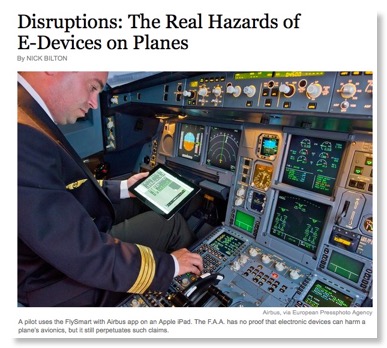
NY Times: "The F.A.A. has no proof that electronic devices can harm a plane’s avionics, but it still perpetuates such claims" "Dealing with the F.A.A. on this topic is like arguing with a stubborn teenager"
Readers may recall that SpectrumTalk has repeatedly talked about the FAA’s renegade role in spectrum management: apparently not happy that Congress has split spectrum management between FCC and NTIA (with some international issues at State), FAA likes to impose itself as another coequal player in national spectrum management. Meanwhile NTIA for decades, glowing in its power derived from Section 305 of the Communications Act, has lacked the moral backbone and institutional authority to keep FAA in line with respect to national spectrum policy issues.
Recently the NY Times published the article whose heading is shown above. Here is a quote:
Dealing with the F.A.A. on this topic is like arguing with a stubborn teenager. The agency has no proof that electronic devices can harm a plane’s avionics, but it still perpetuates such claims, spreading irrational fear among millions of fliers.
A year ago, when I first asked Les Dorr, a spokesman for the F.A.A., why the rule existed, he said the agency was being cautious because there was no proof that device use was completely safe. He also said it was because passengers needed to pay attention during takeoff.
When I asked why I can read a printed book but not a digital one, the agency changed its reasoning. I was told by another F.A.A. representative that it was because an iPad or Kindle could put out enough electromagnetic emissions to disrupt the flight. Yet a few weeks later, the F.A.A. proudly announced that pilots could now use iPads in the cockpit instead of paper flight manuals.
Now FAA likes to say that the problem is “aggregation” - the impact of many emitters operating at the same time. But the real problem of aggregation comes from faulty technical analysis of the spectrum problems.
While aggregation can happen in some scenarios, e.g. terrestrial transmitters operating cochannel with a satellite uplink, real multipath propagation - as happens in most scenarios int he real world - results in lognormal propagation path losses in one or two emitters dominating the interference scenario and the others having no impact.
The Times points out that In December both FCC Chairman Genachowski and Senator Claire McCaskill (D-MO) both urged FAA to be more rational with respect to use of devices on aircraft. Sen. McCaskill even wrote that she was “prepared to pursue legislative solutions should progress be made too slowly.” She said she was urging the agency to embrace the use of electronics, including laptop computers, e-readers, smartphones and other devices, “during the full duration of a flight.”
“The current rules are inconvenient to travelers, don’t make sense and lack a scientific basis,” she said in the letter. “Airline employees have the incredibly important job of keeping us safe in the air. Their efforts are better spent worrying about rules that actually accomplish that goal.”
FAA likes to say that it is only obsessed with safety - an admirable goal if true. However, the sordid history of the FM/ILS affair also shows that FAA is just as concerned about the proprietary interests of “its constituency” - the airlines and AOPA - than it is of safety issues. Also the FAA’s bizarre 2006 NPRM, never coordinated with either FCC or NTIA, that proposed giving the agency veto power over both federal and nonfederal spectrum use in dozens of bands shows a fundamental misunderstanding of the public interest in spectrum.
So kudos to NY Times for their great coverage of this issue. When will NTIA and Congress pressure FAA to start acting more rationally on spectrum matters?
Silicon Flatirons Spectrum Conference Papers Available
Also Paper on FM/ILS Controversy
 The position papers of many of the speakers at the recent Silicon Flatirons “Looking Back to Look Forward: The Next Ten Years of Spectrum Policy” conference are now available, including your blogger’s. Here are the titles and authors:
In U.S. Spectrum Policy: The Way Forward, Kathryn C. Brown and Charla Rath
Beyond Kolkata: Delivering on the Fundamental Goals of the Communications Act, Michele C. Farquhar
Not A Zero Sum Game - Why Objections To The PCAST Report Make No Sense, Harold Feld
The Stunted Public Interest Vocabulary in the Broadcast Spectrum Auction, Ellen P. Goodman
U.S. Spectrum Policy - When the Rubber Meets the Road, Kathleen Ham and Sara Leibman
The Promise and Problems of Strategic Plans, Charles L. Jackson
The Promise and Problems of Strategic Plans: From the Spectrum Policy Task Force to the PCAST Report, Michael J. Marcus
The View Ahead: Technology Opportunities, Preston Marshall
The Wireless Data Demand: Technology and Spectrum Implications, Edward G. Tiedemann, Jr.

However, there are lessons to be learned from this long simmering dispute: Receiver standards often have economic externalities - those who pay the cost are not the same as those who get the benefits. If we do not recognize this issue and find a way to deal with them there will be no progression this area.
Instrument Landing System Receiver Standards:
A Case Study of Receiver Regulation and Its Difficulties
The Instrument Landing System (ILS), used worldwide by aviation users, has two bands, one of which is just above the FM broadcast band at 108.1 -112 MHz. This safety-related landing system has been standardized by both FAA and ICAO, the ITU’s aviation counterpart. Unfortunately the adjacency to the FM broadcast band results in a possible vulnerability to receiver-generated intermodulation interference. This vulnerability was confirmed in FCC Lab measurements.(1 2) FAA and FCC have had a long standing disagreement on the best public policy approach to prevent such interference and NTIA has generally taken a neutral role with respect to this issue and has not been directly involved.
ICAO adopted immunity standards for ILS receivers that were effective international in 1998. (Those stands are mentioned by NTIA on p. 29 of its receiver standards compilation; The specifics of the ICAO regulation can be found in this document from the South African FAA counterpart.) FAA has implemented the ICAO regulation but still allows use of the previous generation of receivers and uses its powers under the Airways Facilities Act to threaten new or modified FM broadcast facilities for “hazard determinations” if they apply for a location, frequency, or power that would cause interference to the earlier generation receivers as projected by a FAA computer model that was not adopted in a “notice and comment” proceeding.
FCC proposed in 1993 to require only ICAO-complaint receivers in all US aircraft after the 1998 effectiveness date. (the NPRM was in response to this petition from broadcast interests.) This NPRM was opposed by aviation interests that felt they should not be burdened with replacing receivers in order to facilitate the use of broadcast spectrum (1 2 3). FCC took no further action on this NPRM until the docket was closed in a 2002 housekeeping action for being “stale”.
It is generally felt that airliners and corporate jets are not affected by this issue since, for practical purposes, they must be equipped to fly outside the US and therefore have ICAO-complaint receivers. However, there are small general aviation aircraft that are not actually required to be ILS-equipped that may well have the previous generation receivers and their trade association, AOPA, has vociferously objected to a mandated upgrade. (It is thought that all ILS receivers made anywhere in the past 20 years comply with the ICAO standard so that any noncompliant receiver in present use is likely 20+ years old.)
This receiver standard issue is a classic economic externality. The aviation users who would incur the cost of a new receiver would get no direct benefit. The benefits would accrue to broadcasters who could modify their facilities to better serve the public though power or siting changes and to the public that would receive addition FM stations if present FAA objections to some new allotments were dropped.
As in the GPS/LightSquared issue, this also falls squarely on the FCC/NTIA jurisdictional fault line, although complicated by the role of FAA and its partially overlapping jurisdiction.
Developing receiver standards is a technically complex issue. But in this case there is a specific international standard that was developed with participation of all affected parties. The US ambivalence towards receiver standards has left that standard in limbo in the US in the 2 decades since it was developed and has limited the utilization of FM broadcast spectrum in order to avoid putting any increased regulatory burdens on an ever decreasing number of small aircraft with obsolescent receivers that could not be used in most other countries.
It is not clear how this issue can ever be resolved due to the jurisdictional issues unless the Executive Branch takes a more holistic approach to such spectrum issues.
FAA and Passenger Electronics Use
Will the familiar warning for airline passengers to "discontinue the use of all portable electronic devices" become a relic of the past?
Perhaps.
By popular demand, the Federal Aviation Administration is forming a group to study policies governing the use of consumer electronics in the sky.
The review could lead to increased use of iPads, portable DVD players and other consumer electronics in aircraft cabins.
Note that the issue here is electronics other than cell phones. Use of cell phones in aircraft is banned by FCC because at high altitudes a cell phone will “see” and impact many cell sites. Thus it will use a large amount of cellular capacity.
FCC did consider allowing femtocell-like base stations in aircraft in Docket 04-435 , but rejected the idea after a tsunami of consumer opposition about the social impact of having someone in the next seat talking loudly (since cell phones have little or no sidetone to given user feedback on appropriate speech level).
Older readers will recall that until about 20 years ago FAA forbid all cell phone use on aircraft, even when the plane was stopped on the runway. FAA wraps itself in its “safety culture” and in pandering to its constituency, e.g. ATA (now actually A4A) and AOPA - but not the general public - to be as unaccountable as possible in some decisions. (Amusingly, FAA staffers routinely criticize FCC for being too close to its constituency.)
The oral traditional about the change about 20 years ago was that a key member of Congress with oversight authority over FAA was trapped on a plane at DCA’s runway for 2 hours without being able to use his cell phone. When he got back to his office he summoned the FAA Administrator and demanded a justification for the then existing rule on no cell phone use ever in aircraft. When the FAA Administrator finally demanded from his middle managers an explanation, he saw he “had no cards” and the present policy of limited cell phone use on the runway was quickly adopted.
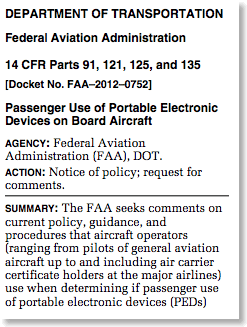
As a service to SpectrumTalk readers, here is a link to the actual FAA “ Notice of policy; request for comments” on Passenger Use of Portable Electronic Devices on Board Aircraft .
DATES: Written comments must be received on or before October 30, 2012
Note that this document states “The FCC will be a key partner in this activity working collaboratively with the FAA, airlines, and the manufacturers to explore broader use of PEDS in flight.” I would like to believe this is true, but as someone with 2 awards from the FAA Administrator for helping FAA resolve critical safety problems, this statement does not ring true. Also, the inability of the FAA spokesman at the FCC Receiver workshop in March to even mentioned the longstanding FM/ILS disagreement between the 2 agencies shows that bilateral collegiality has a long way to go between these agencies. NTIA continues to turn a blind eye to such issues.
Gen. Shelton in the News Again on GPS/LightSquared
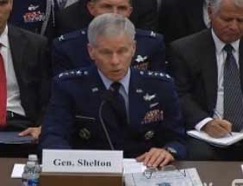
The hearing got off on an odd note with this statement by the committee chair:
That said, I have the unfortunate responsibility to inform the subcommittee that Federal Communications Commission (FCC) Chairman Genachowski refused to appear today. I must also make clear that I consider the Chairman’s failure to show up today to be an affront to the House Armed Services Committee.
Throughout the hearing there was endless ambiguity over whether the GPS receivers possibly threatened by the LightSquared system were military systems or private sector systems. Shelton stated at the hearing:
“Based on the test results and analysis to date, the LightSquared network would effectively jam vital GPS receivers. And to our knowledge thus far, there are no mitigation options that would be effective in eliminating interference to essential GPS services in the United States.”
FoxNews added to the confusion by stating:
The Virginia-based satellite and broadband communications company has plans to build a nationwide, next-generation, 4G phone network that many, including Shelton, think would seriously hinder the effectiveness of high-precision GPS receiver systems, a product used most commonly by the United States military.
A former high level GPS program official recently pointed out to me that the alleged threat to military GPS users is truly bizarre. The proposed terrestrial base stations now are 20 MHz outside the GPS band and are of modest power. A US adversary of even modest means would be capable of building GPS jammers closer to or within the GPS band and with a power much higher than what LightSquared is planning for its terrestrial network.
The Washington Post reported,
“But the new plan, Shelton said, will require billions of dollars in fresh testing of antennas and receivers that could take as long as a decade.”(emphasis added)
Furthermore, such an adversary could also chose a jamming signal more optimized for GPS disruption than the LTE signal proposed by LightSquared. Is this all it takes to disrupt the military’s multibillion dollar critical investment in GPS that is so critical to our national security? If so, there is an urgent problem at hand and it is not just the LightSquared issue, it is the extreme fragility of military GPS systems! More likely, however, is that the proposed system will have no impact on military users but that the whole GPS community is “circling the wagons” in an “all for one, one for all” strategy to protect a few GPS manufacturers who made odd design decisions in their receivers, such as the Deere receiver whose front end covers 3 bands: MSS, GPS, and GLONASS. A strong signal in any of these bands then blocks the receiver.
There was repeated discussion at the hearing of the need for precision GPS receivers to receive “GPS harmonics” for optimal performance. As a service to readers, here is a repeat of the spectrum GPS uses:
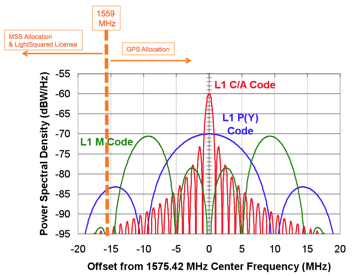
There is some GPS signal power outside the allocated L1 spectrum that ends at 1559 MHz, but not 20 MHz away! At a previous hearing before the House Science Committee, US Geological Survey complained about impact of LightSquared base stations on plate tectonic monitoring receivers. USGS was vague about the bandwidth of this receivers, but it is reported that it is significantly greater than the bandwidth of any usable part of the GPS signal.
Perhaps as indication that the hearing was orchestrated by a PR agency working for commercial GPS interests, it even went into a recent ad by LightSquared in Politico . No mention was made of unreasonable alarmist statements by GPS interests. It became apparent during UWB deliberations that the GPS industry and FAA had a codependency and were willing to do policy favors for each other. Hence FAA took the lead trying to block UWB even though even NTIA readily agreed that none of the UWB emission levels under consideration at the time posed a risk to aviation uses of GPS. Now it looks like Gen. Shelton has slid into the FAA’s former role as defender of GPS commercial interests, this time by blurring the distinction between military uses and commercial uses.
Do we really need this type of codependency?
Prepared Statements
Complete Video of 9/15/11 Hearing
FAA Terminates Its "Spectrum Policy Grab" Rulemaking:
Highlights Fundamental Problem of NTIA Structural Weakness

Four years later, on July 21, 2010 the Federal Register published a Final Rule (R&O in FCC jargon) that goes into effect this week terminating this FAA rulemaking and taking no action at this time in the spectrum area. The NPRM proposed to require that anyone seeking a license or license modification in 13 different bands (some of which spanned more than one FCC allocation) must notify FAA independently of any FCC application. As the FHH CommLawBlog stated “the FAA lowered its conceit of attainable felicity a bunch, giving up on wide swaths of its 2006 proposal.”

The FAA, FCC and NTIA are collaborating on the best way to address this issue. A resolution of this issue is expected soon. Therefore, the proposals on FM broadcast service transmissions in the 88.0–107.9 MHz frequency band remain pending. The FAA will address the comments filed in this docket about the proposed frequency notice requirements and proposed EMI obstruction standards when a formal and collaborative decision is announced.
This problem has been around for at least 20 years and the FAA was so annoyed about perceived FCC and NTIA disinterest in their issues they made a successful end run around them and got some jurisdiction in this area in the Airport and Airway Safety and Capacity Expansion Act of 1987 (Pub. L. 100– 223 passed December 30, 1987) [FAA gave the legal background in p. 34030 of the NPRM, but they garbled the legal citations somewhat.]
Notwithstanding the about quote that “FAA, FCC and NTIA are collaborating” now, this whole incident shows US spectrum management policy at its worst. FCC and NTIA were both blindsided by the NPRM and it took 4 years to get any resolution, which in the end wasn’t much of a resolution. While NTIA thinks that it ”manages the Federal use of spectrum”, p. 42297 of the Final Rule states FAA’s viewpoint about “an existing process involving several Federal agencies with an interest in spectrum use, which NTIA oversees under the Department of Commerce.” So who is actually in charge?
The root cause of this problem is that FAA, which says it really cares about aviation safety where the other agencies don’t, also is caving in to pressure from the Aircraft Owners and Pilots Association (AOPA) - the “NRA” of the general aviation community. The ILS interference problems at the root of this issue are caused by “receiver-generated intermodulation” * in the ILS receiver when 2 or 3 strong FM broadcast signals are present that have a certain mathematical relationship to the ILS frequency. Both the receiver - regulated by FAA - and the FM broadcast stations are involved in the generation of the interference. Almost 20 years ago, ICAO developed receiver standards to minimize this problem.
Under pressure from AOPA, FAA has never made these ICAO receiver standards mandatory for all aircraft in the US. There is no indication that NTIA has ever pressured FAA on this issue.
NTIA has historically taken a hands off position to this problem even though NTIA claims it is responsible for “establishing and issuing policy regarding allocations and regulations governing the Federal spectrum use”. Historically, NTIA has been in favor of receiver standards for FCC-regulated services - but has been silent on other services where receiver problem impact FCC services.
So what is needed here is a real dialogue on how to split the burden of solving this problem between the FAA-regulated aircraft community and the FCC-regulated broadcast community with NTIA taken a forceful role in mediating a solution. However, the charter and legislation of NTIA dating back to the Carter Administration may make this impossible. The head of NTIA is an Assistant Secretary of Commerce and pragmatically assistant secretaries of smaller cabinet agencies do not tell other agencies how to spend their own money. This is the fundamental shortcoming of NTIA and results from its birth, not its present officials. Now many of us have observed the growth of the number of people in the Executive Office of the President with a strong interest in spectrum in the past 2 years. Hopefully this is a sign of the White House trying to exert some effective control over federal spectrum use which otherwise is mostly determined by user agency representatives meeting in secretive IRAC meetings. (They are so secretive, that I had trouble getting of minutes from a meeting that took place 25 years ago that I had attended!)
So FAA has backed off for now, but unless we get some real leadership in federal spectrum management this type of interagency problem will continue. Early in my FCC career, I both attended IRAC meetings from time to time and also represented the FCC at an interagency group on communications security (COMSEC). The Director, National Security Agency (DIRNSA in military jargon) has a national role in COMSEC that parallels NTIA’s role in spectrum policy. But the tone of the two meetings I attended was very different: DIRNSA sought the advice of federal agencies but made it clear that he was in charge and would consider the offered advice in making the final decision. By contrast, it was also clear at IRAC meeting that the various members were horse trading among themselves to decide what to tell NTIA to do. This is not leadership and spectrum is getting to be too precious to both the national economy and the national defense to base policy decisions on IRAC members horse trading among themselves for their own convenience. In Silicon Valley talk: “Adult supervision is desperately needed”.
I strongly believe that the White House needs a stronger role in spectrum policy even if it means partially undoing the creation of NTIA in 1977. I would transform the current NTIA Office of Spectrum Management into the IRAC Secretariat (which is a better description of most of its work at present) and leave most of the staff in Commerce while creating either a small decision making group in OMB or a new version of the old Office of Telecommunications Policy that reviews IRAC recommendations and has the resources to seek independent views of what is in the national interest, not the lowest common denominator of the IRAC membership.
----------
* Receiver-generated intermodulation is difficult to explain to people who are not radio techies because it is counter intuitive in many ways and can not be explained with simple analogies. It is the root cause of several complex spectrum policy issues in recent years such as the 800 MHz NEXTEL/public safety interference issue and the ongoing PCS H block controversy, WT Docket No. 04-356.


 (Does not include readers using RSS feeds.)


![[Valid RSS]](valid-rss-rogers.png "Validate my RSS feed")


