
Mobile Future Filing Highlights FCC's Real Throughput Limit & Its Impact
Who is Mobile Future? Here is their own description:
Mobile Future is an association of cutting-edge technology and communications companies and a diverse group of non-profit organizations, working to support an environment which encourages investment and innovation in the dynamic wireless sector. Our mission is to help inform and educate the public and key decision makers in business and government on the broad range of wireless innovations that are transforming our society and the nation’s economy.
The list of members includes big players such as AT&T, Verizon, Alcatel-Lucent, Cisco, Ericsson, Samsung, and Qualcomm as well as some obscure non-profits, e.g. Foundation for Advancing Alcohol responsibility and Hispanic Chamber of Commerce of Minnesota. Your blogger is actually a volunteer for one of the nonprofit that is an MF member and has absolutely no idea why this organization is interested in mobile spectrum and involved in this lobbying effort except if one of its board members is with the same PR firm MF uses.
MF describes their comments on their website as “Today, Mobile Future submitted comments to the FCC regarding the potential for providing mobile service using spectrum bands above 24 GHz. As consumer demand for wireless continues to skyrocket, the mobile community is exploring ways to unlock additional spectrum resources.”
http://apps.fcc.gov/ecfs/document/view?id=60001013705
5G Will Probably Need an Aggregation of Technologies - Not Just More Spectrum

The new October 2014 issue of IEEE Wireless Communications magazine is a special issue on mulithop cellular - one of the technologies that will likely be part of 5G cellular. While there is no consensus yet on what exactly 5G will be, one article reports:
“it is widely agreed that in contrast to 4G networks, 5G network should achieve 1000 times the system capacity, 10 times the spectral efficiency, higher data rates (i.e., 10 Gb/s for cell center users and 5 Gb/s for cell edge users), 25 times the average cell throughput, and 5 times reduction in end-to-end (E2E) latency, and support 100 times more connected devices with 10 times longer battery life for low-power devices.”
By contrast, gsmhistory.com gives 3 different visions of 5G:
- A super-efficient “universal” mobile network that is always attentive to demand and where resources are continuously optimised to deliver a performance that is “always sufficient” – so users will perceive that they are connected to a network of infinite bandwidth. It would not just be data speed performance that is optimised but low latency needed by applications such as the Internet of Things. It is a revolution in “efficiency” delivering much better performing networks for a lower cost of investment. (Such networks are sometimes called DAN or Demand Attentive Networks). It would re-purpose existing spectrum to work in more efficient ways.
- A super-fast “mobile” network comprising the next generation of small cells densely clustered together to give a contiguous coverage over at least urban areas and delivering peak data rates of up to 1 Gb/s. It gets the world to the final frontier for true “wide area mobility”. Spectrum for this would be under 4 GHz (in order to make wide area coverage economically feasible). Since nobody is likely to reserve spectrum for 5G such a network would enter the market through advanced spectrum sharing – so in this vision 5G might be the first global implementation of Dynamic Spectrum Access. The band 3.4-3.6 GHz has been talked about for such a “spectrum sharing” market entry for 5G.
- A converged wireless-fiber network that uses, for the first time for wireless Internet access, the millimeter wave bands (20 – 60 GHz) so as to allow very wide bandwidth radio channels able to support data access speeds of up to 10 Gb/s. The connection essentially comprises “short” wireless links on the end of local fiber optic cable. It takes data over wireless to the state of the art. But this very high data speed comes at a price for consumers in terms of very much reduced coverage. It would be more a “nomadic” service (like WiFi) ie to fixed locations rather than a wide area “mobile” service
- Advanced coding and modulation techniques for 5G such as non-orthogonal wave form (NOMA).
- Spatial modulation (SM)
- Millimeter wave (mmWave)
- Visible light communication (VLC)
- Massive MIMO
- Cognitive radio networks (CRNs)
- Integration of Wi-Fi and core
- Local caching
- New heterogenous architecture - separate indoor and outdoor technologies
- Direct mobile-to-mobile communications
The introductory editorial explains the significance of the last point
“It has been more than a decade since the multihop cellular network (MCN) architecture was first proposed and analyzed in 2000. As the transmission range decreases k times, the number of simultaneous transmissions and hop count increase by k squared and k times, respectively, which leads to k times cellular capacity increase. Fundamental research projects have demonstrated the benefits of MCN interms of system capacity, service coverage, and network connectivity. Many special issues have been devoted to this stream of research. The actual concept behind the MCN architecture could be regarded as a hybrid of mobile ad hoc networks (MANETs) and cellular networks. This concept of “relaying within a cell” also pushed standard bodies to consider solutions embedded with mesh or ad hoc architectures, such as IEEE 802.11s, IEEE 802.15.5 , and IEEE 802.16j . Now, in the recent standards of the Third Generation Partnership Project (3GPP), Proximity-Based Services (ProSe) related work items also cover the MCN concept. In addition to device-to-device (D2D) direct communications, user equipment (UE)–UE relay and UE–network relay are also supported features.”
Note that in the above discussion new spectrum is included, but is not a “magic bullet” to achieve 5G goals of capacity increase. Synergy among a variety of approaches is needed for such increases. Although not explicitly mentioned, a massive increase of sites for cellular infrastructure is also needed, as has been previously discussed.
Note also that there is a dynamic interaction between unlicensed technology discussed in IEEE802 and licensed technology discussed in fora such as 3GPP. For example, LTE is a close technological cousin of WiMax. These interactions between the licensed and unlicensed communities are beneficial for all involved, although this is rarely discussed in policy circles.
So why is new spectrum the only 5G issue getting attention at FCC?
Acceleration of Broadband Deployment by Improving Wireless Facilities Siting Policies
The discussed focused on the urgent need for wireless capacity and the related wireless infrastructure. WE FULLY AGREE!
But there were 2 key points that were not said, perhaps they would be awkward given the influence of the cellular establishment at FCC and in DC in general.
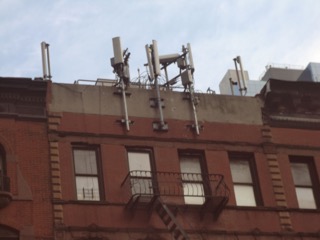
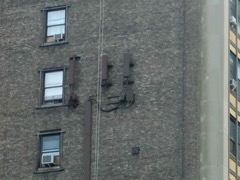
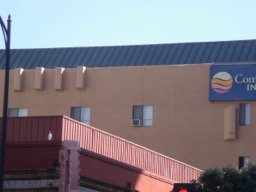
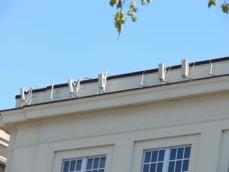
Now the cell industry does sometimes due a good job in designing infrastructure to match its environment. Here are 3 examples of apparently modest cost installations that are reasonable design compromises. Note that in all 3 cases the covers/radomes of the antennas approximately match the surface they are mounted on; in addition there a no loose visually contrasting cables in these last 3 photos:
(In NYC only 2 blocks from the previous photo)

“All politics is local”
There is a limit how much the cellular industry can impose on local jurisdictions at the current ugliness levels without a grassroots political backlash. But well designed infrastructure need not be either ugly or very expensive. More consistent attention to physical design is urgently needed!
UPDATE
PCIA Press Release: PCIA Applauds FCC’s Order on Wireless Infrastructure – Streamlined Rules Will Speed Broadband Deployment
HBO & CBS: Enabling Cutting Both the CATV and Spectrum "Cord"

Even major NAB member CBS is jumping on the bandwagon of alternatives to spectrum! Today they announced CBS All Access:
“a new digital subscription video on demand and Nielsen-measured live streaming service for the CBS Television Network. CBS All Access will offer subscribers thousands of episodes from the current season, previous seasons and classic shows on demand, as well as the ability to stream local CBS Television stations live in 14 of the largest U.S. markets at launch”.
Since the end of WWII broadcast over-the-air (OTA) TV has been both a large spectrum user and a huge player in spectrum regulation. When I joined FCC in 1979, we were at the end of a spectrum policy era in which the TV broadcasters, Motorola, and AT&T were the key players and virtually dictated how spectrum would be divided between their constituencies. Now Motorola and AT&T are a shadow of their former selves and perhaps the time has come for the TV broadcasters to “exit left” from the spectrum policy dictating business.
Sources have told us that the early drafts of the National Broadband Plan pointed out that when 50+ Mbps broadband becomes a universal service-like national norm - something that is critical to US society and economy for reasons not directly related to spectrum policy, then spectrum for OTA TV in urban areas will no longer be important since the content can be easily distributed over the broadband. Now some will ask about the economically disadvantaged - a real concern. But is allocating 100s of MHz and pumping megawatts in the ether the only way to deal with universal access to “free TV”? Universal access could also be handled by providing Internet based distribution of “basic video” - the present “free TV” - on either a Universal Service Fund-like model or via a freemium pricing model where basic video is free over broadband and higher tier services are priced separately, either in packages or individually. You will not find any such discussion in the published NBP. It was too controversial and pressure from the Hill resulted in its deletion as a topic.
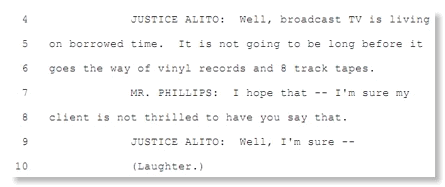
Recall the Justice Alito 2012 quote shown above in a dialogue with Fox’s lawyer at the Supreme Court. Elected officials, FCC staff, and even FCC commissioners can not be as candid as Justice Alito who has life tenure. Maybe OTA TV will be here forever, but shouldn’t FCC and the spectrum policy community consider other alternatives?
The spectrum held by TV broadcasters today has huge economic value. Without worrying about issues of “unjust enrichment” we should let the broadcasters recoup that market value by programs such as the incentive auction so that the spectrum goes to its best uses - not necessarily the CTIA membership. The present OTA broadcasters will thus be compensated and the political process will not have to deal with determining fair compensation or the nuances of § 304. But the main reason OTA broadcasters use spectrum and megawatts of RF is get “must carry” rights to demand compensation from MVPD operators. The vast majority of US household simply do not watch OTA signals directly, although NAB and CEA can’t agree on the details of the data. There must be a better way!
We also note that this year HBO and Game of Thrones dominated Emmy nominations. Here's how the broadcast networks stacked up:
- CBS – 47 nominations
- NBC – 46 nominations
- ABC – 37 nominations
- PBS – 34 nominations
- FOX – 18 nominations
And here's the list of non-OTA leaders
- HBO – 99 nominations
- FX Networks – 45 nominations
- Showtime – 24 nominations
- Comedy Central – 21 nominations
- Lifetime – 17 nominations
- FOX/NatGeo – 12 nominations
Notice a trend?
An Incorrect NerdAlert Prediction from 11/13
866 Mbps Achieved in Unlicensed 60 GHz Band
.Samsung Electronics announced the development of its 60GHz Wi-Fi technology that enables data transmission speeds of up to 4.6Gbps, or 575MB per second, a five-fold increase from 866Mbps, or 108MB per second, the maximum speed possible with existing consumer electronics devices. As a result, a 1GB movie will take less than three seconds to transfer between devices, while uncompressed high-definition videos can easily be streamed from mobile devices to TVs in real-time without any delay.
“Samsung has successfully overcome the barriers to the commercialization of 60GHz millimeter-wave band Wi-Fi technology, and looks forward to commercializing this breakthrough technology,” said Kim Chang Yong, Head of DMC R&D Center of Samsung Electronics. “New and innovative changes await Samsung’s next-generation devices, while new possibilities have been opened up for the future development of Wi-Fi technology.”
Unlike the existing 2.4GHz and 5GHz Wi-Fi technologies, Samsung’s 802.11ad standard 60GHz Wi-Fi technology maintains maximum speed by eliminating co-channel interference, regardless of the number of devices using the same network. By doing so, Samsung’s new technology removes the gap between theoretical and actual speeds, and exhibits actual speed that is more than 10 times faster than that of 2.4GHz and 5GHz Wi-Fi technologies.
Until now, there have been significant challenges in commercially adopting 60GHz Wi-Fi technology , as millimeter waves that travel by line-of-sight has weak penetration properties and is susceptible to path loss, resulting in poor signal and data performance. By leveraging millimeter-wave circuit design and high performance modem technologies and by developing wide-coverage beam-forming antenna, Samsung was able to successfully achieve the highest quality, commercially viable 60GHz Wi-Fi technology.
In addition, Samsung also enhanced the overall signal quality by developing the world’s first micro beam-forming control technology that optimizes the communications module in less than 1/3,000 seconds, in case of any changes in the communications environment. The company also developed the world’s first method that allows multiple devices to connect simultaneously to a network.
As is the case with the 2.4GHz and 5GHz spectrum, the 60GHz is an unlicensed band spectrum across the world, and commercialization is expected as early as next year. Samsung plans to apply this new technology to a wide range of products, including audio visual and medical devices, as well as telecommunications equipment. The technology will also be integral to developments relevant to the Samsung Smart Home and other initiatives related to the Internet of Things
Note the first sentence of the last paragraph: “As is the case with the 2.4GHz and 5GHz spectrum, the 60GHz is an unlicensed band spectrum across the world”. This did not happen by accident. It happened because of FCC initiatives in the 1980s and 90s that recognized technological advances had made new technology possible that was prohibited by anachronistic FCC rules at those times. The initiatives removed those prohibitions but did not require incumbent users to change their operations on bit nor did it increase their interference risk. As a result we have had technical innovation and economic economic growth.
While other WiGig companies like Intel, Wilocity (now owned by Qualcomm) and Nitero have been developing super-fast radios that work 60GHz channel, Samsung claims they’ve actually produced these enhanced speeds by fixing interference issues caused by other devices on the channel.
Now the problem is that the new NOI is rumored to contain a discussion about possible partial or total repurposing of the 60 GHz band for cellular communications, presumably on a licensed basis. The question to be considered on the 8th Floor is how will the fording of the 60 GHz discussion impact capital formation for innovative unlicensed 60 GHz technologies. We are sure the 60 GHz companies have less visibility on the 8th Floor than the major CTIA members and their insatiable demand for spectrum.
We hope the 8th Floor considers carefully the wording of such discussion and its impact on capital formation for ongoing unlicensed 60 GHz systems.
FCC 10/17 NOI to Explore Cellular Use in 60 GHz Wi-Fi Band
In a 9/26 blog post Chmn. Wheeler wrote:
“Sustaining the mobile revolution also depends on our invisible infrastructure – spectrum. The fact that there is no low-hanging fruit in our spectrum inventory that can easily be repurposed for broadband means that the Commission needs to think creatively about how to make more spectrum available and increase the efficiency of its use.
Historically, mobile wireless services have been targeted at bands below 3 GHz due to technological and practical limitations. However, there have been significant developments in antenna and processing technologies that may allow the use of higher frequencies – in this case those above 24 GHz – for mobile applications.
Acting on a recommendation of the Commission’s Technological Advisory Council, I am circulating to my fellow commissioners a Notice of Inquiry that seeks to broaden the Commission’s understanding of the state of the art in technological developments that will enable the use of millimeter wave spectrum above 24 GHz for mobile wireless services.
Early studies show that these new technologies – what some are calling “5G” – can ultimately facilitate a throughput of up to 10 Gigabits/second, a speed that is orders of magnitude greater than that available today. Our effort here is to learn about the technology and ensure a regulatory environment where these technologies can flourish.”
While this blog talks about enabling “ the use of millimeter wave spectrum above 24 GHz for mobile wireless services”, reliable FCC sources report that the current draft of the NOI being discussed for adoption on 10/17 includes discussion of the 57-64 GHz band known for WiGig and 802.11ad unlicensed technology for cellular use.
While we have advocated FCC action on long stalled millimeter wave actions, it is not clear if undoing a 1995 decision that made this an unlicensed band is a positive step forward. And while this NOI is credited to the FCC’s Technological Advisory Council (TAC), I just do not see where they even hinted at such action.
Furthermore, the FCC’s 2002 Spectrum Policy Task Force Report, while not binding, recommended that “all future rulemaking for terrestrial use above 50 GHz should include de novo review of the merits of licensing” due to the fact that propagation is so different than at lower bands.
So where did this idea come from?
Chmn. Wheeler's Speech on Broadband Competition: What Isn't Said About Spectrum Implications
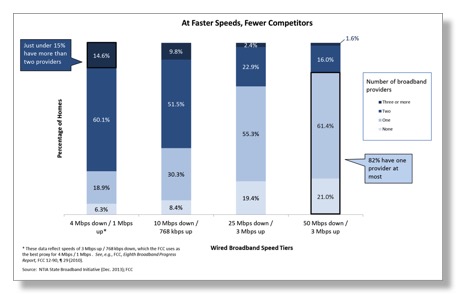
Yesterday, Chairman Wheeler gave a talk entitled The Facts and Future of Broadband Competition” in DC where the above diagram comes from. He introduced the speech as follows:
I want to discuss how the growing bandwidth demands of businesses and consumers are changing the competitive broadband landscape. My goal is not to criticize, but to recognize that meaningful competition for high-speed wired broadband is lacking and Americans need more competitive choices for faster and better Internet connections, both to take advantage of today’s new services, and to incentivize the development of tomorrow’s innovations.
He only uses the word “spectrum” 3 times, on p. 6, in the whole talk:
.Second, where greater competition can exist, we will encourage it. Again, a good example comes from wireless broadband. The “reserve”spectrum in the Broadcast Incentive Auction will provide opportunities for wireless providers to gain access to important low-band spectrum that could enhance their ability to compete. Similarly, the entire Open Internet proceeding is about ensuring that the Internet remains free from barriers erected by last-mile providers.
Third, where meaningful competition is not available, the Commission will work to create it. For instance, our efforts to expand the amount of unlicensed spectrum creates alternative competitive pathways. And we understand the petitions from two communities asking us to pre-empt state laws against citizen-driven broadband expansion to be in the same category, which is why we are looking at that question so closely
We agree with everything he says, but what is telling is what is not said.
The text has the sentence “Today, a majority of American homes have access to 100 Mbps.” This compares well with the statement on p. 9 of the National Broadband Plan (NBP) that “As a milestone, by 2015, 100 million U.S. homes should have affordable access to actual download speeds of 50 Mbps and actual upload speeds of 20 Mbps.” (For reference, Census reports that there are 115,226,802 households in the USA.) Thus at least 57 million homes have access to 100 Mbps, although not necessarily affordable access.
NBP goes on to say
GOAL NO. 3: Every american should have affordable access to robust broadband service, and the means and skills to subscribe if they so choose.
Today’s FCC definition of “broadband” is 4 Mbps which Wheeler calls appropriately “yesterday’s broadband”. He goes on to say, echoing NBP
“high-speed connections are crucial not only for the kind of innovation that will educate our children and deliver quality health care, but also improve energy efficiency, fill the employment ranks, and maintain the United States as the world’s innovation leader for the 21st Century.”
Inside sources tell us that early drafts of NBP mention the impact of this on spectrum: If everyone in the US had access to broadband, even 25 Mbps - already, according to the Chairman on p. 3, 80% have access at some price - why would we the need over the air (OTA) DTV in urbanized areas? The motive for introducing universal broadband is NOT to replace OTA DTV, but rather to move our economy and society forward.
Readers may recall our January 2012 piece on Justice Alito’s comment on OTA DTV during oral arguments:
Unfortunately FCC commissioners are not allowed to make such comments publicly for fear of offending NAB. They even stripped the topic out of the NBP after an early draft leaked to broadcast interests (apparently from 8th Floor sources) and they started getting calls from Congress.
Note that we are not necessarily advocating moving more spectrum from broadcasting to cellular, rather we are saying that the large broadcasting allocations will become more and more untenable as a matter of public policy as broadband penetration increases. This could be accelerated if “free TV” for lower income households could be replaced through freemium basic cable-like service over Internet. All household would be better off with effective broadband. Pumping hundreds of thousands of watts of RF power over several MHz from large transmitter towers in order to qualify for retransmission consent or must-carry could become “so 20th century”! We do not wish the financial demise of the NAB membership, the incentive auction gives them one way to monetize their long term investment.
Your blogger joined FCC spectrum management 35 years ago this month. The world of spectrum use has change considerably in those 35 years with cellular, impact of cellular frequency reuse permitting spectrum productivity that seemed impossible, the upper band of permitted spectrum at 95 GHz, spectrum efficiencies that exceed 1 bps/Hz, DTV, etc. The increasing concentration of spectrum in cellular companies may not be optimal for our society and economy with respect to new spectrum needs we do not understand today just as in 1979 FCC did not appreciate what was coming, e.g. Part 90 was seen as needing much more spectrum then.
While we think that the military needs to be more flexible about its spectrum needs and sharing with the private sector, the US has the largest and most information intensive military in the world and recent events show that for the foreseeable future we face more national security threats that most countries represented in 3GPP. Thus while we may be able to downside or eliminate the need for OTA DTV as broadband penetration reaches new goals, we should not necessarily hand over the spectrum in a way that can not be readily reversed to systems designed in 3GPP for other markets.
NAB should not be able to veto dialogue on the spectrum impacts of broadband penetration just as CTIA should not be able to demand every Hz that “isn’t nailed down”.
UPDATE
As if on cue, the day after this was posted, our home town newspaper had an article entitled “TV is increasingly for old people”. The beginning of the article stated:
The median age of a broadcast or cable television viewer during the 2013-2014 TV season was 44.4 years old, a 6 percent increase in age from four years earlier. Audiences for the major broadcast network shows are much older and aging even faster, with a median age of 53.9 years old, up 7 percent from four years ago.
These television viewers are aging faster than the U.S. population, Nathanson points out. The median age in the U.S. was 37.2, according to the U.S. Census, a figure that increased 1.9 percent over a decade. So to put that in context of television viewing, he said TV audiences aged 5 percent faster than the average American.
Of the networks, Fox has the youngest average viewer age at 47.8 years while CBS has the oldest at 58.7 years. Broadcasting & Cable, the industry’s cheerleader published a similar article on the new data.
Internet Video Use Rises
The Pew Internet & American Life Project released a report this week entitled “Online Video 2013” that CTIA was happy to tweet about under their “FunFactFriday” hashtag as part of their never ending feud with NAB.

The Poynter Institute, an international strategy center and a leader in journalism education, posted the following chart of one of the report’s key findings of the report:
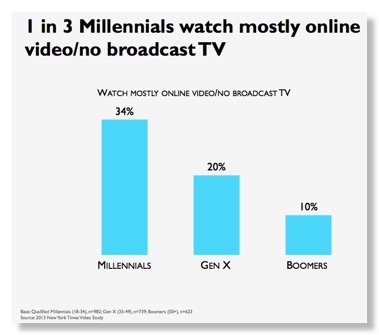
Note that this is similar, but stronger, than the “zero TV” data reported a few months ago by that archenemy of broadcasting, CBS News.
Note that this trend is also related to the NAB/CEA feud over how many homes even have an antenna to watch over-the-air (OTA) DTV.
So if FCC ever become functional and if the incentive auction can be done on schedule with the unexpected delay, parties may wish to consider the long time viability of the classic TV broadcasting model and the statement of Mr. Justice Alito, previously reported here.
For the record, your blogger believes that there is a future for TV broadcasters and even OTA DTV, but it is very different than the one that NAB publicly describes.
Spectrum Lessons from the 2013 Emmys

As NAB engages in arguments with others about how many homes actually watch over-the-air (OTA) television, this week’s Emmy’s demonstrate some of the real problems the TV broadcast establishment is having with their nonspectrum-based competition for the hearts and minds of America.
Consider the outstanding series/program categories of awards:
- Outstanding Comedy Series - Modern Family (ABC)
- Outstanding Drama Series - Breaking Bad (AMC)
- Outstanding Variety Series - The Colbert Report (Comedy Central)
- Outstanding Miniseries or Movie - Behind the Candelabra (HBO)
- Outstanding Reality - Competition Program - The Voice (NBC)
Also consider the outstanding actor/actress awards:
- Outstanding Lead Actor in a Comedy Series - Jim Parsons as Dr. Sheldon Cooper on The Big Bang Theory (Episode: "The Habitation Configuration") (CBS)
- Outstanding Lead Actress in a Comedy Series - Julia Louis-Dreyfus as Selina Meyer on Veep (Episode: "Running") (HBO)
- Outstanding Lead Actor in a Drama Series - Jeff Daniels as Will McAvoy on The Newsroom (Episode: "We Just Decided To") (HBO)
- Outstanding Lead Actress in a Drama Series - Claire Danes as Carrie Mathison on Homeland (Episode: "Q&A") (Showtime)
- Outstanding Lead Actor in a Miniseries or Movie - Michael Douglas as Liberace on Behind the Candelabra (HBO)
- Outstanding Lead Actress in a Miniseries or Movie - Laura Linney as Cathy Jamison on The Big C: Hereafter (Showtime)
Thus in voting by TV industry insiders (not the antibroadcast types at CEA or even CTIA), OTA TV won only 2 out of 5 outstanding program/series awards and only 1 out of 6 outstanding actor/actress awards. Note that HBO alone got more of these awards than ALL of the traditional OTA networks! Sounds like today’s OTA TV is having trouble capturing the audiences it used to get. Maybe it can do better?
Or maybe the whole OTA TV business model is now flawed?
I was interested to read several times that Netflix has outbid its competitors for new popular programming. One reason could be that Netflix has a vast database of user preference information compared to what OTA TV execs have. This allows Netflix to predict the success of new programming better and thus outbid networks and other video providers. GigaOm has written
Netflix didn’t have to spend millions of dollars advertising the new show hoping you would tune in — it knew you’d see it in the recommendations, it knew you’d give it a try and it knew you’d like it.

Together, the major broadcasters account for more than 21 percent of prime-time viewing in the current TV season, down from almost 75 percent in the early 1950s, before cable programmers emerged, according to Nielsen data.
Recently we stayed with a real “millennial” who had 15 Mbps service from Comcast, 2 computers, but no TV and no cable subscription either. For video she relied on Amazon, not the NAB membership. Time will tell how this trend evolves, but it probably should affect spectrum policy decisions in urbanized areas particularly if we can develop mechanisms to replace “free TV’ with universal video service. Actually the National Broadband Plan basically had that but it was too controversial with broadcasters to emphasize.
Europe loves Wi-Fi: new EU study recommends more spectrum should be made available
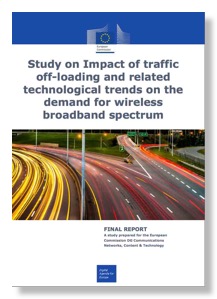
(The primary author of the study is former FCC staffer J. Scott Marcus, now with Germany’s WIK Consult, who is not related to your blogger although we were friendly when we both worked down the hall from each other and while we both lived in Europe.)
It appears that the cellular establishment was behind the ill fated Section 104 of The Spectrum Innovation Act of 2011 that would have required an ill conceived unlicensed auction before FCC could create any additional unlicensed spectrum, even in ISM bands or above 100 GHz! However, the cellular establishment covered its tracks very well because no one ever spoke in public in favor of this odd provision. But since this provision appeared in a House committee staff memo written by a former CTIA staffer, it is a likely guess that CTIA was somehow behind it.
Here is the report summary from the EU website:
How is traffic off-loading evolving over time, both in terms of technical and of market developments, and how does this evolution influence the need for spectrum? It is widely recognized that traffic on the macro cellular network is growing rapidly, largely as a result of impressive take-up of smartphones and tablets. The surprising and little recognized reality is that, according to credible data captured from a range of sources, the visible growth in macro cellular mobile network traffic appears to be only the tip of a much larger iceberg. The volume of traffic that is already being off-loaded, chiefly to Wi-Fi in the home, already exceeds that of the mobile network, and can be expected to grow even faster as well. This is largely a result of the considerable effort that equipment vendors and standards bodies have invested in developing both Wi-Fi and cellular standards to improve interworking between the two and to optimise use of the available spectrum. Traffic off-load generates surprisingly large socio-economic benefits by virtue of the cost that MNOs have saved, or can be expected to save, by building a smaller network thanks to data traffic off-load. Relatively little action is needed at European level; however, a few interventions should be considered in order to ensure that the momentum is maintained. Among these are (1) seeking to make spectrum from 5150 MHz to 5925 MHz available globally for Wi Fi; (2) continue seeking to make 2.6 GHz and 3.5 GHz fully available for mobile use; (3) consulting on future licensing options for 3.5 GHz and other potential new licensed mobile frequency bands; and (4) various measures to reduce administrative burden on the deployment of public off-load services and networks.
Now the spectrum actions here are not really different from what the FCC is trying to do. But FCC seems too intimidated by the cellular establishment and their endless appetite for new spectrum to talk very visibly about this topic. However, snooping around the FCC website we did find this statement in an FCC blog in 2011 by John Leibovitz & Robert Alderfer:
Importantly, the (Cisco) report accounts for some offsetting effects, most notably the use of WiFi and femtocell networks to “offload” capacity from the mobile network to a fixed broadband connection. Cisco estimates that about 21% of traffic from smartphones and tablets was offloaded to WiFi or femtocells in 2010 and that this proportion will increase to 30% by 2015. This finding demonstrates the vital importance of unlicensed spectrum in helping address our nation’s wireless capacity needs. Still, overall traffic growth is likely to outpace offloading, according to Cisco’s forecast.
Also in 2011 Chmn. Genachowski said “Traffic offloading to WiFi helps reduce congestion that could otherwise impair the flow of data on commercial networks. WiFi and other innovations based on unlicensed spectrum have contributed hundreds of billions of dollars to our economy, and offer tremendous potential to foster economic growth and job creation.”

(Graphic from EU website)
Efficient Use of Government Spectrum Act of 2013: NTIA Will Regret Its Silence on AWS-3

CEA immediately praised the new bill with its president and CEO Gary Shapiro, saying:
“This legislation represents an important effort in reallocating our nation’s valuable spectrum for wireless broadband, while raising much-needed funds for the U.S. Treasury. The 1755-1780 MHz band represents key spectrum that our nation’s innovators need to deploy robust mobile broadband networks for the benefit of all Americans.”
Similarly Tim McKone, AT&T Executive Vice President of Federal Relations, said
“AT&T commends Congresswoman Matsui and Congressman Guthrie for introducing legislation that would free up spectrum that is critically important for the wireless industry. While AT&T continues to work with federal agencies and industry on potential spectrum sharing scenarios of government-held spectrum, the economic benefits of an exclusive licensing framework cannot be denied. The wireless industry has invested billions of dollars in infrastructure under this framework. Making the 1755 MHz to 1780 MHz spectrum available for commercial mobile broadband use will not only spur additional investment but will further help fund our nationwide public safety network.”
Oddly, T-Mo, the most obvious beneficiary of this action has been silent to date.
[Note even though AT&T and CEA are praising the new bill, the text is not yet available to mortals such as us. A visit to THOMAS, the Library of Congress website for “the rest of us” at the time of this writing returns the following message:
“The text of H.R.2739 has not yet been received from GPO “]
But this brings to mind NTIA’s silence curing the M2Z/AWS-3 struggle in which M2Z Networks, a former MSS client, sought to solve the idle status of the 2155-2180 MHz band by using it for time division duplex (TDD) operation and leave the federal users in the lower band alone. This proposal was vilified by the cellular industry in general, except for Sprint which was supportive of TDD, and was the subject of a 4.5 year FCC deliberation that was never resolved on either the technical or nontechnical issues pending. Indeed, it ended with a phone call from an FCC staffer to M2Z’s main investor that said though even though over 4 years had elapsed FCC couldn’t decide. The Commissioners never voted on the issue.
NTIA was silent during this proceeding and now probably regrets this silence. Because had NTIA been supportive of the technical issues involved and helped show that careful TDD use of 2155-2180 MHz could have protected T-Mo from its own foolish decision to use handsets made for the European band plan for the US market, NTIA could have helped protect federal users from the hurried expulsion from this band that will result from the new bill. NTIA routinely meddles in FCC spectrum rule makings and, as was mentioned previously here, often uses vagaries of the FCC’s ex parte rules to hide its tracks.
But NTIA probably did want to rile the cellular establishment at the time so they sat idly by while TDD use of the upper band was attacked by almost everyone. Now the hens are coming home to roost and federal users should ask how they got into this hole -- something that was perfectly predictable.
UPDATE
A few days after this post, DoD threw in the towel and agreed to vacate the 1755-1780 MHz band. But, FierceWireless adds:
“However, it's unclear how workable the Pentagon's new offer of a compromise will be. The DoD said that it will cost about $3.5 billion to move its operations out of the spectrum. According to the Wall Street Journal, the Pentagon plans to compress much of its operations into the 1780-1850 MHz band, and will also move some of its operations to the 2025-2210 MHz band, which is currently used by TV broadcasters. However, the Pentagon left many details up in the air, including a timetable for moving off the 1755-1780 MHz band.”
As we pointed out in February, SECDEF Hagel had experience in the cellular industry, -- a point most of the other media outlets missed. While I don’t think Sec. Hagel favored his old comrades over national security, he probably was the first SECDEF to ask the right questions about the military’s voracious appetite for spectrum and about whether this was the band to fall on your sword for Maybe we see more in his memories in 10 years.
The text of HR 2739 is now available for “the rest of us”.
CTIA and NAB's Battling Innovation Websites - I
The blood feud between CTIA and NAB is being expressed now in battling websites, each claiming how innovative their side is. From NAB we have WeAreBroadcasters.com/Innovating and from CTIA we have WirelessisLimitless.org. This is the first of a 2 blog series examining these claims. To be “fair and balanced”, as Fox News would say, we will deal with both sites. CTIA was randomly selected to be first. The following 2 videos are at the top of the CTIA site.
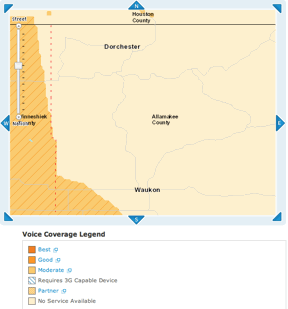
Agriculture is important to the economic fabric of Allamakee County and Iowa. Allamakee County’s 1,032 farms cover 274,844 acres of land, which accounts for 65 percent of the surface land in the county. Crop and livestock production are the visible parts of the agricultural economy, but many related businesses contribute as well by producing, processing and marketing farm and food products. These businesses generate income, employment and economic activity throughout the region.Allamakee County farmers harvested 60,364 acres of corn and 22,008 acres of soybeans, and produced 87,017 hogs and 55,246 head of cattle in 2007. Farms on average are smaller in Allamakee County, at 266 acres, than the statewide average of 311 acres. Sales per farm in Allamakee County were $127,524 in 2007.
Now is spectrum shortage the reason for this lack of cell coverage in these farming areas? A check of the FCC Spectrum Dashboard shows that VZW (dba Cellco Partnership) has licenses in : Fremont, Page, Taylor, Ringold, and Decatur counties in both 700 MHz and the 1700/2100 MHz band, while AT&T (dba AT&T Mobility Spectrum LLC) has licenses in the same 2 bands in Allamakee County where it has no service.
Another odd thing about the videos is the focus in the first one on Smartfield, Inc.’s SmartCrop field monitoring technology. Quite impressive. So we surfed over to the FCC’s equipment authorization site to learn more about this equipment. (Smartfield’s grantee code is “W9B” if you want to check.) Smartfield has 7 FCC equipment authorizations, all of which are for unlicensed Part 15 equipment, the type of thing that CTIA consistently opposes new spectrum for. The video claims that the SmartCrop system uses cellular paths for transmission of data from a central point in the field to Smartfield’s analysis service. So the SmartCrop system appears to be a hybrid unlicensed/cellular service - an inconvenient fact not mentioned in the video.
The second video focus on the wonders of John Deere’s high tech services for farmers. Remember John Deere? These are the people with the irresponsible GPS receiver front end design that covered the GPS band as well as the band above and below it even though it was public knowledge that LightSquared and its predecessors had been given authority to build base stations in the lower band years earlier. The Deere GPS design was easily overloaded by any nearby signal in the adjacent bands and thus was a major cause for the current interest in receiver standards. The CTIA membership did not want LightSquared to compete with them and probably encouraged the John Deere issue as the poster child in the anti-LightSquared campaign to garner political support from farm state members of Congress. So maybe this focus on John Deere could be payback for their anti-LightSquared help.
But if you are a farmer and want to use technology like Smartfield’s or John Deere’s, you really have to have cellular service and the main CTIA members don’t seem to be in a rush to use their existing spectrum to give it to you as they demand more spectrum.
As a sailboat owner, your blogger was impressed with the beauty of the photography in this CTIA video on the Wireless is Limitless site:
Your blogger’s cellular booster antenna
Carrier registration pending
(vertical white rod)
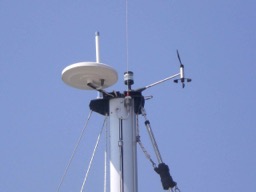
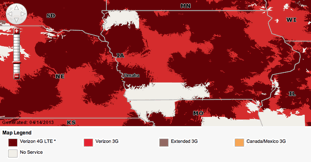
This video describes how the Chesapeake Bay Interpretive Buoy System uses cellular transmission to get real time data on water conditions to fishermen (actually called “watermen” in local parlance) and researchers. But then we recalled that the reason we have a “cellular booster” (fought against so long by the cellular industry in Docket 10-4 and the CTIA 2007 petition) on our boat is that cellular coverage on Chesapeake Bay has real problems. (A cellular industry spectrum specialist acquaintance who also sails - but will not be named here - uses Iridium to keep in touch from his boat.) Let’s look at VZW’s claimed coverage (AT&T’s and T-Mo’s are similar) on Central Chesapeake Bay, the area near Solomons, MD actually shown in the video:
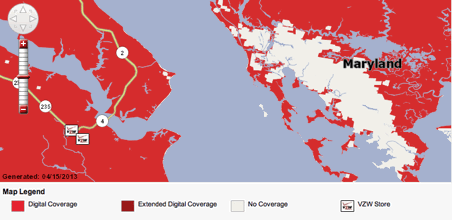
Guess what FCC’s Spectrum Dashboard shows here? Yup, AT&T, T-Mo, and VZW all have multiple licenses in Dorchester County where the white blocks are on all their coverage maps. This is also not a mountainous area.
So whether it is farming in Iowa or maritime coverage on Chesapeake Bay, there are real cellular coverage problems that have nothing to do with spectrum presently available to the cellular industry. As shown above, in these nonmontainous areas there seems to be a lack of interest in the major cellular carriers to finish rolling out their networks. This is good for Iridium and other satellite carriers, but not really good for the public.
The cellular industry certainly needs more spectrum access to keep up with expanding uses that help our society and the economy. But these rural cases are good examples of why spectrum sharing is so important. The real spectrum shortage is in urban areas where civil demand is great and military use small - San Diego being a notable exception. But the demands of the industry for complete reallocations when they can’t even use all the spectrum they have today sound hollow. Why can’t all spectrum users work together to find mutually beneficial solutions to their spectrum problems that don’t depend on cheap Chinese-made equipment. Let’s cool the PR rhetoric and work on real problems.
The review of NAB’s site, also over the top, with be up in a few days.
Spectrum Crisis: Fact Or Exaggeration?

My friends at RF Globalnet had an interesting article written by their editor,Paul Kruczkowski, on November 12th with the above title. Here is the introduction:
It appears that the wireless spectrum crisis may have recently become the mobile broadband spectrum debate. Since 2010 — when the FCC declared that there would be a spectrum deficit of 275 MHz as soon as 2014, and subsequently released its National Broadband Plan to make 300 MHz of spectrum available by 2015 and 500 MHz available by the end of 2020 — it has been widely accepted that we are facing an impending spectrum crisis. The CTIA – The Wireless Association has long supported this position and recently reinforced it with data in its Semi-Annual Wireless Industry Survey showing significant growth in wireless subscriber connections and wireless network data traffic over the past year. Others, however, are questioning the validity of the crisis claims and the projections of runaway wireless network data traffic that have been used to support this argument since 2010.
The interesting thing about the critics of the presumed crisis is that they agree with the FCC and CTIA that the wireless broadband industry would benefit from more available spectrum. On the other hand, they definitely disagree with CTIA’s projected 100%+ annual growth of network data traffic and the FCC’s doomsday position of a massive spectrum deficit by 2014. Tim Farrar, president of consulting and research firm Telecom, Media and Finance Associates, Inc., recently wrote an article on GigaOM called “The Myth of the Wireless Spectrum Crisis”, in which he questioned the FCC’s and CTIA’s narrative of an impending spectrum crisis and used the CTIA’s own data to show that network data traffic growth slowed substantially in the first six months of 2012.
For bureaucratic reasons I can not reprint the whole article, but urge readers to surf over to it. The comments are also interesting. While much cynicism about the cellular industry’s spectrum goals comes from broadcasting circles, RF Globalnet is a techie publication with readers generally unrelated to broadcasting issues.
Broadcasters' Property Rights
It is ironic that a National Broadband Plan insider told me that the first draft of NBP included a similar discussion. But so impressive are the powers of the broadcast interests and so “captured” is the FCC, as are many other regulatory agencies, that within 30 minutes of the release of the first NBP draft to the FCC Media Bureau the Chairman’s Office started getting calls from the Hill objecting to this approach.
Wow! That’s raw political power and regulatory capture! NAB - real impressive. CTIA may still have at the moment the inside track on the 8th Floor, but don’t count out the broadcasters with their decades of experience with playing power games.
(Of course, one might also want to address why there is such regulatory capture and start countermeasures, but I doubt anyone at FCC wants to address that issue. I believe that an active program of job rotation by career civil servants would be a major step to deter such capture. But there has never been interest on the 8th Floor in such an approach since the focus is always on near term gains not long term benefits and rotations would have near term costs.)

US broadcasters have no property rights in spectrum,
says academic research:
The work claims the legal status of broadcasting spectrum is as clear as mud
but incentive auctions are a wayof sidestepping the problem
by Dugie Standeford
© PT Publishing 2012 Tel: +44 (0)20 7100 2875
Reprinted by permission
Legal claims to property rights in spectrum are “highly tenuous” and would likely allow the US government to reclaim the spectrum without compensation
The US Spectrum Act authorising “reverse” and incentive auctions gives broadcasters the option of handing back their 6 MHz licences, relinquishing spectrum and sharing their TV channel with other licencees, or moving from a UHF to a VHF channel. In the reverse auction phase, broadcast TV licensees will be able to bid to voluntarily give up spectrum usage rights in exchange for payments. But one vexing, and still unresolved, question – on which the Federal Communications Commission (FCC) is now seeking comment – is how to determine how much winners of the reverse auction should receive.
Two academic papers by financial analyst Armand Musey, founder of Summit Ridge Group LLC, explore possible property rights broadcasters may have in the spectrum they hold and legal bases on which the government could reallocate the spectrum and assess compensation.
One article, “How the Traditional Property Rights Model Informs the Broadcast Television Spectrum Rationalization Challenge,” appeared in the Spring 2012 Hastings Communication and Entertainment Law Journal. The second, “Broadcasting Licenses: Ownership Rights and the Spectrum Rationalization Challenge,” is in the Spring 2012 issue of the Columbia Science and Technology Law Review. Musey's research focuses on telecom and media regulation with an emphasis on how regulatory policy affects business models and public welfare, and he's particularly interested in wireless spectrum valuation, he said.

The National Association of Broadcasters would not discuss the specifics of the property rights question. But Dennis Wharton, executive vice president, communications, told PolicyTracker that the premise that broadband is somehow a higher and better use of spectrum than broadcasting “is fundamentally flawed.” Musey's research doesn't acknowledge that broadcasting's “one-to-everyone” transmission architecture is far more efficient that the inefficient “one-to-one” architecture of cellphones and the Internet, he said. “The reality is that broadcast and broadband are complementary services, and the government ought not be in the business of favouring one over the other,” he said in an email.
Broadcasters' legal claim
Legal claims to property rights in spectrum are “highly tenuous” and would likely allow the US government to reclaim the spectrum without compensation when broadcast licences expire, Musey wrote in the Hastings article. But the fact that the US has made the reverse auction voluntary, and that it won't force broadcasters to relinquish spectrum, shows that it “is essentially recognizing even greater possession rights for the broadcasters than owners of private property traditionally enjoy,” he said.
There is inherent tension” between the 1934 act, which says spectrum licence holders have no property rights, and the “seeming implicit guarantees of renewal and increased ability to transfer” in later law
But claims that FCC licences confer property rights are weak, the Columbia article argued. Broadcasters' right to control their spectrum are set out in the Communications Act of 1934 and the Telecommunications Act of 1996. Analysed according to their text and relevant legislative history, those measures indicate that broadcasters don't have a claim to property rights that would entitle them to payment for non-renewal of their licences, Musey said. But if one considers how the laws have been applied in some situations, broadcasters may have some “legitimate (and growing)” expectation of property rights, he said.
One area where those rights might be implicated is in the fact that all FCC licence holders expect their licences to be renewed automatically unless they egregiously violate the terms, Musey wrote. Moreover, broadcasters' increased ability to transfer licences suggests they may have some property rights in them. All this is countered, however, by other language in the 1996 act that lets the FCC change a broadcaster's rights upon renewal by, say, reducing the current spectrum allocation of 6 MHz or moving it to a less desirable part of the band. The fact that the regulator has the discretion to make such changes signals that the government still has significant control over the spectrum, he said.
“There is inherent tension” between the text of the 1934 act, which says that spectrum licence holders have no property rights, and the “seeming implicit guarantees of renewal and increased ability to transfer” in the later law, Musey wrote. While 60 years of FCC and congressional policy decisions seem to give broadcasters some expectation of property rights in their licences, however, the fact that Congress has never amended the provision that states explicitly that no such property rights exist makes it likely that any claim for property rights would fail, he said. And even if broadcasters did have some rights in the spectrum and were entitled to compensation for non-renewal, they wouldn't be entitled to payment for any increased value arising from the government's future use and/or need of the spectrum for higher-value, mobile broadband applications, he said.
A need to “fudge”
For practical and political reasons, the most expedient solution to reallocating TV spectrum is for the government to negotiate a price to buy out broadcasters that is more generous than the minimal legal compensation required to give them due process, Musey wrote. But it will be hard for the government to legally justify such a payment without facing claims of waste of government assets; and, conversely, it would be difficult to maximise the value of future FCC auctions to motivate licencees to invest in advanced services on their spectrum if the FCC has a policy of depriving licencees of their expected licence rights, he said. Finding a solution is a challenge, he said.
Maybe that's why the FCC and Congress decided to “fudge” the issue by settling on the idea of a voluntary incentive auction, Musey said. The Spectrum Act requires the regulator to base the incentive auction price on the result of a reverse auction to determine broadcasters' asking price for relinquishing their spectrum. That payment will likely reflect a discount to the market value of the spectrum to its higher-value use but also perhaps be slightly higher than its current use value, he said. The “stick” to encourage broadcasters to participate in the voluntary process is the FCC's argument that it can modify the licences at any time, and the implicit threat to take the spectrum away, he said. While the Spectrum Act prevents the FCC from doing that during the auction process, it could do so after the auction to clear spectrum in problem markets with holdout broadcasters, he said.
'Politically influenced” higher payment best?
Treating spectrum rights as having elements of private property prompts questions about how the government will pay broadcasters for the loss of their rights, Musey wrote. If the FCC can't reach a voluntary settlement with broadcasters, it could try to seize the spectrum under “eminent domain” principles, he said. Under that approach, the government, under the Takings Clause of the US Constitution, would buy licences at the fair market value of the loss it causes a broadcaster's current business.
Eminent domain law prevents payments based on the increase in value of the property for the government's higher-value intended future use, but the political pressures surrounding the incentive auction could push the government to sweeten the offer beyond the current market value of TV broadcast use, Musey wrote. In fact, offering a sum that exceeds market value “may be the most expeditious solution” to shifting broadcasters off the spectrum, he said.
Can the analysis help broadcasters set reverse auction prices?
Asked if his approach could help broadcasters come up with prices for the reverse auction, Musey said, “Yes and no.” Broadcasters can set their fees, but the FCC will decide which bids to accept, he said. If the regulator decides the prices are too high, or not enough broadcasters submit bids in the market where the FCC wants spectrum, “we are back to square one with the government theoretically having the ability to not renew the licenses,” he said.
The FCC's “not so subtle message” to broadcasters is, “We are going to get this spectrum one way or another and if you don't submit sufficient[ly] reasonable bids and we have to pry it away later, it will be on much less attractive terms,” Musey said. There is very much a negotiation over what is reasonable, he said. The FCC must also try not to apply too much pressure and undermine the success of later auctions, or deter other current and future licencees from investing in new services out of concern over the stability of their spectrum licences, he said.•
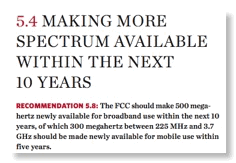
How Do You Count to 500?

On February 24, 2010 Chairman Genachowski announced in a speech at the New America Foundation:
“First, we are going to announce a gameplan to unleash more spectrum for mobile broadband. The National Broadband Plan will set a goal of freeing up 500 Megahertz of spectrum over the next decade. We will work closely with NTIA to do so.”
CTIA had previously stated
So the 500 MHz no doubt was a compromise number that attempted to address reality.“we need at least another 800 MHz within six years to meet the increasing consumer demand whether it's for mobile Internet, mHealth, smart grids, or a number of other wireless uses that change the way we live and work."
Traditionally the cellular industry has used full duplex symmetrically pair spectrum. Thus the cellular 800 MHz band is 824-849 MHz (mobile-to-base) paired with 869-894 MHz (base-to-mobile). The same type of symmetric pairing was used for PCS and 3G in high bands. This was clearly necessary when the predominant use of cellular was 2-way voice which has little tolerance of time latency/delay. But the rapid expansion of mobile communication volumes predicted by CTIA and the NBP are not 2 way voice, rather they are Internet and video related - categories that are asymmetric in information flows and more tolerant in time latency. Many of these flows are also highly intermittent as compared to voice, with high peak to average data rates. Is the traditional type of allocations the best way or the only way to handle this type of growth?
Your blogger has no objection to the reallocation of 500 MHz of spectrum for the traditional paired symmetric use, but it is becoming increasingly clear to all involved that finding 500 MHz of such spectrum will be in the extremely difficult to nearly impossible range. In addition, the major need for spectrum is in major metropolitan areas and the focus on nationwide availability of spectrum ignore options. From what I have heard, the cellular establishment wants FCC and NTIA to find it spectrum that has all the following characteristics:
- Nationwide full time availability
- Paired
- In large contiguous blocks
- Consistent with international allocations and international standards (note that this is not a legal requirement except near borders with Mexico and Canada absent a bilateral agreement)
So isn’t it time to start thinking of Plan B? If 500 MHz of spectrum meeting the cellular establishment’s 4 conditions can not be found with politically acceptable impact on other federal and nonfederal uses, how would “noncomplying” spectrum count towards the 500 MHz goal? Maybe for tactical reasons the cellular establish doesn’t want to consider this possibility, but to many of us it is a quite real possibility as none of the “spectrum haves” are anxious to release their part of the 500 MHz or have any impact from its altered use, e.g. GPS/LightSquared problem.
CBO knows how to “score” budget proposals, should FCC and NTIA start thinking about how to “score” spectrum reallocations with respect to the 500 MHz goal?
[I help my international neighbors by reading in English to their 4 year old. While I was writing this post, one of the books he selected was this one.I recommend it!]
New Cellular Advocacy Group Trivializes Spectrum Policy Issues
A new group, Mobile Future,
is dedicated to educating the public and key decision makers on innovations in the wireless industry that have transformed the way Americans work and play and to advocate continued investment in wireless technologies. We look forward to keeping you in the loop about our news and events.
It apparently is trying to do this by producing PR that trivializes key spectrum issues, rather than encouraging productive dialogue on the issue or even improving the governmental decisionmaking process.
Mobile Future is a mixture of cellular industry groups that partially overlaps the CTIA membership and some public interest groups. The industry membership includes AT&T, T-Mobile, Alcatel-Lucent, Qualcomm, Cisco, and Ericsson but does not include Sprint, Verizon, Nokia, or Motorola. Other members include Black College Communication Association, Labor Council for Latin American Advancement, National Gay and Lesbian Chamber of Commerce, and the National Association of Neighborhoods. You can be pretty sure that the first group of members named above are paying the bills and the second groups is there for “window dressing”.

Note that the “pie” shown here, only includes spectrum used by the sponsors with the except of “radio and TV” - would that spectrum management be so simple. In reality there is military use, there is FAA use, there is local, state, and federal public safety use. There is even amateur radio use, not to forget radio astronomy.
But is mobile capacity really proportional to available spectrum? We will not here get into the previously reported NAB and CTIA battling reports. Your blogger is closer to CTIA on that issue than NAB. But the Mobile Future viewpoint is just too much to swallow.
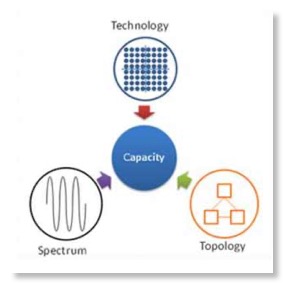
Ofcom, FCC’s well respected UK counterpart, released in January a report entitled 4G Capacity Gains. The study starts with a bold and simple statement that is usually fuzzified in the US cellular industry’s presentations:
- Technology – the cell spectrum efficiency that can be realised by a given feature set
- Spectrum – the bandwidth allocated to a network
- Topology – the mixture of cell sizes and local environments in the network
The report concludes,
“ technology improvements alone will not meet forecast demand increases and that a mixture of changes in topology and spectrum will be required to meet this increase in demand. It is recommended that previous studies into the dimensioning of future spectrum requirements for 4G networks are revisited with the revised cell spectrum efficiency results recommended by this study in mind.”
Thus spectrum alone is not enough to solve the problem, changes in “topology” or number of cells is critical to meet capacity goals.
How is the US doing in this area? A topic the mainstream cellular industry doesn’t like to talk about. Here is one observer’s viewpoint.
FastNetNews reports
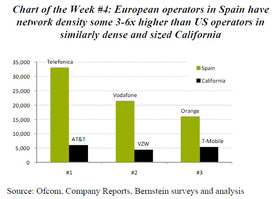
Yes, the cellular industry need more spectrum. But a singular focus on spectrum ignores the need for more infrastructure and improved technology. Indeed, the Commission’s sometimes indifferent view towards new technology and the capital investment needed to develop it is also a detriment to more wireless services to serve society and help the economy. Finally, the singular focus on spectrum is leading to more and more “food fights” over spectrum that FCC (and NTIA) is/are unable to resolve in a timely way.
UPDATE
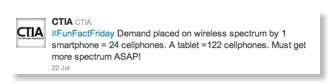
Apparently, the real CTIA is perfectly capable of trivializing spectrum policy also. here is a tweet that CTIA sent out several times on July 22:
Spectrum Issues in NBP
On the same topic is a presentation you blogger gave on NBP in Japan on Monday to the Association of Radio Industries and Businesses (ARIB), an organization roughly comparable to TIA.
New Spectrum Tools Available

The UE site has allocation table information and includes both ITU and domestic footnotes (US, G, and NG ) for the spectrum from to 9 kHz to 1000 GHz. There is even a useful guide to allocation information.
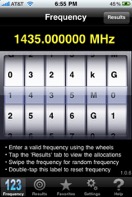
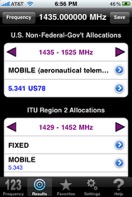
Amusingly it has this one scathing review on the Apple app site from a ham, “If there was a lower rating than 1 star. i would want as low as I could. I been a ham radio op. for 40+ years this is the most useless app I’ve seen.” Well, for most hams it is probably pretty useless, but I suspect readers of this blog will have a different viewpoint.
Both UE and Allocations allow easy access to all footnotes - not so convenient in paper versions.

You can search for a spectrum block and get something that looks like the NTIA spectrum chart for that block that tell you what services are allocated. But the information is presented in allocation jargon such as “This band is used for the Mobile Satellite Service. This is allocated for both Federal and Non-Federal use” with no indication of what the use is called in normal jargon of if the band is actually in practical use. However, you can search more in a window alongside the NTIA-like chart and find what bands in a specific service are in the frequency range of interest and then you get a plain language description of what is happening such as:
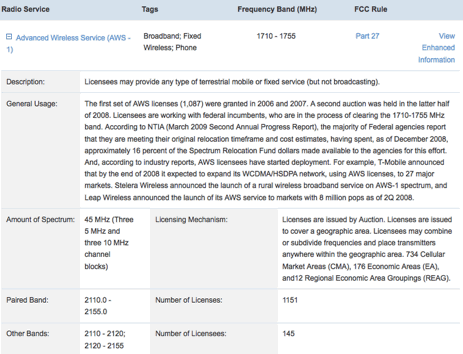
The “View Enhanced Information” button then gets you a list of licenses in that band! This was available before in ULS, but this method is much easier. You can even get maps showing the amount of spectrum available in various counties.
A downside of the Dashboard is the focus on present allocations and the lack of any information on transitions in progress and pending actions. For example a search on 2120-2180 MHz gives the following information:
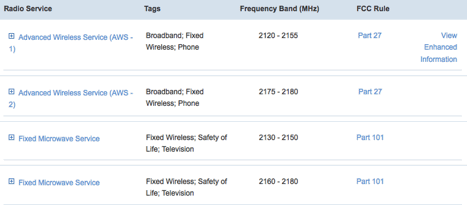
Want to buy a 2130-2150 Fixed license cheap? There is no hint at all about the AWS-3 band (2155-2175/80 MHz). No sign that the days of Fixed in this band are limited. No mention of the pending NPRM in Docket 07-195, let alone the NBP plans for this band.
In Spectrum Policy Task Force days we were trying to develop a web page with information about ongoing proceedings and WRC actions included with current allocations. Unfortunately, the resources were not available at that time. Hopefully the next version of the Dashboard will consider making this information available also.
Both websites are useful tools for the spectrum community and both need user feedback to help them evolve in the directions that users need. Feel free to post to this blog your comments to guide them and congratulations to the developers of both!
NBP - Spectrum Issues
First, at the risk of saying the obvious, we now have a rather detailed statement of strategy for spectrum - something the FCC has not had for a long time. I have previously written how other countries such as Japan and UK had such strategies and how the public availability of such information improves transparency and stimulates R&D. So whether the plan is perfect, good, or even bad, just knowing about current thinking is a great improvement over the past.
On the eve of the report’s release, the New York Times commented how the previous commission was obsessed with broadcast indecency while the current one is focusing on broadband issues. There is some truth to this. But this also points out a fundamental management problem in the FCC structure: the FCC focuses “from crisis to crisis” and the many parts of the FCC can not function in parallel while the 8th Floor is distracted by one megaproblem. Thus when the crisis of the day was indecency then spectrum policy was given little attention and now when the crisis is broadband - admittedly a broad topic - other issues get scant attention. I think FCC should look at how the UK’s Ofcom is organized and observe how this problem is not as severe in their arrangement where the board at the top acts like a corporate board overseeing top managers, not like a group of micromanagers afraid to delegate authority and who fundamentally limit overall productivity of the agency.
To me, the most exciting part of the plan was the public safety issue:
Create a Nationwide Interoperable Public Safety Wireless Broadband Communications Network.
Broadband technologies will give first responders new tools to save American lives. The nation needs a nationwide public safety broadband wireless network that allows first responders nationwide to communicate with one another at all times and without delay. A three-pronged approach will allow the speedy deployment, operation, and continued evolution of such a network. The three prongs are:
1. An administrative system to ensure that public safety users of broadband spectrum have the capacity and service they require for their network; they also should be able to leverage commercial technologies to take advantage of the vast number of applications and devices that are being developed for commercial wireless broadband networks.
2. An emergency response interoperability center to ensure that first responders nationwide can communicate with one another via public safety wireless broadband communications.
3. A grant program to help fund the construction, operation and evolution of the public safety broadband network to ensure resiliency and ubiquitous coverage.

Another great recommendation is
RECOMMENDATION 5.6:
Congress should consider granting authority to the FCC to impose spectrum fees on license holders and to NTIA to impose spectrum fees on users of government spectrum.
One interesting point is that this addresses Federal Government spectrum at all! In the draft Spectrum Policy Task Force report there was one point that just suggested NTIA might consider one new policy and the NTIA and IRAC staff were so incensed that they got the language deleted from the report. Clearly NTIA and FCC are worked together better now and thinking about the public interest, not just the near term convenience of the IRAC membership. There is even this example from the UK:

The UK has been in a leader in both creating a nationwide interoperable public safety systems and in creating incentives for government spectrum users to trade off efficient technology for less spectrum use.


 (Does not include readers using RSS feeds.)


![[Valid RSS]](valid-rss-rogers.png "Validate my RSS feed")


