
Maybe This ex parte Kerfuffle Will Lead to Real Reform in BOTH ex parte Rules at FCC and Its Noncurious IG
US Senate Report reveals that @TomWheelerFCC @FCC emails show "an attempt to avoid exparte filings" #netneutrality https://t.co/T7Oj4dzADM
— Rob Evans (@RobEvan57342786) March 1, 2016
I have no idea about whether the substance of the allegations in the report are correct, but will herein address two underlying issues that have been recurring issues here:
- FCC's ineffective ex parte rules and the disinterest in enforcing them
- FCC's notoriously noncurious and not very credible Inspector General
EX PARTE ISSUES
FCC's ex parte rules were last updated in 2011 in Docket 10-43. In my comments to that rulemaking I stated (p.2)
Among all the federal involved in administrative rulemakings agencies – both Executive Branch agencies and independent agencies – only the Commission has an ex parte system that depends entirely on statements filed by outside parties as the sole source of information in its docket files. As far as we can determine, every other federal agency involved in such rulemakings uses a notification prepared by its own staff, possibly with the inclusion of material provided by the outside party.
The simple fact is that ANY outside party contacting FCC, be it the White House or a Fortune 500 company, has mixed incentives about reveals the nature of the contact and even it existence. FCC's sole focus on these parties' sole responsibility for documenting the meeting is an invitation to problems - which I saw repeatedly during my 25 years at FCC.
In the decision in this rulemaking FCC dismissed my concerns in para. 71 stating"
Other agencies may be differently situated to the extent their docket is primarily adjudicatory rather than rulemaking (e.g., the Federal Trade Commission). Also, staff summaries raise an issue of fairness. The complex legal and technical nature of the issues sometimes presented ex partemake it preferable for the parties arguing those issues to summarize them.
Perhaps the FTC's workload is more adjudicatory than FCC's, but while FCC likes to view the singular nature of its jurisdiction, FAA, NRC, and EPA all has very technical rule makings not that different from FCC's.
However, since those comments were drafted additional information has become available that contradicts one point I made and in the interests of truth I will present it here. In May 2014 the Administrative Conference of the United States, "an independent federal agency dedicated to improving the administrative process through consensus-driven applied research, providing nonpartisan expert advice and recommendations for improvement of federal agency procedures", issued a report entitled "Ex Parte Communications in Informal Rulemaking". It surveyed agency peace in the area and came up with the following conclusion:
"All agencies except two place the burden of disclosure on the agency. FCC and CFPB require the public stakeholder to disclose an ex parte communication. The other agencies either specify that agency personnel are charged with disclosing an ex parte communication or presume the burden falls on agency personnel." (p. 66)
Now my comments were filed in March 2010 and the CFBP policy on ex parte was issued in August 2011, so my comments were correct when filed. However, the CFBP policy states at §(d)(1) "If a summary of an oral ex parte presentation is incomplete or inaccurate, CFPB staff may require the filer to correct any inaccuracies or missing information." FCC rules do not address this quality control issue and the reality is that many parties talking to the FCC staff do not want an accurate public representation of what they said.
The FCC 2011 decision talked repeatedly about more enforcement of these ex parte rules. Comm. Copps said in his statement
"I am confident that the reforms we make to our ex parte rules—combined with rigorous enforcement—will usher in a new era of transparency, openness and credibility to our work.
As if on cue, FCC sent a letter in January 2012 to the Alaska Railroad Corporation, which is owned by the State of Alaska, stating it had violated the ex parte rules because an employee had sent an e-mail with attachments to an FCC staffer dealing with a rulemaking and both failed to file a copy in the docket and again failed to do so when asked by the FCC staffer. In February 2014 Alaska Railroad agreed to a 2.5 page “compliance plan” (p. 4-7) and “a voluntary contribution to the United States Treasury in the amount of ten thousand dollars ($10,000)”.
FCC also started in 2011 a new web page on ex parte violations which were previous not disclosed, perhaps due to "professional courtesy" to the private sector lawyers involved. So what has happened to ex parte enforcement at FCC since then? NOT MUCH!
The $10,000 "voluntary contribution" of the hapless Alaskan agency was a one time thing, perhaps targeted at an out-of-town cash rich entity that could be talked into paying up without questioning the legality of what was going on. The enforcement page slowly filed with entries: 14 in 2011, 2 in 2012, and 2 in 2013 - notice a trend? Last year I called up an FCC OGC official and observed there were no entries since March 2013. They quickly added 2 public notices of sunshine period violation, one for 2013 and 1 for 2014; but these are really different from all the other enforcement issues here.
Has ex parte compliance suddenly become perfect or has FCC just lost all interest in the matter?
INSPECTOR GENERAL ISSUES
FCC Inspector General has been a recurring issue here. It is a very bipartisan issue at FCC: under many chairmen of both parties there has been no interest in letting the IG perform all his statutory duties. Since the first FCC IG in March 1989, all of the incumbents have been cronies of the top leadership, apparently chosen for their lack of curiosity and willingness to spend virtually all their resources on USF fraud and related issues, with a occasional diversion to misconduct by junior FCC staffers. What about the other oversight required by 5 USC App. 4(a)(2)? No interest even though the size of the present IG staff at FCC has zoomed to 60 FTE and its budget for FY16 to $11.8M. The FCC's FY17 budget rationalizes this as
"Currently OIG only takes on top-level investigation cases and top risk finance and program audits. The Office keeps focus on increasing mission responsibility and ensuring appropriate staff levels to keep pace with the workload."
One might think that the instant allegations of improper White House ex parte contact in an independent agency such as FCC might have been handled quickly and decisively by a credible FCC IG investigation. But the decades of bipartisan cronyism between the FCC IG and FCC leadership makes the FCC IG not credible on such issues. In 2009 and 2010 I wrote here posts entitled "A Credible Inspector General Would Make FCC More Credible". It is still true.
A credible FCC IG could address the present allegations in a nonpartisan way and let the chips fall where they may. But since that is not feasible this issue will drag on probably until the end of the Obama Administration in partisan bickering that will lower already low FCC productivity.
FCC Process Reform Report
The comments congratulate FCC on its thorough report to improve its procedures and advocated some clarifications and extensions of the recommendations.
Here is a summary of the points made:
- The comments strongly supported the new promise to act in a timely way on petitions but pointed out that this is already a longstanding, but generally ignored, requirement of §1.403. Timely disposition of petitions is key to capital formation for wireless systems that need nonroutine approvals.
- The report recommended grouping questions at the end of NPRMs. The comments suggested the key issues were to group the questions, limit the number to a manageable amount, and actually number them. The report gave examples from Industry Canada and Ofcom “consultations” where a modest number of questions were grouped and numbered.
- The report suggested “continue to engage with other agencies to develop best practices for rulemaking”. The comments endorsed this concepts and suggested it be broadened to include foreign telecom regulators like the above mentioned Ofcom and IC as well as innovative entities like the North Dakota Supreme Court that issues its opinions in hypertext. It pointed out that in the ex parte rulemaking FCC limited its comparison with other agencies to FTC, and that agencies like EPA, NRC, and FAA might be closer to at least FCC’s technical jurisdiction practice.
- The report urged “better tracking of complaint data”. Following previous discussion here of emerging interference, the comments discussed several cases of large delays in handling such issues and suggester more reporting and public interaction on new interference mechanisms to determine which need timely regulatory actions and which can be handled with benign neglect.
- On the recommendation to “increase technical inputs early in rulemaking”, the comments pointed out the previous IEEE-USA recommendations on supplementing the TAC with a paid advisory committee without conflicts of interest, as EPA and NRC have, that can interact on pending policy issues in a timely way - complementing the functions of the TAC. IEEE-USA had recommended that this be a joint FCC/NTIA committee that could serve both agencies and have security clearances to handle classified issues such as GPS interference and susceptibility. It also recommended that both FCC and NTIA budget for support from National Academy of Science’s National Research Council (NAS/NRC), Federally Funded Research and Development Centers (FFRDCs)e.g. MITRE Corp., Rand Corp., and Aerospace Corp., in support of technical policy issues that the in-house staff do not have experience with. This would follow the practices of NRC and EPA with new technical issues.
- Finally it pointed out that even though §7 was passed 30 years ago FCC has no implementing policies and rules. It urged that FCC either adopt such now or tell Congress that §7 needs repeal or modification. (Although it would be odd to take 30 years to figure that out!)
NTIA's Limited Exemption from FCC Ex Parte Rules
(a) Exempt ex parte presentations. The following types of presentations are exempt from the prohibitions in restricted proceedings …
(5) The presentation is to or from an agency or branch of the Federal Government or its staff and involves a matter over which that agency or branch and the Commission share jurisdiction provided that, any new factual information obtained through such a presentation that is relied on by the Commission in its decision-making process will, if not otherwise submitted for the record, be disclosed by the Commission no later than at the time of the release of the Commission's decision;
It is conventional wisdom, even among experienced communications attorneys, that NTIA is “exempt” from FCC’s ex parte rules. The FCC says the purpose of these rules is as follows
Our ex parte rules play an important role in protecting the fairness of the FCC's proceedings by assuring that FCC decisions are not influenced by impermissible off-the-record communications between decision-makers and others. At the same time, the rules are designed to ensure that the FCC has sufficient flexibility to obtain the information necessary for making expert decisions.
The actual rule involved, 47 C.F.R. 1.1204, is shown at the top of this post. The Commission reviewed and updated its ex parte rules recently in Docket 10-43 in which MSS commented with little impact.
However, the Commission recently reopened part of this issue when in para. 40 of the NPRM of ET Docket No. 13-115 dealing with “Federal Earth Stations Communicating with Non-Federal Fixed Satellite Service Space Stations and Federal Space Station Use of the 399.9-400.05 MHz” it asked
We invite comment on how we might continue to protect against harmful interference to or from Federal earth station operations in a manner that is consistent with the coordination practice as set forth in the MOU, while at the same time ensuring transparency, fairness, and integrity in the Commission’s decision making process.
MSS filed comments recently replying to this invitation and addressing 2 issues of ex parte practice by federal users regulated by NTIA pursuant to Section 305 and 902 of the Communications Act.
First, while the above quoted §1.1204 requires
“any new factual information obtained through such a presentation that is relied on by the Commission in its decision-making process will, if not otherwise submitted for the record, be disclosed by the Commission no later than at the time of the release of the Commission's decision;”
either NTIA is not being consistent in doing so or FCC and NTIA have a non obvious interpretation of this requirement. Usually NTIA complies with the letter of §1.1204 with an “11th hour” the day prior to the FCC’s decision. However, in the case of Docket 10-236, the revision of the FCC’s experimental license rules in Part 5, there is no filing from NTIA or any other federal agency on record. Since many bands covered by experimental licenses were bands shared with federal users and since the proposed new “program licenses” offered new interference issues with both federal and nonfederal incumbent users, it is very hard to believe that NTIA did not indicate some position to FCC.
Perhaps NTIA, with condoning behavior by FCC, has a nonobvious interpretation of §1.1204, perhaps as twisted as NSA’s interoperation of the Patriot Act and FISA. SpectrumTalk suggests that readers and commenters in Docket 13-115 ask NTIA how it actually interprets § 1.1204 and why there was no NTIA filing in Docket 10-236.
The MSS comments also pointed out the “NTIA ex parte loophole” that has been repeatedly discussed in this blog. This is the practice of private parties using NTIA staff to bypass the transparency provision so the ex parte rules and to send negative information to FCC via NTIA so the party on the opposite side does not find out in a timely way what the new issue is and is unable to rebut it quickly.
Your blogger saw this repeatedly drink the UWB rulemaking where cellular interests and GPS interests used NTIA as their covert pipeline to FCC decision makers. In an FCBA public forum at FCC at that time, then NTIA Administrator Gallagher even acknowledged that he would receive such ant-UWB allegation and immediately call a top FCC manager with them!
MSS raised this issue in Docket 10-43 comments. Oddly, the Report & Order in that proceeding mischaracterized the MSS comments as proposing to “delete” the provisions of §1.1204 that apply to NTIA and then dismissed the suggestion as a reductio ad absurdum - a cute debating trick. The issue is not whether NTIA should be allowed easier access to FCC on matters of common jurisdiction, but rather whether private parties should abuse this provision to keep information off the public record so it can not be rebutted.
MSS continues to urge that NTIA document in the FCC docket file all contact with private parties, other than government contractors, that are clearly intended to influence FCC proceedings subject to ex parte rules.
ex parte Enforcement:
$10,000 "Voluntary Contribution" and a "Compliance Plan" in Resolution of a Violation
- Only FCC requires the outside party to file a summary of any face-to-face meeting/telephone call/ and any written documents such as e-mail and depends solely on that filing to document the exchange of information. (Note that some outside parties may see an advantage to “game” the system by delaying or obfuscating public disclosure of points they make to FCC officials
- All other agencies use their staff to summarize the interaction although they include any documents that were presented.
Thus the timely filing of a valid description of the interaction is necessary to fulfill the transparency goals of the FCC’s ex parte rules.
Until January 11, 2011 FCC had never even sent an official violation notice to any outside party for a violation of these rules! All violations were handled informally “between gentlemen” with no public disclosure. Indeed, outside complaints were almost always dismissed also without public disclosure.
The ex parte rule update was adopted on February 1, 2011 and became effective June 1, 2011. In adopting the new procedures the Commission stated:
We will, however, amend our rules to require that the General Counsel refer any case in which a forfeiture or a citation may be warranted to the Enforcement Bureau for disposition and we will delegate authority to the Enforcement Bureau to levy fines for violations of the ex parte rules. In the event the Enforcement Bureau ultimately determines that a forfeiture or a citation is not warranted, the General Counsel will take appropriate action on the matter.
The Docket 10-43 Report & Order gave no legal citation on how the FCC has authority to levy such forfeitures, which your blogger believes exceeds the statutory provisions of Title V of the Communications Act - but, heck, he’s not a lawyer. But it was curious that there was no sign of any such a forfeiture until yesterday.

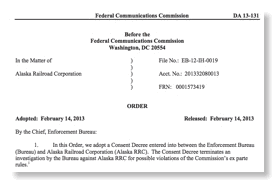
Over a year ago, FCC sent a letter to the Alaska Railroad Corporation, which is owned by the State of Alaska, stating it had violated the ex parte rules because an employee had sent an e-mail with attachments to an FCC staffer dealing with a rulemaking and both failed to file a copy in the docket and again failed to do so when asked by the FCC staffer. The letter referred the issue to eh FCC’s Enforcement Bureau for “possible action”. Your blogger was curious about this when there was nothing on the public record 9 months later and filed a FOIA request. The request was greeted with quibbling from FCC about his eligibility for FOIA requests without charge and at one point FCC/OGC stated that 9 hours of GS-15 time was needed to comply with this FOIA request! However, in order to simplify and resolve this issue quickly your blogger agreed to narrow the scope of the request and today received a “Valentine’s Day present” of the Consent Decree shown above, dated February 14, 2013.
In the Consent Decree, Alaska Railroad agrees to a 2.5 page “compliance plan” (p. 4-7) and “a voluntary contribution to the United States Treasury in the amount of ten thousand dollars ($10,000)”. Now Alaska Railroad is not a major participant in FCC proceedings, indeed it has not filed anything in ECFS during the past 10 years. Either they are the most wanton violator of ex parte rules or they are a “country bumpkin” outside of the Beltway who rarely deals with any FCC issue. But I guess they were an easy target without a major FCBA member representing them. (While your blogger was an FCC employee, he dealt with such occasional problems of the uninformed without proper representation by simply forwarding the communication that wasn’t filed to the Secretary’s Office and asking that it be filed.) The “compliance plan” doesn’t seem very relevant for such a regulatee that rarely interacts with FCC, but hopefully it will set a precedent for more mainstream players.
So a precedent has been set for fines and compliance plans in case of violations. Someday FCC will lock horns with a violator who will litigate whether Title V provides for such types of fines, but until then parties may find it cheaper to just pay $10,000 if FCC asks. The compliance plan looks like a good idea and if the former AMST was still around I would suggest that its should have such a plan, but MST has been absorbed by NAB which was a clean ex parte record.
FCC ex parte enforcement: No More "Professional Courtesy"
ex part enforcement at FCC, or lack thereof, has been a recurring topic here. We now have 3 basic eras of FCC practice in FCC enforcement of its ex parte rules.
1978 - January 2011
“Professional courtesy” combined with “holding telescope to the blind eye” approach. During this 33 year period FCC did not have a single written record of finding an ex parte violation. There is anecdotal evidence that some ex parte complaints were resolved with phone calls to violators and verbal warnings but no written public records exist. Naturally, some entities with little interest in transparency noticed this and saw it as a blank check to do whatever they wanted.January 11, 2011 - August 3, 2011
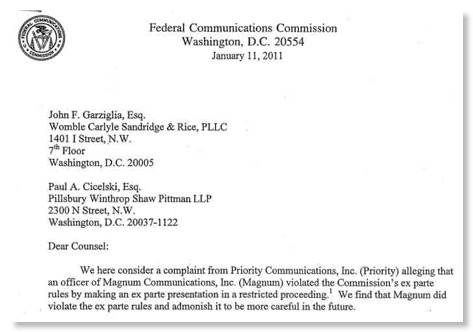
FCC starts more aggressive review of complaints with its 1/11/11 finding that Magnum Communications was guilty of a violation - the first EVER written finding of a violation.August 3, 2011 ->
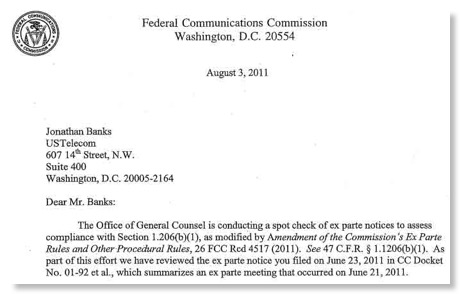
FCC announces 3 findings of violations based on “a spot check of ex parte notices to assess compliance”. In this new era FCC not only finds violations but does not depend solely on complaints.
Imagine the surprise on August 3, 2011 when USTelecom, Public Utility Commission of Texas, and Parrino Strategic Consulting Group received similar letters saying based on a spot check they had been found to violate Section 1.1206(b)(1). Now there was no penalty or even a warning or probation, but they were told “Accordingly, we ask that you file a supplemental notice that complies with the rule within one week.”
As another sign of assertiveness, one July 28, 2011 FCC found that Christian Media, Inc. “violated the Commission’s ex parte rules by soliciting impermissible ex part letters from members of Congress in violation of 47 C.F.R. § §1.1208 and1.1210” and referred the matter to the Enforcement Bureau “to determine whether a forfeiture is warranted”. As stated previously, your blogger doubts that Title V of the Communications Act permits fines in the case of such violations. So my unsolicited “free legal advice” to Christian Media, Inc. is: don’t start liquidating assets now to pay for a possible fine.
But kudos to FCC/OGC for these major changes in ex part enforcement that will either increase compliance OR lead to the realization that there is a good reason why every other federal agency uses a different approach in dealing with ex parte presentations.
FCC Starts Transparent ex parte Rule Enforcement
FCC has had ex parte rules on its books since the late 1970s. The Commission is unique among administrative agencies in the federal government in requiring outside parties to make filings about their ex parte meetings with Commission officials - as far as I can tell every other administrative agency in the federal government has its staff write up memos about such meetings and inserts them into the public record. Only FCC depends on filings by external parties who have mixed incentives with respect to transparency.
On June 1, 2011 major changes to the ex parte rules went into effect along with a promise of greater enforcement. As far as I can tell the only enforcement in the previous 30 + year was one letter sent from the former Cable Services Bureau. Never any action from the Office of General Counsel responsible for ex parte enforcement. A new FCC page on ex parte enforcement reveals a variety of actions in the past year.
In particular the document shown at the top of this post is the first actual finding of a violation EVER! There are 2 other admonitions as well as a referral to the Enforcement Bureau “ to determine whether a forfeiture is warranted”.
Never having attended law school your blogger is still convinced that the threat in the revised rules of fining ex parte violators was a bluff as the terms of Title V of the Comm Act dealing with fines do not permit them in such cases. I note that the R&O adopting the new rules gave no references to the authority for fines.
But, congratulations to OGC for taking the first steps in enforcement. Maybe after they try enforcing the rules they will learn how impractical they are and recommend using the process that the rest of the federal government has used for 30 years.
New ex parte Rules Now in Effect
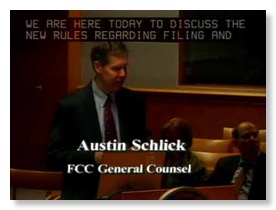
In honor of the effective date, the Commission released a 72 minute video, linked to the above photo of an FCBA workshop on the new rules that clearly explains them.
The Commission has never taken any enforcement action in this area in more than 30 years! The new rules are more practical and GC Schlick promises enforcement action. However, he also talks about the delegation of authority to EB to issue NALs/fines for violations. While fines sound appealing, the R&O adopting the new rules never really explains how such fines are within the FCC’s jurisdiction. In particular, fines are authorized by Section 501 and 502 of the Communications Act. 501 deals with things required or prohibited by the Act and 502 deals with “rules ...made or imposed by the Commission under authority of this chapter”. Never having attended law school, I never the less doubt if a violation of these particular rules fits into either category. I recall that for years FCC threatened fines for violations of Part 68 when it clearly had no legal authority to do so.
So we will see if FCC follows up on its promise to start enforcement. And if they do so we may soon see a legal test of whether fines are a valid weapon here.
FCC Resolves MSS ex parte Complaint:
Continues 30+ year inability to find violations
But, MSTV has actually improved compliance in the process!
But, MSTV has actually improved compliance in the process!
We reiterate the tentative conclusion in the Notice that stricter enforcement
of our ex parte rules complements the improvements to the rules we are
adopting today and reinforces their purpose in making our proceedings
more open and transparent to the public and fairer to
interested parties. -- R&O&FNPRM, Docket 10-43 2/2/11
On August 25, 2008, Marcus Spectrum Solutions filed a Petition for Review with FCC dealing with the rejection by OGC of a previous complaint complaint about MSTV’s apparent violation of the Commission’s ex parte rules.
905 days later, on February 16, 2011, the Commission released a Memorandum Opinion and Order (MO&O) denying the application for review. The MO&O was thus released 2 weeks after the Commission adopted changes to the ex parte rules in Docket 10-43 in the decision quoted at the top of this entry.
The start of this string of events was my October 13, 2006 letter to the FCC General Counsel. During the pendency of Docket 04-186, I noticed that MSTV was often late in their ex parte filings and often so cryptic that one did not know what was discussed. Having been away from FCC for 2 years and living overseas at the time, I wondered if maybe this had become common practice. A search through ECFS for major parties practicing before FCC quickly showed that MSTV was actually an outlier and that other corporations and trade associations were consistently compliant with the rules. So I pointed out to the then GC 16 MSTV filings that appeared to violate the rules.
The letter to OGC was answered on March 30, 2007, 168 days later. It informed me that OGC was “aware of no complaints against MSTV by other parties” - apparently indicating that my enumeration of 16 filings apparently in violation of the rules did not constitute a “complaint”. In dealing with subsequent clearly labeled complaints it became clear that OGC was repeating the FCC’s discredited approach to indecency complaints in the 1980s - a “shell game” approach where each complaint was dismissed for a technicality that failed to meet the threshold for Commission consideration.
Thus the appeal of the Commission of the 3rd OGC dismissal of a complaint. In the process of denying the review, the Commission is in denial about the fact that previous complaints were rejected for the following reasons that do not exist in either the rules or formal precedents:
· a requirement that only parties with standing in a proceeding can file complaints;
· an unspecified “statute of limitations” on the timeliness of complaints;
· a standard of compliance that is the practice of other parties in the same proceeding;
· attaching importance to the presence of multiple complaints; and
· a requirement that the complainant prove substantial harm.
Nevertheless, the Commission then dismisses the MSS request that MSTV receive a formal warning about previous violations by concluding “we agree with OGC that Marcus’s complaints have failed to demonstrate significant non-compliance with the ex parte rules by MSTV under the applicable standards.” (para. 23)
However, after all was said and done, MSTV has quietly moved into compliance with the ex parte rules! The last late ex parte filing by MSTV was 11 months ago! A review of their recent ex parte filings shows that this has been achieved in conjunction with making many presentations joint with NAB - which, in contrast to MSTV, has always had an immaculate record in this area - and by using Covington & Burling for most other ex parte filings.
So the record of the appeal is mixed: it established a precedent that “significant non-compliance” is necessary for even a formal warning but it did move MSTV into compliance. For better or for worse, it is also the first Commission action on ex parte enforcement in the 30+ years since FCC adopted its unique approach to dealing with ex parte meetings - something without a counterpart in all other federal agencies dealing with rulemakings.
FCC Releases ex parte Report & Order
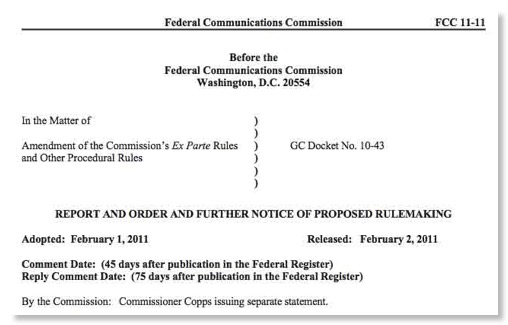
Yesterday FCC released the above Report and Order amending its ex parte rules, a frequent topic in this blog.
Here are the basic results in this rulemaking:
• Ex parte notices will be required for all oral ex parte presentations in permit-but-disclose proceedings, not just for those presentations that involve new information or arguments not already in the record.
• If an oral ex parte presentation is limited to material already in the written record, the notice must contain either a succinct summary of the matters discussed or a citation to the page or paragraph number in the party’s written submission(s) where the matters discussed can be found. If an oral ex parte presentation includes new information, the notice must contain a summary of the new data and arguments presented.
• Notices for all ex parte presentations must include the name of the person(s) who made the ex parte presentation as well as a list of all persons attending or otherwise participating in the meeting at which the presentation was made.
• Notices of ex parte presentations made outside the Sunshine period must be filed within two business days of the presentation.
[Other changes affect ex parte presentation during the Sunshine period - the week prior to discussion at an open Commission meeting, if the rulemaking is not resolved on circulation as most now actually are. These changes will not be discussed here as they are less generally applicable.]
Your blogger’s comments in this rulemaking raised a number of issues, most of which did not fare well - but then again it is not clear if anyone fared any better except perhaps those who argued for the status quo. One proposal that made an impact was to require that ex parte complaints and their disposition be made public. In para. 66 the Commission agreed to do so ending the present “black chamber” practice.
My suggestion for increased enforcement penalties was acted on in a strange way. The R&O dismisses my suggestion that those found in repeated violation should be barred from oral ex parte presentations for a period. Apparently the Commission ignored the specific proposal that the penalty restriction only apply to oral presentations and thus rationalized that it would be inappropriate to ban a party from all participation:
Although it would certainly deter parties from violating the rules, routinely barring parties from further participation in Commission proceedings diminishes their ability to influence action from the Commission that would serve the public interest, and it would lessen the pool of knowledge and information on which to base our decisions.
They did agree to delegate authority to EB to levy fines in case of violations found by OGC.(para. 67) Is this the same EB that recently
let 2 different cellular jammer sellers off without any fine and did the same thing in 2009 for a GPS jammer seller? Is this the same OGC that hasn’t found a single ex parte violation in more than 30 years?
Finally, even though I am not a lawyer, I note that there is no legal reference in the R&O to where the Commission has jurisdiction to levy fines for this type of violation. The Commission’s legal authority for issuing fines stems from Sections 501 and 502 of the Communications Act. It is pretty clear that 501 doesn’t apply here and it is not obvious that 502 does either. (For nearly two decades FCC issued documents claiming that it could enforce the technical rules of Part 68 on CPE vendors while it actually lacked such legal authority. This might be a similar bluff.)
The Commission finally admitted in para. 71 that it is the only regulatory agency in the federal government that has implemented ex parte procedures requiring outside parties to document what was said - a basic conflict of interest. It rationalizes this unique position:
(O)ne agency’s procedural rules do not fit all, and we would be ill-advised to incorporate the ex parte rules of another agency without giving considerable thought to whether those rules would achieve the interests of administrative efficiency, procedural due process and transparency better than our own rules as amended today. From that perspective, we see no clear advantage to the suggestion by Marcus that Commission staff prepare and file ex parte notices. Other agencies may be differently situated to the extent their docket is primarily adjudicatory rather than rulemaking (e.g., the Federal Trade Commission). Also, staff summaries raise an issue of fairness. The complex legal and technical nature of the issues sometimes presented ex parte make it preferable for the parties arguing those issues to summarize them.
So FCC thinks it is the only regulatory agency with a predominantly rulemaking (vice adjudicatory, e.g. enforcement and license award) docket load?
Does FCC think that the docket load at FAA, EPA, and the Nuclear Regulatory Commission are less technical than theirs?
Did FCC consider that even if the staff summarized what was said they could include in the docket handouts from the private parties on esoteric technical issues? The real benefit of staff summaries is the people writing them do not have the incentive to cover up issues so people with other views are kept in the dark. Thus if the submitted handout fairly summarized what was discussed, the staff could simply affirmatively so state. They could also add other issues that came up and points that were not candidly summarized in the handout.
ex parte NPRM Finally Published in Federal Register
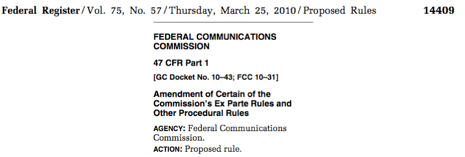
Yesterday, more than a month after it was adopted by the Commission, the ex parte reform NPRM was finally published in the Federal Register. This has the effect of determining the comment period since it is always relative to FR publication:

This late publication raises two questions in view of the Commission’s stated interest in transparency:
1. Why did this important NPRM take so long to be published? Sometimes delays are due to unusual formatting problems such as tables, but that was not the case here.
2. Why doesn’t the Commission give a simple table with the actual due date of comments? OET used to publish such a table for its proceedings. Why does the public have to keep searching the for FR publication dates?
The key information on the comment dates is reprinted here for your convenience:
DATES:
Comments must be submitted by May 10, 2010, and reply comments must be submitted by June 8, 2010.(Actually, as I read §1.4, the reply comment date should be June 9. But let’s not quibble here.)
UPDATE
MSS has set a good example and has filed its comments in this proceeding early. They are the first comments filed in this proceedings, aside from another document that appears to be misfiled.
The comments include some of the MSS correspondence with FCC/OGC on a series of complaints it has made against the entity that appears to be the worst offender of the ex parte rules. For the first time these documents can now be reviewed on the FCC website. Parties filing comments may wish to consider whether a transparent ex parte system should hide the very existence of such correspondence and indicate their viewpoint in their comments.
They might also want to comment on the following sentence of the NPRM in para. 32 that seems the strangest part of the proposal: “We also seek comment on whether all ex parte sanctions, including admonitions, should be publicly announced.” The NPRM gives no hint on why such secrecy would be in the pubic interest.
(We note that the MSS ex parte complaint petition has been on circulation since 2/25/10. Oddly, the oldest item on circulation is the Petition for Determination of Effective Competition of Marcus Cable Associates, LLC which has been on circulation since 08/14/2007. Does the name “Marcus” cause delay on the 8th floor? In any case, there is no relationship at all between MSS and Marcus Cable Associates, LLC .)
FURTHER UPDATE
As of 4/28/10 the Marcus Cable Associates, LLC item is no longer on circulation. Thus it was resolved after 2.5 years of circulation. Will the MSS issue take that long?
FCC ex parte NPRM - Initial Thoughts
“I believe that transparency is best achieved through the creation and publication of clear rules. However, for the regulatory regime to be successful, these rules must also be strictly enforced. Based on personal experience, I know that the U.S. regulatory model has only been successful when the FCC has enforced its rules vigorously. Failure to enforce rules sends the inappropriate signal that companies may engage in anticompetitive behavior or other unlawful conduct with impunity.”
Let me provide for potential commenters some facts that are not in the NPRM.
1. In 2009, there were 6070 ex parte notifications filed at FCC. The numbers for 2008 and 2007 were 10,046 and 7,960 respectively. I assume that the drop in 2009 was due to both the inevitable drop in activity with major changes at the Commission and the distraction of the DTV transition.
2. I believe that the Commission’s ex parte rules were heavily influenced by Recommendation No. 77-3 of the former Administrative Conference of the U.S., formerly codified as 1 C.F.R. 305-77.3. The HBO Case mentioned in Chmn. Genachowski’s statement was in March 2007 and the ACUS recommendation was made in October of that year. The ACUS recommendation stated “Agencies should experiment in appropriate situations with procedures designed to disclose oral communications from outside the agency of significant information or argument respecting the merits of proposed rules, made to agency personnel participating in the decision on the proposed rule, by means of summaries promptly placed in the public file, meetings which the public may attend, or other techniques appropriate to their circumstances.”
3.While the NPRM mentions ex parte policies at 3 other commissions, it fails to mention the key fact that parallel policies are in place at all regulatory agencies, be they independent agencies like FCC or Executive Branch agencies. But only FCC has the system where the outside party files the summary that goes on the public record. Thus in the 30 odd years that ex parte procedures have been used for agency rulemaking, no other agency has ever adopted the FCC’s approach. Perhaps the Commission should ask why?
4.Finally, the NPRM states in para. 32 “Regardless of what amendments are adopted in this proceeding or when, we intend to place greater emphasis on enforcement against impermissible ex parte contacts.” This implies there has been some previous emphasis on enforcement. A fairer statement is that enforcement has been ignored for decades. At the October public workshop the staff stated that it dealt with complaints by calling the party at issue and telling them not to do it again. This is reminiscent of the comedy skit in which an unarmed British policemen says to a fleeing robber “Stop or I’ll say stop again”. As far as I can tell, the Commission has NEVER taken ANY ex parte enforcement action. While the NPRM mentions the possibility of “monetary forfeitures”, I doubt that it has legal authority to do so. However, it does have the authority - unused to date - to forbid future oral ex parte by the guilty party and that should be more than adequate IF there is ANY interest in enforcing these rules.
UPDATE
Your blogger’s Petition for Review has finally made it to circulation on the 8th Floor more than a year after it was filed. This was not a very complex matter although it may be the first time ever the commissioners had to formally consider enforcement of their rules.
Stay tuned for the outcome. How much longer could it take?
Ex Parte Reform Proposal at FCC
Oddly, MSTV has nothing on their website yet on the topic.
Ex parte Reform Proposals Imminent

- The Commission will consider a Notice of Proposed Rulemaking to enhance the efficiency, openness, and transparency of the Commission’s proceedings by improving and modernizing certain organizational and procedural rules.
- The Commission will consider a Notice of Proposed Rulemaking to improve the transparency and effectiveness of the FCC’s decision-making process by reforming the ex parte rules.
So it looks like the new team is making good on their promises for reform in ex parte and other procedures. Faithful readers may recall that ex parte reform and transparency have been frequent topics here. Who knows, they may even act on your blogger’s Petition for Review on an ex parte issue that has been pending for 17 months - even though it is mentioned nowhere on the FCC website.


 (Does not include readers using RSS feeds.)


![[Valid RSS]](valid-rss-rogers.png "Validate my RSS feed")


