
Marriott Pays $600k Penalty for Wi-Fi Jamming in One of Their Hotels
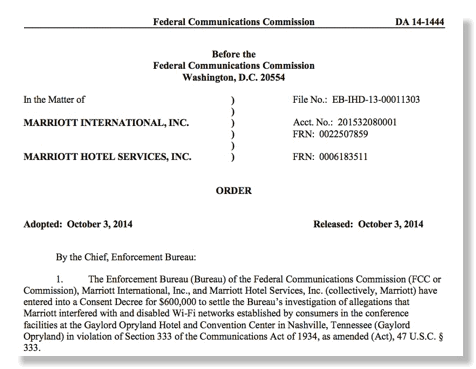
As shown above, FCC released an Order on October 3 terminating an investigation of jamming of Wi-Fi signals at a Marriott hotel by the hotel management with a $600,000 penalty payment. (Until recently such payments were classified by FCC as “voluntary payments” and were tax deductible by the perpetrator - no longer so!)
The press release states
The FCC Enforcement Bureau’s investigation revealed that Marriott employees had used containment features of a Wi-Fi monitoring system at the Gaylord Opryland to prevent individuals from connecting to the Internet via their own personal Wi-Fi networks, while at the same time charging consumers, small businesses, and exhibitors as much as $1,000 per device to access Marriott’s Wi-Fi network.
“Consumers who purchase cellular data plans should be able to use them without fear that their personalInternet connection will be blocked by their hotel or conference center,” said Enforcement Bureau Chief Travis LeBlanc. “It is unacceptable for any hotel to intentionally disable personal hotspots while also charging consumers and small businesses high fees to use the hotel’s own Wi-Fi network. This practice putsconsumers in the untenable position of either paying twice for the same service or forgoing Internet accessaltogether,” he added.
A Washington Post article on the episode was titled “FCC to Marriott: No, you can’t force your customers onto terrible hotel WiFi”. It gives Marriott’s side:
Marriott, in a statement, insisted that its actions were legal and designed to thwart "rogue wireless hotspots.""Like many other institutions and companies in a wide variety of industries, including hospitals and universities, the Gaylord Opryland protected its Wi-Fi network by using FCC-authorized equipment provided by well-known, reputable manufacturers," Marriott said. "We will continue to encourage the FCC to pursue a rulemaking in order to eliminate the ongoing confusion resulting from today's action and to assess the merits of its underlying policy."
Of course, Marriott also sells its own WiFi access for $14.95 a day, sometimes charging for multiple computers in the same room. (It amuses you blogger to observe that cheap hotels such as Quality Inn and Motel 6 generally give free Wi-Fi (often breakfast, too) and charge lower rates than Marriott.
The initial complaint in this case came in March 2013, so the case went from compliant to resolution in 19 months. While this might not seem fast to some, it is much faster than past practice and considering the technical and legal issues involved a timely resolution for string a new precedent a rather timely resolution.
The legal basis for this FCC action was § 333 of the Communications Act , 47 USC 333, a recurring topic here in the context of prison jamming of contraband cellphones. Here is the text of the section:
47 U.S. Code § 333 - Willful or malicious interference
No person shall willfully or maliciously interfere with or cause interference to any radio communications of any station licensed or authorized by or under this chapter or operated by the United States Government.
Clearly Marriott’s action violated this prohibition. While the user’s Wi-Fi system was not “licensed”, it was “authorized” by FCC. Unfortunately, the cellular industry consistently misreads § 333 and tells FCC it means that FCC has no authority to authorize jamming of contraband cellphones in nonfederal prisons, an issue closely related to Docket 13-111.
Beginning of Wi-Fi Privacy-Related Electronic Warfare
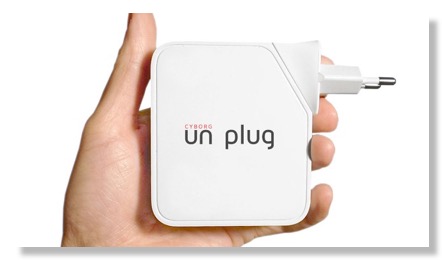
In a previous post we wrote about the jamming threat to Wi-Fi and cellular that may come from unrestricted access by private drones to their spectrum. Today, a CNN post provocatively entitled “This gadget can knock drones and Google Glass offline” describes a device called the “Cyborg Unplug”. Its maker describes it as
Cyborg Unplug is a wireless anti-surveillance system for the home and workplace. 'Plug to Unplug', it detects and kicks devices known to pose a risk to personal privacy from your local wireless network, breaking uploads and streams. Detected devices currently include: Google Glass, Dropcam, small drones/copters, wireless 'spy' microphones and various other network-dependent surveillance devices.
Cyborg Unplug comes hot on the heels of glasshole.sh, a script written by Julian Oliver to detect and disconnect Google's Glass device from a locally owned and administered network. Following broad coverage in the press, the script struck a chord with countless people all over the world that felt either frustrated or threatened by the growing use and abuse of covert, camera-enabled computer technology.
Whether business office, restaurant, school or nightclub: it's your territory and your rules, so make it harder for those that seek to abuse it.
The maker describes the 2 modes of the device:
Cyborg Unplug can be operated in two modes. The recommended mode is Territory Mode, disconnecting target devices from selected network(s) owned and operated by the user. The other mode is All Out Mode, which disconnects all detected target devices from any network they are associated with, including paired connections with smartphones. Please note that this latter mode may not be legal within your jurisdiction. We take no responsibility for the trouble you get yourself into if you choose to deploy your Cyborg Unplug in this mode.
We will not parse here US rules and regulations about whether this is illegal. Nor will we speculate on whether it will actually work as advertised. This new product and its website and PR campaign shows the pent up demand for privacy protecting devices. If this device becomes popular, explicitly illegal Wi-Fi jammer manufacturers probably will go after the same market and a whole cycle of electronic warfare will begin.
The Wi-Fi industry and cellular industry should do some soul searching about whether their nonchalant attitude towards privacy invading uses of their technology contributes to supply and demand issues for jammer-like devices. Your blogger was once involved in electronic warfare issues decades ago. He does not want these to come to the dynamic civil communications systems that contribute so much to our society and economy.
Once Pandora’s Box is fully open, large NALs to mysterious Chinese companies will really have no impact.
Leaders of the Wi-Fi and cellular industries: Are there actions your industries are taking or trends which you are ignoring that are stimulating the demand for jammers? Will addressing these issue within your industries be more effective than relying on the currently underfunded FCC to solve severe problems that are likely beyond its resources if they take hold?
Jammer Enforcement Actions at FCC
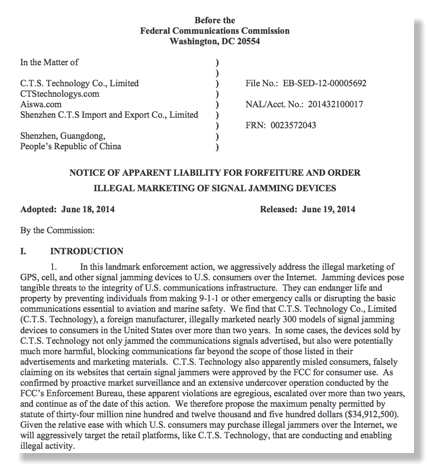
In the above “landmark enforcement action” FCC issued a Notice of Apparent Liability(NAL), i.e. a fine, against a Chinese jammer company for marketing in the US by way of Internet and some unidentified shipping mechanism, “285 different models” of jammers targeted at cellphones, GPS, Wi-Fi, Bluetooth, etc. The amount of the proposed fine is $34,912,500! However, none of this goes to FCC and it is unlikely that any of it will ever be paid in any case.
Lest you think this is the only Chinese company doing this, your blogger has received dozens of e-mail ads for such devices from a different firm and has routinely forwarded them to FCC/EB. So clearly C.T.S. Technology is not the only offender.
Para. 5 of the new NAL states
“We also again warn U.S. consumers that importing a cell, GPS, or other signal jammingdevice (i.e., purchasing such a device online and having it shipped into the United States via the U.S. mail or other transport or courier service) is unlawful and may subject them to civil and criminal penalties.”
This is followed by a citation to fn. 4 which cites 18 U.S.C. § 1362 and 18 U.S.C. § 1367(a) as well as the 2010 Phonejammer.com FCC NAL. The only problem is that the 2 cited laws have nothing to do with ordering jammers - they deal with actually jamming a federal communications system or a communications satellite - something unlikely with the jammers involved here, but remotely possible. (The cited Phonejammer also has nothing to do with ordering jammers.) So was this section of the NAL sloppy legal work in EB or is there a legal ambiguity under present statutes on the issue of importing jammers for personal use? It is clear that § 333 forbids actual jamming of licensed/authorized transmitters:
No person shall willfully or maliciously interfere with or cause interference to any radio communications of any station licensed or authorized by or under this chapter or operated by the United States Government.
The cellular industry prefers to read § 333 as forbidding FCC from ever authorizing any jamming, even in remote prisons. Thus they were successful in stopping FCC from even asking for public comment on the GTL petition on both jamming and “managed access” - notwithstanding the § 1.403 requirement to issue “promptly” a PN asking for comments on such petitions. They even managed to get FCC to draft the Docket 13-111 NPRM to exclude any discussion about what is the scope of § 333 even though this rulemaking is partially responsive to the GTL petition.
The cellular establishment is betting that its interpretation of § 333 will be able to drive all jammers from US territory. However, as we have stated repeatedly, there is a demand for jammers that arises from perceptions of antisocial use of communications. While there are some possible uses of jammers that are beneficial financially to the perpetrator of such use, (e.g. a hotel owner jamming cellphone to force use of expensive hotel room calling services), in practice such use is very rare. Most cellular jamming and GPS jamming is in response to perceptions of antisocial behavior or invasions of privacy. Until the cellphone and GPS industry address those perceptions about the harmony of using their products and the impact on others there will always be consumer demand for jammers. Discussing nonexistent laws that ban consumer ordering of jammers, as in para. 5 of the NAL, or banning all prison jamming use under a specious interpretation of § 333 may feel good to the cellular industry, but are doomed to be ineffective.
Hopefully this NAL might spur Customs and Border Protection to try harder to intercept jammers on their way to the US and might spur carriers like FedEx to ask more questions from shippers like C.T.S. Technology.
UPDATE
Our friends at CommLawBlog, who actually are lawyers when not blogging, also have questioned the legal basis of this NAL stating:
We also can’t help questioning the extent to which C.T.S. actually violated the law.
True, it shipped ten devices to U.S. addresses, but it performed its acts in China, where it may be perfectly legal to ship jammers to U.S. addresses. One unquestionably unlawful step in the transaction was the importation of the ten devices – but FCC staffers, not C.T.S., did that by initiating the transactions and accepting delivery.
Penalizing C.T.S. for the 275 models that it advertised but did not ship to the U.S. is even more tenuous. There is only one Internet; a company cannot easily promote its products on line in some parts of the world but not others. The FCC’s best arguments are probably that (a) some of the advertised products jam wireless frequencies used only in the United States and (b) the company quotes prices in U.S. dollars. True, C.T.S. could refuse to fill U.S. orders and could display a notice on its website stating that policy. But the failure to have the policy and to display the notice may not add up to an actionable violation.
To be clear: C.T.S.’s jammers are disruptive and potentially dangerous. We agree with the FCC that they have no place in the United States. We fully support the FCC’s efforts to keep them out of the country. We just wish the FCC could manage it from a more secure legal platform.
So if the goal is to actually stop the sale and use of such jammers in the USA, not just to posture to the cellular industry, perhaps some more pragmatic actions are needed.
Spectrum Policy Implications of Growing Consumer Interest in Jamming

This is a magazine dedicated to communications, not electronic warfare. However, the issue of jamming is unfortunately intruding on civil communications on a growing basis. It does not take much use of your favorite search engine to discover the Internet marketing of jammers for cellular communications as well as GPS. There are even WiFi jammers and jammers for an anti-car theft system used in 37 countries called LoJack. These products need not meet any out-of-band emission limits (because they are being sold illegally anyway) and thus may well radiate in bands other than their intended targets. Thus, these commercially available jammers pose a real threat to many types of legitimate spectrum users.
The illegal nature of these systems leads to the policy option of controlling their use through marketing regulation. Most, but not all, countries allow their national spectrum regulators to prescribe standards for radio transmitters and forbid the marketing of noncompliant equipment through civil and criminal penalties. Unfortunately, the worldwide market for illicit drugs shows that this supply side regulation is not going to be completely effective. Indeed, the anti-drug marketing efforts in all countries are likely to be better funded than any practical anti-jammer marketing efforts. Furthermore, the rise of Internet-based marketing with offshore production and express shipping to the consumer further complicates supply suppression unless the production countries fully cooperate.
The spectrum community can learn from past efforts in illicit drug suppression that focusing on supply side suppression is unlikely to be successful without some attention to demand side suppression. Suppressing supply for an illicit product will only drive up its price if there is an actual demand for the product and the increased price is likely to attract more suppliers absent draconian penalties.
Perhaps the spectrum user community should be asking why is there a consumer demand for jammers today? It is hard to answer this comprehensively, but here are some thoughts. Cell phone jamming is rarely motivated by direct financial incentive. Hotels may have a financial incentive to jam guests’ cell phone to divert calls to high priced phones in hotel rooms — but this type of jamming is virtually unheard of. More common is jamming in restaurants, theaters, work places, and schools*. Such jamming appears to be more motivated by annoyance issues than direct financial return. In 2005, Motorola, a major producer of cellular equipment at the time, commissioned a study on the annoyance issue from Donald A. Norman of the Nielsen Norman group, an engineering design consultant. Dr. Norman wrote,
We are in real danger of a consumer backlash against annoying technologies. We already have seen the growth of mobile-phone free zones, of prohibition against phone use, camera use, camera phones, in all sort of public and private places. The mobile phone has been shown to be a dangerous distraction to the driver of an automobile, whether hands-free or not. If we do nothing to overcome these problems, then the benefits these technologies bring may very well be denied us because the social costs are simply too great. …
Annoyance with others comes from many sources. Some might consider this a social issue, but there might very well be technological solutions. After all, it is the technology that has provided the affordance — the technical terms that describes the ability to do some action — that is so annoying. Perhaps we could refine the technology so that it better affords politeness to others. (emphasis added)
Dr. Norman also discusses the issue of loud speech by cell phone users that he attributes to lack of sidetone in many cell phones and views as an issue that could be addressed in engineering design. The point here is that interpersonal friction resulting from cell phone use may be a key factor in the demand for cell phone jammers.
In Japan the cell phone industry is more attentive to interpersonal friction problems from cell phone use than in many other countries. Part of the instruction manual from a cell phone marketed in Japan has a section on “Mobile Manners” that recommends:
“Use your handset responsibly. Inappropriate handset use can be both dangerous and bothersome. Take care not to disturb others when using your handset. Adjust handset use according to your surroundings. • Turn off handset power in theaters, museums and other places where silence is the norm.
• Refrain from use in restaurants, lobbies, elevators, etc.
• Observe signs and instructions regarding handset use on trains, etc.
• Refrain from use that interrupts the flow of pedestrian of vehicletraffic.”
Telstra, an Australian carrier, has similar information for its consumers on its website, but generally cellular carriers do not give guidance to their users on avoiding interpersonal conflict through cell phone use. It is likely that interpersonal friction is a major issue in stimulating the demand for jamming devices and reducing it through technical changes, such as changing technology to reduce user voice volume during calls, or consumer education will reduce consumer demand for jammers. Such demand reduction would then complement supply reduction through better enforcement by national spectrum regulators and is more likely to impact the use of consumer jammers than addressing either supply or demand independently.
If we cannot reduce the use of unauthorized consumer jammers through actions such as those discussed above, their use will seriously impact the telecommunications systems that readers have worked assiduously to develop, distribute, and operate for the benefit of our societies and economies.
------------------
*In France jamming of cellphones in prisons, theaters and concert halls is actually explicitly allowed under national law, France, Article L33-3, Code des postes et des communications électroniques, as amended by Loi n°2002- 1138 du 9 septembre 2002 — art. 47 JORF (Sept. 10, 2002)
UPDATE
CEPT/ECC Recommendation 04(01), updated February 2013, says “these discussions have made it clear that there is no legal basis to allow that communications be disrupted by jamming devices operated by the public”. However it goes on to say “CEPT administrations should not allow the placing on the market nor the use of jammers except in the very limited context of authorised use which may be permitted by a national legislation”.
Thus while the above cited French law permits jamming in prisons, theaters and concert halls, this CEPT recommendation is contradictory about permitting jamming by any member of the public in the specific case where it is authorized by national law. It is clear that at present FCC regulations do not permit any jamming by the public or state or local governments. Whether this is a necessary interpretation of 47 USC 333 is an issue FCC has yet to rule on.
Is the Cellular Industry "Tone Deaf"?
Visit msnbc.com for breaking news, world news, and news about the economy
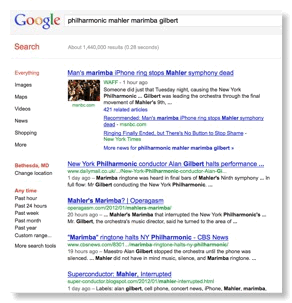
Yesterday afternoon, a NYC area college classmate sent me a link to a post entitled “.Wild Night at Philharmonic After Phone Interruption” from the WQXR Blog.
Last night, in one of the quietest parts of the final movement of a gorgeous New York Philharmonic performance of Mahler's Ninth, a cell phone started ringing ... and ringing, and ringing, and ringing. Alan Gilbert, who was on the podium in Avery Fisher Hall, glared in the direction of the phone, but it kept right on going. Then, the music got louder, and we all assumed that whoever owned the phone had done something about it. But minutes later, when the music got softer again the phone was still going (an iPhone marimba ringtone, which sounds like this):
So Gilbert stopped the performance. He then turned around and indicated that the phone should be turned off. It continued. The conductor then said to the phone’s owner, who was sitting in the front, “You have a phone... Fine, we’ll wait.” And we did, with audience members standing up, pointing in the direction of the offender, and shouting things like “Throw him out!” When the phone was finally silenced, Gilbert turned to the audience to apologize.
As of the posting of this item here, the WQXR Blog had 159 comments on this event - not many praising the cellular industry. One of the comments (#322191) stated,
“It's about time someone took a stand on cellphone protocol. What is so hard about turning it off when requested at a concert. I'm surprised no one has invented a way to check for all cellphones turned on. BRAVO Mr. Gilbert!!!!! I applaud your actions!”
On December 27th, your blogger posted “Some Possible New Year's Resolutions for the Cellular Industry” which included “Social harmony and cell phone use” as item #2. This built on a February 2010 post entitled “Cellphones and Interpersonal Friction”. The 2/10 post, for example, described the Japanese “Manners Mode” built into every cell phone sold in Japan that makes it easy and uniform to disable ring tones - hit the # key! This was not a Japanese government mandate, rather a voluntary standard of the Japanese cell phone industry. Since basically the same suppliers market cell phones in Japan as in the US, one would think that it would be possible here also.
The cell phone industry is united against legalizing jamming, but seems unable to do anything about antisocial cell phone usage that inevitably leads to interest by concert halls and restaurants in cellular jamming. As previously stated here, French national law explicitly permits cellular jamming in concert halls. While jamming in such urban locations inevitably will cause other problems and is thus a bad idea (as opposed to jamming in isolated maximum security prisons where the geometry is very different), there seems to have been little interest in the cellular industry in alternative approaches to minimize the antisocial aspects of cell phone use.
The cell phone industry is usually a positive contributor to US society and the US economy. But it continues to have some blind spots as outlined in the previous New Year's Resolutions post here. Maybe it should address them? Maybe FCC leadership should politely point out these issues from time to time and mention the possible impact of neglect?
I have asked CTIA to comment on the “Mahler incident” and will promptly post any reply.
UPDATE
As you can see from the above YouTube video from a concert in Slovakia, the Mahler/marimba incident was not unique. We patiently await comment from the cellular industry about these incidents and what they are doing to decrease the incidence rate. We know the US cellular industry hates all jamming, any other ideas?
Enforcement Bureau Jammer Initiative

The above text and poster appeared on the FCC website last week as part of a multimedia offensive against illegal jammers. This offensive included an “Enforcement Advisory for Users”, an “Enforcement Advisory for Retailers and Manufacturers”, a news release, a web page on jammer enforcement, a blog on jammer enforcement, and even a Twitter feed on jammer enforcement!
Readers may
The EB “Jammer Enforcement” lists 68 enforcement actions against jammer since 10/04 - impressive at first look. However, a little analysis shows what is really happening here. Only one of these involved a fine (“NAL” in FCC jargon). That involved the appropriately named Phonejammer.com . In this case FCC issues a citation to the company on May 22, 2008 and issued the NAL on April 20, 2010 - 698 days later! It is unclear if Phonejammer.com ever paid the NAL or just morphed into another corporate identity.
The only other fines on the list going back to 2004 are also telling. They both involve Rocky Mountain Radar, a manufacturer of police radar jammers. The 8/14/07 Forfeiture Order has this explanation:
On January 31, 2007, the Spectrum Enforcement Division issued a Notice of Apparent Liability for Forfeiture ("NAL") in the amount of $25,000 to RMR. RMR has not filed a response to the NAL. Based on the information before us, we affirm this forfeiture.
Thus RMR did not even bother responding to FCC/EB! I suspect other jammer sellers will get the message here. A review of the RMR website seems to indicate that similar products are still being sold and they are still selling manuals for the models listed in the citation.
Thus not withstanding the new tweets and blog posts, there is nothing here that would really scare a firm intent upon selling either cell phone or GPS jammers. More puzzling than the FCC/EB inaction on the jamming issue is why CTIA and NAB condone the ineffectual enforcement. CTIA seems more concerns about keeping strictly regulated jamming out of maximum security prisons in rural areas where they could save lives than in keeping wantonly illegal jammers out of the market.
What is needed in jammer enforcement is not tweets about noncredible enforcement, rather some real enforcement! Let me repeat my call from the January FCBA talk:
- Incumbent spectrum users need to work together to advocate an effective compliance/enforcement program at FCC
- Recommend major trade groups form a compliance/enforcement advocacy consortium
Do FCC Commissioners Not Like Doing Enforcement?
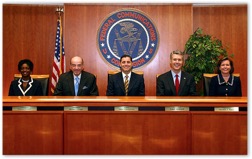
Under current legislation, enforcement is an integral part of the FCC’s job. But it is a lot more fun creating new services and issuing licenses than it is penalizing people for antisocial actions. But as Comm. Abernathy said above during her tenure at FCC, the two go hand in hand.
Thus it is interesting to note the current list of Items on Circulation. There are now 32 items on circulation on the 8th Floor - a major decrease over the historic level! Of the 19 items that have been on circulation for more than 3 months, 8 appear to be enforcement related. These include 3 from the June-September 2008 period that have now spent almost 2 years on the 8th Floor without resolution. The list of all items on circulation more than 3 months is below:
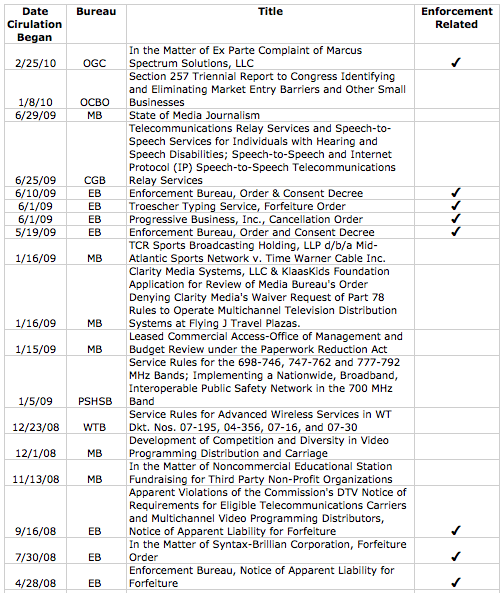
So on today, the 6 month anniversary of our enforcement complaint being on the circulation list, we will not complain about that. But we ask what is served by having these other matters pending for such a long period. Note that this date shown below is only the date that the agenda item reached the 8th Floor. Each issue probably was pending for a long time before it ever got to that high level.


 (Does not include readers using RSS feeds.)


![[Valid RSS]](valid-rss-rogers.png "Validate my RSS feed")


