
Two Recent FCC Actions Highlight Chronic Concerns That Spectrum Policy Resources at FCC Are Too Low
Field Enforcement
- "On August 1, 2016, the Commission was alerted by a posting on Twitter about an unlawful intrusion on the NYPD’s radio system, whereupon the Enforcement Bureau dispatched an agent from its New York Field Office (New York Office) to confirm the intrusion and offer assistance."
- "On September 30, 2016, the NYPD contacted the New York Office and advised that it had arrested two individuals, Mr. Peralta and an accomplice, in connection with unauthorized transmissions made on the NYPD’s radio system."
Does the downsized New York FCC field office have the resources today to have helped NYPD to solve this case had they been asked?
When I was in EB's predecessor, FOB, one of the top priorities of field officer managers was to maintain good relations with local public safety officials so that they could help quickly with public safety interference issues that were of the highest priority then and well as now. So why didn't NYPD tell FCC about this case? Perhaps top FCC officials should ask why! (I suppose the FCC IG could look into to it, but we all know that unlike Curious George he is not at all curious about FCC operations that risk discovering something embarrassing to agency leaders. He is a great team player though!)
Should we look forward to this $404,166 NAL helping to reduce the national debt? Don't count on it. EB is rather evasive about how many NALs are actually paid and this type of fine against an individual has little likelihood of a substantial recovery. Perhaps a more relevant question is why this didn't result in a § 333 criminal prosecution? Now US Attorneys are reluctant to get involved in Communications Act cases involving interference to TV reception or amateur radio shenanigans, but this sounds like what § 333 was intended for and was also a criminal violation of § 301. When I worked in the old FOB, I was personally involved in 4 different successful criminal prosecutions for radio violations (2 satellite jamming cases, 1 aviation air traffic control intrusion case, and 1 maritime false distress case) during a 5 year period. It is unclear when EB was last able to ask and convince DOJ to prosecute any case, perhaps 20+ years ago? Does EB even know how to make such a request to DOJ? Does it even have the files on the old successful FOB referrals to DOJ?
Part 5 Experimental Program Licenses
On April 14th FCC's blog had a new post from OET Chief Julius Knapp entitled "Open for business: FCC's New Experimental Licensing System Accepting New Applications". It failed to mention the origins of this new program, probably because the timing might be embarrassing. On January 31, 2013 FCC adopted the Report and Order in Docket 10-236 updating the Part 5 Experimental License Program. (Note this was 26 months after the NPRM had been adopted — indicating that this docket was not exactly on the fast track. However, both the NPRM and the R&O were released on the day the Commission adopted them indicating FCC leadership was trying to maximize PR since this is treatment only PR-worthy decisions get due to perennial FCC "back office " problems. )
The R&O said about the new types of licenses:
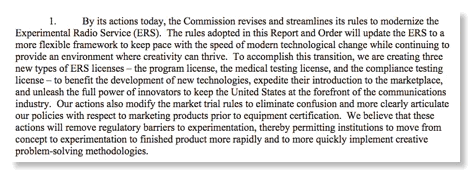
These are all commendable goals but the 4+ years delay between the adoption of the R&O and the opening of the updated application web site that accepts applications is unexplained. There are some plausible issues dealing with a reconsideration of the R&O which was itself on the "slow track" and was slowed further by a 2 month delay in publishing the R&O in the Federal Register. OMB approval was needed for some details of the new website since it gathered information. But the most likely explanation for much of the years of delay was the lack of resources in FCC to modify the website that handles experimental applications. Indeed what was actually done was to add a new section/dashboard so that the basic experimental license website created in the 1990s remains unchanged. (It was state of the art 1990s technology in how it implemented the FCC Form 442 of the era but is a now real pain to use for even simple applications for anyone who doesn't use it on a regular basis due to design quirks and poor instructions.)
So both of these problems are probably cause by chronic low FCC funding for spectrum policy issues other than auctions and 5G. While certain FCC Title II activities are controversial, Title III activities generally are not. Indeed, Title III is both a profit center for the Treasury and a major growth enabler for the GDP. Why far the resources for FCC in this area so low that key activities are not adequately funded. Note that this is a bipartisan issue and both parties are responsible!
The WTB Auction Division is adequately funding because it can "skim" off auction proceeds. (When I was working at FCC many people noted that all the staff in the Auction Division had large displays on their PCs because their were supposedly needed for auctions - even for time clerks?) Ofcom is not funded by an appropriation from the UK Parliament, it is funded by the fees it collects subject to limits set by the agency that supervises it. Perhaps it is time to try to remove the spectrum regulation of FCC from regular politicized appropriations process since it is already supported by various spectrum fees? Recall that Wi-Fi, Bluetooth, and many other unlicensed marvels all started with a $55,652 FCC-funded study at MITRE Corporation in 1980 and today's reality is that FCC can not afford studies of new technology options and can't even afford its own spectrum enforcement activities and implementation of new rules!
Something CTIA and Wi-Fi Community Might Agree On
These days CTIA and the Wi-Fi community don't seem to agree on much due to the ongoing LTE-U/Wi-Fi controversy. But here is something that they are both likely to agree on for this weekend: Let's hope that FCC's total abdication of interest or responsibility for any aspect of drone spectrum issues does not result in spectrum chaos this weekend in the cellular bands and/or Wi-Fi bands, but possibly other bands if the drones marketed in the US are as noncompliant with spectrum emission rules as the drones marketed in Europe.
This EU report observed what has been previously discussed here about the interference potential of drones that are not properly regulated:
So let's hope that the huge number of new drones that will be airborne this weekend do not result in spectrum chaos due to their location at altitudes that were not expected by cellular planners and Wi-Fi users or from out-of-band emissions. And let's hope that if they do cause interference that FCC will respond more quickly and decisively than it did in the case of "cellular boosters", police radar detector interference to VSATs, or the ongoing FM harmonic interference to 700 MHz LTE base stations - which FCC has never made a public pronouncement on.Signals transmitted from the air to the ground have a significantly bigger coverage area than from the ground. Therefore, interferences generated from RPAS could have a major impact on radio communication. This means that there is a higher risk of harmful interference if RPAS systems do not meet the essential requirements.
Perhaps serendipity might save the spectrum community this time from chaos. But really, is this the way to protect multibillion dollar industries that are deeply tied to our society and economy? Should we have an FCC that can pay attention to issues other than corporate merger review and finding more spectrum for cellular carriers?
After the holidays, readers might want to review my TPRC paper this year that deals with FCC productivity shortfalls in spectrum policy and argues that they result from BOTH resource shortages and an inability for the FCC's "8th Floor" to understand they have to delegate some issues more in order to keep up to the magnitude of their job in today's IT focused world. (General Motors board of directors does not review every design detail of next year's Chevy because they could not keep up with their strategic responsibility if they did. FCC's commissioners need to develop a more collegial relationship and decide which issues are "bottom line" for they and need limited availability en banc deliberations and which can be left to staff under agreed guidelines like Ofcom has with its staff.)
And let's all pray we avoid spectrum chaos this weekend. Best wishes to all for a happy holiday season!
EU Market Surveillance Finds High EMC Noncompliance from Present Consumer Drones
- Drones and their use of spectrum
- Enforcement of FCC equipment authorization rules
Every year the EU pick a type of radio equipment for market surveillance to see if actual units are complying with the EU counterparts to FCC equipment authorization rules give in Part 2, Subpart J of FCC's Rules. This year 16 countries (Austria, Estonia, Finland, France, Germany, Greece, Lithuania, Luxembourg, the Netherlands, Norway, Poland, Slovakia, Spain, Sweden, Switzerland and the United Kingdom) cooperatively examined 79 drone models sold in EU territory. 92% of the units tested "were manufactured in countries of the Far East ". The mean price of systems was "between 100 and 200 euro". These units almost all used the 2.4 and 5.8 GHz unlicensed bands, best known for Wi-Fi.
The report observed what has been previously discussed here about the interference potential of drones that are not properly regulated:
Signals transmitted from the air to the ground have a significantly bigger coverage area than from the ground. Therefore, interferences generated from RPAS could have a major impact on radio communication. This means that there is a higher risk of harmful interference if RPAS systems do not meet the essential requirements.
Here is what the EU found about compliance:
The market surveillance authorities found that ninety two percent (92%) of the devices did not fulfil all of the requirements. Half (51%) of assessed RPAS were found to be non-compliant in relation to the effective use of spectrum. Four out of five (82%) had administrative non-compliances within the meaning of the R&TTE Directive.
The campaign showed that the main reasons for non-compliances with the effective use of spectrum were spurious emissions (70%) and radiated power/power density (23%). Furthermore, the figures show that the remote controls on the ground tend to have a higher non-compliance rate than the aircraft systems.
The market surveillance authorities consider the rate of non-compliances too high. The growing market of remotely piloted aircraft systems combined with a low compliance rate could lead to an increase of interferences to the radio spectrum. Market surveillance authorities should therefore continue to check at national level such products and take all appropriate measures to ban non-compliant products from the market. Regular reporting in ADCO R&TTE is recommended.
It is reasonable to assume that most of the models sold in the EU are also sold in the US and that if they don't comply with EU regulations they probably don't comply with FCC ones either. The FCC counterpart of "market surveillance" was reviewed in Docket 13-44 and the rules were tightened in its Report & Order. But it appears that the EU approach is more transparent with eh issuance of reports like that shown above. It also appears that there is central planning of equipment categories to surveil whereas in the US Telecommunications Certification Bodies (TCBs) due surveillance on behalf of FCC and have great discretion in their actions. There is also a conflict here in that TCBs have a supplier relationship to manufacturers/importers who buy their services.
So several questions come from reviewing this EU report:
- Are drones now sold in the US as noncompliant as the ones sold in Europe?
- If so, why haven't the TCBs or the FCC noticed it?
- Does the allegedly overactive Enforcement Bureau have any interest in this matter?
- Will the Wi-Fi community get distracted enough from it present focus on LTE-U issues and recognize this serious threat to its spectrum?
If FCC Can't or Won't Deal with FM Pirates, Perhaps It Should Have a Candid Conversation With FAA on Aviation Safety?
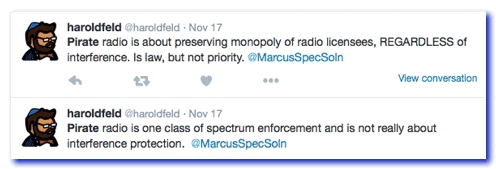
I have known Harold Feld, Public Knowledge's Senior Vice President, for a long time and agree with him on many issues. He has even been a past client. But the above Twitter exchange indicates a not unusual viewpoint in the spectrum policy area and clearly was an undercurrent in the recent consultant's report that rationalized decimating the FCC's spectrum enforcement resources.
Notwithstanding vague promises made to NAB it is pretty clear that broadcast pirate enforcement will be a low priority for the new "modernized" field enforcement at FCC. Pirate broadcasting is often intermittent and at odd hours, requiring both staff overtime and travel, two things that are very scarce at today's underfunded FCC. New equipment designed to decrease necessary staff time would also be helpful, but equipment money is also very scarce.
So let me address the safety implications of pirate broadcasting, rather than view it solely as just an economic inconvenience to incumbent broadcasters. Pirate broadcasters distract audiences and also sometimes even carry paid ads!
But all properly licensed FM stations are subject to technical rules also. While some of them may be about "preserving monopoly of radio licensees", many also deal with preventing interference to other non broadcast radio systems. (The ongoing saga of interference from certain licensed FM stations to 700 MHz LTE base stations due to a regulatory loophole (along with FCC distraction on other issues) is a concrete example that each radio service does not live in a totally independent silo from other services!
It is doubtful that all pirate FM stations buy transmitters that meet all Part 73 technical standards with respect to out-of-band emissions and harmonics. Thus there is a real risk of interference to other radio services without some reasonable check and balances.
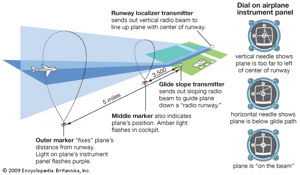
FM stations that are properly licensed use frequencies, powers, and locations that have been reviewed by FAA during the application process to make sure they do not pose a new inference risk to ILS receivers in aircraft. Pirate radios are very unlikely to check with FAA. (FAA's Airspace Analysis Model computer program that does the analysis is publicly available so they might check, but I doubt it.) While it is generally assumed that intermodulation interference can only occur when there are 2 strong signals present with the correct mathematical relationship with the victim signal, that is not literally correct. As shown in ITU-R Recommendation SM.1009-1 the interference power generated in the receiver by the inevitable nonlinearities is the weighted sum of the power of the 2 FM frequencies that have the correct relationship with the ILS frequency. (This is called Type B interference in the jargon of ITU-R.)
If one of these FM broadcast band frequencies comes from full power FM station and is very large at the location of the ILS receiver in the air, only a negligible amount of power at the other frequency is needed to cause interference if they have a certain mathematical relationship. While the math is clear, it is counterintuitive that a low power signal could cause such interference. Many years ago while I was working at FCC on this issue and the main contact with FAA on it I asked them to demonstrate this phenomenon which they kindly did for me and several other FCC officials at their Technical Center in Atlantic City.
Thus a modest power pirate FM could have the right location, power, and frequencies to cause Type B interference to the safety critical ILS signal.
Like FCC, FAA is not a perfect agency. Almost every other aviation regulator in the world limits the likelihood of this interference by both addressing the issue of FM station power, frequency, and location near airports and by mandating receiver immunity standards prescribed in ICAO Annex 10 to the Convention on International Civil Aviation, Volume I – Radio Navigation Aids, Section 3.1.4 Interference immunity performance for ILS localizer receiving systems (2006). However, as we have discussed earlier, FAA has refused to implement their standards for US aircraft in domestic service and has blocked FCC implementation of them. Thus the FAA's Airspace Analysis Model that predicts interference assumes that receivers more vulnerable than the ICAO standards are in use. But as pirate radio stations proliferate without effective enforcement there is a real risk that one of them might just land at a power, frequency, location triple that poses a threat to aviation safety but is not addressed since pirates don't have to deal with spectrum regulations!
If this is the new reality of "field modernization" then I urge FCC to have a pragmatic discussion with FAA,who were consulted on aspects of the consultants study but probably not this one, that FM pirates are a low priority and they might want to increate the immunity of the US air fleet (foreign aircraft already comply) to this type of interference by implementing the 2006 ICAO immunity standard.
New EB Field Chief Announced in Low Key Way

Last Friday, Broadcasting & Cable's veteran reporter and Washington Bureau Chief John Eggerton posted an article entitled "FCC Names First Enforcement Bureau Field Director". The article begins:

FCC Enforcement Bureau Chief Travis LeBlanc announced Friday in an internal e-mail to staff that he plans to appoint the FCC's first ever Enforcement Bureau field director, Charles Cooper. Cooper comes from engineering consulting firm du Treil, Lundin & Rackley, where he was a partner and senior engineer.
Charles Cooper (2011)
Previously EB had announced that spectrum users with unresolved complaints "may contact the Field Director within 2 weeks after the period for the initial response". But only a few industry insiders were told who the acting field director was! (Actually it was also Mr. Cooper.) The policy also stated "Complainant may contact the relevant Regional Director within 1 week after the period for the initial response". For many years after EB was formed in the early 1980s from the former Field Operations Bureau, briefly renamed Compliance and Information Bureau, the phone numbers and e-mail addresses of field enforcement officials outside the Beltway were a closely held secret (even to non-EB FCC staffers) as all public contact was directed to the Call Center in Gettysburg. That changed a few years ago, but such contact information is really buried in the FCC's voluminous poorly organized web site. It certainly is not directly reachable from EB's home page.
Today, several days after the internal announcement and Mr. Eggerton's publication of the news and similar announcements in other publications, there is no word of this new appointment anywhere on the FCC or EB's website!
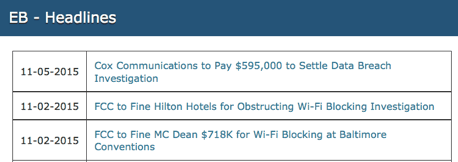
Headlines from EB homepage 11/17/15 10 AM
But does any of this surprise us when FCC never bothered to announce in 2013 that 2 senior official were getting the Presidential Rank Awards, a federal government-wide great honor for senior civil servants that had only been awarded 2 other times since 1978 to FCC staffers. So if the FCC has a million dollars to spend on consultants, perhaps they might also want to hire a consultant on how to motivate their staff more effectively by recognizing their accomplishments?
Here is a bio of Mr. Cooper dating to when he joined FCC a few years ago:
Prior to joining the FCC, Mr. Cooper has most recently been a Senior Engineer and Partner at the engineering consulting firm du Treil, Lundin & Rackley, where for twenty years he focused his engineering talents and expertise on communications issues and gained more than thirteen years of management experience. He is a Registered Professional Engineer, a former member of the Mississippi Air National Guard and Reservist, and a Cum Laude graduate of Mississippi State University. Mr. Cooper has performed and supervised many different types of communications projects including those in all of the broadcast services (AM/FM/TV/DTV). He also has experience inwireless, point-to-point microwave and land-mobile. He has served twice as president of the Association of Federal Communications Consulting Engineers.
Congratulations to Mr. Cooper on this appointment and our best wishes for success. Hopefully he can convince FCC leadership to give him the needed mix of personnel resources, overtime, travel funding, and equipment funding needed to do this key job. It would not hurt if key industry trade associations ask FCC leadership about the flow of resources to the remaining EB spectrum enforcement operation. Indeed, they might also want to talk to OMB and the congressional appropriation committees about the importance of adequate spectrum enforcement resources for their billions of dollars worth of Title III licenses.
Spectrum Enforcement Downsizing Report has Leaked Out
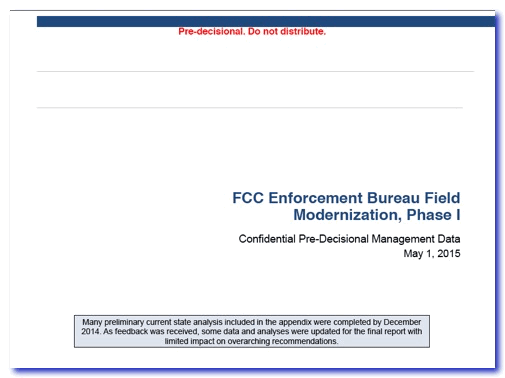
The consultant's report that was used to rationalize the downsizing or decimation of the FCC's spectrum enforcement field staff has now leaked out. I previously filed a FOIA request for this. EB's response that did not produce even a word of the text due to total stonewalling. Of course this is the same EB that in the previously discussed case of the Motorola 5 GHz radio that was interfering with safety-of-life airport weather radars thought so little about the FOIA Act and its mandates that they let Motorola's lawyer respond directly to me (saving FCC postage, perhaps?) and ignored the statutory requirement of marking any redacted section with the FOIA exemption number.
Now, through anonymous sources, we have a 253 page Powerpoint presentation. Oddly, it lacks any indication of authorship. The second slide being with this statement:
FCC engaged OceanEast and Censeo in October 2014 to conduct an organizational assessment of the Enforcement Bureau’s (EB) Field operations in order to identify whether Field resources were being used in an efficient manner aligned with FCC mission and policy priorities in the current state and for the long term
OceanEast was paid $845,520 in FY15 by FCC for this study.
Would a comparable amount of effort spent on reviewing FCC's overall throughput and productivity in it main product line of telecom policy have been more cost effective?
Below is page 86 of the presentation on how the EB field staff, at least those around when the survey was held, thing about decision making speed in the Bureau:
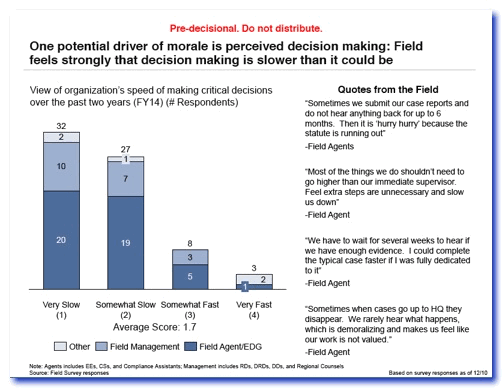
Note that 32 out of 70 EM field staffers felt that EB's "speed of making critical decisions over the past two years" was "very slow" and another 27 felt that it was "somewhat slow". Does this have something to do with the growth of the EB front office staff? Or perhaps the Commission's present general disinterest in spectrum policy other than key political issues such as the incentive auction?
Perhaps our recent post on antenna tower marking and lighting enforcement is indicative of this problem. The Johnson Towers Corp. case was initiated by an inquiry from FAA to FCC in November 2013 and was not finally resolved until 2 years later! The General Communication, Inc./Alaska Wireless Network, LLC case also took about 2 years to resolve. (Since this case involved a self-reported violation, erasable people could disagree on whether a $620,500 fine was appropriate, but since this is a safety of life issue most would agree that timely resolution of both of these cases was needed to show that FCC is serious!
A final sample of the slides in the report that FCC leadership tried to suppress deals with the staff's understanding of FCC's enforcement goals:
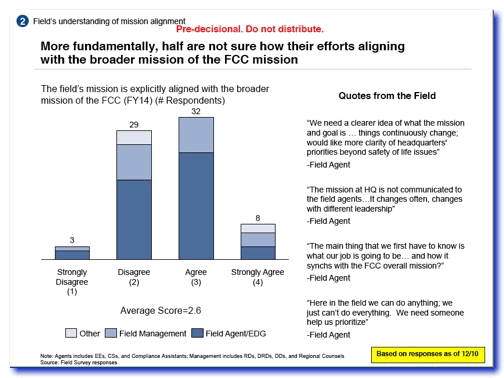
32 out of 70 EB staff respondents answers that they either disagreed or strongly disagreed with the statement "The field’s mission is explicitly aligned with the broader mission of the FCC". Is this an indication that spectrum enforcement should be downsized or a call for a major shakeup in EB leadership? For more than a decade the EB spectrum enforcement staff has been puzzled on what were the goals and priorities of the organization. Since they didn't know the goals, initiative was discouraged because you might enforce something that wasn't wanted. Look at the April 24, 2010 blog post that was here. FCC could have saved a lot of money if they had read it and acted! Here is an excerpt from hat post that indicates EB staff confusion over enforcement goals:
Sources in EB tell me that during the DTV transition when EB agents were visiting electronics retailers in large numbers to check for proper labeling on TV receivers being sold they were actively discouraged from noticing other equipment being sold that was illegal. Thus a return to the Adm. Nelson “telescope to the blind eye” approach.
Field downsizing will not accomplish anything - except maybe saving some money to be spent elsewhere in FCC - unless FCC & EB leadership take an active role in defining clear goals for field spectrum enforcement and gets adequate funding for equipment, travel and overtime: 3 things that field enforcement needs that are not needed by FCC staffers in Southwest! (As we have said before, city hall clerks need fewer resources than policemen and firemen. Does that mean that cites should downsize police and fire resources?) There is a real risk that the downsizing without strong leadership will facilitate spectrum chaos.
Indeed, the current glut of broadcast pirates may be a premonition of what is coming if FCC does not get its spectrum act together. Aviation safety may also take a big hit as the report minimizes the need for continued tower marking and lighting inspections mandated by §303(q) and gives no alternatives to assure this safety related compliance.
Think about this next time you fly!
CLARIFICATION
At no time has your blogger ever solicited internal nonpublic FCC documents from FCC staff. The first draft of the consultant report that I announced on this website was received from a known source outside FCC who sent it unsolicited. The longer document in this post was received unsolicited from a GMAIL account that is clearly a pseudonym and the cover message implied it was from an FCC employee. I have no idea who it was from and again did not solicit it, although I had requested it in my FOIA request that I believe was improperly handled at FCC. Before posting it here, I checked to make sure it contained no information affecting national security or law enforcement function or the privacy of FCC employees.. Indeed, the document's marketing do not imply it contains such material.
EB Field Consultant Report Revisited
Readers may recall that this blog was the first to provide a leaked version of the consultant's report on Enforcement Bureau field activities that was used to rationalize decimating this organization and reducing it to 54 staffers nationwide.

In this case, the provider acquired another Alaskan telecommunications company’s cell towers in mid-2013, at which time it conducted an internal inventory of its cell towers. The provider found that 118 cell towers, including many of the recently acquired towers, were not registered in the ASR system in violation of the FCC’s Rules. It also concluded that three of its towers were not properly lit. The company self-reported the apparent violations to the FCC in early 2014, and thereafter began a complete review of its towers.
The provider settled the FCC’s subsequent investigation into the tower violations with a hefty $620,500 payment. In addition, the provider agreed to complete the tower review it commenced in 2014 and to bring all of its towers into compliance by April 30, 2016.
(The low key hidden press release on the fine is here and the more detailed Consent Decree and Order are here)
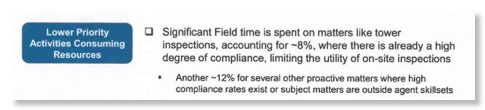
With the downsizing of the EB field staff and the reducing of field locations from 24 to 13 nationwide towers owners in most of the country can be assured that the likelihood of an inspection or even being noticed by FCC agents traveling outside their office has been reduced to near zero. The report claimed that FAA was consulted. Did they talk to the FAA staff that deals with spectrum management only or did they also speak to the FAA staff responsible for airspace obstruction marking and lighting? Like or not, §303(q) makes FCC responsible for marking and lighting of antennas that intrude into navigable airspace.
It is actually amazing that aviation organizations such as the usually shrill Aircraft Owners and Pilots Association ("Protecting Your Freedom to Fly" although in the case of FCC it is usually protecting the right of AOPA members to have all aircraft radios grandfathered from new rules for higher spectrum efficiency"), Airlines for America, and Helicopter Association International were silent about the field downsizing that will directly affect aviation safety.
In drafting this blog entry I noticed something else strange about the package of leaked documents that included the consultant's report. It also included a memo from EB Chief LeBlanc to the EB field staff dated March 10, 2015. (pdf p. 4-5 of this package.) In that memo was the following statement:
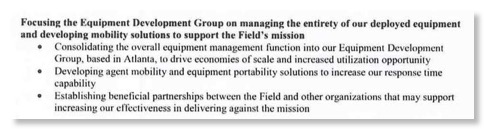
EDG is the field unit based in suburban Atlanta that designs and build receiver and direction finding equipment for field operations including the custom made covert direction finding cars FCC agents use. It also designs and maintains the HF direction finding equipment used by the FCC's Public Safety and Homeland Security Bureau that is rarely mentioned. But as we have said in a previous post "The Equipment Development Group in Powder Springs, GA shrinks from 10 positions to 7." So how is EDG going to be able to handle these new functions with a smaller staff?
UPDATE
The EB homepage now has another antenna marking/lighting violation posted, unlike the Alaskan one described above that is hidden somewhere in the bowels of the website. This new one was released on November 3 and deals with Johnson Towers Corp., "an owner-operated company with no employees and three antenna towers" in Pinellas Park, Florida. This action follows an NAL issued in November 2013:
"In response to the NAL, JTC asserted that insufficient finances and lawsuits hindered its ability to install lighting systems on antenna structures 1060088 and 1060090, acknowledged that it did not notify the Commission about the dismantlement of antenna structure 1060089,and stated it would come into compliance as quickly as possible."
Did EB's "Field Modernization" consultant know about this action when he concluded that there was "a high degree of compliance" in tower compliance? Was FCC leadership aware of this as they agreed to implement the report's recommendations? The importance of this issue is clearly stated in the new order: "Critically, conformance with the lighting requirements imposed by the Commission and the FAA ensures that antenna structures do not pose a public safety risk to passing aircraft." Thus tower lighting and marking is a safety of life issue even though it appears to be one of EB's lowest priorities.
The NAL describes how this incident was brought to the FCC's attention by FAA who noticed a paperwork issue. An agent from EB's Tampa office visited the Pinellas Park site and noticed the unauthorized demolition and the lack of lighting on the remaining towers. Now it is only 20 miles from Tampa to Pinellas Park so this was an FAA inquiry that was easy to followup. But post-"Field Modernization" most of the USA will be more than 100 miles from the remaining 13 offices. How are tower lighting and marking rules of Part 17 going to be enforced in this new era? When the broadcasters complained about pirate enforcement issues, EB announced they would develop a plan - not yet finished. How will the downsized EB field organization deal with safety related tower enforcement.
Also, why did it take 2 years and 2 days to resolve an enforcement issue related to a safety of life topic? (Actually 2 years and 5 months if you start from the originally inquiry from FAA on April 14, 2011.)
Of course, another issue is why doesn't the aviation community care? AOPA has traditionally been a total nuisance at FCC trying to avoid having their member spend money to upgrade avionics to meet new spectrum efficiency standards. Don't the lives of their members, as well as the public, matter as much as the wallets of their general aviation aircraft-owning members?
Demise of FCC Form 740 Along with the Rest of Spectrum Enforcement
October 19, 2015 - Order
FCC Form 740 Suspension Order
For those of you not familiar with the Form 740, it is the form needed to import electronics equipment that is FCC-regulated, or potentially FCC-regulated, into the USA. Below is a key section of the form: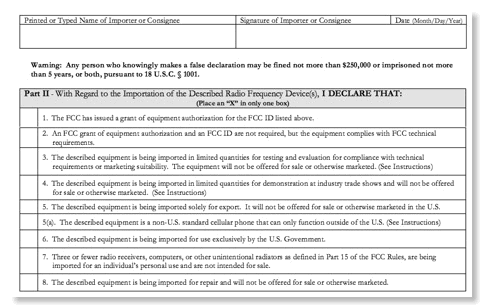
Part of present Form 740
Note that the importer or consignee has to certify subject to criminal penalties that the items have been issued a grant of equipment authorization. In view of the recent VW kerfuffle perhaps FCC should up the ante and require a statement both that there is a grant and that the equipment has hardware and software that is consistent, within normal commercial practices, with what was approved by FCC - which is most cases was actually a TCB operating on behalf of FCC.
FCC had previously proposed to delete the Form 740 filing requirements in the NPRM of Docket 15-170 stating (at para. 119)
We also question whether the Form 740 requirement continues to be useful for us to identify non-compliant RF devices and take appropriate follow-up action. The continuation of the burden of filing Form 740 no longer appears justified and we propose to eliminate the requirement. We seek comment on this conclusion and the observations on which it is based. Parties are invited to identify any benefits we could derive by continuing to collect the Form 740 information, in its current form or a modified form, and specifically to comment on whether and how any of the underlying objectives of our equipment authorization program would go unmet if we eliminate our existing means of collecting this data.
While the form may not allow ready identification of "non-compliant equipment", the threat of criminal prosecution under 18 USC § 1001 might be a real deterrent to such importation if FCC really cared about spectrum enforcement. But as we have written recently there are serious questions whether FCC cares about any type of spectrum enforcement.
Recall the chart from the consultant's report used to justify spectrum enforcement downsizing that we have used several time before:
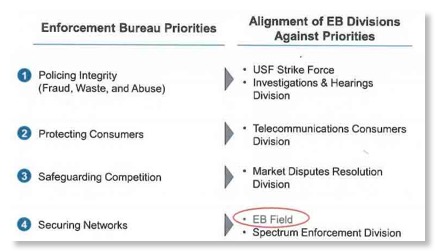
Spectrum seems to be EB's lowest priority. And what little interest they have seems to be ex post facto enforcement of public safety interference, with maybe a little time for broadcast pirates. Ex ante enforcement of equipment marketing has been low on both OET's and EB's agenda for more than a decade.
Now Marcus Spectrum Solutions LLC does not own any Title III radio licenses, let alone ones that are worth billions of dollars. But since the fair market price of spectrum is in the range of $0.50 - $2/MHz-pop there certain are firms - and maybe even individuals - who own billions of dollars worth of licenses. But if I was responsible for such licenses and accountable to shareholders I would be very nervous about the sudden demise of the Form 740 along with FCC's ever shrinking interest in all spectrum enforcement.
The Report and Order in Docket 13-44 had some improvements related to enforcement and post-market samples: it allowed for some FCC involvement in TCB sampling of production units (para. 27), but it still limits sampling to 5% and does not address purchasing units at the retail level where they can not be tampered with as in the case of "lab queens"/"golden apples" that are selected for testing because of superior performance or possibly even modification à la VW emission tests. It also requires that TCBs only test units made by their own clients - a certain conflict of interest.
So given FCC decreasing interest in spectrum enforcement, the new 740 Order should be no surprise, but maybe the major spectrum licensees as well as legitimate manufacturers of radio equipment should challenge it forcefully?
Enforcement Bureau Too Aggressive?

Dave pointed out that prior to LeBlanc's arrival there had only been 5 enforcement actions greater than $5M none of which was over $25M, but that since he arrived at EB there have been another 5 over $5M and one of them involved $100M! Dave has been quoted as saying at the conference that FCC has become "much, much more aggressive on enforcement”.
Too aggressive on enforcement?
Let's note that these actions all deal with Title II issues. EB was created to manage all FCC's enforcement work and to give them rational priorities. This is a spectrum blog and so let's review what today's EB has been doing with technical spectrum policy enforcement. The field staff downsizing is an obvious feature. Although increased productivity has been promised, there is no sign of the equipment, travel, training, and overtime funding needed to make that happen.
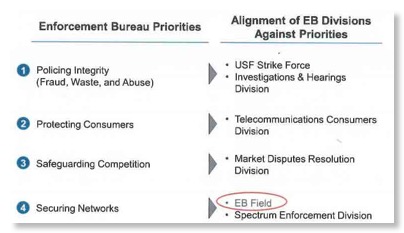
The consultant's report that was leaked revealed EB's priorities:
From Sunset Park, Fri. at ~4:55pm, many of the usual suspects seemed to be off the air, but 91.3 & 95.9 were on, w/preaching in English. We were on a hill w/view of NJ skyline & could also hear an apparently NJ-based Haitian pirate at 102.1 FM, spaced awfully close to WFAN-FM. Around 5:30 p.m. Fri., some of the usual suspects like 90.9 and 91.7 started their broadcast day. Others like 89.3 & 89.7 were still dark. ...also 92.9, 94.3, 94.5, 95.1, 97.5, 97.7, 99.3, 99.7, 99.9, 101.5, 101.7, 102.1, 102.3, 103.1, 104.1, 107.1, 107.9, and possibly 104.7.
Note that spectrum and field issues are at the bottom of the list. The recent tweets below on pirate radio activity ion New York shows what results from such a low priority:
While your blogger was involved in 4 criminal prosecutions ( 2 satellite jamming, 1 air traffic control intrusion, and 1 maritime false distress) during his brief tour in EB's predecessor, the Field Operations Bureau, it is unclear if EB has ever been involved in a criminal Title III matter since its creation more than 20 years ago from the merger of both FOB and enforcement parts of other bureaus. While this is blamed on DOJ disinterest, one wonders what has changed so much since the creation of EB?
Note that when AT&T and Motorola were found to be involved in harmful interference to safety-related Terminal Doppler Weather Radars near airports that detect turbulence that can endanger aircraft, they got off with "voluntary payments" of $25k and $9k . (AT&T and Moto's legal fees for these matter surely dwarfed the pittance they paid for their guilt.!) While there have been several $100+k NALs for cellular jamming incidents, have anywhere near these amounts ever been paid by the guilty party? Have Chinese jammer manufacturers ever paid any of the $1M+ NALs issued to them? There are anecdotal reports that EB and the FCC bureaucracy have little attention span for collecting such NALs.
So maybe the problem is a misbalance of enforcement interest between Title II and Title III issues and too much of a focus on impressive press releases as opposed to actual compliance or even payment of penalties?
When FCC announced the downsizing of spectrum enforcement, CTIA, NAB, and APCO complained and managed to get promises that their specific enforcement areas would not be ignored, but the overall plan changed little other than these promises. There is little assurance that the remaining EB field staff will have access to equipment funding travel, and over time to do the job expected of them and promised to the 3 large associations.
The root cause of this downsizing was the FCC's desperate budget situation.
While Congress might not want FCC to have resources for controversial topics like "spectrum caps" and "net neutrality", perhaps the key trade associations should start exploring with OMB and appropriation committees some sort of "lock box" arrangement for basic FCC noncontroversial long term spectrum policy and enforcement funding for issues that have been bipartisan for decades?
What is FCC Doing to Help Displaced Long Term Field Employees
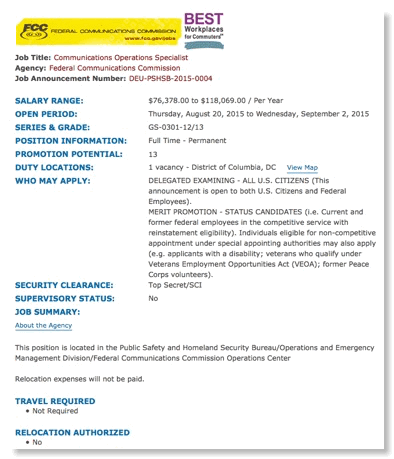
The above is a current vacancy announcement for FCC. As you can see at the bottom the posting does not authorize relocation for whoever is hired. This has been the general practice at FCC since the Fowler chairmanship in the 1980s. But FCC in the name of "field modernization" is about to layoff 44 field employees, most of them long term employees. A handful of field employees will keep their jobs but face downgrades — effectively demotions from the same change.
The field modernization is a decided issue that has been voted on by the Commission and we will no rehash it here even though we disagree. However, a separate issue is what to do now to implement it. It is reasonable to assume that some of the affected employees would qualify for this job opening in Public Safety & Homeland Security Bureau. Will they be given preference? Other agencies give preference to displaced employees. Will FCC?
If they apply and are selected will FCC pay relocation costs? (Former Managing Director Ed Minkel was remored to reject any selection for a posting who was eligible for relocation costs. Does his current successor have the same policy?)
Relocation costs of federal employees transferring to a new work station is allowed under Chapter 302 of the GSA Federal Travel Regulations. More specifically §302-1.1(b) says you are eligible for relocation costs if you are " An employee transferring in the interest of the Government from one agency or duty station to another for permanent duty, and your new duty station is at least 50 miles distant from your old duty station." Note that under §302-3.100 FCC can pay relocation costs for "employees separated as a result of reduction in force or transfer of functions who are re-employed within one year after such separation."
If "field modernization" is going to save FCC so much money, can't some of it be used to hire long term loyal employees who qualify for other positions in FCC? Should they be actively considered? Should they get a modest preference?
New Details of "Field Modernization"/Spectrum Enforcement Cutback
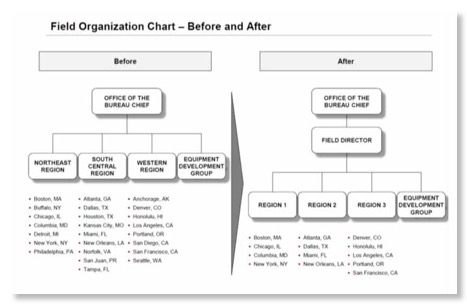
This week FCC notified its union, pursuant for federal labor relations laws, of the details of last week's "Field Modernization". We have posted the key documents for readers to review.
Some observations:
- Number of people affected: The present staffing level is 98 and the new one is 54 for a net loss of 44 positions. The 98 number includes no vacancies so this is a loss of 44 FCC employees, most of whom are long time employees.
- Three "bargaining unit" staffers will be downgraded/demoted from GS-14 to GS-13: 2 in Miami and 1 in LA. "Save pay" provisions will limit the salary impact but the salary impact will be real and negative for these 3 individuals.
- A few supervisors will also be downgraded/demoted but the details were not part of the notification to the union and are more difficult to deduce at this point.
- A new GS-15 Enforcement Bureau Field Director office is created with a GS-15 EE as "Field Director" and 3 lawyers as ""Field Counsel". Two of these lawyers are named and do not presently work in DC so it is unclear where these positions will be. The Field Director will be an awfully lonely position if his/her nearest colleagues are in Columbia MD.
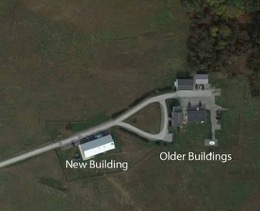
- The Equipment Development Group in Powder Springs, GA shrinks from 10 positions to 7. This is the part of EB that develops new equipment and built special equipment. In the long term with a decrease in overall staff and number of offices there may be less equipment to build. But the only way to increase the productivity of field staff is to give them the right equipment to make them more productive as the consultant's report says. Various statements have been made about keep some of the savings from the staff cuts within the field to buy equipment, but the downsizing of EDG raises the question of whether this is credible.
- Equipment acquisition in EB (as well as in OET) has always been limited by the late availability of funds every fiscal year and excessive procurement bureaucracy. As a result usually only off-the-shelf equipment is bought, usually "riding" a DoD contract so the model options are limited. In order to get specialized equipment more procurement flexibility is needed and that generally means earlier availability of funding something that does not appear to be of interest at present to the FCC's Managing Director.
- t is unclear if FCC will pay relocation costs of any of the 44+ employees who are affected by these changes who qualifies for a position elsewhere in FCC. FCC since the Reagan era FCC has not budgeted for staff relocations even though it has staff "outside the Beltway". Indeed, former Managing Director Minkel (1980s) would cancel personnel postings if the person selected was legally entitled to relocation at FCC expense! Great way to help morale!

- Despite the promises to NAB to increase suppression of pirate radio stations there is not evidence this will happen or be sustainable. Pirates are generally not limited to the usual 40 hour work week and suppression needs availability of both overtime funding and travel funding - for those not conveniently near any of the remaining offices. In addition, since the creation of PSHSB aft 9/11 the entire 24/7 operation of FCC moved from EB to PSHSB and is only interested in off hour contacts dealing with safety-related issues not pirate broadcasters. Who you gonna call on weekend/evenings about a private station? Ghost Busters?
"Field Office Modernization" OR Spectrum Enforcement Cutback
Yesterday FCC at a public commission meeting voted unanimously to
"modernize the agency’s field operations within the Enforcement Bureau. The proposal will improve efficiency, better position the agency to do effective radio interference detection and resolution and meet other enforcement needs, and save millions of dollars annually after implementation is complete."
The decision was in an Order that was adopted and released immediately. The Order states
The Field will embark on a program to update its equipment and employee skillset to address the likely issues that will accompany new and expanded uses of spectrum. This program will include the expanded use of remotely operated monitoring equipment to supplement field staff, as well as the identification and use of portable devices capable of assessing interference issues in bands expected to experience heavy spectrum use. Upon completion of all required implementation steps, the Commission will first apply the net savings resulting from this reorganization effort to this program, before applying those monies to the agency’s general fund. The net savings will not be used to increase the number of full-time non-field-related employees in the headquarters office of the Enforcement Bureau.
Now recall that TR Daily previously reported "FCC officials also have told stakeholders that the field operations would get the first shot at any money the FCC saves by closing field offices." So where are the savings going? Will there really be enough money after all these jobs are eliminated "to update its equipment and employee skillset"? While a statement has been made that savings can not be used to increase EB front office bureaucrats - comments were made at the commission meeting that EB front office bureaucrats have actually have increased significantly in the past few years - there is now little assurance it will actually go to equipment and training.
Paragraph 15 of the Order states "IT IS FURTHER ORDERED THAT all Enforcement Bureau field agents shall have electrical engineering backgrounds." Your blogger was educated and overeducated in electrical engineering. He has actually worked in spectrum enforcement. Focusing on academic credentials for such work is naive. Perhaps the intent was not to have non techies, but the skill set for solving spectrum enforcement problems in the field has little to do with most EE curriculums these days. Yes, some universities such as Virginia Tech, UCSD, NYU (now merged with "Brooklyn Poly"), and University of Texas-Austin have programs in wireless technology, but the vast majority of EE graduates have virtually no exposure to wireless technology, focusing on issues such as software engineering and semiconductor design and manufacturing. This coupled with the totally inept technical staff recruiting FCC has had for the past decade means less capability in new hires, not more. For spectrum enforcement, you need people who really understand spectrum issues intuitively. Let us go back to the MGM-produced WWII era film "Patrolling the Ether". When FCC wanted good agent then it hired ham radio operators. While having a ham license is not a perfect predictor of success, it is a better predictor of success than simply having an EE degree given the state of EE education in wireless issues now. One has to hire good people, not take short cuts in focusing on credentials!
For the past 3 decades, ever since Ed Minkel became the first Managing Director, FCC has avoided paying for personnel relocations. Will FCC pay for relocations related to this downsizing? For example, will staffers whose jobs are eliminated be eligible for FCC paid relocation to another office with a vacancy or to Washington if they are selected for a job there? We believe that the near total absence of FCC-funded relocations were both a major contributor to poor morale in field offices and has denied FCC headquarters of the historic flow of individuals with field experience and actual problems of licensees. The 2016 FCC Budget has only $55k for Budget Object Classification Codes 22, "Transportation of Things" and there is no indication of any budget for the subcategory "2210 Change of Official Station".
Finally a word to the GPS, aviation, and consumer electronics industries: Your trade associations, GPS Innovation Alliance, AOPA "Protecting your freedom to fly", Airlines for America, and Consumer Electronics Association were totally silent during the several month public debate on this downsizing that even under the best of circumstances will result in a lot fewer "boots on the ground". The broadcast industry, cellular industry, and public safety interests spoke up loudly during the deliberations on "modernization"/downsizing and as a result they got specific assurances that their interests would be attended to. Your industries were totally silent. Therefore do not be surprised to see the outcome of less spectrum enforcement on your industries may be much more severe than on those who spoke up!
- GPS: The GPDS industry is very susceptible to jamming sometimes called "privacy protection devices". FCC has the legal authority to both stop jamming and to stop the marketing of jamming devices. Will have the number of field agents and have the number of field office improve their capability?
- Aviation interests: The report that started this downsizing clearly stated that since FCC-enforced antenna marking and lighting issues have high compliance now less enforcement is needed. Fortunately aviation collisions into towers that are poorly marked, poorly lighted, or reported in incorrect locations are rare, but you know what the consequences of such collisions are! A lot of tower owners will know they are hundreds of miles away from the nearest FCC office and that the likelihood of marking and lighting enforcement has just decreased markedly. So why hire a tower caliber to replace that bulb? Fly carefully now!
- Consumer Electronics: FCC Rules serve to both limit interference and to create a "level playing field" for firms competing in the manufacture and sale of consumer electronics. In the consultant's report that lead to this downsizing, equipment marketing enforcement was never mentioned. So don't expect much in the future!
When FCC was Serious About Spectrum Enforcement
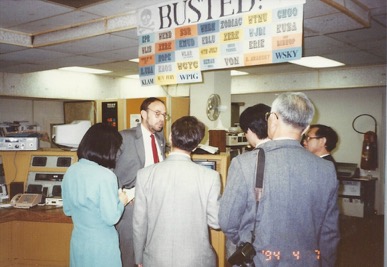
In searching through some old photos your blogger found the above picture of the “Comm Room”, the 24/7 command post of Enforcement Bureau’s predecessor, FOB. The photo is dated 1994 and is at the former 1919 M St., NW location of FCC. Your blogger is showing around some visitors from the FCC’s Japanese counterpart and was not responsible for the operation of this facility - rather at this time during his “exile” resulting from the 1985 Wi-Fi decision when he was responsible for new technology to support spectrum enforcement work.
What was interesting to note is the “BUSTED” sign showing 27 pirate radio operations that had been closed down in recent months as part of a friendly contest between the enforcement regions. Pirates often operate at night and on weekends and overtime is needed to chase them. Travels costs of also needed in many cases. Is FCC interested in chasing and closing, let alone prosecuting, private radio station these days? It does not appear that they are!
Briefing on FCC Consultant Report
on Spectrum Enforcement Downsizing
Of course, slide 2 of the briefing shown above shows that EB had already made spectrum enforcement its 4th and lowest priority before they even considered downsizing:
Slide 2 from briefing on consultant report
The report finds that “only 40% of Field time address RF spectrum enforcement” - Slide 11. Did they ever ask firemen how much time they spent actually putting out fires?
The report envisions “Equipment that meets the needs of the Field to resolve matters timely and efficiently” - Slide 18. Do the authors and the Commission realize that technical equipment - for both enforcement and the OET Lab - historically has been an afterthought in FCC budgeting? The pending FY 2016 budget request, before Congress no doubt cuts it, calls for $121,920 for OET and $167,132 for EB in equipment purchases. While some extra money is usually added just before the end of each fiscal year, such last minute spending is severely restricted due to procurement issues and certainly does not allow for equipment customized for FCC enforcement. Look at the current Keysight (formerly Agilent/H-P) website prices and you will see that this type of money doesn’t go very far. (If FCC buys equipment that DoD is buying in large quantities, then the price might be 30% less by “riding the contract”. But this then limits equipment selection choices.)
How much money has EB been spending to develop new spectrum enforcement techniques? How much does it plan to spend if the downsizing is approved? It is ironic that when I worked in the old FOB it received funding from other agencies for special shortwave monitoring such as surveillance of Soviet jamming of Voice of America. This funding was then used to develop new technical enforcement methods of value to both FCC enforcement and the sponsoring agency. However, with the creation of the Public Safety and Homeland Security Bureau, the short wave mission was split from EB and hence that source of money for technique development dried up.

Slide 19
With such a tiny budget how practical are “beneficial partnerships”? Should the real focus be “mobility solutions”? In the real world there are a lot of interference complains to public safety that are very intermittent but very troubling. The circa 1991 case at Roanoke VA airport comes to mind as a individual used a VHF aeronautical radio to give orders to aircraft while they approached the airport late at night every few days. The key to solving such cases is to collect data verify the presence of the illegal emissions and to start narrowing down the location of the source. Many of these initial reports of interference turn out to be false due to equipment malfunctions, unusual radio propagation, or operator confusion. So the ability to get equipment to an area quickly and leave it there under remote control is important for both confirmation and data collection on approximate location area and technical characteristics of the interference source that can be used for evidence uncivil or criminal enforcement. (We note that its has been more than a decade since EB has been involved in any criminal prosecutions related to spectrum enforcement - perhaps consistent with the low priority above.) Sending multiple people to do the final tracking is not cost-effective unless you are certain the problem is real, know the modus operandi and typical times of occurrence, and have evidence that can be used in enforcement actions to document illegal transmissions.
The study correctly noted that broadcaster public files are now online - meaning that onsite inspections of such files are not needed. Actually over the years, many field functions have been eliminated or moved to other parties including amateur license exams and most ship inspections. This generally has been done with legislation. Oddly, the study feels tower lighting and marking inspections are no longer important. While it unclear why Congress ever tasked FCC with enforcing tower marking and lighting on FCC licensed antennas - in most other countries the FAA-equivalent has this jurisdiction - compliance
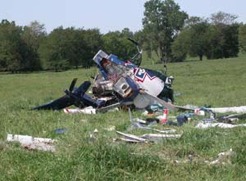
Consider the Coinjock NC helicopter crash into a new unlit tower that killed 2 people. This results in a $1M payment to the federal government that was the largest FCC penalty ever at the time!
FCC spectrum enforcement has some major problems, but a preemptive slashing of resources is not the solution. More dialogue with the spectrum users is needed. Possibly more enforcement functions can be privatized, but this will require consensus building and new legislation.
Your blogger was active in investigating and prosecuting the satellite jamming incidents of the 1980s. At that time it became clear that there was a long term technical solution to locate satellite interference sources in real time but that the resources needed to implement it was beyond what FCC could ever afford. The former FOB sponsored a multi month dialogue between researchers in this technology and satellite owners and encouraged private funding of the appropriate technology’s development and private operation when it proved successful. This technology is now implemented in the private sector and intentional and unintentional satellite interference is handled routinely without FCC intervention. In some areas, similar privatization may decrease the need for FCC resources, but this $750,000 contractor study does not address this type of issue at all.
UPDATE
Wheeler Maintaining 'Field Presence' in Alaska, Hawaii, Puerto Rico http://t.co/fuNEHyVYBR
— Communications Daily (@Comm_Daily) June 5, 2015As this was being drafted, Communications Daily broke the above news that FCC will maintain a spectrum enforcement “presence” in Alaska, Hawaii, and Puerto Rico. Whether that presence will be one person is not clear. This change indicates how poorly the original plan was thought out!
FCC Spectrum Enforcement Cutback Discussion at NPSTC Meeting
We note that on June 1, the FirstNet Public Safety Advisory Committee will discuss the same issue at its meeting in San Diego.
The FCC presentation was from William Davenport, Deputy Chief, EB.
Our current structure is unsustainable.
Background:
The field is largest part of the EB. It was its own bureau once upon a time. In the 1990s it was about 300 people. Over time it shrunk. Current field structure is 108 employees in 23 field offices plus EDG. 63 Agents, 21 managers, 10 admin staff, 8 EDG engineers and others. $21M to operate field; 70% is salaries.
Current model of the field is broken. Adopted more than 20 years ago and has been in need of close examination for years. Based on regulatory model that simply doesn’t exist anymore. Modern enforcement is about responding to wireless IX complaints, not conducting random broadcast inspections.
Current situation has been to eliminate field offices through attrition. Several offices are nearly empty, with two layers of middle management and outdated equipment.
FCC budget has been flat for several years despite rising costs.
We realized we needed to establish a clear linkage between the FCC’s priorities and the field’s mission. We began by figuring out how to execute activities in the most efficient and cost effective manner. Field modernization strategy was developed to refocus the field around its core mission and create a model that would be viable for the next ten years.
Over a 5-month period, 160 interviews were conducted. Looked at field operations at other agencies. We learned that our field work isn’t being prioritized properly. Everyone agrees that #1 priority is resolution of RFI.
When we looked at EBATS data, we were surprised to learn that only 40% of time was spent on RFI. Of this work <10% was PS related. Many offices do not have much RFI work. Some offices receive <1 RFI complaint/agent/week. One office received 1 complaint/agent/5 weeks. Work is supplemented by tower inspections (1300) with only 1 in 10 turning into actual cases (lights actually out), 440 broadcast inspections.
Most field offices receive just 1 PS complaint per month or less. Have to ask whether it makes sense to spend hundreds of thousands of dollars keeping these offices open.
25% of time doing non-operational work, like drafting sanctions, online training and waiting for the plumber. Field agents have complained about this for years.
Productivity problems have also been worsened due to inefficient management structure – employees have also complained about this for years. We didn’t want to cut back management in case hiring authority was restored. Now, 3, 4, or 5 layers of review are required for sanctions.
Offices are too big and too expensive. 20% of field budget is spent on rent. Some office rents are above market rate. Average space is 900 sf per employee vs. 270 sf at HQ. One office has almost 4000 SF. As time passed, there has been no authority to backfill and so space per employee grew and grew.
There are significant overhead expenses of $77k per FTE (double HQ).
Response to problem:
Field agents will spend more time in field working on RFI matters. Outside of Columbia, offices will be focused on RFI issues exclusively. The “Tiger Team” is not a substitute for other field offices; it is a support team for other offices but will also handle mid-Atlantic region response duties and headquarters initiatives.
Our performance will not decline. We will continue to meet speed of disposal goals, for example providing an initial response to PS complaints within 24 hours. Not all PS matters require an immediate on-scene response. We will reduce # of managers from 21 to 5. Ratio will be 1 manager per 10 agents.
Pre-positioning vehicles in SJ, Honolulu, Anchorage, Phoenix, Denver, SLC, KC, Billings, and Seattle to enable agents to fly in. Expect to respond within 4-6 hours for 85% of all Part 90 matters, 90% of all PS matters, 97% of all RF complaints.
FAA has 7 agents to respond to RF issues who handled 2700 cases. FAA has fixed DF equipment at NY, CG, and LA. CBP has similar equipment.
Planning on improving qualifications of employees by making all agents EEs.
Savings from this plan will be reinvested into other high-priority enforcement initiatives. Focusing equipment development on more mobile solutions and increased training.
Implementation:
We understand that there are worries about loss of local knowledge and “cop on the beat” to expand new speed of disposal targets for non-PS cases. We will improve case tracking and establish targets beyond initial contacts. We will establish escalation procedures. We will improve our visibility by traveling throughout entire AOR, speaking at events, and meeting with stakeholders.
Commissioners are reviewing our recommendations. If approved, we will commence the reorganization immediately. This is the first phase of a larger project that will include improved training and databases. We want to set up an automated system for part 15 complaints so that OET can become aware of issues.
People don’t know how to contact the FCC. Even Federal agencies are filing complaints using the consumer web system. We plan to make office phone numbers available. A field director will be established in Washington whose entire purpose is to manage and promote the field.
It’s not physically possible for us to roll out a car for every single PS issue.
This is the first time I’m hearing these kind of stories. They help me make the case for more resources. I am going to push for EB to come back to NPSTC next year.
I’m hoping to make the field more central to the operation of the agency as a whole. Senior people at the FCC don’t know what the field does.
We hope to make the field as relevant as it can possibly be.
When we implement this plan, I’m sure there will be lots of issues and challenges. We have commitment from the chairman to fund this plan and use the savings towards training and better offices.
Procedurally, the Commission adopts the plan through an Order, which amends the FCC’s rules. Then, there is a two-track process: consult with the Appropriations Committees to reappropriate funds for buy-outs, etc. and negotiate with NTEU (30 days notice and 120 days negotiation). Then, there could be mediation and potentially arbitration. Hoping to get this all done sometime in the Fall.
While some promises may be written in water, Commissioners and very senior people in the agency have been promised that “a chunk of” the savings will go back into the field with new equipment, databases, training. There’s no way that we can back off from the resource commitments that we’ve made.
I’m counting on groups like this to keep up the pressure. That way, we’ll be better able to support more staff and other enhancements to field enforcement.
NPSTC Audience Comments and Questions:
FCC should have come to PS first with this proposal. We should not have heard about this through outside sources.
We quit calling the FCC because it took too long for them to respond. Can we now start calling FCC again?
Response means you are headed out of the office, not making a phone call.
Over the past few years, there has been a disconnect between the FCC field offices and PS. Field offices used to be engaged with PS. Current office staff is less engaged. We try and work out problems with wireless companies, but two weeks later the problem recurs. When we call wireless companies, we get a voicemail box that is full. Having PS fend for itself is a problem.
We’ve lived through many reorganizations. They are always designed to improve service to the public, but they eventually come face to face with the agency’s financial reality. Things have gotten so bad in the past that there was no money to purchase fuel for the DF cars.
The CSMAC and the TAC have prepared reports on spectrum sharing. Critical to the success of spectrum sharing is the ability to resolve interference in real time; not weeks or months. On the one hand there is an FCC initiative to encourage sharing, but red flags were raised all along (including by DoD) that interference and enforcement are critical to the success of spectrum sharing.
Prioritizing interference resolution needs to be done up front or you are not going to attract investment in spectrum sharing technology or you will chill government agencies.
In this case the field has a key, vital role in ensuring that investment is, in fact, a wise investment. On the one hand, we’re encouraging sharing; on the other we’re trying to make enforcement more efficient. Any paper plan often times doesn’t quite match reality.
We all deal with flat budgets; you’ve mentioned lots of improvements, which will cost money. Will there be a provision to allocation some of the savings toward these improvements? Otherwise, I’m hearing you say that “the check’s in the mail.”
Proposed FCC Spectrum Enforcement Cutback
Unconfirmed reports that #FCC will close ALL Enforcement Bureau offices in WA, AK, and HI - entire Pacific coast 2 be served by LA and SF
— Michael Marcus (@MarcusSpecSoln) March 11, 2015Above: our Twitter feed scooped everyone else on the news of the spectrum enforcement cutback on 3/10 and had a
key role in stimulating discussion on this vital spectrum policy issue
As your blogger first tweeted on March 10 , FCC is considering a major cutback in spectrum enforcement activities including both a staff reduction and office closings. We would fully agree that something iOS wrong with spectrum enforcement at FCC now and or the past decade or two, but it seems unlikely that this massive downsizing is the right answer. The proposal is based on a consultant’s report that you blogger has filed a FOIA request for on 03/17/2015 although nothing has been received. A package of related material was received from an outside FCC source and has been posted on DropBox. It consists of a 2 page letter from Chmn. Wheeler to House E&C Chairman Walden, a 2 page letter from Chief, Enforcement Bureau and the FCC Managing Director to the Enforcement Bureau Field Staff, and a 36 slide Powerpoint presentation. There is reportedly a 300 page report behind this, appropriate since the study cost $700,000 - much more than EB has spent in technical equipment in any year for the past several decades. Presumably, when FCC finally addresses the FOIA request we will know if the 35 page prevention is all FCC got for nearly $1M!
Let me bring up some issues that are not addressed in the available documents:
- This is an era of increased spectrum sharing in order to get maximum utilization of spectrum - a limited resource. Many parties, both in the federal government and in the private sector are reluctant to share their spectrum. After all, “what’s in it for them”? The 5 GHz U-NII unlicensed radar spectrum sharing policy change resulted in interference to a safety critical NOAA weather radar. FCC’s spectrum enforcement staff had to sort this out quickly and identify both policy issues and noncompliance issues. While this might not seem a classic function of the Enforcement Bureau, it is a function critical to FCC and its Title III role. In order to encourage future sharing and reallocations, FCC must maintain a credible posture for rapidly resolving such interference whether they are policy based or compliance based. Thus our biggest concern about this proposal is the loss of credibility of FCC spectrum enforcement. While NTIA likes to state publicly that it is in change of federal spectrum management, a more pragmatic approach is that large federal spectrum users such a DoD and FAA and well positioned to drag their feet on spectrum sharing if they don’t feel comfortable with enforcement issues.
- What will be the impact of the FCC enforcement downsizing on federal spectrum users and public safety spectrum users? While FCC could save resources by decreasing its spectrum enforcement staff, if other federal agencies respond by adding more staff and technical resources and if large state and local public safety agencies do likewise there will be no net savings. In particular, FCC spectrum enforcement staff has special legal authority for inspections that other agencies lack. So FAA can increase its staff, but their effectiveness is limited by the law.
- EB a long time ago lost interest in hard core spectrum enforcement. Your blogger worked in EB’s predecessor in the late 1980s after being exiled from OET because of the then controversial decision that is known as the foundation of Wi-Fi and Bluetooth. But during the few years he was there he was actively involved in 4 criminal prosecutions for violations of the Title III and related legislation: 2 satellite jamming cases, 1 Coast Guard false distress case, and 1 FAA air traffic control intrusion/“phantom air traffic controller” case. (There was another case where FCC pushed for prosecution after it identified the source of ATC intrusion, but FAA top leadership refused to cooperate for political reasons so there was no resulting prosecution.) It appears that since the creation of EB there has never been a similar criminal prosecution. While criminal prosecutions are not the only way to deal with spectrum violations, there are some dangerous and antisocial violations where criminal prosecutions are perfectly appropriate. Why hasn’t there been one in the history of EB?
- Historically, the field-based spectrum enforcement staff rotated around the field and some rotated into Washington. Some even transferred from field enforcement to DC-based policy positions. This cos fertilization was very constructive for FCC and resulted in 4 bureau chiefs: MB’s predecessors James McKinney and Lex Felker, WTB’s predecessor Carlos Roberts, and OET’s Richard Smith as well as many middle manager e.g. former IB branch chief Rick Engelman. But in response to Reagan Era budget cuts, FCC stopped virtually all agency funded moving of staff. Whereto this is even legal is debatable. But it certainly is a terrible personnel policy. You are hired in office x which is recent years have all had a tiny staff and you can only get more experience or a new environment if you more yourself to a new location. The consultant’s report says field spectrum enforcement staff morale is low - this long standing policy is a key factor.
- The importance of deterrence. When your blogger first came to FCC, Radio Shack was one of the largest retailers of Title III-regulated equipment. Dave Garner, their regulatory counsel, explained the importance of visible enforcement in equipment marketing. he explained further that product managers frequently tried to cut corners for a competitive edge and that he routinely had to plead to the CEO to block the development and marketing of noncompliant products. He could only do that because FCC had a credible enforcement program for equipment marketing enforcement. It no longer does. Neither EB nor OET wants to check what is really being marketed. What little surveillance there is is done by the commercial testing community which fundamentally has a conflict of interest! They are supposed to check post approval production units for 5% of the models they approve. But this is a sore point for the labs and there is no incentive for them to be suspicious. In reality, the only enforcement is in response to complaints from competitors, preferably those with a prominent lawyer representing them! (While I was in OET I was amused to see a former FCC chairman in private law practice walk in with another partner from his firm carrying a box of equipment. It turns out that his client made car battery chargers and alleged that a competitor charger was cheaper because it did not comply with FCC rules. While visiting the FCC Lab a few days later, I noticed that suddenly testing battery chargers had become a major project!)
- Note that if thousands of units of illegal equipment are sold in the US before they are noticed and action requested by a competitor or interferee, it will take a long time to remove these units from service as long as they perform a useful function for their owner. So delays in finding noncompliant equipment due to lack of effective market surveillance poses a real risk to all spectrum users!
If you agree with some of these points, we urge you to make your views known to the 8th Floor as well as the key Congressional committees. FCC spectrum enforcement needs some major changes, this type of massive slashing is not the right approach! Indeed, why not try a new approach in one region first and do a real experiment?
Major Spectrum Enforcement Cutback Planned at FCC:
Most Industry Silent
Word leaked out last week about a major cutback in FCC spectrum enforcement that is being implemented. This cutout results from a $745,603 study FCC commissioned from Oceaneast Associates, an SBA Certified Small Disadvantaged Business and 8a Program participant. The contract was award without competition to the firm which describes itself as “management and IT consulting firm”. We have filed a FOIA request for the report (Tracking FCC-2015-000358) and will make it available here as soon as it is obtained.
While the study has not been made public, it has apparently been provided to at least one member of Congress and this is likely FOIA-able although, as previously mentioned here, FCC’s FOIA practices are less transparent than CIA’s.
Here is some information that has leaked out about the report and FCC’s plans:
- Some 160 stakeholders, including current and former EB/field staff, trade associations, government agencies, FCC advisory committees, and others, were interviewed by the consultant over a period of months - although reportedly NAB only hear about this a few days ago.
- Report concluded field staff had little consensus on their mission, except that resolving public safety interference was always Job #1. Probably true as a result of 2 decades of poor leadership, inadequate funding, and discouragement of initiative to solve problems. Actually, one way to be ready to solve public safety problems quickly is to use idle periods to solve other interference problems to improve skills and try new approaches - but that has been discouraged.
- Office closures and overall staff reductions will be balanced by increased field travel budgets, increased use of pre-positioned fixed equipment in locations where there is no field office, and establishment of a new quick-response “Tiger Team” based at Columbia. Remaining offices after cutback: NYC, Columbia MD, Atlanta, Miami, Chicago, Dallas, LA and SF. 33 agents remaining - a 50% cut
- Increased field travel funding would be about $200k annually (Is this realistic considering the need for travel to Hawaii, Alaska, Puerto Rico and USVI, not to mention Guam?)
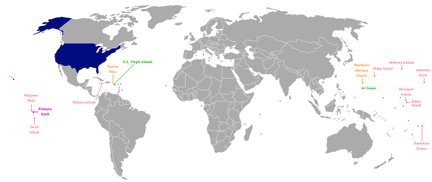
FCC’s jurisdiction extends beyond the Beltway!
Licensed under CC BY-SA 3.0 via Wikimedia Commons
- Report found that the field is ill-equipped to monitor, identify, or locate problems related to many current or emerging RF technologies - again not a surprise considering low funding for 2 decades. Mobile DF is “becoming increasingly irrelevant” - perhaps, but works for most sources of deliberate and accidental interference.
- Procedurally, an order started circulating on the 8th floor on March 9 that would authorize an internal re-organization. The Hill has a period when they can veto such a change, but does not have to fact either way and in the past never has. Union requirements specify 30- and 120-day time periods to reach agreement on the necessary terms of the reorganization and on personnel changes. Buy-outs, early retirement offers, and possibly RIFs. The earliest this reorganization could occur is Fall 2015.
But here are some other concerns of your blogger:
- With the increased emphasis on sharing of federal spectrum by FCC licensees and new unlicensed technology, will the “powers that be” in federal spectrum management, NTIA or IRAC depending on your viewpoint, really be receptive to more sharing in view of FCC decreased resources to identify and resolve quickly any problems? What is the real impact of this bias against sharing?
- Will other federal agencies that have turned to FCC for timely interference help end up spending more for internal spectrum staffing and equipment than the money saved at FCC? Will they be as effective without the name and legal power of FCC to press compliance by people who cause interference by accident or intentionally?
- Fewer people in the field in fewer cities also decreases resource to monitor actual spectrum use in order to provide input to the policy process at FCC. While in the past many incumbents did not want such information, most recent studies, including PCAST, have surged more use of spectrum use observations in the policy process.
So far few in the regulatee community have spoke out on this issue. NAB has allegedly issued a “press statement”, but it is nowhere to be found on its voluminous website. The NAB statement is reported to have been:
"This is a potentially troubling development, particularly as the FCC begins encouraging spectrum sharing among different types of communications services. Having a robust interference enforcement presence in FCC field offices is critical to ensuring that consumers receive the services that they expect."
NAB’s endless tweets from @AirWharton have not mentioned the issue to the faithful to date. The broadcasting industry’s key mouthpiece, Broadcasting & Cable, has only mentioned the issue in passing.
CTIA is reported to be deliberating the issue this week. APCP and UTC have been silent although they should know better. Only ARRL, not always the most influential group at FCC, has issued a clear statement of concern.
We urge spectrum users to consider these issues and make their viewpoints heard at FCC on the 8th Floor and at congressional committees.
vox populi, vox dei
UPDATE
As if on queue, a few hours after this was posted NAB’s above mentioned PR man,@AirWharton, tweeted:

The link in the tweet is to http://recode.net/2015/03/17/fccs-hot-mess-of-a-database-may-not-bode-well-for-future-airwaves-sharing/, a blog post about apparent inconsistencies/errors in theFCC’s TV whitespace database that allows unlicensed sharing to TV broadcast spectrum where there are no actual TV signals present. Rather than just snipping at FCC policy, perhaps Mr. Wharton and his colleagues should ask their members whether they feel good about the pending decimation of FCC spectrum enforcement resources?
While the FCC enforcement employees involved will be affected by the change, so will a lot of other spectrum users, both federal and nonfederal, who depend on enforcement of rules and deterrence of illegal spectrum activities.
UPDATE 2 - 3/18/15
Perhaps the above update worked, perhaps something was already in progress but NAB has now ended its near silence on this issue. In an article today in Broadcasting & Cable, the key trade magazine and mouthpiece of the industry, NAB’s Dennis Wharton is quoted:
“This is a potentially troubling development, particularly as the FCC begins encouraging spectrum sharing among different types of communications services," said Dennis Wharton in response to both stories. "Having a robust interference enforcement presence in FCC field offices is critical to ensuring that consumers receive the services that they expect.”
NAB has interference concerns about the way the FCC is setting up the incentive auction repacking framework in which TV stations and wireless companies may be close neighbors on the same of adjacent channels. In addition, the FCC and the National Telecommunications & Information Administration are teaming up on a "Model City" program to test advanced spectrum sharing among different services. The administration has made it clear that advanced spectrum sharing is one way to free up more spectrum from government use. In fact, they just announced an April 15-16 joint workshop on establishing that "Model City."
Thanks to NAB for speaking out. Let’s hope CTIA, APCO, and UTC also recognize that they also have self interests here. Maybe even TIA and CEA too?
Mysterious 10/24 "Special Commission Meeting"
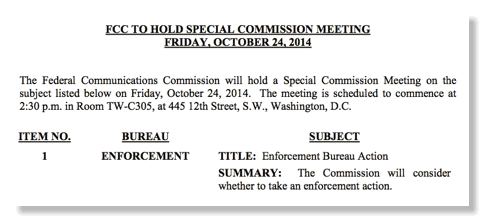
Late Friday FCC released a very unusual sunshine notice for a “special commission meeting” on 10/24 at 2:30 PM - itself an odd time for such a meeting. What is going on?
In response to our tweet on the issue several speculated it deals with the **dskins matter. We don’t think so. The issue there is a challenge to a broadcast station renewal which is not an enforcement matter and will be dealt with in a different procedure on a less urgent basis.
Our best guess is that this is something that has lingered on circulation at FCC for a while with a cryptic title that no one noticed since there are often such cryptic enforcement titles on the list. The Chairman has great control over the FCC’s agenda and perhaps got fed up with this issue lingering on the circulation list without everyone voting on it and perhaps forced the issue to a head by calling an open meeting when they can force a vote if a quorum shows up. This presumes that at least 2 other commissioners want the issue resolved in a public way.
What type of issue would force such a confrontation on the 8th Floor? Most likely it is an issue that will be of interest to consumers - considering how close it is to the election.
One possibility is a net neutrality-like issue with a major ISP. While FCC has no specific net neutrality rules in place, a case could be make that some major ISPs has been deceiving customers - a violation of other rules that are in place. For example, my ISP charges me for 15 Mbps service and advertises that it meets or exceeds that goal, but when I use Netflix I am certain that the speed is much less.
On the other hand Communications Daily reported today that it is a routine enforcement matter that was about to meet a statute of limitations deadline and that the 2 Republicans had not voted yet on it during circulation due to concerns about an overly aggressive stance of the new EB leadership. As we have written before, the basic problem in recent years has been that EB has been too enforcement adverse. Clearly there is a disagreement on this issue on the 8th Floor. Commissioners generally want to be friends with various industries. Giving out things like spectrum gets you friends, taking enforcement actions doesn’t.
UPDATE
Surprisingly FCC kept secret the details of who they target of this enforcement action was until about 2 hours before the scheduled “special meeting”. At that time a press released appears on the FCC website with the basic details and said a fine would be issued and the meeting was cancelled. Late in the day, an NAL was posted about “10M Fine Proposed Against TerraCom and YourTel for Privacy Breaches”. Note that Commissioners Pai and O’Rielly had serious questions about the statute involved and the lack of FCC rules and precedents in this area. We will leave it to the courts to decide who is right.
Do not expect your taxes to decrease because of the accused firms paying $10M. Your blogger doubts anywhere near that will ever be collected based on past experience. May there will be a consent decree, but it will likely be for much less.
Here is a story about it from our hometown newspaper entitled “FCC: Phone companies posted private info online” with additional information
Marriott Pays $600k Penalty for Wi-Fi Jamming in One of Their Hotels
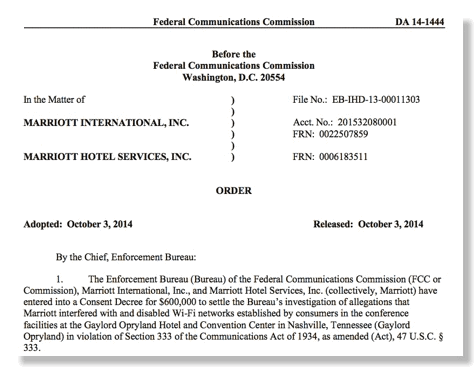
As shown above, FCC released an Order on October 3 terminating an investigation of jamming of Wi-Fi signals at a Marriott hotel by the hotel management with a $600,000 penalty payment. (Until recently such payments were classified by FCC as “voluntary payments” and were tax deductible by the perpetrator - no longer so!)
The press release states
The FCC Enforcement Bureau’s investigation revealed that Marriott employees had used containment features of a Wi-Fi monitoring system at the Gaylord Opryland to prevent individuals from connecting to the Internet via their own personal Wi-Fi networks, while at the same time charging consumers, small businesses, and exhibitors as much as $1,000 per device to access Marriott’s Wi-Fi network.
“Consumers who purchase cellular data plans should be able to use them without fear that their personalInternet connection will be blocked by their hotel or conference center,” said Enforcement Bureau Chief Travis LeBlanc. “It is unacceptable for any hotel to intentionally disable personal hotspots while also charging consumers and small businesses high fees to use the hotel’s own Wi-Fi network. This practice putsconsumers in the untenable position of either paying twice for the same service or forgoing Internet accessaltogether,” he added.
A Washington Post article on the episode was titled “FCC to Marriott: No, you can’t force your customers onto terrible hotel WiFi”. It gives Marriott’s side:
Marriott, in a statement, insisted that its actions were legal and designed to thwart "rogue wireless hotspots.""Like many other institutions and companies in a wide variety of industries, including hospitals and universities, the Gaylord Opryland protected its Wi-Fi network by using FCC-authorized equipment provided by well-known, reputable manufacturers," Marriott said. "We will continue to encourage the FCC to pursue a rulemaking in order to eliminate the ongoing confusion resulting from today's action and to assess the merits of its underlying policy."
Of course, Marriott also sells its own WiFi access for $14.95 a day, sometimes charging for multiple computers in the same room. (It amuses you blogger to observe that cheap hotels such as Quality Inn and Motel 6 generally give free Wi-Fi (often breakfast, too) and charge lower rates than Marriott.
The initial complaint in this case came in March 2013, so the case went from compliant to resolution in 19 months. While this might not seem fast to some, it is much faster than past practice and considering the technical and legal issues involved a timely resolution for string a new precedent a rather timely resolution.
The legal basis for this FCC action was § 333 of the Communications Act , 47 USC 333, a recurring topic here in the context of prison jamming of contraband cellphones. Here is the text of the section:
47 U.S. Code § 333 - Willful or malicious interference
No person shall willfully or maliciously interfere with or cause interference to any radio communications of any station licensed or authorized by or under this chapter or operated by the United States Government.
Clearly Marriott’s action violated this prohibition. While the user’s Wi-Fi system was not “licensed”, it was “authorized” by FCC. Unfortunately, the cellular industry consistently misreads § 333 and tells FCC it means that FCC has no authority to authorize jamming of contraband cellphones in nonfederal prisons, an issue closely related to Docket 13-111.
FCC@80: Bob Weller's Farewell Talk to FCC on WWII-era Radio Intelligence Division
The ever mobile Bob is now joining NAB, effective today, as Vice President of Spectrum Policy reporting to Rick Kaplan, Executive Vice President of Strategic Planning - another FCC alum. It is rumored that he will be replacing Vic Tawil, another FCC alum, who is about to retire.
The FCC’s Radio Intelligence Division (RID) and the Foreign Broadcast Intelligence service (FBIS - later “Foreign Broadcast Information Service”) were formed on the eve of WWII to harness the then formidable and unique technical capabilities of FCC in support of the war effort.
As a result of the group sourcing, the following publicly available histories were found:
- The History of the Radio Intelligence Division Before and During World War II A collection of articles and manuscript of George E. Sterling,Chief, Radio Intelligence Division (1940-1946), FCC Commissioner (1948-1954) Edited by E. Merle Glunt & Albert A. Evangelista
- THE U.S. HUNT FOR AXIS AGENT RADIOS by George E. Sterling (From CIA website)
- Foreign Broadcast Information Service History (From CIA website)
- FBIS Against the Axis, 1941-1945 (From CIA website)
The video of Weller’s talk has is not on the FCC website, but has been uploaded to Dropbox. (Download by hitting the “download” button after using this link.)
(During Bob’s talk he worked in some mild criticism of FCC’s current engineering staffing system: FCC used to have central hiring of entry level engineers with recruiting tied to the academic year and a common training program in the former Norfolk VA field office and briefly at the Columbia MD field office. This program allowed competitive recruiting when other employers were recruiting as well as a common core of technical training for FCC engineers. [Realistically many electrical engineering degree programs today do not include much material on communications technology.] Such recruiting and training has been erratic for over a decade now due to budget uncertainties and may well be a problem in a few years as current senior engineers retire.)
One aspect of RID that was not mentioned is of great interest to your blogger and was not publicly known until the 1980s: FCC (along with FBI) disagreed with the Army on the disloyalty of Japanese-Americans after Pearl Harbor, particularly with the Army allegations that Japanese-Americans were transmitting information to Japan from covert transmitters. Peter Iron’s book Justice at War documents how both FCC Chairman James Fly and RID Chief George Sterling responded to requests from the Attorney General about the pending appeal of the Korematsu case to the Supreme Court.
In particular, Irons describes an April 1, 1944 memo to Attorney General Biddle from Chmn. Fly that left the AG “in a virtual state of shock”:
The FCC chairman provided documentation that (Army General) DeWitt had been personally informed by the FCC staff, both before his evacuation recommendation and afterward,that not one of the reports of illicit radio transmissions had been verified. .. (Fly wrote) “The fact is that military personnel was entirely incapable of determining whether or not the many reports of illicit signals were well founded. The basic trouble observed (by RID) was the lack of training and experience of military personnel carrying on the monitoring and direction-finding work.”…(Fly added that the Army) ”repeatedly made wholly inaccurate reports of illicit stations along the West Coast”. (p 282 - paperback edition)
Chmn. Fly also sent the AG summaries of George Sterling’s confrontational 1942 meetings with Gen. DeWitt, the main advocate of “internment/relocation” in which he heard DeWitt’s concerns about how “the woods were full of Japs with transmitters” and how Sterling wrote “I had never seen an organization so hopeless to cope with radio intelligence requirements”.
Since a major justification for the “internment/relocation” was “the interception of illicit radio transmissions” this unpleasant news from FCC to DOJ put DOJ in an awkward position as it prepared for the Korematsu case. So being bureaucrats, they solved the problem by “deep sixing” the FCC memos and fuzzifying their brief to the Supreme Court. The memos were rediscovered in the 1980’s by Korematsu’s legal team in a coram nobis petition and in September 1987 the 9th Circuit Court of Appeals granted the petition for Korematsu and the related Hirabayashi case, reversing their wartime convictions because it found if “suppressed (FCC) material been submitted to the Supreme Court its decision probably would have been materially affected ”.
While this seems like ancient history, recall what happened after 9/11 when speaking about civil rights became secondary to fear and constitutional concerns lost their primacy. For Fly and Sterling to speak out during WWII on the erroneous justification for the treatment of Japanese-Americans required supreme courage to go against the flow of the times. I believe that FCC should recognize and acknowledge the heroism of these two as one of FCC’s proudest contributions to our country.
Travis LeBlanc - New Chief of FCC's Enforcement Bureau

On March 4, 2014, Chmn. Wheeler announced his “intent to appoint” Mr. LeBlanc:
FCC Chairman Tom Wheeler announced today his intent to appoint Travis LeBlanc as acting Chief of the Enforcement Bureau. Mr. LeBlanc previously served as a top deputy and senior advisor to California Attorney General Kamala Harris, overseeing the office’s operations and activities involving complex litigation and policy matters on a broad range of issues such as technology regulation, telecommunications, high-tech crime, cyber-security, privacy, intellectual property and antitrust.
“The credibility of the Commission’s rules depends on its enforcement activities,” said ChairmanWheeler. “Travis LeBlanc brings a wealth of experience with both federal and state law enforcement,most recently in the largest state Attorney General’s office in the country. He is a savvy prosecutor who also knows how to secure agreements with private companies in order to advance the public mission.”During his time in the Office of the California Attorney General, Mr. LeBlanc established and oversaw California’s first high-tech crime and privacy enforcement units. He also secured global agreements witha number of high-tech companies to protect consumer privacy, promote online safety and respectintellectual property rights.
Before joining the California AG, Mr. LeBlanc was an attorney in the Office of Legal Counsel at the United States Department of Justice, where he advised the President and Attorney General on significantmatters of constitutional, statutory and regulatory law. Prior to joining OLC, Mr. LeBlanc was anattorney at Keker & Van Nest LLP in San Francisco, and Williams & Connolly LLP in Washington DC,where he represented corporate and individual clients in criminal and civil cases in federal and statecourts.
Mr. LeBlanc holds an A.B. from Princeton University, a J.D. from Yale Law School, an M.P.A. from theJohn F. Kennedy School of Government at Harvard University, and an LL.M. in International Law from the University of Cambridge. He served as a law clerk to the Honorable Stephen Reinhardt of the United States Court of Appeals for the Ninth Circuit.
The Enforcement Bureau is the FCC’s largest bureau and the primary organizational unit responsible forenforcement of provisions of the Communications Act, the Commission’s rules, Commission orders andterms and conditions of station authorizations.
We welcome Mr. LeBlanc and wish him best as EB tries to sort out its priorities.
[We would like to point out, as we have previously, that the use of the phrase, “FCC Chairman X announced today his intent to appoint Y …” is apparently inappropriate since bureau chiefs are appointed by the Commission pursuit to Section 4(f)(1) of the Communications Act. However, the previous post shows that this type of announcement is not unique here: Chmn. Kinnard and Martin used the same active verbs. However, Chmn. Kinnard also used less active forms of statements as have Chmn. Powell and Hundt. Perhaps the active/passive verbs in the announcement depends on how sensitive the Chairman’s Office staffers are to the other commissioners or whether they are career civil servants themselves.]
Update
In an FCC news release dated September 2, 2014 it was revealed that Mr. LeBlanc was still “Acting Chief of the Enforcement Bureau” almost 6 months after the announcement discussed above. Why the delay?
Possibly the previously discussed “back office problems”. Career SES appointments require OPM approval and peer review at OPM by SES career civil servants to minimize political players moving into such career positions. Perhaps HR was slow. Perhaps OPM is slow. No real evidence except the apparent delay in making his appointment final.
When I was promoted to SES in 1981 the final approval took a long time due to inattention in the FCC HR operation to getting the right information onto the paperwork to OPM. Perhaps the same is still going on?
Jamming Enforcement at FCC Picks Up
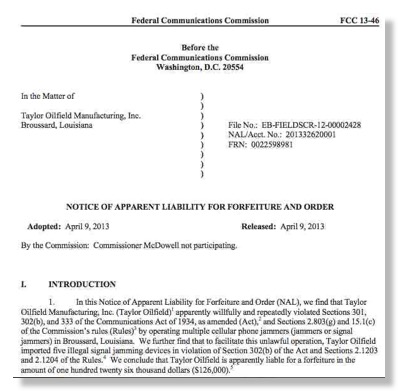
On April 9, FCC approved and released two Notices of Apparent Liability (NAL -- effectively fines) for use of cellular jammers. The one shown above was to Taylor Oilfield Manufacturing, Broussard, Louisiana for $126,000. The other was to The Supply Room, Inc., Oxford, Alabama for $144,000. OUCH!!!
(Now before you sell your stock in these companies your should know that FCC is always in a poor position to collect the full amount of such NALs from anyone able to hire an attorney unless the local US Attorney is really interested in getting fully involved. This can be problematical in many parts of the US.)

The NALs have the following text
Signal jamming devices operate by transmitting powerful radio signals that overpower,jam, or interfere with authorized communications. While these devices have been marketed withincreasing frequency over the Internet, with limited exception, they have no lawful use in the UnitedStates. (A footnote clarifies that federal agency use is a separate issue.)
Your blogger fully agrees that since FCC has never authorized any jamming, the import and use of such equipment is illegal. However, they also have the following text:
In order to protect the public and preserve unfettered access to emergency and other communications services, the Act generally prohibits the importation, use, marketing, manufacture, and sale of jammers.
This sentence is a more complicated issue and sounds more like CTIA’s interpretation of Section 333, the subject of CTIA’s 2007 petition that FCC has never acted on. (The petition also contained the issue of “cellular boosters” which was addressed and finally resolved in Docket 10-4 a few months ago.)
The issue of what Section 333 of the communications Act really means is also addressed in GTL’s July 2011 petition which is sitting without action in FCC’s petition “black hole”. Thus CTIA has repeatedly stated that Section 333 forbids FCC from even considering authorizing jamming in any context including nonfederal high security prisons. Somehow CTIA and NTIA have concluded this nonobvious reading of Section 333 does not affect NTIA at all. As GTL points out, this ignores the “inconvenient truth” that Section 305 only exempts federal use from Sections 301 and 303 of the Act and also that the analogous terms of 18 USC 1367, dealing with the special case of satellite jamming and passed contemporaneously with Section 333, explicitly excludes jamming by federal agencies while Section 333 is silent on special treatment of federal users.
But there is no question here that the new FCC NALs are consistent with the law.
Why were these 2 small private companies spending money on cellular jammers? Here is some explanation from the texts of the NALs:
The manager also claimed that Taylor Oilfield utilized the jamming devices to prevent its employees from using their cellular phones while working, apparently following a near miss industrial accident that allegedly was partially attributable to employee cell phone use.
The general manager also confirmed that Supply Room utilized the jamming devices to prevent its employees from using their cellular phones while working.
This is typical of the cellular industry’s lack of attention to the unintended consequences of its technology, In 2005 (the then existing) Motorola commissioned a study by Don Norman on “Minimizing the annoyance of the mobile phone: The Annoyance, Irritation, and Frustration of The Mobile Phone -- A Design Challenge”. Unfortunately today’s cellular industry doesn’t seem too interested in such issues. They do not view them as a “design challenge” rather as legal issues that must be acted on to help their industry.
From Comm Law Blog

All complex new technologies have unintended consequences. As cellular expands the unintended consequences of these systems are becoming more visible. Shouldn’t the cellular industry address those issues more in addition to demanding more spectrum and more jammer enforcement?
Equipment Authorization NPRM: 1st Comments Deal with Enforcement
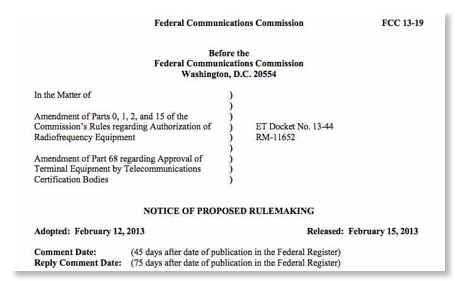 Today the comments of Marcus Spectrum Solutions LLC in the Equipment Authorization Rulemaking, Docket 13-44, were posted on the Commission’s comment website, ECFS. These comments were the first filed and were filed early in an attempt to raise a key issue in this proceeding: the enforcement mechanism of rules must be credible in order to deter the introduction of noncompliant equipment into the US wireless market. The present equipment authorization rules are outdated and lack credibility with respect to enforcement because of changes in both the marker for wireless equipment and the technology used today.
The real threat of continuing the current basic structures is twofold:
- Noncompliant equipment’s market share could increase and discourage compliance by legitimate manufacturers due to both price pressure and rapid copying of legitimate equipment.
- Noncompliant equipment could cause the very interference problems that the Commission’s Title III rules were designed to prevent!
The comments suggest changes in 4 areas:
- Criminalize the submission of fraudulent postmarket samples. FCC has never taken serious action against manufactures/imported who submit doctored samples.
- Codify key terms of KDB Publication No. 610077 and increase post-market sampling rate of TCBs. This obscure publication includes key requirements for TCBs to sample equipment on the market. Sampling should be increased above the present 5% and the requirements should be codified in the FCC Rules to make them clear to all
- Address TCBs’ basic conflict in post-market testing. Recognize that TCBs have conflicting incentives to identify their customers’ possible noncompliance
- Make post-market surveillance credible by including consistent retail sampling. In almost all cases FCC only tests samples provided by manufacturers/importers who have incentive to doctor noncompliant equipment on to test large numbers to find one that is atypical. FCC is urged to require TCBs to do some testing of models acquired from retail or wholesale sources at random. The widespread use of software to control transmitter parameters means that it is much easier to doctor a test sample now than it was when these rules were originally formulated.
It is hoped that other parties interested in this proceeding, especially groups representing licensees will consider these concepts and give their views on such topics in their own comments/reply comments.
ex parte Enforcement:
$10,000 "Voluntary Contribution" and a "Compliance Plan" in Resolution of a Violation
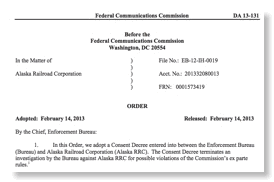
- Only FCC requires the outside party to file a summary of any face-to-face meeting/telephone call/ and any written documents such as e-mail and depends solely on that filing to document the exchange of information. (Note that some outside parties may see an advantage to “game” the system by delaying or obfuscating public disclosure of points they make to FCC officials
- All other agencies use their staff to summarize the interaction although they include any documents that were presented.
Thus the timely filing of a valid description of the interaction is necessary to fulfill the transparency goals of the FCC’s ex parte rules.
Until January 11, 2011 FCC had never even sent an official violation notice to any outside party for a violation of these rules! All violations were handled informally “between gentlemen” with no public disclosure. Indeed, outside complaints were almost always dismissed also without public disclosure.
The ex parte rule update was adopted on February 1, 2011 and became effective June 1, 2011. In adopting the new procedures the Commission stated:
We will, however, amend our rules to require that the General Counsel refer any case in which a forfeiture or a citation may be warranted to the Enforcement Bureau for disposition and we will delegate authority to the Enforcement Bureau to levy fines for violations of the ex parte rules. In the event the Enforcement Bureau ultimately determines that a forfeiture or a citation is not warranted, the General Counsel will take appropriate action on the matter.
The Docket 10-43 Report & Order gave no legal citation on how the FCC has authority to levy such forfeitures, which your blogger believes exceeds the statutory provisions of Title V of the Communications Act - but, heck, he’s not a lawyer. But it was curious that there was no sign of any such a forfeiture until yesterday.

Over a year ago, FCC sent a letter to the Alaska Railroad Corporation, which is owned by the State of Alaska, stating it had violated the ex parte rules because an employee had sent an e-mail with attachments to an FCC staffer dealing with a rulemaking and both failed to file a copy in the docket and again failed to do so when asked by the FCC staffer. The letter referred the issue to eh FCC’s Enforcement Bureau for “possible action”. Your blogger was curious about this when there was nothing on the public record 9 months later and filed a FOIA request. The request was greeted with quibbling from FCC about his eligibility for FOIA requests without charge and at one point FCC/OGC stated that 9 hours of GS-15 time was needed to comply with this FOIA request! However, in order to simplify and resolve this issue quickly your blogger agreed to narrow the scope of the request and today received a “Valentine’s Day present” of the Consent Decree shown above, dated February 14, 2013.
In the Consent Decree, Alaska Railroad agrees to a 2.5 page “compliance plan” (p. 4-7) and “a voluntary contribution to the United States Treasury in the amount of ten thousand dollars ($10,000)”. Now Alaska Railroad is not a major participant in FCC proceedings, indeed it has not filed anything in ECFS during the past 10 years. Either they are the most wanton violator of ex parte rules or they are a “country bumpkin” outside of the Beltway who rarely deals with any FCC issue. But I guess they were an easy target without a major FCBA member representing them. (While your blogger was an FCC employee, he dealt with such occasional problems of the uninformed without proper representation by simply forwarding the communication that wasn’t filed to the Secretary’s Office and asking that it be filed.) The “compliance plan” doesn’t seem very relevant for such a regulatee that rarely interacts with FCC, but hopefully it will set a precedent for more mainstream players.
So a precedent has been set for fines and compliance plans in case of violations. Someday FCC will lock horns with a violator who will litigate whether Title V provides for such types of fines, but until then parties may find it cheaper to just pay $10,000 if FCC asks. The compliance plan looks like a good idea and if the former AMST was still around I would suggest that its should have such a plan, but MST has been absorbed by NAB which was a clean ex parte record.
Satellite Jamming Case 25th Anniversary
On September 6, 1987 as the country was enjoying the Labor Day weekend, cable viewers exercising their 1st Amendment right to watch the Playboy Channel (now PlayboyTV) were surprised to see the above image on their TV rather than Three Daughters, the film that was being shown.
On April 27, 1986 the first known incident of intentional domestic satellite jamming took place involving HBO’s satellite signal for cable TV. Below is a news story about it:
While some viewed it as a prank, satellite owners were validly concerned that such jamming used higher power than the satellite was designed for and could permanently damage a satellite transponder. Your blogger was part of an FCC/FOB (now Enforcement Bureau) team that identified the party responsible for the jamming within a few days and with both technical evidence and circumstantial evidence convinced him to plead guilty to a misdemeanor.
Within 6 months Congress, at the encouragement of the satellite industry, passed 18 USC 1367 making such jamming a felony:
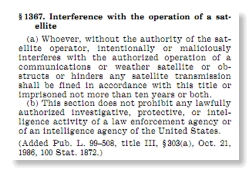
(It is hard to imagine Congress dealing with such an issue so fast now, but the speed was an indication about the concern over this issue at the time. Note that this section was passed contemporaneously with Section 333 of the Communications Act on jamming in general, makes “willful or malicious interference” a misdemeanor and is interpreted by the cellular industry as denying FCC, but not NTIA, authority to authorize jamming in any circumstance. Note further that 18 USC 1367(b) specifically exempts “any lawfully authorized investigative, protective, or intelligence activity of a law enforcement agency or of an intelligence agency”. FCC has never ruled on any interpretation of Section 333.)
Given this recent legislation, less than a year old at the time of the Playboy incident, FOB repeated the thorough type of investigation that identified the source of the Captain Midnight jamming the previous year in less than a week. It took a few days longer than the first time, but the team - basically the same people as in the previous case - identified the perpetrator as Thomas Haynie, an employee of Pat Robertson’s Christian Broadcasting Network, now CBN. Since Robertson was running for the Republic nomination against Bush (41) at the time, this made the case a political hot potato! At no point during Mr. Robertson’s candidacy did information about this case leak out.
While there was never any evidence that anyone else in CBN was involved in planning or executing the incident, there was later clear evidence that CBN staffers gave false and misleading statements to investigators and actually destroyed evidence, perhaps as part of a “coverup”. It appeared that CBN paid the full legal defense cost of Mr. Haynie’s later trial, estimated to be about $300,000 - apparently from funds it collected as charitable donations for its main mission.
Haynie was convicted in 1990 after a jury trial in Norfolk and in 1991 the 4th Circuit Court of Appeals upheld the conviction. The appeals court decision is a good summary of the trial and the evidence presented.
Last night 8 of the veterans of this case gathered to reminisce about it. Most of us had not seen Dick Smith, former Chief of FOB and later OET, in many years and were pleased he took time from a family visit to join us. In the 25 years since this incident and its successful prosecution, there has never been another case of intentional domestic jamming from a US source.
The 2 successful investigations had their intended effect!
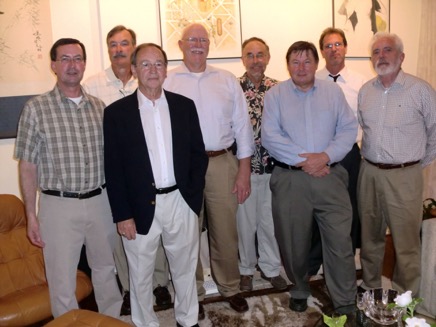
Satellite Jamming Sleuths at 25th Reunion: “Joe” Monie, Charles Magin, Dick Smith, Richard Engelman, Michael Marcus, James Higgins, Bob Weller, George Dillon
Motorola Wages "Reverse FOIA" Fight on Explanation of Interference from Motorola Product to Safety-related Weather Radar
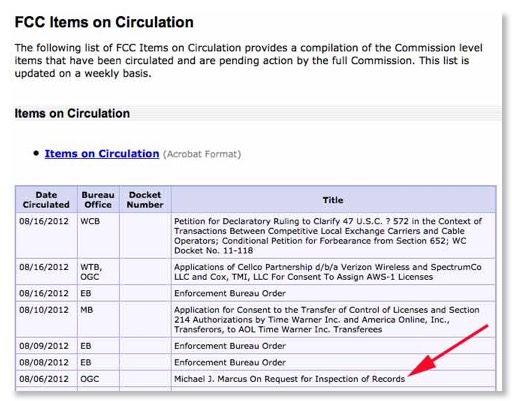
Observers of the FCC’s minutia have noticed that your blogger’s name is now on the FCC’s “Items on Circulation” list for the 2nd time. This post explains why: A FOIA request I filed on behalf of this blog and the public interest is being blocked to a considerable degree by a “reverse FOIA” campaign from Motorola dealing with a product line it sold last year.
The Court of Appeals for the District of Columbia Circuit has defined a "reverse" FOIA action as one in which the "submitter of information -- usually a corporation or other business entity" that has supplied an agency with "data on its policies, operations or products -- seeks to prevent the agency that collected the information from revealing it to a third party in response to the latter's FOIA request."
So here are the basic facts:
- On August 11, 2011 I submitted a FOIA request to FCC for Motorola’s response to an Enforcement Bureau Letter of Inquiry (“LOI”) in EB-09-SE- 064, the investigation of U-NII interference to Terminal Doppler Weather Radar (TDWR) , a safety-related system to detect severe storms near airports, near the San Juan International Airport. This document was cited in an April 2010 Consent Agreement between Motorola and FCC where Motorola “agree(d) that it will make a voluntary contribution to the United States Treasury in the amount of $9,000” and make some management changes and FCC agreed to terminate the investigation.
- Rather than getting a response from FCC, I got a response from Motorola that included a severely redacted copy of their letter to FCC. (Those of us who worked at FCC know that it was traditional for FCC to give “professional courtesy” to Motorola in the past.) Much to my surprise, a September 9, 2011 letter from FCC’s Enforcement Bureau simply ratified Motorola’s redactions, part of which are shown below:
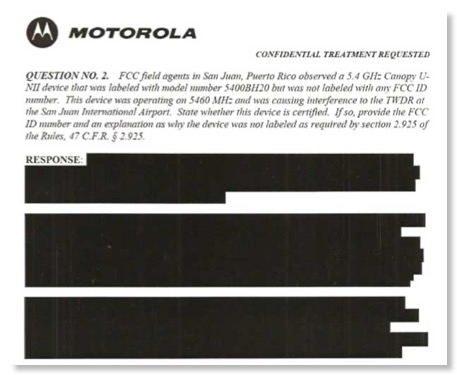
Motorola redactions of their response to FCC/EB which included a request for the FCC ID number of the unit involved and a question about whether it was properly certified. Is this really proprietary information?
- On September 23, 2011 (nearly a year ago) I filed a timely appeal of these excessive redactions under the provisions of 47 C.F.R. §0.461(i)(1). Motorola engaged Wiley Rein (“Broadcasting & Cable has recognized Wiley Rein as a ‘powerhouse law firm.’ “ ) to wage a reverse FOIA fight to protect all the original redactions.
- While it is generally felt that the FOIA legislation requires redaction of proprietary information, the Supreme Court held in Chrysler Corp. v. Brown that "Congress did not design the FOIA exemptions to be mandatory bars to disclosure" and that the agency could release information in the public interest.
A major reason for my request for this information is not voyeurism and has been discussed here previously: the software defined radio (SDR) rules adopted in Docket 00-47 were modified shortly afterwards in Docket 03-108 at the request of several manufacturers including Motorola. These changes watered down the software security provisions for SDRs. As a result of these concerns, the former 2.932(e) was replaced with the present 2.944 which does not apply to transmitters unless the “software is designed or expected to be modified by a party other than the manufacturer”. It is your blogger’s guess that the root cause of this series of interference incidents is this rule change.
While Motorola, and hopefully the company that now makes the Canopy products in question, are bound by the Consent Agreement and are unlikely to repeat the actions that resulted in this dangerous interference, other manufacturers of radios implemented with SDR technology are still only bound by the vague terms of the present §2.944 and might take similar actions to what Motorola did and is now trying to hide in this reverse FOIA action. Is it in the public interest to see what the root causes of this problem were and if necessary take steps to prevent any other firms from doing what Motorola employees did here?
Readers may recall a recent FOIA controversy at FCC involving Google. In that case Google told FCC to release only a highly redacted version of its “Spy-Fi” report which was done on 4/13/12. Under blistering criticism, Google released the report with minimal redactions - the only remaining redactions appear to be identities of people interviewed.
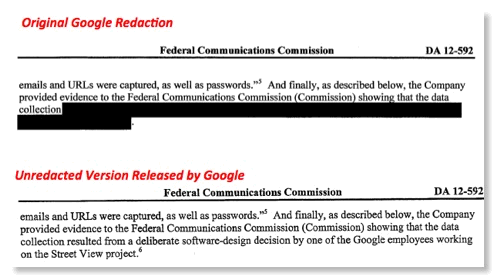
Google’s original redactions of “Spy-Fi” FCC report along with the unredacted text released by Google after public outcry. Large corporations, like government agencies, sometimes try to hide their misdeeds from the public by misusing information disclosure laws.
Motorola has changed a lot in the past 2 decades. The Canopy device involved in this controversy is part of a product line that was sold to Cambium Networks in September 2011, about the time this FOIA battle started. The remaining publicly owned company, Motorola Solutions, focuses on the Part 90 market with public safety being a key customer. (“Motorola Solutions serves both enterprise and government customers with core markets in public safety government agencies and commercial enterprises” ref.) Motorola Solutions has a set of publicly stated values that includes:
Motorola Solutions, is it really worth risking your reputation with your current customer base on this issue and the vagaries of the 8th Floor? I have offered repeatedly to settle this FOIA issue through discussions and recognize that the document in question has some valid trade secrets. Google made a wise decision to err on the side of disclosure, perhaps you should also. Your counsel knows how to reach me.We are accountable. We stand behind the work we do, the contributions we make and the high business standards we maintain.
Public safety users, do you really want to depend on an infrastructure provider that doesn’t meet the standard of transparency that Google set with respect to admitting practices that resulted in safety-related interference? Perhaps you should press Motorola to come clean on what really happened in San Juan?
UPDATE
FCC has now released an Order supporting some of your bloggers requests to remove redactions and upholding Motorola’s requests for redaction on other issues. However, the final redactions have not been released yet and any decision to appeal further will depend on the nature of the final redactions.
FCC's Ambivalent Views on Equipment Enforcement

Last week I gave an invited talk at the American Council of Independent Laboratories” (ACIL) 2012 Policies & Practices Conference. ACIL is the trade organization that represents private testing labs including the ones active in the FCC’s equipment authorization program, which FCC describes as
“The FCC oversees the authorization of equipment using the radio frequency spectrum. These devices may not be imported and/or marketed until they have shown compliance with the technical standards specified by the commission.”
The talk was entitled “Enforcement in the Digital Age”. Readers may recall that equipment marketing enforcement has been a recurring theme in this blog. While FCC sometimes lashes out with dramatic equipment marketing enforcement actions, in general FCC seems to turn a blind eye to such enforcement issues, relying almost exclusively on a complaint-driven process. FCC bureaucrats have learned that enforcement usually makes somebody angry, the perpetrator, who then hires a big law firm. Unless there is somebody who is pleased by the enforcement, a big complainant for example, the principle of “aggravation minimization” dictates don’t get involved.
Oddly, the major trade associations, NAB, CTIA, TIA, and CEA, seem to have little or no interest in equipment enforcement, except perhaps for the case of jammers. As a result there is essentially no independent surveillance of marketing of noncompliant equipment other than the recent (long overdue) initiative on cellular and GPS jammers. Enforcement Bureau staffers do not spot check retailers for noncompliant equipment. They don’t even go to the annual Consumer Electronics Show. There is a small amount of market surveillance by TCBs, but, as discussed in slides 16-17 this is minimal and hopelessly affected by intrinsic conflicts of interest.
The FCC Lab does not routinely call in equipment for post approval testing or ask manufacturers for copies of test data for equipment subject to Verification or Declaration of Conformity. During my tenure such events were very rare and may well continue to be very rare. Indeed, as I pointed out in my talk (slide 18 ), the labels on equipment subject to Verification or Declaration of Conformity do not necessarily contain enough information to even identify who the “responsible party” is that is supposed to have the test data. This if a suspicious unit were to be bought at a retailer - another unlikely event - it can be difficult to trace the source under present rules.
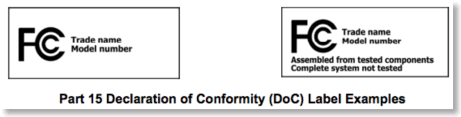
The issue of “lab queens” was discussed (Slide 15). “Lab queens” does not refer to the possible life style of FCC employees, rather it refers to test samples of equipment that are atypical of the actual production equipment. This could result from either testing many units and selecting the one with the best performance or by intentionally modifying a production, for example to decrease its power. This actually happens and so far has never resulted in a major penalty. I proposed criminalizing this behavior by requiring a sworn affidavit from a US resident stating that the unit was normal production unit taken from normal inventory. Further I proposed that FCC be authorized to request a “coupon” good for a unit of equipment at any retail dealer. This would allow FCC for the first time to get reliable samples of production equipment for sampling.
I pointed out that FCC keeps saying that it will modify its rules quickly when new types of equipment-related interference are actually encountered. This is just not credible. In the case of police radar detector interference to VSAT systems it took over 10 years for FCC to react. In the ongoing case of interference from early generation bidirectional cellular amplifiers if has taken more than 5 years and there still is no action so marginal manufacturers can still make the original designs although reputable manufacturers have eliminated the problem through design changes. I urged a regular public report on “emerging interference issues” which are not even well disseminated within FCC staff at present. (Slides 9-10)
Presently unregulated amplified
TV antenna with 55dB gain!
I ended the presentation with an open question: why do the major trade associations with an apparent interest in orderly spectrum use (CTIA, NAB, TIA, CEA) remain so silent on the issue? Is reasonable progress possible?
FCC ex parte enforcement: No More "Professional Courtesy"
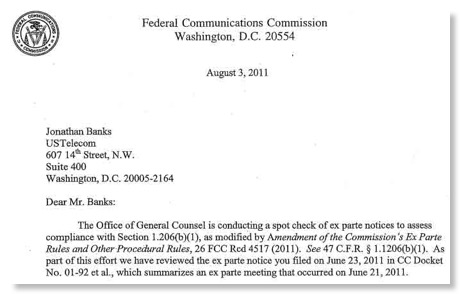
ex part enforcement at FCC, or lack thereof, has been a recurring topic here. We now have 3 basic eras of FCC practice in FCC enforcement of its ex parte rules.
1978 - January 2011
“Professional courtesy” combined with “holding telescope to the blind eye” approach. During this 33 year period FCC did not have a single written record of finding an ex parte violation. There is anecdotal evidence that some ex parte complaints were resolved with phone calls to violators and verbal warnings but no written public records exist. Naturally, some entities with little interest in transparency noticed this and saw it as a blank check to do whatever they wanted.January 11, 2011 - August 3, 2011
FCC starts more aggressive review of complaints with its 1/11/11 finding that Magnum Communications was guilty of a violation - the first EVER written finding of a violation.August 3, 2011 ->
FCC announces 3 findings of violations based on “a spot check of ex parte notices to assess compliance”. In this new era FCC not only finds violations but does not depend solely on complaints.
Imagine the surprise on August 3, 2011 when USTelecom, Public Utility Commission of Texas, and Parrino Strategic Consulting Group received similar letters saying based on a spot check they had been found to violate Section 1.1206(b)(1). Now there was no penalty or even a warning or probation, but they were told “Accordingly, we ask that you file a supplemental notice that complies with the rule within one week.”
As another sign of assertiveness, one July 28, 2011 FCC found that Christian Media, Inc. “violated the Commission’s ex parte rules by soliciting impermissible ex part letters from members of Congress in violation of 47 C.F.R. § §1.1208 and1.1210” and referred the matter to the Enforcement Bureau “to determine whether a forfeiture is warranted”. As stated previously, your blogger doubts that Title V of the Communications Act permits fines in the case of such violations. So my unsolicited “free legal advice” to Christian Media, Inc. is: don’t start liquidating assets now to pay for a possible fine.
But kudos to FCC/OGC for these major changes in ex part enforcement that will either increase compliance OR lead to the realization that there is a good reason why every other federal agency uses a different approach in dealing with ex parte presentations.
FCC Starts Jammer Enforcement on a Large Scale
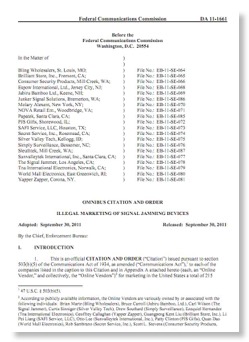
Readers may recall that enforcement has been a recurring theme here and your blogger has criticized both the Commission for its disinterest and major trade associations that have myopically made this a low priority issue in their interactions with FCC.
The PN stated,
The FCC Enforcement Bureau has issued 20 enforcement actions against online retailers in 12 states for illegally marketing more than 200 uniquely-described models of cell phone jammers, GPS jammers, Wi-Fi jammers, and similar signal jamming devices. These devices have the capacity to prevent, block, or otherwise interfere with authorized radio communications in violation of section 302(b) of the Communications Act and sections 2.803 and 15.201(b) of the Commission’s rules.
The Enforcement Bureau’s actions are intended to warn retailers and potential purchasers that marketing, selling, or using signal jamming devices in the U.S. is illegal and that the FCC will vigorously prosecute these violations.
Enforcement Bureau Chief Michele Ellison said, “Our actions should send a strong message to retailers of signal jamming devices that we will not tolerate continued violations of federal law. Jamming devices pose significant risks to public safety and can have unintended and sometimes dangerous consequences for consumers and first responders.”
Unfortunately EB included in the Citation text that clearly would have gotten a staffer into trouble during my nearly 25 year tenure at FCC: it prejudged the commissioners on something they had never ruled on. Para. 9 of the Citation states
Signal jammers, however, cannot be certified or authorized because their primary purpose is to block or interfere with authorized radio communications. As noted above, a device intended for such use is clearly prohibited by section 333 of the Communications Act. Thus, signal jammers such as those offered by each of the Online Vendors identified in Appendix A cannot comply with the FCC’s technical standards and therefore cannot be marketed lawfully in the United States or its territories.
First, “ a device intended for such use is clearly prohibited by section 333 of the Communications Act” is clearly not the meaning of Section 333 which deals with jamming, not jamming equipment. Section 302(b) gives the Commission to ban equipment that does not complies with its regulations for transmitters and the lack, at present, of any such regulations for jammers is thus illegal. Isn’t that clearer than misconstructing Section 333? I believe that anyone with a legal background will see that the references to Section 333 in the Citation adds nothing to this marketing case and is only posturing unsupported by any citations to regulation or precedent.
In its new found jammer marketing enforcement enthusiasm, EB also updated its FAQ on GPS, Wi-Fi, and Cell Phone Jammers. Unfortunately, in doing so it pandered excessively to CTIA lobbying and ignored the lack of any en banc Commission precedent on its interpretation of Section 333. The new FAQ, gives the text of Section 333 and then states “Jammers cannot be marketed or operated in the United States except in the very limited context of authorized, official use by the federal government.” This, at best, fuzzifies whether the Commission has the legal jurisdiction to authorize jammers in some contexts for nonfederal users and fully agrees with CTIA petition of November 2, 2007 that the Commission has never even asked for public comment on (with the exception of the section on bidirectional amplifiers that is being considered in Docket 10-4).
This highlights the inability or unwillingness of the Commission to take any action on the CTIA petition or to take any action on contrary points of view in the July/August 2009 petition of the South Carolina Department of Corrections and 30 other states to allow jamming in prisons to control illicit cellphone use and the 7/20/11 GTL petition that deals with both jamming and “managed access”. Both of the latter petitions contain legal arguments addressing why Section 333 does not limit the Commission’s jurisdiction in this area. So if this were so clearcut, FCC would have dismissed the CTIA petition as moot and the other petitions as being beyonds its jurisdiction. However, the 8th Floor remains silent on this public safety issue apparently for fear of offending CTIA.
So kudos to EB for the enforcement action it has initiated at last and a minor criticism for its pandering to CTIA on the FAQ. Let’s hope that EB follows through on this enforcement action by working with DOJ to seize inventory and assets of the perpetrators, not just asking them to reply and giving them opportunity to restructure. EB’s predecessor, the former Field Operations Bureau used to take such aggressive action from time to time. A few veterans of that era still work in EB, maybe they should be consulted on more assertive options for these devices that endanger public safety.
But at the risk of sounding like a broken record, isn’t it time for FCC to address the several petitions it has on prison jamming where the intention is to protect the public safety and resolve both the jurisdictional issue Section 333 and the technical issue of whether the benefit of prison jamming outweighs whatever interference risk it determines results from it?
UPDATE (11/13/11)
As your blogger expected, the EB action above did not get immediate compliance. Today, at least one of the cited firms, Espow International, Ltd of Jersey City, NJ (http://www.espow.com/) was still selling the very models cited!
Those of us with experience in the former FOB know that this type of citation is not reliable in achieving compliance for people profiting from such obviously illegal equipment. FOB used to get court orders to seize inventories of personal computers that did not have proper FCC equipment authorization and that posed much less of a public safety threat than the unauthorized jammers involved here.
The equipment importing and marketing sectors know full well that for the past decade or so FCC has shown little interest in marketing enforcement and bolder action is needed to overcome a decade of inaction. Generally, such enforcement at FCC has no constituency and projects without strong outside supporter tend to get few resources at FCC. The major trade groups will have to unite and praise FCC for these first steps but urge more assertive action to start a real cleanup.
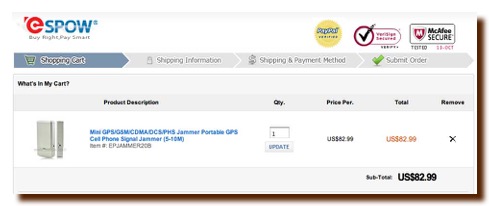
U-NII/Weather Radar Interference Update
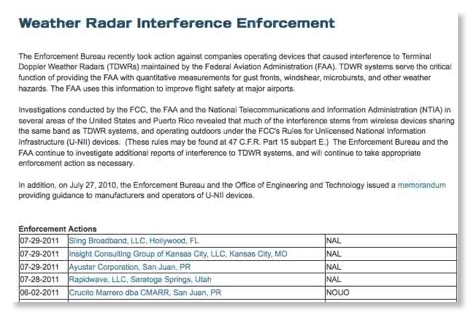
The FCC/EB webpage linked to the picture above now lists 17 FCC enforcement actions related to U-NII interference to FAA TDWR weather radars since 2007. For those not familiar with the jargon here, a March post here reported how 5 GHz unlicensed U-NII equipment operating in the 5.47-5.725 GHz band are required to have dynamic frequency selection (DFS) as defined by 15.407(h), basically a listen-before-talk (LBT) cognitive radio system, in order to avoid interference to several types of federal government radar systems that operate in the same band. The Terminal Doppler Weather Radar, an FAA weather radar near airports, has been receiving interference in several cases despite this requirement. The big question - Why?
(One)U-NII device was tested against FCC DFS certification waveforms and it did not detect any. It also failed to detect any emulated TDWR waveforms. The device, however, was FCC certified, meaning it had passed these same tests when the FCC laboratory tested its DFS performance. A firmware update from the manufacturer eventually rectified this problem, illustrating how firmware upgrades can lead to DFS non-compliance.
This strongly implies that the manufacturer changed the firmware after FCC approval. While the original FCC software defined radio (SDR) rules would have made such a software change a Class 3 Permissive Change and required regulatory review, the softening of the rules in Docket 03-108 and deletion of the former 2.932(e) gave a green light to such software changes.
Two March 2010 enforcement actions seem to confirm this. These involved Airspan and Motorola. Airspan agreed in a consent decree as follows:
Remedial Measures. Airspan has developed and distributed to its United States MicroMAX customers a software upgrade for its MicroMAXdevice that prevents users from disabling the DFS radar detection mechanism and varying any other operating parameters of the device.
Thus they were selling a unit where the users could turn off the required DFS capability needed to protect safety-related FAA radars! Airspan agreed to make a $10,000 “voluntary payment” to the Treasury as part of the consent decree.
Motorola agreed to a $9,000 “voluntary payment” but their consent decree is more cryptic than the one for Airspan or a similar one for Axxcelera Broadband Wireless, Inc. that appears to be based on a hardware component issue not a software change. The Airspan consent decree has clearly stated “remedial measures” that says what they will correct, Moto gets off with a $1,000 small “voluntary payment” (trivial to what this must have cost in legal fees), a vague agreement to train their employees better:
Motorola will train and provide materials concerning Section 302(b) of the Act and Parts 2 and 15 of the Rules pertaining to U-NII devices and the requirements of the Consent Decree to those of its employees who are involved directly in the development and marketing of U-NII devices imported, marketed and sold by Motorola in the United States.
Cryptically the consent decree states
On April 20, 2009, the Bureau issued an LOI (letter of inquiry) to Motorola. The LOI directed Motorola to submit a sworn written response to a series of questions relating to the marketing and selling of U-NII devices. Motorola responded to the LOI on May 20, 2009.
The content of Moto’s response to the LOI indicating how this happened is not on the public record. This is reminiscent of the “professional courtesy” Moto used to get from FCC when it was the dominant player in the mobile radio field and contrasts with how the lesser firms, Airspan and Axxcelera, were treated - they both paid a greater “voluntary payment” and had their violation more explicitly reported. Moto’s failings are not given in the public document, only in the referenced in the publicly unavailable 5/20/09 LOI response.
The coddling and preferential treatment of Motorola was common in the past but neglects the fact that it may have contributed to Moto’s lack of competitiveness and its ultimate demise as the top mobile radio firm. In the past Moto may have stressed its regulatory prowess over its technical prowess and was not prepared for the level playing field that cellular presented with new competitors. As Trefis reported
Motorola’s market share is expected to decline from a high of 22% in 2006 to 2.8% in 2010, [3] and could continue to decline to 1.6% by the end of Trefis forecast period(2011).
UPDATE
You blogger has filed a FOIA request for the above mentioned Motorola response to the FCC letter of inquiry (LOI) and will publish here the text when received. Today, the following interim response from FCC was received:
Your Freedom of Information Act ("FOIA") request dated August 11, 2011, was assigned to the Commission's Enforcement Bureau. You seek the response to a Letter of Inquiry ("LOI") issued in the Enforcement Bureau's investigation of Motorola, Inc. ("Motorola") (EB-09-SE-064). Motorola responded to the LOI on May 20, 2009. This email is to inform you that Motorola filed a request for confidential treatment of most of its LOI response pursuant to 47 C.F.R. § 0.459 of the Commission's rules. Since the confidentiality request is pending, pursuant to Section 0.461(d)(3) of the Commission's rules, we will serve Motorola with a copy of your FOIA request and afford them 10 calendar days to respond. Motorola also is required to serve you with a copy of its response.
The criteria for withholding such information is given in 47 CFR 0.457(d) . We patiently await word from Motorola if it is willing to let the world know why its equipment violated FCC rules or whether they will fight the release of any substantive information.
FCC Enforcement in Action: The Mysterious AT&T San Juan Case
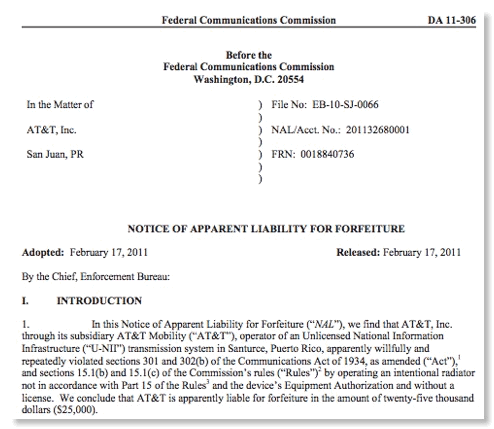 The issue of FCC equipment marketing enforcement has been a recurring issue here. Mitchell Lazarus, writing recently in FHH CommLawBlog pointed out the strange case of a recent Notice of Apparent Liability dealing with alleged AT&T use of 5605 MHz in San Juan PR. The NAL states
As part of its ongoing coordination efforts with the Federal Aviation Administration (“FAA”), the Enforcement Bureau received a complaint that radio emissions were causing interference on or adjacent to the frequency 5610 MHz to the FAA’s Terminal Doppler Weather Radar (“TDWR”) installation serving the San Juan International Airport. ... On December 7, 2010, agents from the Enforcement Bureau’s San Juan Office (“San Juan Office”) conducted an investigation on the roof of the Miramar Plaza Condominium Building in Santurce, Puerto Rico. The agents from the San Juan Office confirmed by direction-finding techniques that radio emissions on frequency 5605 MHz were emanating from the building’s roof, the location of one of AT&T’s U-NII transmitters, a Motorola Canopy. The Canopy model is certified for use as a Part 15 intentional radiator only in the 5735.0 - 5840.0 MHz band and is not certified as a U-NII intentional radiator.
In his blog post, Mr. Lazarus comments
In cases where a transmitter fails to match its certification, as here, the FCC usually cites the manufacturer. Going after AT&T makes sense only if the FCC thinks the transmitter was compliant when shipped, and that AT&T took it out of the box, re-tuned it to an unauthorized frequency, and turned off the DFS. That would indeed be a blatant offense. But the FCC does not accuse AT&T of doing this. The farthest it goes is to say AT&T “consciously” operated at the unauthorized frequency.
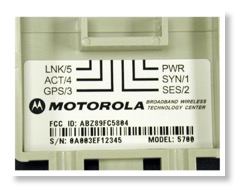
The original software defined radio (SDR) rules adopted in Docket 00-47 in September 2001 had the following requirement:
2.932(e) Manufacturers must take steps to ensure that only software that has been approved with a software defined radio can be loaded into such a radio. The software must not allow the user to operate the transmitter with frequencies, output power, modulation types or other parameters outside of those that were approved. Manufacturers may use authentication codes or any other means to meet these requirements, and must describe the methods in their application for equipment authorization.
In comments filed in Docket 03-108 this rule was challenged by several parties. The R&O states:
Motorola Canopy model #5700A number of parties support a requirement for devices to comply with the rules for software defined radios if the software and operating parameters can be easily changed post- manufacture and/or that pose a high risk of causing interference to licensed services such as public safety.
Intel states that those devices that use software defined radio as a manufacturing technique and are not intended to be modified in the field should not be required to be declared as software defined radios, and that the Commission should impose requirements on only those devices where the manufacturer intends to allow modifications in the field. Vanu, Inc., a manufacturer of software defined radios, believes that mandatory certification as software defined radios may be desirable when harmful interference may result from a foreseeable modification to the device’s software by a third party. It states that the Commission could adopt security requirements that are not limited to radios that meet the definition of software defined radios. The National Public Safety Telecommunications Council and the SDR Forum believe that the Commission’s concern should not be that a radio could be reprogrammed on an individual basis because the number of radios potentially affected that way would not be significant.
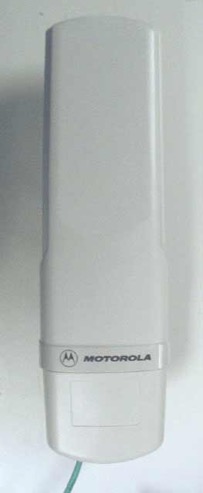
So there are several possible explanations of what happened in the San Juan case:
- an unintentional manufacturing error in software or hardware left the Canopy unit capable of operating at 5605 MHz. (Use of this frequency is only permitted if the unit has dynamic frequency selection capability to avoid radar systems. This Canopy unit does not have that capability.)
- Motorola violated its equipment authorization grant and intentionally shipped a unit capable of operating on 5605 MHz
- AT&T or a contractor modified the the software in the Canopy unit to change the frequency out of the authorized band.
So while I don’t have a lot of sympathy for AT&T in this case, it would appear that either Motorola is at fault in its sale of the Canopy unit, in which case its dealers would also be culpable or this case highlights an error in the logic used by the Commission in 2005 for watering down the former 2.932(e) requirement into the present much weaker 2.944 requirement.
It is ironic that when I spoke to the SDR Forum on a panel last year (just prior to the group changing its name to Wireless Innovation Forum) someone asked the panel if the FCC SDR security rules were too weak. I think they are and are the most likely root cause of this incident, but that is what the SDR Forum and others myopically asked for in Docket 03-108 and the FCC complied, ignoring concerns stated by Cingular/Bellsouth at the time.
Let’s hope FCC gives us a full explanation of what really happened in San Juan so we can avoid similar events in this and other bands.
While we are at it, it would also be useful for FCC and NTIA to publicly state why TDWR interference is a recurring problem given that NTIA was able to dictate the terms of the U-NII rules for the shared band. I suspect that DoD dominated the IRAC discussions of the issue and FAA naively assumed that DoD would watch out for all federal radars, not just military units, so did not realize until it was too late that TDWR was different than the military units in some key aspects.
Enforcement Bureau Jammer Initiative

The above text and poster appeared on the FCC website last week as part of a multimedia offensive against illegal jammers. This offensive included an “Enforcement Advisory for Users”, an “Enforcement Advisory for Retailers and Manufacturers”, a news release, a web page on jammer enforcement, a blog on jammer enforcement, and even a Twitter feed on jammer enforcement!
Readers may
The EB “Jammer Enforcement” lists 68 enforcement actions against jammer since 10/04 - impressive at first look. However, a little analysis shows what is really happening here. Only one of these involved a fine (“NAL” in FCC jargon). That involved the appropriately named Phonejammer.com . In this case FCC issues a citation to the company on May 22, 2008 and issued the NAL on April 20, 2010 - 698 days later! It is unclear if Phonejammer.com ever paid the NAL or just morphed into another corporate identity.
The only other fines on the list going back to 2004 are also telling. They both involve Rocky Mountain Radar, a manufacturer of police radar jammers. The 8/14/07 Forfeiture Order has this explanation:
On January 31, 2007, the Spectrum Enforcement Division issued a Notice of Apparent Liability for Forfeiture ("NAL") in the amount of $25,000 to RMR. RMR has not filed a response to the NAL. Based on the information before us, we affirm this forfeiture.
Thus RMR did not even bother responding to FCC/EB! I suspect other jammer sellers will get the message here. A review of the RMR website seems to indicate that similar products are still being sold and they are still selling manuals for the models listed in the citation.
Thus not withstanding the new tweets and blog posts, there is nothing here that would really scare a firm intent upon selling either cell phone or GPS jammers. More puzzling than the FCC/EB inaction on the jamming issue is why CTIA and NAB condone the ineffectual enforcement. CTIA seems more concerns about keeping strictly regulated jamming out of maximum security prisons in rural areas where they could save lives than in keeping wantonly illegal jammers out of the market.
What is needed in jammer enforcement is not tweets about noncredible enforcement, rather some real enforcement! Let me repeat my call from the January FCBA talk:
- Incumbent spectrum users need to work together to advocate an effective compliance/enforcement program at FCC
- Recommend major trade groups form a compliance/enforcement advocacy consortium
Recent EB Action Shows Slowness of Title III Technical Enforcement
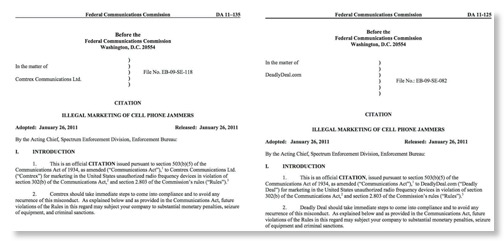
On January 26, 2011, the Commission released two citations, shown above, for the marketing of cellular telephone jammers. Although your blogger has argued here that the Commission has the authority to authorize the use of cell phone jammers in prisons if it adopted new rules, it is unambiguous that the jammers being sold here were illegal because they had not equipment authorization and thus selling them violated Section 302 of the Communications Act.
In August 2009, I wrote here about an enforcement case involving the sale of a GPS jammer. At the time I used the following calendar to show the foot dragging involved in this action:
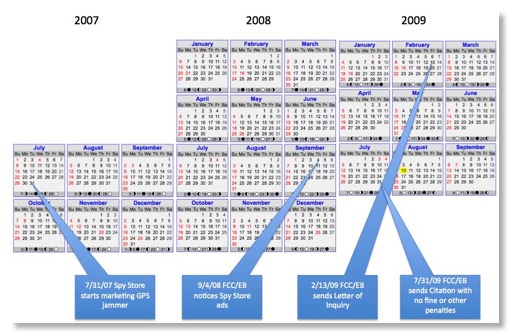
So how has timeliness improved? Note that in both the GPS and cell phone cases there was no question that the devices being sold were illegal and the sale violated Section 302. Note that violations of Section 302 are a misdemeanor and punishable as a criminal act under Section 501.
The two companies involved in the citation were DeadlyDeal.com and Comtrex Communications Ltd. Reading the citations carefully one sees that FCC was aware of DeadlyDeal.com’s marketing at least by April 8, 2009, yet did not even communicate with the company until February 18, 2010, 325 days later. In the case of Comtrex Communications Ltd., FCC was aware of the marketing at least by by June 9, 2009 and sent the first communications to the company September 29, 2009, 112 days later.
But both the GPS case and the present cellular cases ended up the same way with citations with no explicit penalty, except perhaps postage to respond to FCC letters. What type of deterrent is this for future illegal marketing by others?
On January 25, I gave an invited talk at the FCBA FCC Enforcement Brown Bag Lunch on the subject on unlicensed devices and enforcement. Here are the slides I used. I made the point that ever since the reorganization of the former FOB into Enforcement Bureau, the technical staff there has suffered from poor morale and poor leadership and that incumbent spectrum users need to advocate for more effective enforcement and leadership or major interference problems are likely to arise. This dilatory indecisive action in both the GPS jammer case and the cellular jamming case highlights how large numbers of interference causing devices could enter the marketplace before FCC takes any action. I urge the major spectrum incumbents and their trade associations to engage FCC senior leadership on how unacceptable this indecision is and the risks that result from it.
Furthermore, the lack of credible enforcement leads incumbents and NTIA to be reluctant to allow new technology near their bands for fear that noncompliant equipment will cause interference and there will be no timely FCC action. Thus the compliance status quo actually limits the Commission’s Title III policy options for new technologies!
IT GETS STRANGER!
Shortly after this was posted, Steve Crowley sent a comment to the blog pointing out that on the same day EB issued these 2 citations it issued a $10,000 NAL (fine) to an Arizona car dealer for unlicensed use of GMRS, a CB-like radio service than needs a license. Steve asks, “Is that worse than selling illegal jammers?”
So not only did EB act more promptly in the GMRS case than in the cell phone jamming cases and the GPS jamming case, they took decisive enforcement action rather than the toothless citation issued for these 3 jamming equipment cases. Where does CTIA and its membership stand on this type of enforcement? Should the 8th Floor ask for an explanation?
====
On a side issue, both the citations have this paragraph in them:
Jamming devices, however, cannot be certified or authorized because the main purpose of a jamming device is to block or interfere with radio communications. As noted above, such use is clearly prohibited by section 333 of the Communications Act. Thus, cell phone jammers, such as the Blocker, cannot comply with the FCC’s technical standards and therefore cannot be marketed in the United States.
This is the CTIA party line on its preferred interpretation of Section 333. The paragraph in the citations has no references to Commission decisions or court cases because there are none on this issue. This interpretation shows up in staff actions taken on delegated authority and in the case of these specific citation is irrelevant because sale of the devices violated Section 302 regardless of what Section 333 means. Their inclusion here is either because of ignorance or a desire to pander to CTIA. Repeating the same interpretation does not make it correct! The Commission has been sitting on the petition of South Carolina and 30 other states for over a year now. If this was such a clear issue they would have dismissed the petition per Section 1.401(e) of the FCC Rules months ago.
Obamacare, Judge Hudson & FCC

On Labor Day weekend 1987, the Playboy satellite channel’s uplink was jammed by an unknown source for a minute or so with an image containing biblical text. The previous year, after the Captain Midnight HBO satellite jamming incident, Congress had passed 18 USC 1367 criminalizing satellite jamming (but not any other types of jamming). The Playboy incident was the first case after the new law was enacted. The same team that solved the Captain Midnight case in about a week went to work on this case also. George Dillon headed the overall investigation and I handled the technical side. In a little over a week, we verified that the jamming came from Pat Robertson’s Christian Broadcasting Network (CBN) in Virginia Beach, VA and through great detective work and initiative by the late J. J. Freeman, Engineer-in-Charge of the FCC’s Norfolk Office at the time, we had a key piece of CBN’s equipment we could soon match with recordings of the jamming signal and proof that the only person working at the time was one Thomas Haney.
FCC, following normal procedure for criminal violations of laws relating to its jurisdiction referred the case for possible prosecution to the appropriate U. S. Attorney - Henry Hudson in the Eastern District of Virginia. Then ... nothing happened.
We found out that Mr. Hudson had 2 dilemmas: first, he had recently lead Attorney General's Commission on Pornography (“Meese Commission”) and had pressured mainstream media outlets from stocking magazines like Playboy; second, at that time Pat Robertson was a viable candidate for the Republican presidential nomination (later won by Bush 41) and was the darling of the Republican right wing establishment. There was probably fear that prosecution of Haney might uncover wrongdoing by Robertson himself. (In retrospect, there was never any evidence that anyone at CBN other than Mr. Haney had any a priori involvement with the jamming, but there was evidence that after the event CBN managers, not necessarily Mr. Robertson, were involved in a coverup and destruction of evidence.)
It was reported to FCC that Mr. Hudson ultimately met with Attorney General Meese to discuss this relatively obscure case and recused himself from it based on some undisclosed conflict relating to Playboy. Meese let Hudson recuse himself and assigned a career prosecutor from the DOJ Criminal Division to prosecute the case successfully and convict Mr. Haney of a felony. I think the FCC team was ultimately happier with the seasoned pro we got than it would have been dealing with Mr. Hudson’s ambivalent staff. However, Congress had recently passed 18 USC 1367 and Mr. Hudson’s ambivalence to congressional intent always surprised me.
(It is ironic that today CBN’s Washington Bureau is located at ... 1919 M St., NW - the FCC’s former headquarters!)
Do FCC Commissioners Not Like Doing Enforcement?
Under current legislation, enforcement is an integral part of the FCC’s job. But it is a lot more fun creating new services and issuing licenses than it is penalizing people for antisocial actions. But as Comm. Abernathy said above during her tenure at FCC, the two go hand in hand.
Thus it is interesting to note the current list of Items on Circulation. There are now 32 items on circulation on the 8th Floor - a major decrease over the historic level! Of the 19 items that have been on circulation for more than 3 months, 8 appear to be enforcement related. These include 3 from the June-September 2008 period that have now spent almost 2 years on the 8th Floor without resolution. The list of all items on circulation more than 3 months is below:
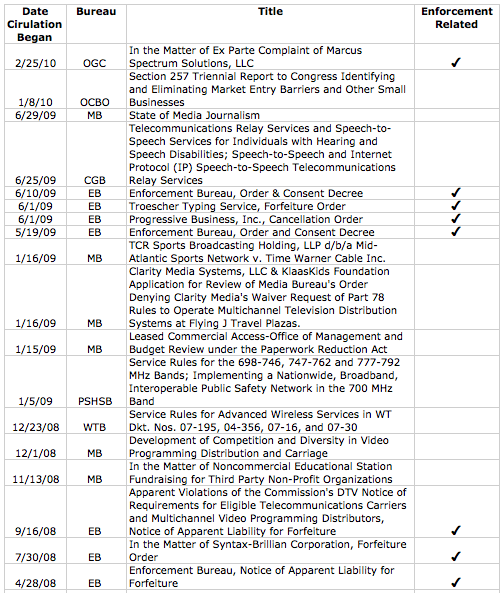
So on today, the 6 month anniversary of our enforcement complaint being on the circulation list, we will not complain about that. But we ask what is served by having these other matters pending for such a long period. Note that this date shown below is only the date that the agenda item reached the 8th Floor. Each issue probably was pending for a long time before it ever got to that high level.
FCC Enforcement: A Glass Half Full or Half Empty?

“We have written elsewhere about the irritations of other people using cell phones in public places. Technology, having caused this problem, also offers a solution: widely available on the Internet are jammers that silence phones nearby, and sometimes at a considerable distance. We Googled “cell phone jammer” and found dozens of places selling them.
Some outfit calling itself the “Federal Communications Commission” has declared jammers to be illegal. Recently it levied a fine of $25,000 against a company with the unwisely chosen name of “phonejammers.com” that offers them on the Internet.”
Sounds like FCC is back in the enforcement business? Maybe not or at least not with any enthusiasm. After a long time period a $25,000 fine with no equipment seizure. Surely Phonejammer’s legal bills were much higher than this fine. Is this a message adequate to deter Phonejammer or anyone else from such activity?
A previous post described the 23 month saga of FCC enforcement action against a GPS jammer. So how did FCC do in the present case? Well, maybe 23 months is a secret time limit for enforcement action. So here are milestones in this case from the public released FCC Notice of Apparent Liability for Forfeiture (“NAL”):
- “On May 22, 2008, the Spectrum Enforcement Division (“Division”) of the Enforcement Bureau (“Bureau”) issued a Citation to Phonejammer pursuant to Section 503(b)(5) of the Act”
- “On November 9, 2009, the Bureau’s Dallas, Texas Field Office (“Dallas Field Office”) received a complaint from a provider regarding interference to its authorized cellular and PCS frequencies in the 800 MHz and 1900 MHz bands...During the course of its investigation of the complaint, the Dallas Field Office determined that the interference had been caused by a 5 watt adjustable power jammer identified as Phonejammer model number PJ005 (“Model PJ005”), installed at a Carrollton business.”
- “On February 4, 2010, the Division issued a Letter of Inquiry (“LOI”) initiating an investigation into Phonejammer’s marketing of phone jammers in the United States.”
- “In March 2010, during the course of investigating a complaint from the St. Lucie County, Florida Sheriff’s Office (“SLCSO”) regarding interference to cellular and PCS frequencies utilized by SLCSO detectives, the Bureau’s Tampa, Florida Field Office (“Tampa Field Office”) traced the interference to a phone jammer installed at a business located in Port St. Lucie, Florida.”
- April 20, 2010 - NAL released by FCC
So it looks like the investigation go lost after the May 2008 initiation. The FHH CommLawBlog folks point out, “We Googled ‘cell phone jammer’ and found dozens of places selling them.” Does EB use Google?
A key issue throughout the investigation was the statement by Phonejammer that they were not actually selling jammers within the US. Did EB attempt an “undercover buy” to nail down this point early?
If EB takes years to deal with blatantly illegal GPS jammers and cellphone jammers, it is unlikely they deal at all with other equipment that has more subtle violations such as power exceeding legal limits or strong out-of-band emissions. Sources in EB tell me that during the DTV transition when EB agents were visiting electronics retailers in large numbers to check for proper labeling on TV receivers being sold they were actively discouraged from noticing other equipment being sold that was illegal. Thus a return to the Adm. Nelson “telescope to the blind eye” approach.
But the continued indifferent approach to enforcement raises the real possibility of massive sales of an interfering device before regulatees demand action which then could be too late.
Enforcement may not be as much fun as making the NBP, but it is also part of the job for FCC
======
Parenthetically, the NAL contains in para. 6 the sentence, “Thus, intentional radiators that cannot legally be operated – because, for example, they interfere with or jam authorized cellular or PCS communications in violation of the requirements set forth in Section 333 of the Act – are not eligible for a grant of equipment certification.”
When your blogger worked at FCC, OGC was very strict on forbidding the staff to say in documents written under delegated authority what powers the FCC did not have. This quote in the NAL has not footnote other than a general cite to Section 333. As the South Carolina Department of Corrections and 28 other state corrections agencies have said in their petition, this view is inconsistent with the legislative history of Section 333 - which resulted from a request of EB’s predecessor from cases dealing with aircraft jamming by licensed pilots. July 13th will be the first anniversary of the SCDC petition’s filing which has seen no public action yet.


 (Does not include readers using RSS feeds.)


![[Valid RSS]](valid-rss-rogers.png "Validate my RSS feed")


