
Unlicensed Spectrum Provisions in 2018 Omnibus Spending Bill
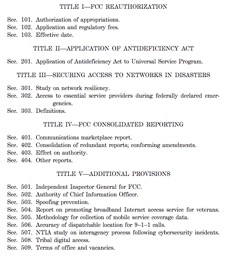
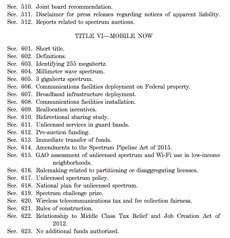
On March 23 POTUS signed into law the 2018 Omnibus Spending Bill. As a public service, we are providing to the telecom community the sections that deals with telecom issues so readers don't have to plow through all 2000 pages. The index of the telecom provisions is given above.
Since CTIA and NAB will quickly tell their members about the sections that direction affect them - while they claim credit for these provisions, we will not address such issues here. Rather we will focus here on the unlicensed spectrum issues in the new law.
SEC. 603. IDENTIFYING 255 MEGAHERTZ
This section requires NTIA and FCC to identify "identify a total of at least 255 megahertz (sic) of Federal and non-Federal spectrum for mobile and fixed wireless broadband use." It further specifies that "100 megahertz below the frequency of 8000 megahertz shall be identified for use on an unlicensed basis" and that "55 megahertz below the frequency of 8000 megahertz shall be identified for use on either a licensed or unlicensed basis, or a combination of licensed and unlicensed." Thus 100 -155 MHz of spectrum will become available for unlicensed uses, presumably from spectrum used in whole or part by federal users, in the next few years.
SEC. 611. UNLICENSED SERVICES IN GUARD BANDS
This provision states:
After public notice and comment, and in consultation with the Assistant Secretary of Commerce for Communications and Information and the head of each affected Federal agency (or a designee thereof), with respect to frequencies allocated for Federal use, the Commission shall adopt rules that permit unlicensed services where feasible to use any frequencies that are designated as guard bands to protect frequencies allocated after the date of enactment of this Act by competitive bidding under section 309(j) of the Communications Act of 1934 (47 U.S.C. 309(j)), including spectrum that acts as a duplex gap between transmit and receive frequencies.
Two comments here:
- It is unclear whether the requirement for FCC to consult not only with NTIA but also "each affected Federal agency" is a practical requirement here. It is bad enough that the US has 2 parallel agencies in charge of spectrum policy, but here it appears that Congress may not trust the agency that regulates federal spectrum use on behalf of POTUS.
- It is unclear why this provision was even needed since FCC and NTIA already had the legal authority to do this. So rather than enabling anything, this provision might actually slow it down. Time will tell!
SEC. 615. GAO ASSESSMENT OF UNLICENSED SPECTRUM AND WI-FI USE IN LOW-INCOME NEIGHBORHOODS
(GAO) shall conduct a study to evaluate the availability of broadband Internet access using unlicensed spectrum and wireless networks in low-income neighborhoods.
A odd provision! For example, what does "wireless networks " mean here? In general today's use of "wireless" seems to be the services that members of "CTIA-The Wireless Association" offer. Or perhaps the services regulated by FCC's Wireless Telecommunications Bureau. Neither of which seem to include Wi-Fi®.
"Wi-Fi®", as the ® indicated, is a certification mark of the Wi-Fi Alliance. It would be odd if Congress passed a bill on the availability of Xerox® brand copiers in low income neighborhoods. So why did Congress use "Wi-Fi" here?
Then in Sec. 615(a)(2) the bill requires GAO to "consider and evaluate both "the availability of wireless Internet hot spots and access to unlicensed spectrum in low-income neighborhoods, particularly for elementary and secondary school-aged children in such neighborhoods" as well as "any barriers preventing or limiting the deployment and use of wireless networks in low-income neighborhoods"
While many unlicensed Wi-Fi® networks are free to the users, that is not a requirement of FCC rules. The law is unclear then if both free networks and fee-based subscription networks are intended.
Finally, in the 5 GHz band, the impact of LTE-U on Wi-Fi® networks is not going to be positive, but will be very contentious. Is GAO supposed to reopen this can of worms?
SEC. 617. UNLICENSED SPECTRUM POLICY
Even though the whole concept of "unlicensed spectrum" has a foggy foundation in present law and appears to be a contrition of Sec. 301, this prevision tries to build a better foundation for unlicensed while not explicitly saying it is authorized. The bill states
(a) STATEMENT OF POLICY—It is the policy of the United States— (1) to maximize the benefit to the people of the United States of the spectrum resources of the United States; (2) to advance innovation and investment in wireless broadband services; and (3) to promote spectrum policy that makes available on an unlicensed basis radio frequency bands to address consumer demand for unlicensed wireless broadband operations.(b) COMMISSION RESPONSIBILITIES—The Commission shall ensure that the efforts of the Commission related to spectrum allocation and assignment made available on an unlicensed basis radio frequency bands to address demand for unlicensed wireless broadband operations if doing so is, after taking into account the future needs of homeland security, national security, and other spectrum users— (1) reasonable; and (2) in the public interest
We are troubled by the requirement to take "into account the future needs of homeland security, national security, and other spectrum users". While CTIA is now supporting the use of 6 GHz C band spectrum for unlicensed use, perhaps in exchange for the unlicensed community supporting their access to the 4 GHz part of the band, we are aware of no previous occasion when CTIA has every supported the designation of ANY spectrum for unlicensed use. Indeed, BOTH CTIA and NAB have consistently opposed any new unlicensed bands for decades! After NAB and friends said no new spectrum was needed for the ATSC 3.0 transition, they are now trying to slow down for the umpteenth time TV white space implementation so they can simulcast - something their original petitions said was no necessary! So we are not sure if ANY new unlicensed spectrum could pass the test of not impacting "future needs of homeland security, national security, and other spectrum users". Where the "the public interest" stand with respect to these incumbents?
SEC. 618. NATIONAL PLAN FOR UNLICENSED SPECTRUM
The "plan" is introduced here:
NATIONAL PLAN—Not later than 18 months after the date of enactment of this Act, the Commission, in consultation with the NTIA, shall develop a national plan for making additional radio frequency bands available for unlicensed or licensed by rule operations.
This plan can identify new bands that meet the policy statement in Sec. 617, above, including the issue of the needs "of other spectrum users". Interestingly Sec. 618 (c)(2)(D) then states that new bands must "not significantly impact homeland security or national security communications
systems" — oddly leaving out the phrase "other spectrum users" included in Sec. 617. Does this really mean that NAB and CTIA can object on the basis of their "future needs" but not on the basis of "significant impact". VERY ODD! Possibly a drafting error in a smoke filled room late at night.
CONCLUSIONS
Congress did a lot in this legislation. Much of it was already within the legal jurisdiction of FCC and NTIA. Unless Congress wants to revise such issues ever few years, perhaps it should ask the more basic question as why much of this legislation was needed. Perhaps Congress should be more explicit in telling FCC and NTIA what there general goals and priorities are, and let the agencies implement them subject to oversight.
In general, the spectrum policy resources of BOTH FCC and NTIA are too meager considering the $300+B contribution of spectrum related activities to the GDP. FCC and NTIA spectrum activities cost about $200M annually. Both agencies are user fee supported and there is virtually no opposition among their users to the current fee levels. Whether you want to believe Comm. Rosenworcel's off stated number that Wi-Fi® contributes more than $240 B of economic benefits annually, clearly the FCC's Docket 81-413 decision has had huge economy benefit even though it was almost universally opposed at the time. The "killer app" specific suggestion to use the ISM band for unlicensed use came from an FCC-funded study by MITRE Corp. that cost $56k. The plain truth is that neither FCC nor NTIA have this type of funding any more for independent study of spectrum policy issues although its UK counterpart Ofcom does.
Thus it is not clear if the requirements of this legislation, absent a resource increase for both FCC and NTIA spectrum activities, will result in a net gain of spectrum productivity productivity or just drain resources from other important spectrum efforts.
2 Unsung FCC Pioneers in Early 5G #HighBandSpectrum Policy
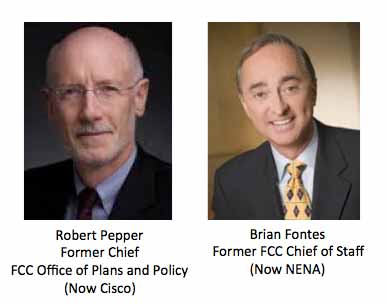
(UPDATE: Robert Pepper is now with Facebook)
There is an implicit viewpoint at FCC that telecom technology is like a "conveyor belt sushi"/kaitensushi /回転寿司 restaurant in Japan: you sit at the counter and various types of sushi come on a conveyor belt in front of you unordered and you just wait until you see one you like and then take it off for eating. So at FCC you just wait for telecom technology to magically come from a conveyor belt and you pick winners and ignore the losers.
Video on "conveyor belt sushi"/kaitensushi /回転寿司 in Japan from NHK
Well, telecom technology does not come by magic! It requires bright people with good ideas and then investment in R&D to work on such ideas. In radio technology, the risk of that investment and thus its commercial likelihood depends on regulatory risk of FCC approving the commercial use and hence profitability of the technology.
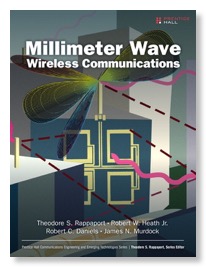
"it took about ten years for low-cost commercial products to evolve from 1998 (sic) when USA became the first country in the world to authorize low-power 60 GHz operation…(S)hort range wireless networks provided the relevant applications to take advantage of unlicensed 60 GHz spectrum, as well as other frequencies in the mmWave band…Due to the inherent nature of mmWave frequencies … many emerging or future mmWave wireless products and standards (such as 5G mmWave cellular, inter vehicular communications, and backhaul/fronthaul communications standards) are likely to share characteristics with the 60 GHz WPAN/WLAN standards.
Thus #HighBandSpectrum 5G did not come unsummoned from a sushi conveyor belt, but derived from earlier visionary FCC action in Docket 94-124 in the Hundt Chairmanship. In my main website I have given more background of how this came about, here let me emphasize the role of the 2 individuals shown above.
When I proposed the concept of a 60 GHz unlicensed band in late1992 to the leadership of FCC's Office of Engineering and Technology, it was immediately rejected. This was probably because of the FCC culture related to "Nobody every got fired for buying IBM", i.e. if you only do things major regulatees propose you can never be criticized. (At the time I was working in EB's predecessor FOB as part of an "internal exile" resulting from the Docket 81-413 proceeding that is now known as the basis of Wi-Fi and Bluetooth but which at the time was very controversial.)
After the OET rejection, I sought guidance from Dr. Robert Pepper - legendary Chief of the FCC's Office of Plans and Policy (now OSP) from 1989 to 2005 - an amazing tenure in a very partisan agency. Bob was interested in the idea when I presented it to him, he asked me many questions and then proposed a meeting with the Chairman's Office to discuss the issue. This was during the Quello Chairmanship and Dr. Brian Fontes, his long term staffer was his Chief of Staff. Bob came with me to the meeting with Brian and the then Chief of OET. We both gave our viewpoints and Brian agreed with me that we should start drafting an NPRM for unlicensed use of 60 GHz - far above the then upper limit of FCC radio service rules at 40 GHz. The NPRM was drafted and approved on 10/20/95 under Chmn. Hundt who succeeded Quello. The R&O was adopted on 12/15/95 and by that time both Dr. Pepper and Dr. Fontes had left FCC after many years of loyal service.
Bob is now Vice President, Global Technology Policy at Cisco. Brian is now Chief Executive Officer of the National Emergency Number Association.
I hope that the 5G community can now remember that these two gentlemen played a key role in the early development of 5G #HighBandSpectrum policy in starting the "conveyor belt" moving at a time when the cellular mainstream had little or no interest in upper spectrum bands and thus giving us the wonderful technology that was approved yesterday!
@FCC Makes Unforced Error on History of Unlicensed
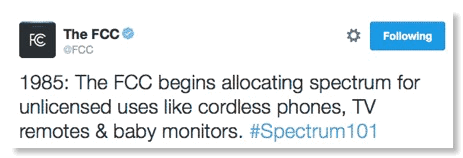
At 12:06 PM on April 1, 2016 the official FCC Twitter account, @FCC, sent out the above tweet as part of "Spectrum101: Great Moments in Spectrum History". It has now been deleted, possibly because I responded to this tweet with the statement that while the unlicensed ISM band that is home to Wi-Fi and Bluetooth (and many other devices) began in May 1985, unlicensed spectrum has been around since 1938 although it is not explicitly authorized in the Communications Act of 1934. Hopefully, some readers here are old enough to remember that cordless phones predate 1985. (If you can't remember this, ask your parents.)
The video below shows the FCC's May 1985 decision and may explain why I remember it so clearly:
Former FCC staffer Kenneth Carter explained the actual history of unlicensed in a 2009 paper titled "Unlicensed to kill: a brief history of the Part 15 rules". Ken wrote:
In 1938, shortly after its founding, the FCC first permitted unlicensed devices to be sold and operated without a license. The Part 15 rules stem from what is possibly an oversight offundamental physical phenomenon by the Communications Act of 1934. Congress had intended to treat the regulation of spectrum in the way in which we traditionally think of it. Namely, the FCC was to award rights through licensing discrete individual entities, including such as radio broadcasters, the military, and the alike. This, however, failed to recognize two facts. First, that nearly all devices that employ electricity leak or reradiate electromagnetic energy, albeit at very low power levels. Second, also at this time, radio device manufacturers started introduce short range, low duty cycle communication devices which operated employing low levels of energy over very short distances[8]. As a result, the FCC set about to promulgate rules to manage such devices based on the jurisprudence that if RF emissions that were sufficiently weak and short ranged so as to not be considered measurable, they would, therefore, not rise to the level of harmful interference. This was explained by then-FCC Chief Engineer, Ewell Jett in 1938:
"What we are concerned with immediately is the problem of interference. If certain low power devices can be used without interfering with radio communications, there would appear to be no engineering reason for suppressing their use. (Footnotes omitted)
What is the difference between 1938 style unlicensed spectrum and post 1985 style? The original unlicensed rules allowed only specific functionality in a specific band requested by a petitioner. This band could be used by cordless phones, this for garage door openers. Always with very low power. Have a new possible use? File a petition and wait!
The Docket 81-413 regime adopted in 1985 set forth some technical requirements and allowed much higher power. It did not restrict the type of use. Thus while the rulemaking never mentioned radio LANs, when they became important in the late 1980s the RLAN proponents used the Docket 81-413 unlicensed regime to get access to the ISM bands quickly without nonroutine FCC action. True "permissionless innovation" before the term was invented!
Another garble in the this short length (and short lived tweet) is the use of "allocating" as the 5th word. All real spectrum wonks know that unlicensed is not an allocation, rather it is a permitted secondary use on an NIB (noninterference basis). Why there were so many garbles in such a short tweet is puzzling and raises questions of FCC as an "expert agency in spectrum".
Or maybe we should have read the date more carefully? However the other "#Spectrum101" tweets the same day seemed correct.
Our fellow bloggers at CommLawBlog on the same day as this tweet had an April Fools post entitled "Looking for Improved Public Image, FCC Reorganizes Office of Media Relations". After reading both the tweet and the CommLawBlog post, it is hard to tell which is real!
Tragedy of the Commons: An Alternative View


The concept of "the tragedy of the commons" is gaining currency again as the industry debates the regulatory and commercial wisdom of allowing LTE access to the Wi-Fi bands via LAA (licensed assisted access) or LTE-U (unlicensed LTE).
The term is often used as if it refers to a "known" which emerged from the study of land usage: the idea that commonly held resources go to rack and ruin. In fact the opposite is the case: in the disciplines where it has been studied, it is widely viewed as discredited. In history, there is little evidence of a tragedy, and in economics, the academic who challenged the concept won a Nobel prize.
Modern usage stems from a 1968 academic article called "The Tragedy of the Commons" by Garrett Hardin. He argued that open pastures are inevitably overgrazed because adding extra cattle gives a large individual benefit to their owner, whereas the eventual environmental degradation caused by overstocking is shared by all users.
Privatise common land and the problem disappears: overstocking damages the landowner directly, so this incentive to inefficiency disappears. In the 1970s and 1980s, this became a powerful argument for privatisation - particularly in developing economies - and was applied not just to land but also to industries and utilities.
In the spectrum world, the argument claims that congestion will eventually make unlicensed bands unusable because individuals suffer only marginally as the problem intensifies.
Hardin was extending an argument made by the Victorian economist William Forster Lloyd in 1833 and used to justify enclosure of common lands in the UK. Enclosure was the practice of taking land used by the general public and giving or selling it to private landlords. This had been going on since medieval times, but intensified from the 17th century onwards.
So where is the evidence that overgrazing caused by common ownership leads to Lloyd's famously "puny and stunted" cattle? In fact, there isn't much. To paraphrase the historian E.P. Thompson, the problem with the "tragedy" argument is that it assumes commoners have no common sense. Scholars like Neeson have documented how communities held special courts to manage the commons and prevent over-grazing.
Furthermore, who would have the money to buy the additional animals to ruin the grazing for everyone else? The richer farmers who would have the most to gain from enclosing common land! Neeson presents evidence of the well-off being prosecuted for ignoring the rules of the common.
Historically, is the "tragedy of the commons" a myth? This probably overstates the case. Evidence presented by Neeson shows isolated examples of badly managed commons but plenty of examples of good management.
Hardin himself recognised this and retracted his original thesis, conceding: "The title of my 1968 paper should have been 'The Tragedy of the Unmanaged Commons'."

The shared student kitchen: a poorly managed commons
The economist Elinor Ostrom won the Nobel prize in 2009 for her re-examination of this debate, producing more subtle and convincing arguments based on the study of the management of natural local resources in developing countries. For her, it was the involvement of the local community that was the key to success.
What can spectrum policy learn from these debates in history and economics? Put simply, we shouldn't regard "the tragedy of the commons" as an inevitability.
The evidence suggests common usage can be a tragedy if poorly managed or a success if well managed. This ties in with our practical experience: surprisingly little congestion has been found so far in studies of Wi-Fi usage. The international development community would call this an example of Ostrom's law, whereby an allocation of resources that works in practice can work in theory. We should recognise this in the spectrum world too.
© PT Publishing 2016
FCC 10/17 NOI to Explore Cellular Use in 60 GHz Wi-Fi Band
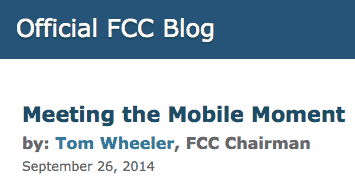
In a 9/26 blog post Chmn. Wheeler wrote:
“Sustaining the mobile revolution also depends on our invisible infrastructure – spectrum. The fact that there is no low-hanging fruit in our spectrum inventory that can easily be repurposed for broadband means that the Commission needs to think creatively about how to make more spectrum available and increase the efficiency of its use.
Historically, mobile wireless services have been targeted at bands below 3 GHz due to technological and practical limitations. However, there have been significant developments in antenna and processing technologies that may allow the use of higher frequencies – in this case those above 24 GHz – for mobile applications.
Acting on a recommendation of the Commission’s Technological Advisory Council, I am circulating to my fellow commissioners a Notice of Inquiry that seeks to broaden the Commission’s understanding of the state of the art in technological developments that will enable the use of millimeter wave spectrum above 24 GHz for mobile wireless services.
Early studies show that these new technologies – what some are calling “5G” – can ultimately facilitate a throughput of up to 10 Gigabits/second, a speed that is orders of magnitude greater than that available today. Our effort here is to learn about the technology and ensure a regulatory environment where these technologies can flourish.”
While this blog talks about enabling “ the use of millimeter wave spectrum above 24 GHz for mobile wireless services”, reliable FCC sources report that the current draft of the NOI being discussed for adoption on 10/17 includes discussion of the 57-64 GHz band known for WiGig and 802.11ad unlicensed technology for cellular use.
While we have advocated FCC action on long stalled millimeter wave actions, it is not clear if undoing a 1995 decision that made this an unlicensed band is a positive step forward. And while this NOI is credited to the FCC’s Technological Advisory Council (TAC), I just do not see where they even hinted at such action.
Furthermore, the FCC’s 2002 Spectrum Policy Task Force Report, while not binding, recommended that “all future rulemaking for terrestrial use above 50 GHz should include de novo review of the merits of licensing” due to the fact that propagation is so different than at lower bands.
So where did this idea come from?
Drones & Spectrum:•Will FCC Policy Vacuum Trigger Jamming Increase?
•Will Propagation from Altitude Overload Already Crowded Spectrum?
•Will Propagation from Altitude Overload Already Crowded Spectrum?
Seattle Woman Spooked by Drone Outside Her Window
The GPS and cellular industry are vehemently against jamming of their spectrum and are pressing FCC for more rigorous action. The recent June 20 FCC workshop on “GPS Protection and Receiver Performance” was full of pledges to step up enforcement and the recent $34,912,500 NAL to a Chinese jammer manufacturer was an attempt by FCC to show its commitment to such enforcement - although the likelihood of the perpetrator ever paying anything is slight.
From an actual jammer ad
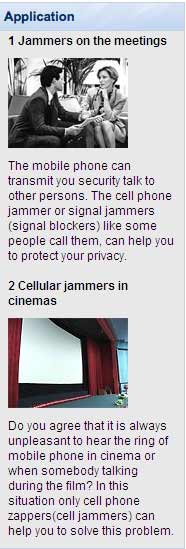
The picture at left comes from a cellular jammer ad and shows the pitch they are using. (We will not give the original source here but it has been shared with FCC/EB.)
While FAA is working under a congressional mandate to resolve its regulations for drones, FCC seems disinterested in the matter -- except in the context of the NPSTC National 4.9 GHz Plan for public safety users. But as the NY Times reported yesterday “Drones Outpacing Rules as Popularity Soars in New York”.
Using either cellular spectrum or unlicensed spectrum from drones is really a bad idea and should be forbidden.
Why? There are good technical reasons why we have frequency allocations for the Aeronautical Mobile Service where drone-related communication should be. The range of a radio signal (and its potential interference to other users) is determined both by its transmitter’s height as well as its (effective radiated) power. Airplanes and drones are at much higher heights than terrestrial users.
The unlicensed and cellular bands and their technical rules were designed for terrestrial use. Using cellular or unlicensed spectrum at even several hundred foot altitude will impact other users much more than comparable terrestrial use. For example, in a dense cellular repeater environment, a drone-based cellphone will likely hit several repeaters with comparable power and use up disproportionate spectrum capacity. Similarly, it will disproportionately increase the apparent load in unlicensed systems, effectively decreasing their capacity much more than a terrestrial user with the same bit rate.
In addition to this overload problem, drone based imagery will likely be seen by many as invasive as shown in the video at the top of this post. Experience has shown that such feelings often lead to interest in jamming for self-protection. While such jamming is illegal, it is growing and FCC actions to date under present laws and rules have had little impact. Thus it is likely that the growth of drone-based imagery in the unlicensed bands and cellular bands will be accompanied by a surge of jamming to the detriment of all cellular and unlicensed users!
So why isn’t anything being done? Look back a few blog entries to the “VA and FCC” entry here. Your blogger believes that like the VA, FCC is operating at a throughput less than that required for its actual spectrum policy role. In this hypothesis, major regulatees, both licensed and unlicensed, are implicitly or explicitly told to limit their requests to FCC so they can at least get their key requests accomplished.
What could be done about drones at FCC to prevent drone based downlinks from adversely impacting unlicensed systems and cellular systems? The previous drone post here advocated amending § 15.9 to forbid drone based imagery as well as the currently forbidden (for non law enforcement) “eavesdropping”. With respect to cellular systems, both § 22.925 and § 91.21 limit use of transmitters in "1) Aircraft operated by a holder of an air carrier operating certificate or an operating certificate; or (2) Any other aircraft while it is operated under IFR" and "aboard airplanes, balloons or any other type of aircraft". We urge FCC to amend these to forbid use of cellular spectrum from drones and urge the cellular community to tell FCC this is an urgent matter.
Note that we are not advocating that FCC forbid spectrum for drones, rather that such spectrum use be in bands that are planned for such use considering the heights involved in it.
Sprint’s New Drone
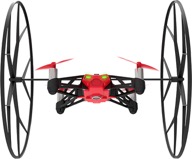
Review of a Consumer Drone Using 2.4 and 5 GHz Unlicensed Spectrum
IEEE Communications Society Award for Public Service in the Field of Telecommunications
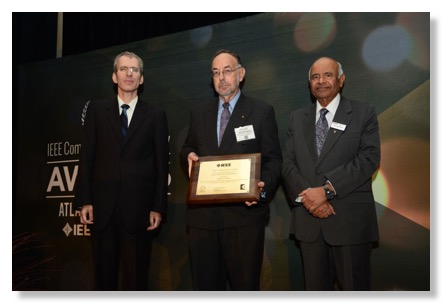
Chair ComSoc Award Committee Andreas Molisch, your blogger, ComSoc President Vijay Bhargava
At the December 2013 IEEE Global Communications Conference (GLOBECOM), you blogger was awarded the IEEE Communications Society Award for Public Service in the Field of Telecommunications. This award is given for “major contribution to the public welfare through work in the field of telecommunications”.
The citation for the award read “For pioneering spectrum policy initiatives that created modern unlicensed spectrum bands for applications that have changed our world."
As you can see comparing the above photo with the below 1985 video of FCC’s adoption of the ISM band rules that are the basis of Wi-Fi, Bluetooth, ZigBee, and various other unlicensed services, your blogger hasn’t changed much in the past 28 years.
Thanks to IEEE ComSoc for this great honor, awarded last year to Dr. Veena Rawat, formerly of Industry Canada - FCC’s great counterpart to the North. Among Dr. Rawat’s many major accomplishments was the timely introduction of Canadian policies that paralleled the FCC’s ISM band rules at a time when FCC was still having misgivings about what it had done.
UPDATE
As if on queue, Chmn. Wheeler said in a speech the day after this was posted:
One of the FCC’s great success stories was the creation of unlicensed uses in the 2.4 GHz band in the 1980s. Who would have imagined that WiFi, Bluetooth, and other innovations would result?
CTIA's Love/Hate Relationships with Both SF and Unlicensed
We have written several times about CTIA’s love/hate relationship with unlicensed spectrum and about its generally negative view towards San Francisco - ruling it off limits for any future CTIA meeting and suing it over the city’s attempt to make sure customers have basic information about cell phone safety - information similar to that now available on the website of the Swiss EPA and similar to the text that CTIA’s French counterpart supplies for inclusion with every new cellphone and SIM sold in France.
So imagine your blogger’s surprise when he found this paid content on the Washington Post website:
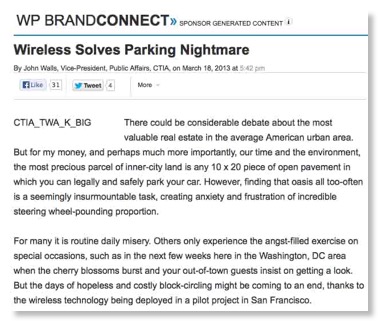
CTIA’s ever quotable John Walls even says
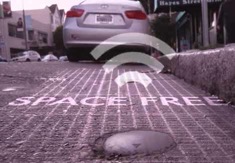
San Francisco’s SF Park initiative uses wireless sensors in city parking spaces and garages to inform city drivers where they can park, thereby reducing congestion, saving time, and lowering greenhouse gas emissions.
Nice words from CTIA about SF!!! Well it certainly is a wireless system and it certainly is in San Francisco, but as we noticed in an April post on CTIA’s boasting about a “wireless” system for farmers, it appears that unlicensed is a key part of the system.
In reality unlicensed and cellular systems have a real synergy. But CTIA endlessly seems to oppose any new unlicensed spectrum and appears to have been the force behind the ill fated “unlicensed auction” House bill that was drafted by a former CTIA staffer.
Wi-Fi on Airlines: Honeywell Survey Finds Huge Demand
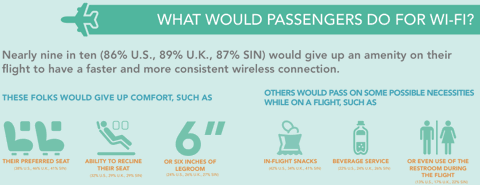
The Today show today included a tidbit about a recent Honeywell Aerospace-sponsored survey on the public’s view of Wi-Fi on airplanes. No doubt Honeywell is a provider of the equipment for this connectivity so a poll sponsored by them might have some biases like the previously mentioned polls by CEA and NAB on home use of over the air (OTA) TV. But the graphic shown at the top was truly fascinating!
In a press release and a paragraph entitled “Comfort Redefined” Honeywell wrote:
For most travelers, the current commercial flight experience can be summarized in one word: crowded. Crowded flights and cramped seats have become the norm. According to the Honeywell survey, however, almost 90 percent of fliers would give up an amenity on their flight — preferred seats, extra legroom and more — to be guaranteed a faster and more consistent wireless connection. This finding potentially alters how passengers define comfort on flights. The survey indicated:
More than one-third of Americans and Singaporeans and nearly half of Britons who would give up an amenity would give up a preferred seat for a better Internet connection.
Almost two-thirds of passengers would rather have access to fast in-flight Wi-Fi that allows them to stream video and music than sit in their preferred seat.More Connections, Please
More than three in four fliers surveyed think wireless access should always be available on planes. And when it comes to the current in-flight Wi-Fi experience, passengers want the type of consistency and speed experienced at home or in the office, especially on transoceanic or international flights.
In-flight Wi-Fi service causes frustrations for nearly nine in ten users worldwide. Inconsistent or slow connections disappoint fliers most.
More than one-third of passengers surveyed would be disappointed if in-flight Wi-Fi was not available on an international flight or over an ocean.
Now we know that cell phone use and Wi-Fi are cross elastic with the right hardware and Skype software. But if the Honeywell survey is even vaguely correct, it is amazing what a resonance Wi-Fi use in aircraft has hit!
1985 FCC Approval of Band that is the Home of Wi-Fi
MS-Supported Study: The case for permissive rule-based Dynamic Spectrum Access
Thanki compares a license-based access regime, in which a user will need to obtain a license through a regulatory award or market-based negotiation, to a rule-based access regime, "in which the satisfaction of certain conditions, such as limited transmit power levels, checking with an online database and/or payment of an access fee permits spectrum access."
Thanki does an interesting comparison of licensed and unlicensed systems that you rarely hear int he DC policy community:
The successes of the narrow licence-exempt bands demonstrate the power of rules- based access to spectrum. In twenty years of operation licence-exempt technologies now account for:
• The majority of innovation in wireless communications – licence-exempt connectivity is near ubiquitous in smartphones, tablets and PCs and is rapidly growing in a vast range of consumer and industrial goods. The licence-exempt bands are also home to a diverse range of open standards which act as a platform for further innovation.
• The majority of wireless devices – in 2013 fewer than 2.5 billion devices will be sold that incorporate licensed connectivity and nearly all of these will also feature complementary licence-exempt technologies. However, at least 2.5 billion devices will be sold that use licence-exempt communication technologies exclusively. This disparity is set to increase.
• The majority of Internet data traffic delivered to consumers – Wi-Fi carries 69% of the total traffic generated by smartphones and tablets and 57% of total traffic generated by PCs and laptops. Overall the volume of Internet data traffic delivered by licence-exempt Wi-Fi exceeds that of cabled connections and licensed mobile networks combined.
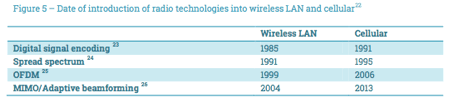
Thanki includes the following interesting table on unlicensed innovation vs. cellular innovation:
As a pioneer in creating today’s unlicensed spectrum environment, your blogger was certainly gratified by the closing words of the Thanki paper:
The relatively small ranges of frequencies opened up for non-discriminatory access have quickly become home to the majority of wireless innovation, the majority of wireless devices and the majority of wireless data traffic. This has surprised many in the spectrum management community who expected tradable exclusive licences to be the focus of investment, competition and innovation…
Granting exclusive-usage rights – over frequencies or frequencies at particular times or in particular places – is likely to hinder efficient usage and innovation. Instead, rule-based access has generated a virtuous cycle in which rapidly increasing usage enables and is enabled by advances in technology that allow ever more interleaved, interference-resistant communication. This is creating an unprecedented boom in wireless innovation as innovators are voting with their feet and adopting the licence- exempt bands which offer a multiplicity of low-cost, reliable and globally harmonised standards. Instead of pushing against this trend with schemes such as LSA, whose justification lies in economic theory rather than achievements in practice, better regulation would focus on expanding rules-based access, whose current achievements are only an inkling of its future potential, to further and more varied bands of spectrum.
But life is not really this simple and BOTH licensed and unlicensed approaches have complementary benefits. Unfortunately the cellular community’s love/have relationship with unlicensed tends to obscure the issue. Also the unlicensed community also sometimes overreacts, perhaps in response to the cellular community’s hype, with statements seeing unlicensed as a panacea.
The possible sale of Vodaphone’s share of VZW implies that VZW has a net worth in the order of $200B. This value does not just come from “monopoly rents”, rather VZW and other carriers have make significant investment in infrastructure. Cellular service may be ubiquitous in urban areas and on most major highways, but rural area cellular coverage still has limitations and always will in a privately operated system without universal service-like subsidies for areas where coverage makes little economic sense. (By contrast, Japan uses revenues derived from a $5/year spectrum use fee on all cell phones and all other transmitters to subsidize wireless infrastructure that is noneconomic. Such a policy in the US would be controversial and is not advocated here.)
This nationwide buildout of infrastructure would have been unlikely in a pure unlicensed spectrum model. However, despite the denials by the cellular industry today’s ubiquitous broadband would have been impossible without the licensed/unlicensed synergy that the cellular industry denies or minimizes as they constantly “diss” unlicensed.
Perhaps what we really need today is consensus building between the cellular community and the unlicensed community to get a better mutual understanding of each other’s roles and the mutually beneficial synergy between the two communities.
Europe loves Wi-Fi: new EU study recommends more spectrum should be made available
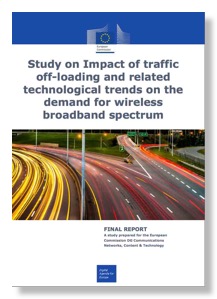
(The primary author of the study is former FCC staffer J. Scott Marcus, now with Germany’s WIK Consult, who is not related to your blogger although we were friendly when we both worked down the hall from each other and while we both lived in Europe.)
It appears that the cellular establishment was behind the ill fated Section 104 of The Spectrum Innovation Act of 2011 that would have required an ill conceived unlicensed auction before FCC could create any additional unlicensed spectrum, even in ISM bands or above 100 GHz! However, the cellular establishment covered its tracks very well because no one ever spoke in public in favor of this odd provision. But since this provision appeared in a House committee staff memo written by a former CTIA staffer, it is a likely guess that CTIA was somehow behind it.
Here is the report summary from the EU website:
How is traffic off-loading evolving over time, both in terms of technical and of market developments, and how does this evolution influence the need for spectrum? It is widely recognized that traffic on the macro cellular network is growing rapidly, largely as a result of impressive take-up of smartphones and tablets. The surprising and little recognized reality is that, according to credible data captured from a range of sources, the visible growth in macro cellular mobile network traffic appears to be only the tip of a much larger iceberg. The volume of traffic that is already being off-loaded, chiefly to Wi-Fi in the home, already exceeds that of the mobile network, and can be expected to grow even faster as well. This is largely a result of the considerable effort that equipment vendors and standards bodies have invested in developing both Wi-Fi and cellular standards to improve interworking between the two and to optimise use of the available spectrum. Traffic off-load generates surprisingly large socio-economic benefits by virtue of the cost that MNOs have saved, or can be expected to save, by building a smaller network thanks to data traffic off-load. Relatively little action is needed at European level; however, a few interventions should be considered in order to ensure that the momentum is maintained. Among these are (1) seeking to make spectrum from 5150 MHz to 5925 MHz available globally for Wi Fi; (2) continue seeking to make 2.6 GHz and 3.5 GHz fully available for mobile use; (3) consulting on future licensing options for 3.5 GHz and other potential new licensed mobile frequency bands; and (4) various measures to reduce administrative burden on the deployment of public off-load services and networks.
Now the spectrum actions here are not really different from what the FCC is trying to do. But FCC seems too intimidated by the cellular establishment and their endless appetite for new spectrum to talk very visibly about this topic. However, snooping around the FCC website we did find this statement in an FCC blog in 2011 by John Leibovitz & Robert Alderfer:
Importantly, the (Cisco) report accounts for some offsetting effects, most notably the use of WiFi and femtocell networks to “offload” capacity from the mobile network to a fixed broadband connection. Cisco estimates that about 21% of traffic from smartphones and tablets was offloaded to WiFi or femtocells in 2010 and that this proportion will increase to 30% by 2015. This finding demonstrates the vital importance of unlicensed spectrum in helping address our nation’s wireless capacity needs. Still, overall traffic growth is likely to outpace offloading, according to Cisco’s forecast.
Also in 2011 Chmn. Genachowski said “Traffic offloading to WiFi helps reduce congestion that could otherwise impair the flow of data on commercial networks. WiFi and other innovations based on unlicensed spectrum have contributed hundreds of billions of dollars to our economy, and offer tremendous potential to foster economic growth and job creation.”

(Graphic from EU website)
FCC Meeting Today Only Deals with Spectrum
The first item dealt with a Report & Order in Docket 10-4, which non techies refer to as the signal booster item although more strictly speaking it deals with bidirectional amplifiers (BDAs) for mobile radio systems. This has been a recurring topic here. 2487 days after May 1, 2006 when CTIA presented the Commission with a white paper declaring “FCC action is urgently needed”, FCC finally acted, sort of, in a decision that makes BDAs explicitly authorized under certain conditions.
The original 2006 CTIA white paper said,
“CTIA asks the FCC to issue a notice to consumers confirming and informing them that operating wireless repeaters without licensee authorization is unlawful and may result in service outages and other harms to the network. CTIA also asks the FCC to issue a notice to manufacturers, importers, distributors, and retailers clarifying that they are permitted to market and sell repeaters only for use under the clear authority and control of licensees.”
This was oddly reminiscent of the old AT&T’s preCarterphone view of CPE. FCC’s R&O took a more positive view of the public needs in rural America:
The decision strikes a balance between public needs and the rights of the carriers. I said “sort of” in the introduction, because FCC has agreed to revisit this issue in 2 years and statements at the meeting made it clear that if the carriers do not all cooperate with legitimate user requests the rules may be modified to make them more user friendly and less carrierWhile nearly the entire U.S. population is served by one or more wireless providers, coverage gaps that exist within and at the edge of service areas can lead to dropped calls, reduced data speeds, or complete loss of service. Robust signal boosters can bridge these gaps and extend coverage at the fringe of service areas. Signal boosters are particularly useful in rural and difficult-to-serve indoor environments, such as hospitals. Signal boosters can also improve public safety communications by enabling the public to connect to 911 in areas where wireless coverage is deficient or where an adequate communications signal is blocked or shielded. In short, because signal boosters represent a cost-effective means of improving our nation’s wireless infrastructure, the rules we adopt today should lead to more robust service for many Americans at home, at work, and on the road.
As reported previous, FCC’s delay on this issue, the 2487 days from the CTIA white paper to today’s R&O, was a lose/lose period for both sides.
The BDA manufactures faced serious offshore competition from irresponsible manufacturers who made no attempts to limit interference from their units to cellular systems as well as being denied access to normal capital from the financial community because of the risks involved when the megacorporations that are the 4 major carriers sought to have them driven from the face of the earth! The carriers also faced both continuing interference from early models of BDAs as well as current models from irresponsible manufacturers along with the knowledge that no matter what the new rules say the bad units will continue in use for several more years. THE COSTS OF FCC DELAY!!
CTIA has issued no statement as yet on the R&O while Wilson Electronics, a major manufacturer of this equipment has.
The second item dealt with an expanded “Wi-Fi” band at 5 GHZ. I put Wi-Fi in quotes since it is a registered trademark of the Wi-Fi Alliance which in the past has indicated misgivings about the FCC’s casual use of terms like “super Wi-Fi”. Also the present and probably the new FCC rules do not require the use of only IEEE 802.11 standards in any specific unlicensed bands.
The Commission press release states
The Commission proposed to make up to 195 megahertz of additional spectrum in the 5 GHz band (a 35% increase) available to unlicensed wireless devices. It also proposed to create a more flexible regulatory environment, and to streamline existing rules and equipment authorization procedures for devices throughout this band.
Unlicensed National Information Infrastructure (U-NII) devices today operate in 555 megahertz of spectrum in the 5 GHz band, and are used for short range, high speed wireless connections including Wi-Fi enabled local area networks and fixed outdoor broadband transceivers used by wireless Internet service providers to connect smart phones, tablets and laptops to the broadband network.
The proposed modifications would provide access to additional contiguous spectrum with consistent technical requirements, allowing unlicensed devices to use wider bandwidth channels, leading to faster speeds.
This spectrum current has federal users in parts of it and thus FCC and NTIA share responsibility for it. NTIA has agreed to the NPRM and may modify its position later. In or nearby the promised spectrum are present and planned uses by Intelligent Transportation Systems (ITS). Some members of the ITS community have been comparing this NPRM to the GPS/LightSquared issue although the major ITS trade association, ITS America was quite moderate and open minded in its statement.
The link to NPRM text is now here.
Cellular Industry's Love/Hate Relationship with Unlicensed Spectrum
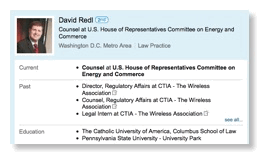
However, Thomas M. Lenard, president of the Technology Policy Institute has tried to explain its merits in a post entitled “Use the market to allocate spectrum” in another blog. While the intent of Mr. Lenard appears to be limited to spectrum related to the proposed incentive auction, the language in Section 104 would have made any future new unlicensed spectrum nearly impractical regardless whether it was exclusive unlicensed spectrum in the incentive auction spectrum or even secondary/“junk” spectrum use such as for Wi-Fi or U-NII.

AT&T said the number of connections to its Wi-Fi network nearly tripled year-over-year in the third quarter to 301.9 million. AT&T also said that the amount of data on its Wi-Fi network in the quarter more than doubled from the year-ago period.
The statistics reflect not only AT&T's growing use of Wi-Fi offloading for its cellular networks but also the wider trend within the industry to use Wi-Fi as a tool to manage mobile data traffic. Indeed, AT&T said that users are now making around 100 million Wi-Fi connections per month, more than the total number of connections made in all of 2009 and five times the total number of connections made in 2008. For now at least, neither AT&T nor any other U.S carrier counts Wi-Fi usage toward a subscriber's monthly data allotment.
AT&T's Wi-Fi hotspots now number 29,000 across the country, and AT&T said hotel locations account for approximately 40 percent of the carrier's total Wi-Fi network traffic.

In a sure sign that the cellular industry is getting serious about Wi-Fi, telecom networking giant Ericsson is buying BelAir Networks, adding its high-performance outdoor hotspot technology to its portfolio, sources told GigaOM. The deal could signal a big shift in the mindset of the big wireless vendors, which have always favored their own specialized and expensive cellular technologies to meet growing mobile data demand rather than more generic but much cheaper Wi-Fi technology. ...
As smartphone data usage explodes, consumers have begun turning to home, office and public Wi-Fi to bring their handsets online, taking advantage of fast speeds while bypassing the data caps on their mobile plans. There are some exceptions, such as AT&T, but most U.S. mobile operators have been reluctant to incorporate Wi-Fi directly into their networks, preferring instead to keep customers on their 3G and 4G networks, where they can collect data revenues and maintain control of the network connection. With big vendors like Ericsson on board, though, that attitude could be changing.
While your blogger was responsible for bringing a total of 5234.5 MHz into unlicensed use through the proposals he drafted and the decisions he helped draft in Dockets 81-413 and 94-124, he does not see unlicensed as a panacea for all the world’s spectrum problems. Exclusive licensed and unlicensed band both have positive points and both contribute towards an efficient telecom infrastructure.
It is unfortunate that many on both sides view the choice between licensed and unlicensed as a zero sum game with respect to the long term interests of the cellular industry. The continuing industry interest in Wi-Fi shows that the truth is more complex.
Spectrum Innovation Act of 2011:
Will the "unlicensed auction" provisions lead to another "D Block Auction" fiasco?
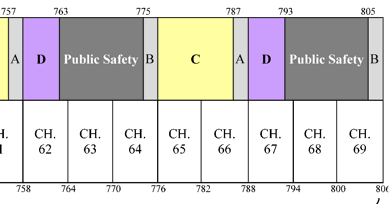
What if they had an auction and no one came? This is basically what happened in the 2008 D block auction where FCC declared, “The provisionally winning bid for the D Block license, however, did not meet the applicable reserve price and thus did not become a winning bid.”
Of course in reality only one firm bid showing essentially zero interest in the package offered. Why? The basic reason was that the package that was up for sale was so poorly defined that a potential bidder with an MBA on his staff could not possibly estimate either potential costs or possible income. It was unclear what level of service the D block owner had to provide to public safety community and it was unclear if he would get any income from public safety use of D block spectrum that would, in effect, deny commercial use for a period. Could the licensee charge for public safety use of D block in excess of x% occupancy? At the time of the auction no one knew.
FireceWireless described the new legislation as follows:
The proposal to require unlicensed spectrum to be auctioned is drawing fire from the tech community. In essence, companies that might be interested in building products to work on unlicensed spectrum would be required to pay for the spectrum despite the fact that they wouldn't receive any exclusive rights to it. Confusingly, if the total value of all bids for such spectrum were to exceed the highest single bidder, the spectrum would then become unlicensed. If, however, a single bidder sought exclusive use of the spectrum and outbid other bidders wanting the spectrum to be unlicensed, the spectrum would then go to the single bidder. (emphasis added)
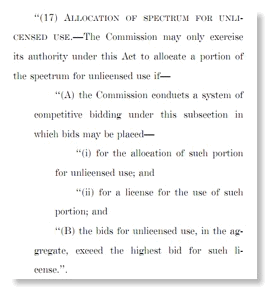
People opposed to this provision also compare it to the Unlicensed PCS (U-PCS) rules the Commission adopted in 1993 and which were a dismal failure. Opponents blame the fiasco over the user fees for equipment in the band which would have been about $5/unit.
These rules, adopted at the request of industry that drafted them were amazing complex and included provisions for both “isochronous devices” and “asynchronous devices” as requested by the commenting parties. My personal view on the failure of these rules is that they were much too complex, totaling over 3800 words and the parties requesting them did not realize that once they were enshrined in 47 C.F.R. any changes to them were protected by both the full faith and credit of the APA and the Commission’s long standing near indifference to technical rulemakings - especially when it gets distracted by “sexier” things such as DTV and broadband. By comparison, the original ISM band rules that spawned both Wi-Fi and Bluetooth consisted of exactly 398 words! I think a key factor of U-PCS’ failure was the extreme complexity and inflexibility that was demanded by the petitioners and FCC acceded to.
Given that most unlicensed bands are “damaged goods” as previously stated, and that most unlicensed bands are really very specific provisions for narrow spectrum slivers, e.g. 15.233, requiring auctions for any new unlicensed band seems like regulatory overkill. On the other hand allowing such type of auctions and giving guidances of what considerations should be used in deciding on them might be constructive.


 (Does not include readers using RSS feeds.)


![[Valid RSS]](valid-rss-rogers.png "Validate my RSS feed")


