
A UK Alternative View on Broadband and the Future of Over-the-Air DTV
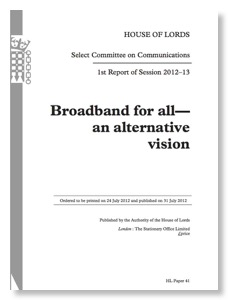
an alternative vision”. You probably did not see anything about it on US TV news programs, perhaps it was overshadowed by the Olympics. Or perhaps it was too troubling for the networks, or NAB, to address in a timely way. (As of this posting, NAB, CTIA, and Broadcasting & Cable have nothing about this report on their websites.)
(While we learned in high school and from Gilbert & Sullivan that the House of Lords consisted of hereditary peers, the scions of ancient dukes and earls, as a result of reforms in recent decades only 92 out of the present 775 members are hereditary peers, the rest being life peers appointed for life based on their own achievements.)
Here is the header from the article on the Daily Mail’s website:
The end of broadcast TV? House of Lords calls for all channels to go online (but you'll have to buy yet another box to watch them)
* Plan could see internet only TV service across the UK
* Report warns broadband speeds in rural areas will need to be improved before the move
The Daily Mail wrote
If you have only just managed to switch your TV to digital, bad news - you may soon have to buy yet another box.
A parliamentary inquiry today forecast a second wave of switchover as TV moves online.
The House of Lords says the government should begin planning for every channel to be available online to free up spectrum for services like high speed mobile phone services’.
Eventually the case for transferring the carriage of broadcast content, including public service broadcasting, from spectrum to the internet altogether will become overwhelming,' the Lords communications committee said in its report on internet infrastructure.
FCC sources report that the first draft of the National Broadband Plan had a discussion of reallocation from broadcast to broadband that was bolder than the final report but not as bold as this UK proposal. Within 30 minutes after the draft was given to the FCC Media Bureau, the Chairman’s Office started receiving calls from “The Hill” telling them to back off - such is the power of broadcasters in Washington!
Here is the text of the UK report that gives its controversial recommendation (para. 141)
We recommend that the Government, Ofcom and the industry begin to consider the desirability of the transfer of terrestrial broadcast content from spectrum to the internet and the consequent switching off of broadcast transmission over spectrum, and in particular what the consequences of this might be and how we ought to begin to prepare.
The UK report clearly recognizes that the switch would not be easy and that it should not be done until alternatives for media distribution are in place, operational, and affordable for all. But it recognizes the huge economic benefits of increasing broadband penetration - not just the benefit for certain industries, but for the whole society and economy.
The US National Broadband Plan has a key issue that is clearly missing, no doubt as a result of the political intervention on the first draft: If the US can achieve near universal penetration of broadband to US households by policies including making broadband the universal service equivalent of dial tone, why do we need over-the-air TV in populated areas. Indeed, if we are willing to use DBS for universal service-like video distribution, why do we even need over-the-air TV in rural areas?
Such a dramatic change has to be carefully planned and must respect the equities of the broadcasting industry. But is NBC in the business of pumping electromagnetic energy into the spectrum, most of which passes houses without any TV antenna, or is it in the business of putting together compelling programming that people want to watch and bundling that with compatible ads? Any such evolution must consider the needs of the economically disadvantaged and their right to continued access to “basic TV” as well as rural needs, but that is why FCC has had universal service programs.
Readers may recall a January post here with the following quote from Justice Alito during a Supreme Court oral argument:
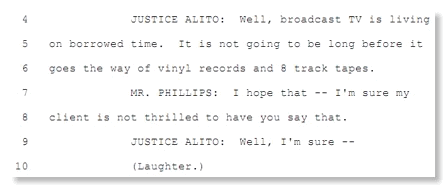
What does Justice Alito and the House of Lords’ Communications Committee have in common? Appointments based on excellence in life accomplishments and life tenure. It would appear that officials without such life tenure are unwilling to raise serious long term questions of the public interest for even debate if they are unacceptable to strong trade associations.
IEEE-USA Harmful Interference White Paper
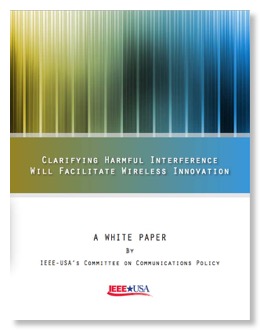
The document shown at right, a white paper entitled “Clarifying Harmful Interference Will Facilitate Wireless Innovation“, was released this week by IEEE-USA and was drafted by its Committee on Communications Policy. Here is the executive summary:
In recent years, many of the spectrum policy controversies in the United States have dealt with the basic issue of whether a proposed technology or service will cause “harmful interference” to existing spectrum users. Resolving these issues has typically taken several years in an era where technology is moving at “Internet speed.” As the Federal Communications Commission (FCC) discussed in its Wireless Innovation Inquiry, the delays and lack of transparency associated with making go/no go determinations on harmful interference may be discouraging private investment in the development of innovative wireless technology.
This White Paper reviews the background of what is harmful interference and suggests incremental ways in which the two spectrum management agencies in the United States, the FCC and the National Telecommunications and Information Administration (NTIA), could clarify the definition by giving guidance on the sub-problems associated with harmful interference determinations. Changing the definition is probably impractical, due to the long list of precedents over decades that have been built on the current definition, even though it is not established by statute.
The White Paper also suggests that establishing timeliness goals similar to those voluntarily created by the FCC for equally complex and voluminous merger and acquisition reviews could also address the disincentives for private capital formation in the wireless technology area. Such timeliness goals could create a more “level playing field,” with respect to other technical areas concerning private funding of technical development.
FCC Workshop on Spectrum Efficiency and Receivers
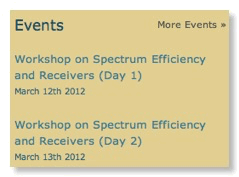
As part of the Commission’s efforts to enhance the use of spectrum for mobile broadband, the FCC Office of Engineering and Technology, in conjunction with the Wireless Telecommunications Bureau and the Office of Strategic Planning will host a workshop on "Spectrum Efficiency and Receiver Performance." The workshop will be held on Monday, March 12, 2012 and Tuesday, March 13, 2012, in the Commission Meeting Room at FCC Headquarters in Washington, DC.
The role of receivers in enabling access to spectrum for new services implicates federal stakeholders, as well as the private sector. Receiver performance issues have often arisen as a conflict between legacy stakeholders and new entrants where deployment of new technologies and services threatens to adversely impact an incumbent or place restrictions on the new entrant. Past examples include interference issues between new cellular radio systems and public safety radio systems, satellite digital radio systems and proposed terrestrial data services, unlicensed WiFi systems and FAA weather radar systems, and ancillary terrestrial service on mobile satellite spectrum and GPS. The resolution of such matters has historically required a public process involving regulators, stakeholders and other parties. Because such discussions sometime begin upon the introduction of a new service or technology, full deployment of such new services could be hindered. New approaches to spectrum management focusing on spectrum efficiency and receiver performance may enable more assured deployment of new services and reduce the necessity for the involvement of regulators.
This two-day workshop will discuss the characteristics of receivers and how their performance can affect the efficient use of spectrum and opportunities for the creation of new services. Key topics will include current practices for receiver design, case studies involving interference due to receiver characteristics, and approaches for promoting interference avoidance and efficient use of spectrum, given the current receiver base and potential future deployments. The workshop will include perspectives from licensees, equipment manufacturers, component providers, and other interested parties.
Apparently there will be panels of speakers, but they have not been announced. Nor has any sort of agenda beyond the above been announced.
(I was surprised by the mention of “unlicensed WiFi systems and FAA weather radar systems” as I have previously written this appears NOT to be a receiver problem, but rather an SDR security issue for the unlicensed cognitive radio systems. Oddly, my September 2011 appeal of an initial redaction of a FOIA request has never been acted on by FCC/OGC. I believe the requested document with fewer redactions would confirm the real nature of the TDWR problem. Motorola is fighting the release of the document with fewer redactions in a “reverse FOIA” action.)
My suspicion is that there is a major coordination problem among the various power that be within FCC on both the agenda and the speakers, probably in their attempt to pacify various industry sectors who have their own view of the issue. Perhaps there is an NTIA problem also.
NTIA has classically been in favor of receiver standards, claiming they have them for federal systems. (Mostly true.) However, NTIA has been unwilling to pressure FAA into adopting 20 year old ICAO Instrument Landing System receiver immunity standards that are used around the world and has been strangely silent on the issue of GPS receiver standards.
In any case, it seems rather strange to have a 2 day workshop with no published agenda 3 working days before it starts.
UPDATE
The afternoon of March 9, the agenda was released.
UPDATE 2
The Powerpoint presentations used are available now on the (ever chaotic) FCC website.
Here are the videos of the 2 days:
Cellular Industry's Love/Hate Relationship with Unlicensed Spectrum
However, Thomas M. Lenard, president of the Technology Policy Institute has tried to explain its merits in a post entitled “Use the market to allocate spectrum” in another blog. While the intent of Mr. Lenard appears to be limited to spectrum related to the proposed incentive auction, the language in Section 104 would have made any future new unlicensed spectrum nearly impractical regardless whether it was exclusive unlicensed spectrum in the incentive auction spectrum or even secondary/“junk” spectrum use such as for Wi-Fi or U-NII.

AT&T said the number of connections to its Wi-Fi network nearly tripled year-over-year in the third quarter to 301.9 million. AT&T also said that the amount of data on its Wi-Fi network in the quarter more than doubled from the year-ago period.
The statistics reflect not only AT&T's growing use of Wi-Fi offloading for its cellular networks but also the wider trend within the industry to use Wi-Fi as a tool to manage mobile data traffic. Indeed, AT&T said that users are now making around 100 million Wi-Fi connections per month, more than the total number of connections made in all of 2009 and five times the total number of connections made in 2008. For now at least, neither AT&T nor any other U.S carrier counts Wi-Fi usage toward a subscriber's monthly data allotment.
AT&T's Wi-Fi hotspots now number 29,000 across the country, and AT&T said hotel locations account for approximately 40 percent of the carrier's total Wi-Fi network traffic.

In a sure sign that the cellular industry is getting serious about Wi-Fi, telecom networking giant Ericsson is buying BelAir Networks, adding its high-performance outdoor hotspot technology to its portfolio, sources told GigaOM. The deal could signal a big shift in the mindset of the big wireless vendors, which have always favored their own specialized and expensive cellular technologies to meet growing mobile data demand rather than more generic but much cheaper Wi-Fi technology. ...
As smartphone data usage explodes, consumers have begun turning to home, office and public Wi-Fi to bring their handsets online, taking advantage of fast speeds while bypassing the data caps on their mobile plans. There are some exceptions, such as AT&T, but most U.S. mobile operators have been reluctant to incorporate Wi-Fi directly into their networks, preferring instead to keep customers on their 3G and 4G networks, where they can collect data revenues and maintain control of the network connection. With big vendors like Ericsson on board, though, that attitude could be changing.
While your blogger was responsible for bringing a total of 5234.5 MHz into unlicensed use through the proposals he drafted and the decisions he helped draft in Dockets 81-413 and 94-124, he does not see unlicensed as a panacea for all the world’s spectrum problems. Exclusive licensed and unlicensed band both have positive points and both contribute towards an efficient telecom infrastructure.
It is unfortunate that many on both sides view the choice between licensed and unlicensed as a zero sum game with respect to the long term interests of the cellular industry. The continuing industry interest in Wi-Fi shows that the truth is more complex.
Can Cognitive Radio Technology Help Solve Some Difficult Spectrum Management Issues by Creating "Virtual Guardbands"?

The hidden node problem refers to the problem of protecting receivers from interference in a cognitive radio system when you can’t explicitly detect the receiver’s presence. This is the crux of the TV whitespace problem since TV receivers can not announce their presence. (In that case the use of cognitive radio detectors 20+ dB more sensitive than TV receivers can be used to solve the problem although FCC chose the more conservative approach of geolocation for initial implementation.)
The instant article considers the case of a full duplex mobile transmitter with known frequency offset, as in the case of the ubiquitous cellphone. It points out that in this case the hidden node is no longer “hidden” since it can be readily detected at short distances by the uplink signal and that the receiver frequency can also be calculated by adding the offset to the detected uplink frequency.
This is a special case of Preston Marshall’s general observation that while cognitive radios are best known for finding empty spectrum that can be used without cochannel interference, if you know the location and characteristics of nearby receivers you can also select frequencies that will not result in interference from adjacent channel or intermodulation mechanisms in receivers with limited rejection capability. Pres points out that receiver ejection capability is generally expensive because it requires on precise analog components, whereas cognitive radio technology is mostly digital with little marginal cost in the long run.
In the AWS-3 proceeding, T-Mobile, the adjacent channel licensee in most places, claimed that adjacent channel interference to their FDD downlink was inevitable if the adjacent AWS-3 were used for either uplinks or TDD. Since we now know that T-Mobile was “on the auction block” during this deliberation, they had every incentive to maximize their sale value by using a massive legal effort for both trying to stop a new entrant and removing any risk of interference from concerns of potential purchasers. One of the parties in the AWS-3 proceeding mentioned a variant of virtual guardbands in comments, but this was promptly dismissed by the cellular mainstream as speculative.
But while there might be some slight question of how well TV whitespace devices can detect a TV signal from 50 miles away that provides marginal reception to TV sets using antennas near the devices, detecting a cellphone uplink signal nearby - the only place where adjacent channel or intermodulation interference is a threat - is trivial by comparison.
Industry loves to demand guardbands: it is a proven technology to prevent interference and also limits competition. But guardbands also have a real cost in our spectrum dependent economy that is always searching for more spectrum. Virtual guardbands can be a realistic way to use today’s technology to avoid interference while allowing more intense spectrum use at the boundaries of FDD bands.
FCC has never resolved the AWS-3 issue, they just told M2Z Networks that no answer was coming soon. AWS-3 continues to lie fallow as we beat the bushes to find the 500 MHz of new spectrum demanded by the National Broadband Plan. - there are no easy answers. Maybe with technologies such as virtual guardbands we can put AWS-3 to use serving society and the economy. With AT&T and T-Mobile now before the Commission begging for permission to merge, maybe they can more more flexible on the AWS-3 issue as a merger condition.
Section 7 & Wireless Innovation: IEEE-USA Letter to FCC

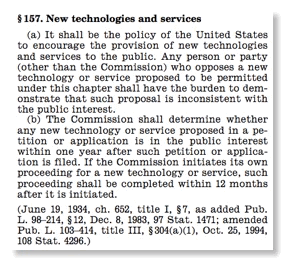
The IEEE-USA letter points out that the Commission does have explicit guidelines for review of pending mergers and forbearance petitions pursuant to Section 10(c) of the Act that both give nominal time schedules. However, there is no analogous guidance on Section 7 issues.
The letter also pointed to recent White House initiatives to speed up patent review to expedite innovation:
We believe that FCC might wish to emulate the White House’s recent Startup America initiative “to dramatically increase the prevalence and success of America’s entrepreneurs.” Under part of this program the Patent and Trademark Office (PTO) will offer an Enhanced Examination Timing Control Initiative “to give innovators more control over the application processing and support a more efficient market for innovation.” For wireless innovations subject to non- routine FCC approvals, FCC deliberations determine if and when diffusion, and thus positive cash flow, is possible. In contrast, the improved and more timely PTO decisions only scope the level of intellectual property protection were these cash flows possible. We urge the FCC to examine this PTO initiative and consider offering to entrepreneurs parallel programs to resolve policy deliberations on a faster, more predictable basis.
FCC has a poor track record in responding to this type of suggestion. Let’s hope they are more attentive this time. If others with like views tell Chmn. Genachowski their views, more may happen.
vox populi, vox dei


 (Does not include readers using RSS feeds.)


![[Valid RSS]](valid-rss-rogers.png "Validate my RSS feed")


