
FCC-CIRC#1
A New Procedure for FCC:
ATSC 3.0 Issues
Now this can be resolved simply by specifying a vaguely transparent mechanism for giving feedback on these drafts, whether it is ECFS or a more informal system. Should there be some "paper trail" of what the feedback was or who gave feedback?
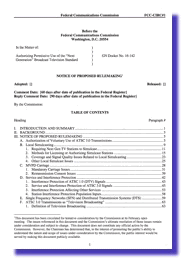
But here are my views on FCC CIRC #1, shown above. This is a draft NPRM "Authorizing Permissive Use of the 'Next Generation' Broadcast Television Standard" called ATSC 3.0. Readers of this blog know that there is no greater supporter of Section 7 of the Communications Act which deals with new technology. Thus it is amusing to note that even though NAB explicitly raised the issue of Section 7 on p. 1 of its petition:
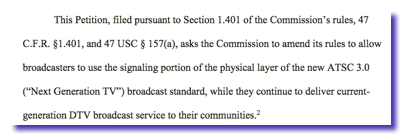
that he draft NPRM actually never mentions the Section 7! Did the FCC staff that drafted it not notice that Chmn. Pai's very first speech as a commissioner dealt explicitly with the Commissioner's failure to use this law signed by Pres. Reagan 30+ years ago? In that speech, then Comm. Pai said:

So since NAB raised it, why doesn't the NPRM deal with the Section 7 issue?
(Perhaps NAB is "entitled" as a "professional courtesy" to the same superfast treatment that CTIA received for 5G. FCC staff may be afraid of even citing Section 7 for fear of setting a precedent that less entitled entities might seek to use. Previously FCC set an odd precedent that one is never entitled to Section 7 treatment unless the issue was raised from the very beginning. NAB's, perhaps unintentional, mention of Section 7 may thus be creating problems for the Section 7 deniers on the FCC staff and in certain industries. But isn't Section 7 the "law of the land"?)
Another issue with the present draft is its exclusive focus on the positive aspects of the NAB petition. Unfortunately a transition to ATSC 3.0, like many other spectrum policy transitions, has a transitional period that has some pain for those involved. In the DTV transition this was minimized by giving each broadcast a 2nd channel so they could simulcast on the 2 incompatible technologies. There were originally 82 TV channels. At the time of the DTV transition there were 67. Now there are 49 and it is simply impossible to have full parallel simulcasting in 2 different standards now. So the petitioners and the draft NPRM ask for the requirement that those broadcasters voluntarily turning off their ASTC 1.0 signal to use ATSC 3.0 must maintain coverage by arranging for continuing ATSC 1.0 coverage in their service area on the multiplex streams of a remaining ATSC 1.0 broadcaster. This is feasible because an ATSC 1.0 system broadcasts a 19 Mbps digital stream that can be divided up several ways. Thus if you have a DTV receiver and a physical antenna you may notice channels like 4-1, 4-2, and 4-3. (I have one on my sailboat!) These are 3 different video signals multiplexed together to the same 6 MHz TV channel. (In this case the TV is apparently tuned to "channel 4", but likely a different physical channel number that the TV set learned during initial setup is the physical frequency used for the signal.) Channel 4-1 is the main signal of the TV broadcasters, so in DC and many other cities it is the NBC affiliate. The other 2 are video streams of lesser technical quality, often old analog programming, that the broadcaster makes a little extra money out of. In some cases the other sub channels have novel programming of local interest.
Now para. 11 of the NPRM draft raises this issue a little:
"If the simulcast content will not be identical to the originating station’s primary video programming stream, we ask commenters to explain the reasons for any deviations in content and/or format (HD) versus SD) and the impact of such deviations on television viewers and the regulatory implications."
But the text of the NPRM draft does not discuss what this means. The technical quality of a DTV signal on a consumer's TV set depends greatly on how many bits/s are provided for that signal. By packing multiple network TV signals on a single 19 Mbps ATSC 1.0 signal it is very possible that the bit rate of a given network signal will decline from present practice and hence the signal quality will also decline. For some types of programming this may not be apparent, e.g. talk shows like "Meet the Press". But for more action programming, e.g. James Bond films and football, the degradation will be apparent. This is not discussed at all.
If the remaining ATSC 1.0 stations during the transition previously had multiple subchannels and the channel's moving ATSC 3.0 also had subchannels, will many of those sub channels and their diversity disappear during the transition? Presumably this is part of the question in para. 11, but it isn't clear.
Now depending if you want to believe NAB or not, 80-90% of US households do not have a physical TV antenna and get video programming from MVPDs. This large fraction of US households will see little or no impact from the NPRM. However, NAB claims this MVPD market share is decreasing and is even giving away free antennas to expedite that decrease. The draft doesn't discuss this bifurcation of US households and the varying impact on them.
(Para. 4 explains that MVPD is an abbreviation of "multichannel video programming distributors", but explains it no further. As a public service, here is a Wikipedia link that explains for the non-FCBA members what this specialized term means. We believe that a 49 page NPRM that will affect millions of US households should have room for a sentence or two explaining such jargon.)
The draft asks in para. 71-73 about possibly requiring all future TV receivers to include the new ATSC 3.0 technology. The draft accepts the NAB suggestion:
The Petitioners assert, however, that the Commission should not mandate Next Gen TV tuners in television receivers at this time,but should instead allow the marketplace to dictate the availability of television receivers with a Next Gen TV tuner.
But it does ask questions about a possible consumer receiver mandate under the provisions of the 1962 All Channel Receiver Act. Nowhere in this discussion is there any viewpoint other than "manifest destiny" for new broadcast technology. For example there is no mention of the market place failures for previous NAB boosted technology such as AM stereo or HDRadio. Indeed the market failure of AM stereo was not only in the US, but worldwide under a variety of regulatory policies! In today's fast changing world of digital electronics do such mandates make any sense? This is an issue not in the present draft.
We support the basic idea of this NPRM, but take advantage of this opportunity to urge the Commission to consider the above issues in drafting the final version. We also urge it to clarify how they want to receive feedback on such drafts.
UPDATE
Draft agenda items that are released prior to their adoption now give this statement at the bottom of their first page:
This document has been circulated for tentative consideration by the Commission at its April open meeting. The issues referenced in this document and the Commission’s ultimate resolution of those issues remain under consideration and subject to change. This document does not constitute any official action by the Commission. However, the Chairman has determined that, in the interest of promoting the public’s ability to understand the nature and scope of issues under consideration by the Commission, the public interest would be served by making this document publicly available. The FCC’s ex parte rules apply and presentations are subject to “permit-but-disclose” ex parte rules. See, e.g., 47 C.F.R. §§ 1.1206, 1.1200(a). Participants in this proceeding should familiarize themselves with the Commission’s ex parte rules.
This certainly clarifies what the procedures are.
Oddly, draft items are only released in .txt and .pdf formats while adopted items are relate in both of these as well as .doc format. it is puzzling why final documents have 3 formats and draft only have two. MS Word comes with a free document comparison tool which could be used to see what changes are made in a draft before adoption and compare them with ex parte filings. This can be done with .pdf version, but requires finding the right software tool.
Are 5G Spectrum Deliberations at the Expense of All Other New Technology?
We will be repeating the proven formula that made the United States the world leader in 4G: one, make spectrum available quickly and in sufficient amounts; two, give great flexibility to companies that can use the spectrum in expansive ways; and three, stay out of the way of technological development. We will also balance the needs of various different types of uses in these bands through effective sharing mechanisms; take steps to promote competitive access to this spectrum; and encourage the development of secure networks and technologies from the beginning.
These statements are very admirable. But do they mean that 5G is not only FCC's highest goal but its only new technology goal at present — perhaps other than NAB's pet project of ATSC 3.0?
Is FCC interested in making new spectrum available "quickly and in sufficient amounts" for any other types of spectrum licensees - licensed or unlicensed? If 5G gets absolute priority at FCC on spectrum access, what about others needing spectrum that is not even in conflict with 5G spectrum? Are they entitled to consideration of "spectrum quickly and in sufficient amounts" if the request is noncontroversial? Is FCC spectrum policy productivity so low that only one new technology issue can be discussed at a time?
People may forget that the unlicensed ISM bands made available in Docket 81-413 were widely opposed by incumbents, even the predecessor of CEA now CTA, and had almost no corporate support in the rulemaking is now the basis of BOTH Wi-Fi and Bluetooth. There was some participation of predecessors of today's cellular carriers in Docket 94-124 that created the 60 GHz band that in turn stimulated much of the R&D responsible for #HighBandSpectrum 5G and which is about to be expanded in Docket 14-177. But they were focusing on obscure details and seemed mainly interested in computer-to-computer communications, not anything even vaguely resembling 5G. Reagan had a point when he warned against governments "picking winners and losers": Enabling 5G in a timely way should not be at the expense of slowing down all other new radio technologies not in conflict due to bottlenecks in FCC deliberative processes.
We frankly don't know what the "killer apps" technologies will be 10-20 years from now. In my most megalomaniacal phantasies in the early 1980s when I was working on Docket 81-413 I count not imagine how ubiquitous ISM band uses such as Wi-Fi and Bluetooth might become. Even the pioneers of 802.11, led by NCR which has never sold consumer electronics, thought they were developing a wireless LAN for wireless PC-based cash registers for department stores. Had they approached FCC with such a request in the absence of the Docket 81-413-developed rules I am sure they would have been politely told to go away. (Indeed, in the 1990s, before the commercial availability of Wi-Fi, Kodak approached FCC several times for a special band for downloading pictures from digital cameras to photo printing machines in camera shops and was told to go away. Ultimately Wi-Fi was capable of this functionality.)
This week UK's Ofcom released a bold NOI-like document on fixed service bands. It included the following text:
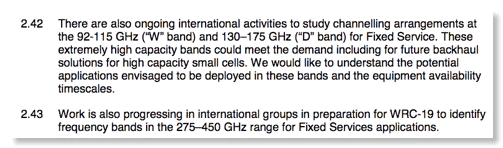
By contrast the FCC 5G proceeding has mentioned twice the possibility of other uses of #HighBandSpectrum:
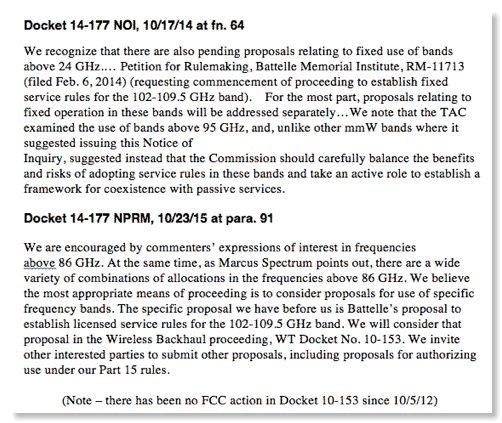
There has been no further action on any uses of spectrum above 95 GHz, let alone above 75 GHz! While Ofcom acknowledges the existence of WRC-19 Agenda Item 1.15 on new allocations in 275-450 GHz, can you find any mention of this on the FCC's voluminous website?
So let's cheer the adoption of the 5G rules this week, but let's also ask whether FCC can now deal with other innovative technologies. Perhaps FCC can even explain how it will implement the provisions of § 7 of the Communications Act? Under the Chevron Doctrine FCC can do that and the courts must give deference, but FCC has given no public guidance on how it deals with new technology in the 30+ years since § 7 was enacted.
All new technologies matter and are entitled to timely consideration.
CTIA & NAB Demand Quick Action on Their New Technologies
While FCC Goes Slow on Everyone Else's!
Broadcasters Push for ATSC Decision By Oct. 1: https://t.co/fGXq4RNQu4
— Broadcasting & Cable (@bcbeat) June 28, 2016
Learn why the @FCC should vote next month to allocate #HighBandSpectrum for #5G innovation https://t.co/Otwc2S3cSX
— CTIA (@CTIA) June 28, 2016
In the above pair of tweets CTIA and NAB demand quick action on their favorite new technologies. NAB even has the chutzpah to invoke Section 7 of the Communications Act - a topic that FCC has tried careful to avoid for 30+ years. As we have written previously, there is even an opinion among FCBA members that trying to invoke Section 7 will result in additional delay!
Mitch Lazarus in his "Wireless Innovation" NOI comments pointed out the chilling effect FCC delays and regulatory uncertainty have on technical innovators. He stated in thiose comments:
The Commission's Rules are based largely on the technologies in place when they were written. New radio-based technologies often fail to satisfy those rules. The more novel an innovation, the lesslikely it is to comply. In consequence, a new wireless technology may need a Commission rulemaking or a waiver before it can reach the market. Technical proceedings in general, including those to authorize new technologies, have been dismayingly slow." (Emphasis added.)
Lazarus gives 11 examples of noncontroversial technologies that dragged on in FCC deliberations for years. He comments
"For a pre-revenue company burning through investors’ cash, having to wait two or three years for the first sales dollar can be a deal-breaker. Some companies give up at the starting line. Others try to go forward, but not all of them make it. One of my clients, dependent on a single product, went out of business waiting for Commission action. Others, though they survive, worry that their product will be leapfrogged by competing technologies and be obsolete on release. Even if all goes well and the product eventually sells, it still has lost considerable time on the market, which nowadays is short enough anyway."
I have elaborated on this issues in my paper at last year's TPRC on FCC's spectrum policy productivity. I concluded in the paper that the these long delays result from BOTH low funding of FCC spectrum policy staffing as well as an FCC organization structure which has not kept up with the explosion of spectrum technology options in parallel with the growing burdens of the APA as its case law expanded.
So while I have no objection to innovation from NAB and CTIA members, even timely action on such innovation, isn't time to treat all innovation in a timely way? Should FCC use the Chevron Doctrine to share with the public what it believes the true meaning of Section 7 is and how it will deal with new technology? While corporate mergers have no such statutory mandate, FCC has clear guidance on how it will deal with them. Why not comparable public guidance on new technology also?
While FCC publicly gloats above "changes to its rules and procedures to improve the timeliness and transparency of the review process for certain applications and petitions for declaratory rulinwith
reportable foreign ownership", should new technology consideration get comparable reforms? Why not streamline new technology also?
There seems to be a consensus now that the unlicensed ISM bands created in 1985 by FCC with a combination of indifference and hostility from spectrum incumbents at the time has had great economic benefits, perhaps adding $140B/year of economic activity. Would today's FCC spend any decision making effort on such a proposal that not only wasn't backed by major trade associations, but was even opposed by several of them?
Todays interest in "Upper Spectrum Band" 5G results from R&D that was greatly stimulated y the rules adopted in Docket 94-124 in the 60 GHz band. CTIA members did not even participate int hat rulemaking, no doubt because it seemed so esoteric at the time. But today they are reaping huge benefits from the R&D it stimulated.
Is it wise for today's FCC to pursue only technology innovation initiatives backed by these major trade associations?
Your thoughts are welcomed in comments
Will FCC Punish NAB for Raising the §7 Issue in Its ATSC 3.0 Petition?
New technologies and services
(a) It shall be the policy of the United States to encourage the provision of new technologies and services to the public. Any person or party (other than the Commission) who opposes a new technology or service proposed to be permitted under this chapter shall have the burden to demonstrate that such proposal is inconsistent with the public interest.
(b) The Commission shall determine whether any new technology or service proposed in a petition or application is in the public interest within one year after such petition or application is filed. If the Commission initiates its own proceeding for a new technology or service, such proceeding shall be completed within 12 months after it is initiated.
Indeed, a prominent communications attorney in private practice told me a few years ago that FCC would punish any party who had the temerity to claim entitlement to timely action for new technology under this provision by delaying any action even more than usual! (As Mitchell Lazarus showed in his comments in the still pending after 7 years "Innovation NOI", Docket 09-157, 2-5 year delays are common even for noncontroversial policy changes for new technology!)
Along the same lines, a senior current 8th Floor staffer told me that mergers at FCC should get higher priority than new technology issues because mergers add more to the US economy! (Note this staffer was not from Comm. Rosenworcel's staff since she believes that FCC's past unlicensed spectrum decisions "contribute $140 billion in economic activity annually".)
Your blogger is not opposed to mergers or FCC merger reviews, just puzzled why merger reviews have a published timetable that is usually met while the provisions of § 7(b) are consistently ignored.
But my unnamed lawyer friend does not represent NAB and its ATSC 3.0 copetitioners. Thus my surprise when I read this introductory section of NAB's ATSC 3.0 Petition for Rulemaking.
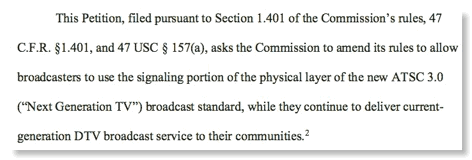
Did NAB touch the "third rail" of FCC policy deliberations: § 7 ? Will FCC punish NAB for claiming Section 7 status?
Actually various senior FCC staffers over the years have said this is not a problem because "everyone knows" that § 7 is just advisory and doesn't mean what its plain language says it means. Well apparently NAB and its copetitioners Association of Public Television Stations, AWARN Alliance, and Consumer Technology Association (former CEA) didn't know that! But if such knowledgeable groups as NAB and CTA were fooled by the apparent plain language of § 7 isn't it reasonable that an "outside the Beltway" startup might also believe what the law appears to state?
Isn't time for FCC to take the Chevron decision precedent and state clearly what it really thinks § 7 means? Clearly a lot of people are confused here. If FCC decides after 30+ years that § 7 needs updating or clarification, it has an annual opportunity to ask Congress for such changes. To my knowledge it never has, preferring to ignore the issue.
Will FCC punish NAB with extra delay for having raised this ugly issue as my unnamed friend predicted? NAB is nowhere as powerful it was two decades ago since CTIA is clearly the alpha male of FCC regulatees these days. (You don't see CTIA raising § 7 issues - they don't have to in order to get their way!)
Broadcasters no longer "alpha male" at FCC
.@youtube: “we reach more 18-49 year olds during primetime than the top 10 TV shows combined” https://t.co/9xjRY3sGQP
— CTIA (@CTIA) May 6, 2016
But acknowledging the § 7 issue in any FCC action on this petition would be very awkward for the § 7 denialists at FCC who redact the section from all paper copies of the Comm Act on 12th St., SW and use the FCC "great firewall" to keep the staff from finding it on WestLaw.
Perhaps FCC insiders can convince NAB et al. to quietly amend their petition and bury this awkward issue?
Europe and Japan March Ahead in Millimeterwaves with their State Capitalism Spectrum Model While FCC Hesitates
We have previously written about the FCC's "War on Millimeterwaves" - the inaction on moving the upper end of spectrum regulation above 95 GHz where it has been since 2003. Why invest in such new technology when you have no idea when FCC will allow market access? There are lots of other new technologies out there, some FCC regulated and others with different types of regulation, where either no government approvals are needed for new technology or where the needed approvals are both timely and transparent. Unless you are a masochist, why limit yourself to FCC-regulated technology and certainly why invest in a technology where there is "no light at the end of the tunnel". FCC's "blind eye" to the statutory requirements of Section 7 of the Communications Act to act in a timely way on "new technology" isn't helping either.
So let's look at what our national economic competitors are doing. The new report shown at the top of this page is from ETSI, the European Telecommunications Standards Institute. While this might sound like ANSI, its US counterpart, ETSI is really very different in that Europe's telecom regulators are key members and CEPT, the organization of Europe's "FCC's" had a key role in starting it. Also note that in Europe national and EU regulations often permit the use of equipment meeting ETSI standards, e.g. GSM and DECT, and forbid alternative technologies such as those developed and sold in the US.
In this document Europe Inc is making a roadmap for millimeter wave technology and it is clear that the same Europe Inc. is subsidizing the R&D of this technology. Here is part of the discussion of what this technology can be used for:
A variety of wireline as well as wireless technologies are available to build transmission infrastructures and usually a mixed environment of physical media is adopted. While optical fibre is perceived as the physical medium with the top performance, there are techno-economic factors that make installation or even extension of optical fibre network not always the most appropriate solution. Hence, wireless technologies represent today a significant or even a dominant percentage of various operators' transmission networks to serve efficiently the increasing upward trend for providing data-hungry applications.
While microwave solutions at traditional bands are more or less employed by all kinds of service providers (mobile, fixed), it becomes clear that moving to millimetre wave frequency bands, where underutilized massive bandwidth is available, will assist to deliver transmission services of equal to optical fibre performance avoiding the constraints that the latter might impose at particular scenarios. In this sense, millimetre wave frequency bands can be used in an immense number of current and future high-speed wireless transmission applications.
While FCC Docket 14-177 deals with mobile applications above 24 GHz, the NOI seems to go out of its way to deal only with mobile uplinks and downlinks issues, even though now mobile systems will need lots of infrastructure and backbone, much of which is a target for mmWaves. In any case, while UK's Ofcom has been much faster than FCC on its counterpart of 14-177, the FCC next action is still a few months away.
This week we have news from Japan on Fujitsu's development of a new 300 GHz receiver, shown below:
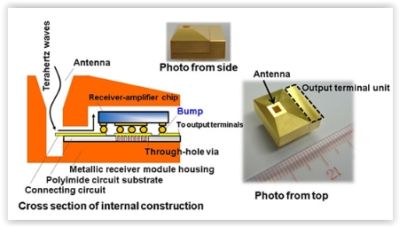
Note this section from the linked Fujitsu news release:
A portion of these research results were obtained through "R&D Program on Multi-tens Gigabit Wireless Communication Technology at Subterahertz Frequencies," a research program commissioned by Japan's Ministry of Internal Affairs and Communications as part of its "Research and Development Project for Expansion of Radio Spectrum Resources."
Yes, Japan, Inc. is partially funding this R&D through the very same agency that is FCC's Japanese counterpart! Now do you think Fujitsu is losing sleep about regulatory delay when it is ready to market this technology?
Such state capitalism is not the US system and should not be the US system. But in highly regulated areas like spectrum how can US entities compete against Europe, Inc. or Japan, Inc.? The answer is increasing transparency of spectra policy as well as its timeliness.
Why is Qualcomm a US company? Qualcomm was incorporates in July 1985 a few months after the May 1985 Docket 81-413 decision that permitted general use of sported spectrum in 3 unlicensed bands. According to cofounder Viterbi this stimulated the capital formation needed to get things rolling and within 2 years Qualcomm got FCC approval for its CDMA cellular technology - unbelievably controversial at the time.
At the end of the Declaration of Independence are the words "we mutually pledge to each other our Lives, our Fortunes, and our sacred Honor.” Qualcomm founders Viterbi and Jacobs may not have pledged their "lives" to get the company founded, but they certainly pledged their "fortunes" and "sacred honor" as 2 major leaders of communications theory and technology at the time. But they were able to get timely and transparent treatment from FCC at that time and a major company now results that contributes to US leadership in telecom technology.
Let's face up to the reality of state capitalism in our economic competitors and see what can be done to "level the playing field". I think speed and transparency for new technology would be a good step. Who knows, maybe even FCC compliance with Section 7 of the Communications Act after these many years might be nice step?
Should FCC Clean Up Its Spectrum Policy Backlog Before Reviewing Another Cable Merger?
Charter Communications expected to acquire Time Warner Cable in $55 billion deal http://t.co/jzM3wSG7NQ
— Washington Post (@washingtonpost) May 25, 2015This weekend word broke on yet another cable merger. We have no view on the merits of this merger, or for that matter on the merits of most mergers. But such mergers compete for scarce attention at FCC as it presently operates and detracts from its other duties such as Title III technical policy issues other than more spectrum below 5 GHz for the cellular industry. Even though the merger has not even been formally filed, Chmn. Wheeler has already issued today a public statement before 8:45 AM promising to review it. At least he did not promise quick action.
But what about the statutory promise of 47 USC 157(b) for timely action on “new technology” deliberations? What about new technology deliberations at FCC that seem to be stalled? For example:
- Wireless Innovation NOI - Docket 09-157 (8/27/09)
- Petition of South Carolina Department of Corrections and 30 other state corrections agencies on jamming cell phones in prisons (7/13/2009) (This was finally included in Docket 13-111 after having been never placed on notice for public comment and that docket is also languishing!)
- FWCC 42 GHz petition (5/9/12)
- Issue of interference from FM broadcast stations to 700 MHz LTE cellular base stations apparently resulting from a conflict between cellular rules and broadcasting rules (Since FCC has never acknowledged this issue, we will give it a date of 2 years ago)
- IEEE-USA petition for a declaratory ruling on whether 7 presumptively applies to technology above 95 GHz where there are presently no FCC rules (7/1/13)
- Battelle petition for Fixed service rules at 102-109.5 GHz (2/6/14)
- NOI on Mobile Service above 24 GHz (10/17/14) - Note that while not much time has elapsed, Ofcom, FCC’s UK counterpart has already issued two documents on this issue as well as a consultant’s findings since the issuance of this NOI! This is cutting edge technology moving quickly with government funding in many other countries, but uncertainties with FCC’s position are deterring private capital formation in USA in this technology.
- (While we can’t attach a date to it, the FCC’s continuing silence on all matter associated with spectrum for UAV’s/drones just drones on as the general issue of civil drones attracts ever growing attention. While there appears to be a dialogue between FAA and FCC on the issue, there is no statement on where drones may or may not use spectrum or any proposals.
Perhaps FCC has a valid viewpoint with its secret interpretation of the Communications Act that Section 5(c) trumps the Section 7 requirement on timely action for new technology. But if this is so, perhaps the Commission should tell Congress and the public that Section 7’s promise is now moot and you should expect dilatory action on everything except corporate mergers and more spectrum for cellular carriers?
In preparing for a talk this week, I was reviewing a video placed on YouTube by MobileFuture, a lobbying group representing many cellular interests. I noticed this predicted outcome of not giving cellular interests all the spectrum they want:

The irony is that the Commission’s current paralysis on more spectrum for cellular carriers and corporate mergers, not to mention partisan feuding over net neutrality, has resulted in chilling innovation for other wireless technologies not of immediate interest to the cellular industry, even backhaul technologies such as in the FWCC and Battelle petitions! As our national competitors subsidize R&D for these technologies, the US risks losing technological leadership unless FCC gives some signals to the private sector. (See p. 8-14 of NYU WIRELESS Docket 14-177 Comments)
So a modest proposal: no action on the new merger request until FCC makes real progress on cleaning up its Title III backlog.
We could point out that while FCC has made a promise on timeliness on corporate mergers, the statutory promise of Section 7 would seem to take precedence unless FCC wants to put its cards on the table and publish its secret ruling about why Section 5(c) makes that moot.
Fox News Rants on "War on Christmas" While FCC "War on Millimeter Waves" Continues

Today, in time for the holiday season, The Washington Post reports that Bill O’Reilly is back to his ranting on the “war on Christmas”. Something that is not obvious as holiday decorations are going up everywhere and holiday music is becoming ubiquitous.
But also today I got from a client an FCC rejection of a millimeter wave experimental application that had the attached explanation:
“You are advised that the Commission is unable to grant your application for the facilities requested. We have received an objection to your application from NSF. If you still wish to pursue this testing, you should exclude the passive band (X - Y) GHz on your application to further discuss your request prior to refilling.” (We are not giving the exact band here to protect the privacy of the applicant)”
This action is a natural consequence of the bizarre revision of § 5.85(a) in the Report and Order of Docket 10-236 on January 31, 2013 that apparently was a clerical error! A timely Petition for Reconsideration as filed by your blogger and received support from several parties, including Boeing - a real Fortune 500 corporation with a real lawyer representing them! Since then - NOTHING! Except of course, today’s rejection of the client’s application. (Your blogger was not involved in the filing, so this rejection is actually income generating, so thanks FCC in a way!)
The § 5.85(a) problem is only one part of the FCC’s 3 prong “war on millimeterwaves”. As described here previously, the other 2 prongs are:
- The inaction on the 7/1/13 IEEE-USA petition seeking to to declare technology above 95 GHz to be presumptively “new technology” in the context of 47 USC 157 and therefore entitled to timely consideration with the burden of proof on those opposed to such new technology
- The failure of the RF safety NPRM, Docket 13-84, to propose quantitative safety standards above 100 GHz even though it is based on an IEEE standard that goes to 300 GHz.
While one might argue that the NOI in Docket 14-177 is a major change in the “war on millimeter waves”, a careful reading shows that the authors tried very hard to limit the coverage to both 24-86 GHz only as well as to mobile only, although there is passing mention of cellular backhaul.
So while the “war on Christmas” exists only in the minds of a few people at Fox News, the “war on millimeter waves is quite real at FCC!
Chmn. Wheeler, Tear Down This 95 GHz Wall!

On October 17, FCC will consider a millimeter wave (mmW) NOI that will be the first major mmW deliberation there in more than a decade. mmW is sometimes called the “spectrum frontier” and is the upper end of radio spectrum that is enabled by breakthrough technology. Indeed, a major motivation for the NOI is that the work of Ted Rappaport of NYU and others has shown that mobile use above 24 GHz is practical.
(Your blogger recalls that in the early 1980s when Motorola was pushing for more Part 90 sharing of UHF TV spectrum - an action that indirectly resulted in DTV due to an NAB backlash - Motorola and others claimed land mobile above 1 GHz was physically impossible!)
Description of 10/17 NOI from FCC Tentative Agenda
Due to military R&D, US firms are the leaders in basic mmW technology, but commercial mmW applications lag in part due to outdated FCC policies and the general procedure of FCC to wait for petitions its in inbox. Does FCC really think that it is easy to raise capital for moving technology from IEEE journals to the marketplace win part of the process is getting FCC to act on a rulemaking to permit the new technology? As part of my teaching last year, I asked 3 prominent communications attorneys in DC how long they thought it would take for FCC to act on approving a new technology using the verging spectrum above 95 GHz. The answers were all in the 3-5 year range!
This is not how we facilitate US technological competitiveness and economic growth. The roots of Wi-Fi and Bluetooth was a policy of FCC Chairman Ferris, later supported by Chairman Fowler, that FCC should identify promising technologies held back by anachronistic FCC policies and modify those policies to allow the technologies - with due deference to others who might be adversely affected - but not to require the new technologies. Indeed, Qualcomm cofounder Andrew Viterbi has said that the May 1985 FCC spread spectrum decision was important in enabling the final capital formation for the incorporation of Qualcomm 3 months later as it showed real FCC interest in CDMA which was then opposed by most mainstream industry players. (Cofounder Irwin Jacobs and the current Qualcomm management differ on this point and some others about the early company history.)

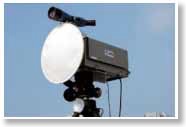
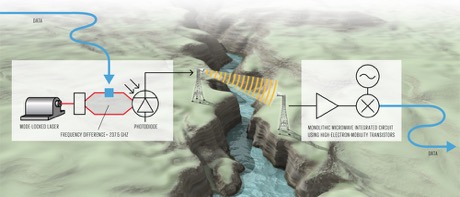
Above is a diagram of a German 237 GHz System exceeding 100 Gbits/s. Not only is its sale and use illegal in USA, but such an experiment probably could not have even been authorized due to the recent glitch in §5.85(a) that came about in the Report and Order of Docket 10-236 that for the first time forbids all experiments in passive bands. This change was made without any explanation and without any supporting comments. A timely filed Petition for Reconsideration on this issue has received no objections in more than a year and is supported by others, yet the matter is still unresolved at FCC. (Note, if FCC can not complete the whole reconsideration order on this docket in a timely way, it could at least issue a public notice announcing an interim liberal waiver policy for mmW experiments that impinge on passive bands based on whether there will actually be interference at the place and time of the experiment and NTIA - home of “spectrum sharing is the new normal” - could say that it supports such a policy as all such bands are G/NG shared.)
So here is what we urge FCC to do at the 10/17 meeting:
- Make clear in the NOI that the wall at 95 GHz is not intentional and is not a fundamental barrier to any proposed mmW uses.
- Make clear that despite theTentative Agenda description given above for the NOI that FCC is open to consider all uses of spectrum in the mmW bands, fixed, mobile and others and promises timely consideration of new proposals in order to support US competitiveness in mmW technology
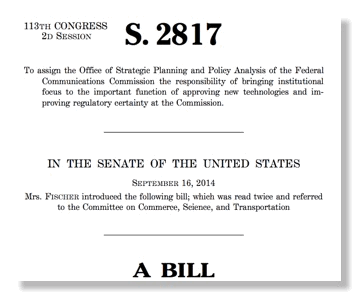
Sen. Fischer Introduces S. 2817 to Urge FCC Compliance with Section 7

Section 7, passed over 30 years ago is brief:
(a) It shall be the policy of the United States to encourage the provision of new technologies and services to the public. Any person or party (other than the Commission) who opposes a new technology or service proposed to be permitted under this chapter shall have the burden to demonstrate that such proposal is inconsistent with the public interest.
(b) The Commission shall determine whether any new technology or service proposed in a petition or application is in the public interest within one year after such petition or application is filed. If the Commission initiates its own proceeding for a new technology or service, such proceeding shall be completed within 12 months after it is initiated.
It basically puts the burden of proof on those who oppose new technology and sets a schedule for deliberations on new technology, FCC has consistently ignored both provisions.
Sen. Fischer’s bill assigns 2 new functions to the FCC Office of Strategic Planning and Policy Analysis
(A) take steps to ensure that the Commission complies with each deadline under subsection (b) (of section 7);
(B) review each regulation proposed by the Commission and analyze the impact of the regulation on innovation, economic growth, andjob creation;
Now in a well functioning agency this congressional tinkering wouldn’t be needed. But there is something in the FCC’s hidebound culture under both parties that has resulted in a 30 year consistent avoidance of Section 7.
Let’s not be naive: a junior senator from the minority party in the Senate without cosponsors is not going to change FCC’s long habit of ignoring this provision of its statute. But maybe she will get more attention than an obscure spectrum blogger! Maybe she can get FCC to explain why it continues to ignore this part of its statute?
Section 7 is not a perfect piece of legislation as presently written. But if FCC doesn’t like it, why hasn’t it proposed any changes in 30 years?
Comments on House Spectrum White Paper

Your blogger filed comments yesterday on the House Energy & Commerce Committee’s spectrum white paper.
The comments focused on FCC and NTIA reforms that might be accomplished with little or no new legislation - a likely necessity given our dysfunctional Congress now. They explained that not only is FCC slow in authorizing even noncontroversial new technology, it is slow in dealing with interference problems of major industries that need rulemaking action to resolve. They raise the hypothesis that FCC implicitly or explicitly tells even powerful regulatees that its spectrum policy resources are limited so they have to choose between getting new spectrum or getting help cleaning up existing spectrum. Shouldn’t FCC be able to do both?
But FCC probably can’t do both as long as it has only one job stream focused on the 8th Floor. Under Section 5 of the Communications Act FCC has great power to delegate authority to employees or boards of employees - as it did with the former Review Board.
The comments also raise the issue of Section 7 of the Communications Act and the 30 yeas that FCC has ignored it.
FCC Process Reform Report
The comments congratulate FCC on its thorough report to improve its procedures and advocated some clarifications and extensions of the recommendations.
Here is a summary of the points made:
- The comments strongly supported the new promise to act in a timely way on petitions but pointed out that this is already a longstanding, but generally ignored, requirement of §1.403. Timely disposition of petitions is key to capital formation for wireless systems that need nonroutine approvals.
- The report recommended grouping questions at the end of NPRMs. The comments suggested the key issues were to group the questions, limit the number to a manageable amount, and actually number them. The report gave examples from Industry Canada and Ofcom “consultations” where a modest number of questions were grouped and numbered.
- The report suggested “continue to engage with other agencies to develop best practices for rulemaking”. The comments endorsed this concepts and suggested it be broadened to include foreign telecom regulators like the above mentioned Ofcom and IC as well as innovative entities like the North Dakota Supreme Court that issues its opinions in hypertext. It pointed out that in the ex parte rulemaking FCC limited its comparison with other agencies to FTC, and that agencies like EPA, NRC, and FAA might be closer to at least FCC’s technical jurisdiction practice.
- The report urged “better tracking of complaint data”. Following previous discussion here of emerging interference, the comments discussed several cases of large delays in handling such issues and suggester more reporting and public interaction on new interference mechanisms to determine which need timely regulatory actions and which can be handled with benign neglect.
- On the recommendation to “increase technical inputs early in rulemaking”, the comments pointed out the previous IEEE-USA recommendations on supplementing the TAC with a paid advisory committee without conflicts of interest, as EPA and NRC have, that can interact on pending policy issues in a timely way - complementing the functions of the TAC. IEEE-USA had recommended that this be a joint FCC/NTIA committee that could serve both agencies and have security clearances to handle classified issues such as GPS interference and susceptibility. It also recommended that both FCC and NTIA budget for support from National Academy of Science’s National Research Council (NAS/NRC), Federally Funded Research and Development Centers (FFRDCs)e.g. MITRE Corp., Rand Corp., and Aerospace Corp., in support of technical policy issues that the in-house staff do not have experience with. This would follow the practices of NRC and EPA with new technical issues.
- Finally it pointed out that even though §7 was passed 30 years ago FCC has no implementing policies and rules. It urged that FCC either adopt such now or tell Congress that §7 needs repeal or modification. (Although it would be odd to take 30 years to figure that out!)
Free the Spectrum >95 GHz!
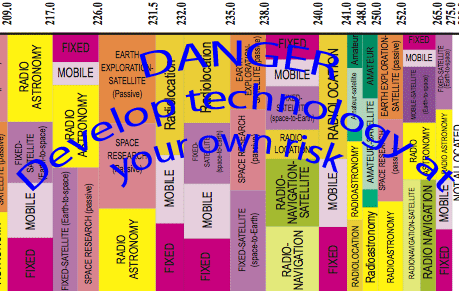
Your blogger’s comments on Docket 13-259, the IEEE-USA petition to FCC asking that technology greater than 95 GHz be declared “new technology” subject to timely consideration under Section 7 of the Communications Act are now posted on the FCC site. As of this writing, also posted as early filings are comments from IEEE 802 and from David Britz, a former research in the area for AT&T.
If you are interested in facilitating the introduction of commercial technology above 95 GHz, presently forbidden by law in the US and facing multiyear case-by-case deliberations, you may wish to consider telling FCC whether you agree with the points made in the above comments. Feel free to disagree on issues. Heck, feel free to say that use of spectrum above 95 GHz is not even in the “public interest” -- if that is what you believe.
Note to those interested in passive uses such as radio astronomy and remote sensing: bands for such uses are already allocated and protected and are not under consideration here for nonpassive use. The issue here is actual access to bands that already have fixed and mobile allocations but have no FCC service rules.
FCC Requests Comment on IEEE-USA >95 GHz Petition
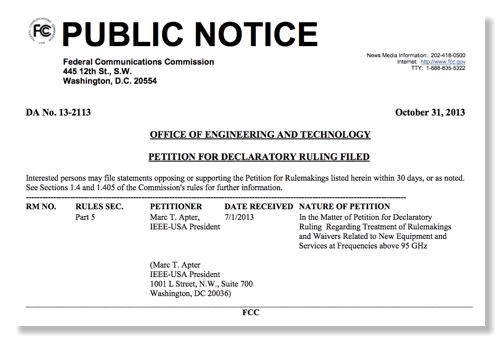
In a Halloween present to your blogger, FCC released the above PN asking for comment on the previously discussed IEEE-USA petition to expedite deliberations on technology >95 GHz in accordance with the terms of Section 7 of the Communications Act.
In an apparent clerical error they omitted either an RM number or a Docket number creating an ambiguity on how to actually file comments. A knowledgeable source says this happens sometimes and is normally corrected in a day or 2.
We look forward to seeing your comments.
vox populi, vox dei
UPDATE
FCC issued an erratum on November 1 and now this issue is docketed as ET Doc. 13-259.
By my calculation, comments are due December 2, 2013.
For those who do not do this often, the link for uploading a comment into this docket is at
http://apps.fcc.gov/ecfs/upload/display?z=e83p0
Convert your comments to .pdf format before uploading to FCC
.
Remember to enter 13-259 in the first entry block labeled
“Proceeding Number:  ”
”
If you need any help, place contact your blogger
Frequencies Above 95 GHz: Why Not Declare that Section 7 Presumably Applies in Order to Stimulate US Innovation and Economic Growth?
135 GHz antenna developed by Singapore
government lab and announced last week
(The fact that this antenna looks so unusual is an
indication that technology at this band is very
different and conventional regulatory thinking
may be inappropriate.)
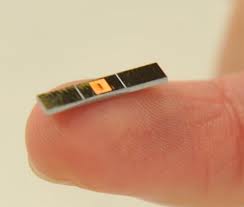
Almost on cue from my 8/25/22 post on moving the upper limit of FCC radio service rules above 95 GHz, RF Globalnet published on 8/28/12 a post entitled “A*STAR's IME Develops Smallest Antenna That Can Increase WiFi Speed By 200 Times”. A*STAR is the Singapore Agency for Science, Technology and Research, the “lead agency for fostering world-class scientific research and talent for a vibrant knowledge-based and innovation-driven Singapore” - somewhat of a combination of the US’ NSF and national laboratories (e.g. Argonne National Lab) in a state capitalism industry model. (Original A*STAR press release)
The RF Globalnet article reported (in Singapore/Commonwealth spelling):
Researchers from A*STAR’s Institute of Microelectronics (IME) have developed the first compact high performance silicon-based cavity-backed slot (CBS) antenna that operates at 135 GHz. The antenna demonstrated 30 times stronger signal transmission over on-chip antennas at 135 GHz. At just 1.6mm x 1.2mm, approximately the size of a sesame seed, it is the smallest silicon-based CBS antenna reported to date for ready integration with active circuits. IME’s innovation will help realise a wireless communication system with very small form factor and almost two-thirds cheaper than a conventional CBS antenna. The antenna, in combination with other millimetre-wave building blocks, can support wireless speed of 20 Gbps – more than 200 times faster than present day Wi-Fi, to allow ultra fast point-to-point access to rich media content, relevant to online learning and entertainment.
So the Japanese have a product prototype at 120 GHz that they used at the Olympics 4 years ago and a Singapore government lab is developing 135 GHz commercial technology. Where do US firms stand? There is some interest among US firms in this area. The US-based IWPC MoGig group includes several US entities such as AT&T and Northrop Grumman. But a rational “due diligence” assessment of regulatory risk by anyone wanting to invest in R&D in these bands would lead to great regulatory uncertainties at present:
- Only experiment licenses are possible with no guarantee of renewal or expectation of protection
- Unlicensed use is impossible
- The legality of equipment sales is questionable
- The time for FCC to respond to a waiver request or a petition for rulemaking to permit a specific product to be sold and used in these bands is in the multiyear range and the need for NTIA coordination (all these bands are G/NG shared) is complicated since there is no public information on federal government uses or requirements in these bands other than radio astronomy and passive sensing
Recall the words of Comm. Pai in his maiden speech at CMU in July:
I’ve met with those in the private sector who decide whether to make investments and to create jobs and have asked what’s holding them back. The principal answer that I have received has been remarkably consistent, and it can be summed up in two words: “regulatory uncertainty.”
Some of the factors that contribute to this uncertainty fall outside of the FCC’s jurisdiction, such as taxes, health care, and financial regulation. But concerns are expressed regarding the FCC in two general ways. The first involves inaction, or delayed action, by the Commission. At first blush, it may seem odd for those in the private sector to be complaining that its regulator is moving too slowly. Entrepreneurs are usually happy to be left alone, free to innovate without government intervention.
But the communications industry often doesn’t fit that stereotype given the FCC’s pervasive role. If a company wants to market a new mobile device, it needs the FCC’s approval. If a company wants to purchase another firm’s spectrum licenses, it needs the FCC’s approval. If a company wants to provide a new wireless service, it needs the FCC’s approval. And if a company finds that there isn’t any spectrum available and proposes the reallocation of inefficiently used spectrum, it needs the FCC’s approval.

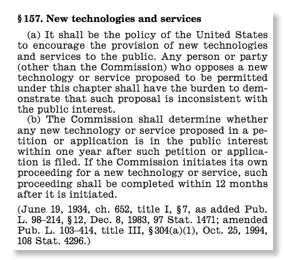
Comm. Pai has the same understanding of Section 7 that I have:
“Looking at that provision, the message from Congress is clear: The Commission should make the deployment of new technologies and new services a priority, resolving any concerns about them within a year.”
It is interesting to read Section 7(a) (47 USC 157(a)) in the light of the FCC/NTIA Section 301/305 dichotomy and in view of the fact that any action in these shared bands de facto requires NTIA concurrence. Without the benefit of any formal legal education, let me state that the policy provisions of Section 7(a) applies to both FCC and NTIA. Further, the requirement that
Any person or party (other than the Commission) who opposes a new technology or service proposed to be permitted under this chapter shall have the burden to demonstrate that such proposal is inconsistent with the public interest.
would indicate that NTIA (and IRAC) is a “person or party other than the Commission” and thus has “burden to demonstrate that such proposal is inconsistent with the public interest”.
But here is a humble suggestion:
Why don’t FCC and NTIA jointly declare that any proposed private sector use of frequencies greater than 95 GHz will be presumptively treated as a “new technology or service” and that FCC and NTIA will both strive to meet the 1 year deadline of section 7(b) and the burden tests of Section 7(a)? Further, why doesn’t FCC use the same “shot clock” for tracking such actions as it already uses for corporate mergers where there is no statutory deadline?
Benefits? Stimulating innovation and economic growth and bringing FCC into compliance with this neglected section of the Act.
Section 7 & Wireless Innovation: IEEE-USA Letter to FCC

The IEEE-USA letter points out that the Commission does have explicit guidelines for review of pending mergers and forbearance petitions pursuant to Section 10(c) of the Act that both give nominal time schedules. However, there is no analogous guidance on Section 7 issues.
The letter also pointed to recent White House initiatives to speed up patent review to expedite innovation:
We believe that FCC might wish to emulate the White House’s recent Startup America initiative “to dramatically increase the prevalence and success of America’s entrepreneurs.” Under part of this program the Patent and Trademark Office (PTO) will offer an Enhanced Examination Timing Control Initiative “to give innovators more control over the application processing and support a more efficient market for innovation.” For wireless innovations subject to non- routine FCC approvals, FCC deliberations determine if and when diffusion, and thus positive cash flow, is possible. In contrast, the improved and more timely PTO decisions only scope the level of intellectual property protection were these cash flows possible. We urge the FCC to examine this PTO initiative and consider offering to entrepreneurs parallel programs to resolve policy deliberations on a faster, more predictable basis.
FCC has a poor track record in responding to this type of suggestion. Let’s hope they are more attentive this time. If others with like views tell Chmn. Genachowski their views, more may happen.
vox populi, vox dei
White House Announces
"Startup America":Maybe a Good Time for FCC to "Rediscover" Section 7 and Start Complying with it?
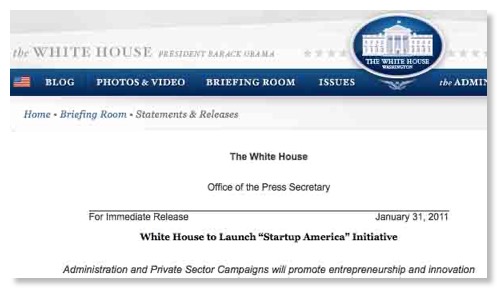
The White House announced today “Startup America”, “a plan for winning the future by out-innovating, out-educating, and out-building the rest of the world.”
President Obama said, “Entrepreneurs embody the promise of America: the belief that if you have a good idea and are willing to work hard and see it through, you can succeed in this country. And in fulfilling this promise, entrepreneurs also play a critical role in expanding our economy and creating jobs. That’s why we're launching Startup America, a national campaign to help win the future by knocking down barriers in the path of men and women in every corner of this country hoping to take a chance, follow a dream, and start a business.”
NTIA’s parent, the Department of Commerce seems fully committed to the program
The Department of Commerce will expand the i6 Challenge to help foster the commercialization of clean technologies, and are finalizing a plan to allow entrepreneurs to request faster review of their patents, an initiative that should lower patent pendency times overall and speed the deployment of new ideas to the marketplace.
No indication whether NTIA will be involved just as there is no indication whether NTIA will follow the President’s earlier guidance that “each agency shall ensure the objectivity of any scientific and technological information and processes used to support the agency's regulatory actions.”
Readers may recall that FCC’s long term apparent disinterest in compliance with Section 7 of the Communications Act of 1934, as amended, has been a recurrent theme here. By contrast, let’s see what Commerce’s Patent and Trademark Office is doing as part of the new program:
U.S. Patent & Trademark Office (USPTO) Gives Applicants Greater Control Over Examination Timing and Enables Fast-Track Examination Within 12 Months: The USPTO is pursuing an Enhanced Examination Timing Control Initiative (Three-track Examination) to give innovators more control over the application processing and support a more efficient market for innovation. Under this initiative, applicants would be able to request prioritized examination (Track I), obtain processing under the current procedure (Track II), or request a delay lasting up to 30 months (Track III). Entrepreneurs who are seeking capital, or accelerated market penetration, may benefit from the prioritized examination offered by the Track I option. In contrast, those entrepreneurs working to commercialize more embryonic ideas may prefer the extended timeframe associated with Track III. Another benefit to entrepreneurs will be shorter overall examination queues.
Section 7 is not a perfect piece of legislation. FCC has never implemented rules for administering it. FCC could ask Congress to amend it or even repeal it rather than just ignoring it. If anything, at present it is false hope for entrepreneurs and may discourage investment in entrepreneurial firms from VCs who get a cynical view of FCC’s treatment of startups in recent years.
But why don’t FCC and NTIA get on the President’s bandwagon and make life easier for wireless startups by promising decisions on some plausible schedule and real use of objective scientific information by NTIA in its presentations to FCC on shared spectrum - limited in public disclosure only by the need to protect properly classified information.


 (Does not include readers using RSS feeds.)


![[Valid RSS]](valid-rss-rogers.png "Validate my RSS feed")


