
Does Cellphone Industry REALLY Pay Attention to Its Unintended Consequences?
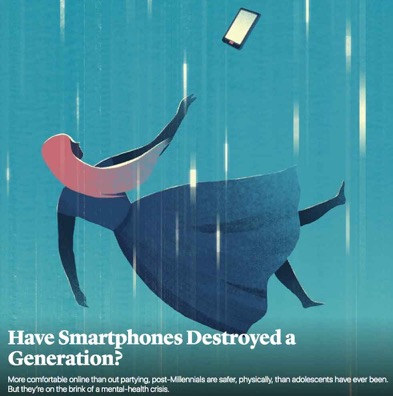
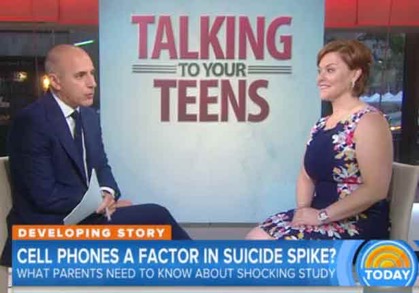
This morning NBC's Today Show had a feature on the possible impact of smartphones on the rising teenage suicide rate. The piece was based on an Atlantic article entitled "Have Smartphones Destroyed a Generation?" which uses the above artwork. Coming the day after FCC adopted and released the Mid-Band NOI with glowing praise for all aspects of the cellular industry this reminds you blogger of a recurring theme here reflected in the title of this post.
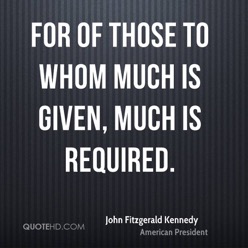
( Based on Luke 12:48)
Yesterday's open FCC meeting shows how well the industry has captured the commissioners' near total attention with their glowing praise for a new inquiry into possibly new "commercial" spectrum bands between 3.7 and 24 GHz. While there was some slight parenthetical mention of unlicensed spectrum needs, NO other spectrum issues were mentioned. Indeed, the FCC's silence on any drone spectrum issue drones on respect drone policy being a key topic in DC for at least 2 years. Chmn. Pai's 2 parenthetical mentions of drones in old tweets appear to be the only statement any commissioner has ever made on the topic! Cellular spectrum is an important issue, but with the industry's urging it seems to have become the almost only spectrum issue that gets any attention at FCC, NTIA, and in Congress. Indeed, the industry's endless appetite for spectrum has resulted in a backlash at NTIA and within IRAC and all requests for sharing of federal spectrum are on a slow track there. Pending legislation on increased sharing/reallocation for cellular use make help that industry's near term problems, but will complicate all otters spectrum sharing as hostility in NTIA and IRAC increase. (The new delay requested by Sen. Cruz on confirming the next NTIA head is not helping!)
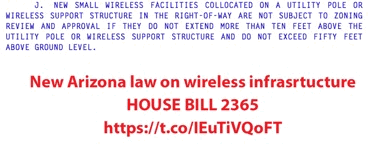
The industry is not only demanding fast track access to new spectrum by dominating the spectrum policy agenda to the near exclusion of all other issues - except perhaps NAB's pet issues on incentive auction costs and ATSC 3.0, it is also demanding both FCC ordering of quick local government consideration of all local approvals of new infrastructure along with a parallel campaign in state legislature to preempt most local government review of most new construction. Below is an example of such a new law in Arizona , although there are signs that similar legislative action is underway in many states.
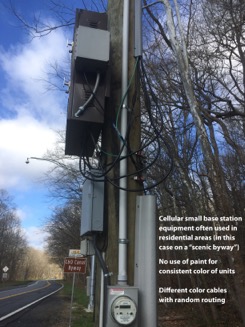
We have previously published posts that give several other areas of unintended consequences in which the industry has paid little attention to the impact of their technology and services. These include:
- Obnoxious use of cellphones in theaters and restaurants
- Contraband cellphones in prisons
- Safety issues of texting & driving
- Silence on drone spectrum issues
- Purchase of prepaid cellphones by the dozen by criminals without any identification
So while we agree that the cellular industry need more spectrum and that infrastructure construction needs more streamlining, the industry should also back off on being the center of attention and being unwilling to compromise with others acting int he public interest to meet its goals. Spectrum policy resources at both FCC and NTIA have been underfunded and will be more so under the 2018 federal budget. The cellular industry, along with most FCC regulatees has been silent on this continued underfunding and even nearly silent on the downsizing and undersizing of FCC spectrum field enforcement. Maybe the cellular industry should pay more attention to issues other than its immediate needs?
So cellular industry if you want to make your industry the center of both FCC and Congressional spectrum policy deliberations and always be first at the well for new spectrum, why don't you pay more attention to the unintended consequences of your industry such as those discussed above to show that you are responsible corporate citizens?
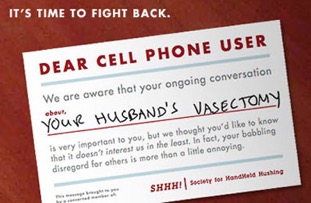
Another Obnoxious Use for Cellphones: Smartphone Use in Movie Theatres

Textual healing
Roger from Great Falls, Va., said that a new year is a good time to remind people not to look at their cellphones during movies. “Taped requests prior to the movie are useless since the offenders already have their faces buried in their screens at the time,” he wrote. “A crowded theater looks like a flock of fireflies just from the LED lights, as emails are checked throughout the movie.”
Sure, Roger, I’ll mention it, but I don’t think it will do much good.
I’ve written about this in the past. Back then, I didn’t think theaters were quick enough to add admonitions against cellphones before the movie started. To their credit, they finally did. Then there was a period when people seemed to sort of get that it was rude to text during a movie.
But now we’ve emerged out the other end, into a time when cellphones are so ubiquitous that half the people who look at them during movies probably aren’t even aware of it. People don’t stop texting when they’re hurtling down the interstate. Why would they stop when in a movie theater?
Roger wrote: “I’d bet that a theater that can block signals would be a big draw. Heck I’d pay a premium for that. In the meantime it looks like Redbox is the only option.”
Theater owners hate to hear that. But they don’t seem willing to invest in the bodies that would stop texting, like an usher at the back of each auditorium looking for cellphone scofflaws.
My only suggestion is to patronize theaters unlikely to attract texters. I think I’ve seen a cellphone out at the AFI Silver only once. The Landmark cinemas on E Street and in Bethesda are great because their auditoriums are underground, unable to be penetrated by cellphone signals.
Of course, they tend to show small, independent films, so if you want to see a blockbuster you may have to sit in the front row, where you’re sure to have only one glowing screen in front of you.
Of course, this is not the first time this problem has been recognized in the blogosphere: National Review, Screen Rant, Today Show. There is even a post in the Houston Press blog advocating more cell phone use in theaters - another reason not to move to Ted Cruz ’s and Rick Perry’s Texas where the theatre patron next to you may well also be armed.
While the cellular industry demands the focused attention of the spectrum policy community on their ever growing spectrum needs, where do they stand on this issue? I can find nothing relevant on CTIA’s voluminous website. Indeed, the industry is silent on many unintended impacts of their technology except to occasionally deny them.
But why can’t the cell industry both ask for more spectrum and try to clean up some of the problems it has created? Maybe the solution is technical, maybe it is better user education, but why not at least try and heed the advice of the Don Norman report?
Jammer Enforcement Actions at FCC
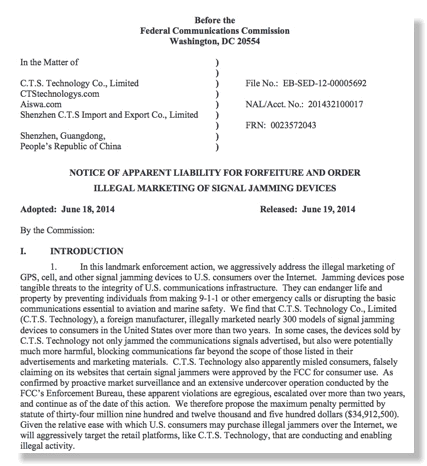
In the above “landmark enforcement action” FCC issued a Notice of Apparent Liability(NAL), i.e. a fine, against a Chinese jammer company for marketing in the US by way of Internet and some unidentified shipping mechanism, “285 different models” of jammers targeted at cellphones, GPS, Wi-Fi, Bluetooth, etc. The amount of the proposed fine is $34,912,500! However, none of this goes to FCC and it is unlikely that any of it will ever be paid in any case.
Lest you think this is the only Chinese company doing this, your blogger has received dozens of e-mail ads for such devices from a different firm and has routinely forwarded them to FCC/EB. So clearly C.T.S. Technology is not the only offender.
Para. 5 of the new NAL states
“We also again warn U.S. consumers that importing a cell, GPS, or other signal jammingdevice (i.e., purchasing such a device online and having it shipped into the United States via the U.S. mail or other transport or courier service) is unlawful and may subject them to civil and criminal penalties.”
This is followed by a citation to fn. 4 which cites 18 U.S.C. § 1362 and 18 U.S.C. § 1367(a) as well as the 2010 Phonejammer.com FCC NAL. The only problem is that the 2 cited laws have nothing to do with ordering jammers - they deal with actually jamming a federal communications system or a communications satellite - something unlikely with the jammers involved here, but remotely possible. (The cited Phonejammer also has nothing to do with ordering jammers.) So was this section of the NAL sloppy legal work in EB or is there a legal ambiguity under present statutes on the issue of importing jammers for personal use? It is clear that § 333 forbids actual jamming of licensed/authorized transmitters:
No person shall willfully or maliciously interfere with or cause interference to any radio communications of any station licensed or authorized by or under this chapter or operated by the United States Government.
The cellular industry prefers to read § 333 as forbidding FCC from ever authorizing any jamming, even in remote prisons. Thus they were successful in stopping FCC from even asking for public comment on the GTL petition on both jamming and “managed access” - notwithstanding the § 1.403 requirement to issue “promptly” a PN asking for comments on such petitions. They even managed to get FCC to draft the Docket 13-111 NPRM to exclude any discussion about what is the scope of § 333 even though this rulemaking is partially responsive to the GTL petition.
The cellular establishment is betting that its interpretation of § 333 will be able to drive all jammers from US territory. However, as we have stated repeatedly, there is a demand for jammers that arises from perceptions of antisocial use of communications. While there are some possible uses of jammers that are beneficial financially to the perpetrator of such use, (e.g. a hotel owner jamming cellphone to force use of expensive hotel room calling services), in practice such use is very rare. Most cellular jamming and GPS jamming is in response to perceptions of antisocial behavior or invasions of privacy. Until the cellphone and GPS industry address those perceptions about the harmony of using their products and the impact on others there will always be consumer demand for jammers. Discussing nonexistent laws that ban consumer ordering of jammers, as in para. 5 of the NAL, or banning all prison jamming use under a specious interpretation of § 333 may feel good to the cellular industry, but are doomed to be ineffective.
Hopefully this NAL might spur Customs and Border Protection to try harder to intercept jammers on their way to the US and might spur carriers like FedEx to ask more questions from shippers like C.T.S. Technology.
UPDATE
Our friends at CommLawBlog, who actually are lawyers when not blogging, also have questioned the legal basis of this NAL stating:
We also can’t help questioning the extent to which C.T.S. actually violated the law.
True, it shipped ten devices to U.S. addresses, but it performed its acts in China, where it may be perfectly legal to ship jammers to U.S. addresses. One unquestionably unlawful step in the transaction was the importation of the ten devices – but FCC staffers, not C.T.S., did that by initiating the transactions and accepting delivery.
Penalizing C.T.S. for the 275 models that it advertised but did not ship to the U.S. is even more tenuous. There is only one Internet; a company cannot easily promote its products on line in some parts of the world but not others. The FCC’s best arguments are probably that (a) some of the advertised products jam wireless frequencies used only in the United States and (b) the company quotes prices in U.S. dollars. True, C.T.S. could refuse to fill U.S. orders and could display a notice on its website stating that policy. But the failure to have the policy and to display the notice may not add up to an actionable violation.
To be clear: C.T.S.’s jammers are disruptive and potentially dangerous. We agree with the FCC that they have no place in the United States. We fully support the FCC’s efforts to keep them out of the country. We just wish the FCC could manage it from a more secure legal platform.
So if the goal is to actually stop the sale and use of such jammers in the USA, not just to posture to the cellular industry, perhaps some more pragmatic actions are needed.
Cell Industry Finally Acts on Smartphone Theft Prevention
Each device manufacturer and operating system signatory of Part I of this "Smartphone Anti-Theft Voluntary Commitment" agrees that new models of smartphones first manufactured after July 2015 for retail sale in the United States will offer, at no cost to consumers, a baseline anti-theft tool that is preloaded or downloadable on wireless smartphones that provides the connected capability to:
- Remote wipe the authorized user's data (i.e., erase personal info that is added after purchase such as contacts, photos, emails, etc.) that is on the smartphone in the event it is lost or stolen.
- Render the smartphone inoperable to an unauthorized user (e.g., locking the smartphone so it cannot be used without a password or PIN), except in accordance with FCC rules for 911 emergency communications, and if available, emergency numbers programmed by the authorized user (e.g., "phone home").
- Prevent reactivation without authorized user's permission (including unauthorized factory reset attempts) to the extent technologically feasible (e.g., locking the smartphone as in 2 above).
- Reverse the inoperability if the smartphone is recovered by the authorized user and restore user data on the smartphone to the extent feasible (e.g., restored from the cloud).
In addition to this baseline anti-theft tool, consumers may use other technological solutions, if available for their smartphones.
CNET reported that New York Attorney General Eric Schneiderman and San Francisco District Attorney George Gascon have concerns about the new CTIA announcement:
"While CTIA's decision to respond to our call for action by announcing a new voluntary commitment to make theft-deterrent features available on smartphones is a welcome step forward, it falls short of what is needed to effectively end the epidemic of smartphone theft. We strongly urge CTIA and its members to make their antitheft features enabled by default on all devices, rather than relying on consumers to opt-in."
(Note to CTIA: CNET is owned by CBS so you might want to boycott them because they agree with San Francisco on this issue.)
But this announce is a good step forward to improving the safety of smartphone users. Even if not all users opt-in, “herd immunity” would apply if the vast majority of users activate the feature. However since there are indications the the electronic serial numbers of many cell phone models are presently changeable as an “undocumented feature”, this will only apply if the new system is robust in the face of tinkering by overseas nerds who stand to make >$100/stolen phone if they can reactivate the phone for sale in their country.
Cellphones on Airplanes: Round 2
§ 22.925 Prohibition on airborne operation of cellular telephones.
Cellular telephones installed in or carried aboard airplanes, balloons or any other type of aircraft must not be operated while such aircraft are airborne (not touching the ground). When any aircraft leaves the ground, all cellular telephones on board that aircraft must be turned off. The following notice must be posted on or near each cellular telephone installed in any aircraft:
“The use of cellular telephones while this aircraft is airborne is prohibited by FCC rules, and the violation of this rule could result in suspension of service and/or a fine. The use of cellular telephones while this aircraft is on the ground is subject to FAA regulations.”

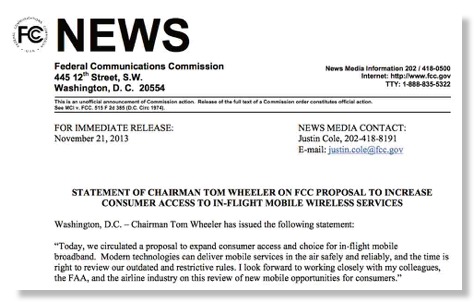
Yesterday, 11/22, the NY Times reported that Chmn. Wheeler is clarifying his views on the cellphone on airplane proposal that he had announced the previous day. Here is the full statement:
“Yesterday we announced a Federal Communications Commission (FCC) proposal that recognizes that there is no technical reason to prohibit mobile devices from interfacing with the onboard wireless data systems being installed on many aircraft. If the Commission adopts this proposal after the public has had the opportunity to comment it will be only a technical advisory, an update to our rules. There is nothing in the proposal that prohibits airlines from developing whatever in-flight phone usage policy they may wish.
“The job of the FCC with respect to this issue is limited to issues related to communications technology. Technology is available and being deployed today on flights outside the United States that permits use of mobile devices on planes without causing interference to cell phone networks on the ground. These advances in technology likely no longer warrant – on a technological basis – the prohibition of in-flight phone use with the appropriate on-board equipment.
“We understand that many passengers would prefer that voice calls not be made on airplanes. I feel that way myself. Ultimately, if the FCC adopts the proposal in the coming months, it will be airlines’ decisions, in consultation with their customers, as to whether to permit voice calls while airborne. The European Union has had a similar policy since 2008. That experience has demonstrated that it is possible to adjust the on-board communications equipment not to handle voice traffic, thus effectively shutting down any calls.
“We believe that airlines are best positioned to make such decisions. For this reason, our proposal does not impose any requirement that airlines should provide voice connectivity. We encourage airlines, pilots, flight attendants, and the public to engage in our upcoming rulemaking process.”
In order to add some facts to this discussion, we have place at the top of this post the actual present FCC rule which probably goes back to the beginning of cellular in the early 1980s. Note that it forbids the use of cellphones “aboard airplanes, balloons or any other type of aircraft” thus it is not focused on protecting the aircraft’s avionics which was the rationale for the FAA’s Kindle ban that was reversed recently.
While cellphones worked on aircraft on 9/11, use of basic cellphone technology from a high altitude, be is an airliner, a Piper Cub, or a balloon creates real problems for the terrestrial cellular system and this was the rationale for the original rule. At altitude such a phone illuminates many cell base station, either causing interference in many cells or tying up extra spectrum assets. However, today we have new technical options as Chmn. Wheeler alludes to: very low power picocells or femtocells can provide service to cellphones on the plane on standard cellular spectrum. Today’s cellphones, unlike the first generation, have a very complex transmitter power control system under the control of the base station the phone is communicating with. With the resulting use of very low power by both the consumer cellphones and the plane’s picocell or femtocell there is no impact on the terrestrial system and hence the original rule is not needed and could be replaced with a complex rule that stipulates how much power can be used and under what circumstances. (Note - the communications between the picocell/femtocell and the ground must be done on a noncellular frequency such as the longstanding “Airfone” spectrum or a satellite system.)
In the FCC Blog, Roger Sherman, Acting Chief, Wireless Telecommunications Bureau states
As the expert agency on communications, it is the FCC’s role to examine how we regulate the industry, and address unnecessary regulations when possible. In this case we have an outdated rule on our books that has been overtaken by advances in technology. If the technological justification for our existing prohibition is no longer valid, then it is our responsibility to examine ways to update and modernize the rules through an open and transparent rulemaking process.
I fully agree with this general concept.

The technical rationale for §22.925 no longer exists as Chmn. Wheeler stated and as I discussed above. BUT this is not the only technology that is forbidden by an anachronistic FCC rule. Why should this be an immediate priority? There appear to be no petitions requesting this change, while there are other technical petitions in FCC’s petition black hole that have sat without action for literally years. Indeed, it is hard to find anyone even advocating this change!
As I have discussed in the context of the history of Wi-Fi, that ubiquitous system came about from a directive from Chmn. Ferris to actively search for technologies being held back by anachronistic restrictions and to “free” those technologies so they could sink or swim in the marketplace on their own merits.
Now the marketplace for Wi-Fi technology is very different than the marketplace for cellphones on airplanes. Especially after the recently approved American/USAir merger there are fewer and fewer airlines these days and they are desperately searching for ways to extract more fees from passengers.
I strongly support the Commission searching for anachronistic technical restrictions and freeing technology to serve the public. That is what brought us Wi-Fi and that is what brought us the new WiGig 60 GHz technology for wireless connections of video in the home. But the FCC clearly has limited resources and the next year’s deliberations on the incentive auction and the transitions from analog telephony will be very time consuming for FCC leadership and staff. Shouldn’t FCC consider a wide variety of obsolescent regulations for review and prioritize them according to factors such as long term benefit to society and the economy?
If they can’t think of anything else more productive than cellphones on airplanes, they might want to start with ending the current prohibition on all nonexperimental spectrum use above 95 GHz.
Cellphones on Airplanes:
Here We Go Again!
As the Commission approaches 2014 with urgent and critical decisions on IP replacing analog telephony and the incentive auction, it is puzzling that it suddenly want to consider the res judicata issue of cell phone use on airplanes. (Note this is not literally cellphone use on airplanes since use of a full power cellphone at high altitude hits many different cells and ties up significant cellular capacity. The system talked about is the system now used in Europe with essentially a low power femtocell on the aircraft that is connected to the ground via satellite or a noncellular air-to-ground frequency.)
Because the Commission considered this very issue in Docket 04-435, 9 short years ago. Officially, that docket was terminated without a decision because
But a quick review of the record shows that 8,123 (!!!) comments were filed (a large number for EMC issues) and most of them they deal with other than electromagnetic interference issues. Here is a typical comment filed:“(t)he comments filed in response to the NPRM provide insufficient technical information on whether the use of cellular phones onboard aircraft may cause harmful interference to terrestrial networks.”
The AP article on the FCC’s rejection of the proposal was clearI heard on the radio that the FCC is considering allowing cell phone usage on planes. I most urgently beg you NOT TO DO THIS, in the interests of public safety.
If the cellular industry want to have more cellphone use in places where it presently is missing, you blogger humbly suggests they do something about making such use LESS OBNOXIOUS as was made clear in the comments 9 years ago. Here is some guidance from the manual of a cell phone sold in Japan. Even see this in a US cellphone manual or advertising from a US carrier?Striking a blow for cell phone haters everywhere, a government agency on Tuesday said it will keep a rule in place that requires the divisive devices to be turned off during airline flights.The reasoning behind the decision was technical. But the avalanche of comments the Federal Communications Commission has logged from airline travelers have been nothing short of visceral.
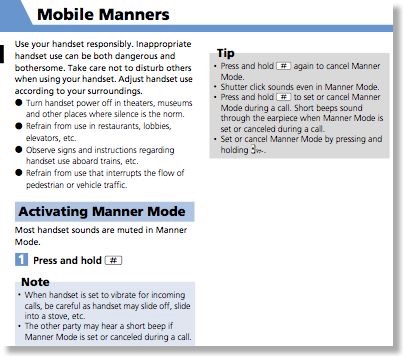
From the manual for a cellphone sold in Japan
We would also urge the industry and proponents of cellphone use in aircraft to review the 2005 study Motorola commissioned study by Don Norman on “Minimizing the annoyance of the mobile phone: The Annoyance, Irritation, and Frustration of The Mobile Phone -- A Design Challenge” and seriously consider Mr. Norman’s recommendations that seem to have been ignored so far.
Cellular technology can add a lot to our society and economy but when poorly designed and promoted it can also contribute to both antisocial use and social friction. The social friction resulting from much current cellphone use, we believe, was the cause of the Docket 04-435 backlash and will continue to be the case unless industry starts addressing it as Japanese industry has.
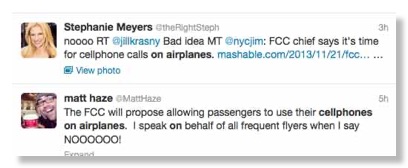
Initial Twitter response
Tip O’Neill, mentor of Chmn. Ferris, famously said “all politics is local”. This is why this initiative is doomed unless the industry “wakes up and smells the coffee”.
Doesn’t the industry ever wonder why people want to jam their product? Let me give them a hint: hotels might have a financial incentive to jam cellphones to get guests to use overprice phones in their rooms. But this is not a problem in practice. Illegal jamming by private parties is generally addressing obnoxious or unsafe uses of cellphones.
Cecilia Kang reports in the Washington Post, “FCC sees backlash after proposing to allow in-flight cellphone calls on planes”, that there is someone who actually likes this proposal.
Visit NBCNews.com for breaking news, world news, and news about the economy
UPDATE
If you want an alternative viewpoint, here is “The FCC should get out of the way of cellphones on planes” by Stephen Stromberg, an oped from the Washington Post
I contacted CTIA and asked if they had a statement on the issue, the response was “We do not have a statement.”
UPDATE
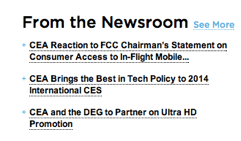
“CEA Reaction to FCC Chairman’s Statement on Consumer Access to In-Flight Mobile Wireless Services” is now available on the CEA website. In it Julie Kearney, vice president of regulatory affairs and Doug Johnson, vice president of technology policy of the Consumer Electronics Association (CEA)®, are quoted as saying:
“Of course, any liberalization of the use of wireless devices on airplanes should not negate general common courtesies. Engaging in phone conversations in flight may prove technically feasible but many may find it socially undesirable…CEA has always held this view and urges airlines to exercise good judgment. All stakeholders should work together to ensure that passengers continue to enjoy comfortable air travel, if voice communications are permitted.”
We congratulate CEA on addressing issues that are “socially undesirable” and hope that the mainstream cellular industry also addresses the social implications of today’s cellular use.
Also to be perfectly objective, the Washington Post on 11/24 published an editorial entitled “The FCC makes the right call on cellphones on planes”. The Post writes
“The immediate impact of the FCC ridding the country of its unnecessary rule, then, may well be small. Yet we hope that carriers explore their options to bring air travel into the 21st century, with all its pluses and minuses. While some passengers mourn the disappearance of their last disconnected refuge, others will embrace the convenience of connection. Either way, there’s no reason for the government to play referee.”
The Societal Cost of Unrestricted Sale of Burner Phones
However, if at the same Walmart you want to buy Sudafed you will find that the law allows for the sale of pseudoephedrine only from locked cabinets or behind the counter. The law also:
- limits the monthly amount any individual could purchase
- requires individuals to present photo identification to purchase such medications
- requires retailers to keep personal information about these customers for at least two years after the purchase of these medicines.
As we wrote last month, CVS is voluntarily beginning to limit - not forbid - sales of nail polish remover because the acetone in it is also key to the crystal meth production process. However there is no sign that they are limiting sales of “burner” phones.
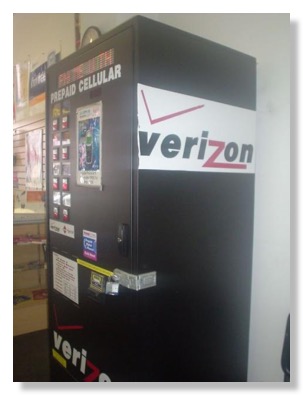
In its reply comments to Docket 13-111 on wireless devices in prisons, Verizon Wireless commented on “brier” phone restriction issue. This is the first time we are aware that CTIA or any of its major members has publicly addressed the feasibility of restricting sales of “burner” phones. VZW told FCC:
One commenter suggested that the Commission consider placing requirements on the type of information and the validity of information carriers obtain in providing service to customers purchasing prepaid devices. MSS Comments at 13-14. See also Indiana Department of Corrections Comments, GN Docket No. 13-111, filed July 17, 2013 (“Indiana DOC Comments”) at 1 (questioning whether selling such devices to anonymous persons is desirable public policy). While MSS acknowledges the legitimate need of some users, such as battered spouses, to obtain such devices anonymously, it urges the Commission to consider requiring identification validation for at least some purchasers of prepaid devices. Given that such a requirement would necessarily impact users other than contraband device users, this suggestion is beyond the scope of this proceeding and should not be considered in this docket.

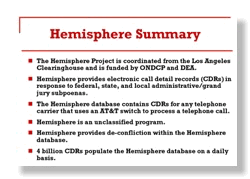
Why does DEA needs such a comprehensive, and no doubt costly system? The article goes on to say:
The Obama administration acknowledged the extraordinary scale of the Hemisphere database and the unusual embedding of AT&T employees in government drug units in three states.But they said the project, which has proved especially useful in finding criminals who discard cellphones frequently to thwart government tracking, employed routine investigative procedures used in criminal cases for decades and posed no novel privacy issues. (Emphasis added.)
Thus because the cellular industry is not willing to consider any compromise to the unrestricted sale of “burner” phones we must live with a large invasion of privacy by DEA and its state and local partners and the potential abuse of this information. It appears that AT&T has even turned this into a new secret, but presumably profitable, product line!
Wouldn’t modest regulations on “burner” phone sales, perhaps similar to the above stated DEA rules on Sudafed sales, be a more reasonable balance of public interests? If there is ever a cell phone triggered IED incident in the US, there will be a large outcry for such regulation and the outcome will not be as moderate and balanced as what would be feasible today in a less frantic atmosphere. We urge the initiation of a deliberate dialogue on this topic to balance all legitimate needs. Do we really need unrestricted sales of bags full of anonymous prepaid “burner” phones?
Nail Polish Remover & Cell Phones
Almost 2 years ago we wrote here, “Isn’t it odd that we are more concerned about over-the-counter sales of Sudafed and Plan B than we are about bagfuls of anonymous cellphones?” While cellphones are generally a product with positive social impact, the special case of anonymous “burner” phones is more questionable.
Sudafed and Plan B are also products with positive social impacts, but government regulators have placed modest limits on their sales in order to limit the negative potential for their use. (Plan B restrictions were basically thrown out in a later court case dealing with the details of FDA’s authority.)
Nail polish remover has a high acetone content and acetone is a key ingredient in making crystal meth. (The main ingredient of Sudafed is also used as a crystal meth ingredient.) So acetone and Sudafed are both “dual use products” with valid societal uses but a real potential for abuse. But so are burner cell phones which remain without any limits on their purchase and use.
For those who never watch TV, burner phones are the communications system of choice for gang members, drug dealers, and incarcerated criminals - not to mention adulterous spouses. Need one or several? Go into Walmart, Best Buy, etc. and buy a bagful or 2 for cash along with prepaid cards for extra time. (You need several to help cover your tracks. Throw them away after a week. That’s why they’re called “burners”.) Internet activation is needed, but heck, you just need the patience to enter fake names and addresses. The carriers don’t care!
Now CVS has decided that without a legal mandate it will take a reasonable step to limit nail polish sales to prevent its diversion to drug manufacture. A CVS spokesman has said,
"Because acetone is an ingredient used in the illegal manufacture of methamphetamine, we recently implemented a policy that a valid ID must be presented to purchase acetone-containing products such as nail polish remover. Our policy also limits the sale of these products in conjunction with other methamphetamine precursors and is based on various regulations requiring retailers to record sales of acetone. We are in the process of implementing this in all stores."
Here are several reports on this action in addition to the Fox DC Channel 5 video at the top:
So thanks to CVS for thinking about the implications of the products they sell. (However, they also sell burner phones and haven’t put any restriction on their sale.)
Maybe someday the cell phone industry will come to grips with the fact that totally unrestricted sale of burner phones is not really in the public interest. The proper solution is complicated by the fact that full documentation of all users may be difficult in some cases, e.g. battered spouses. But unless the industry and regulators start thinking about feasible practical controls the same national security pressure that has President Obama rationalizing the need for “metadata”, will likely result in more draconian action against unrestricted sale of burners.
Jamming Enforcement at FCC Picks Up
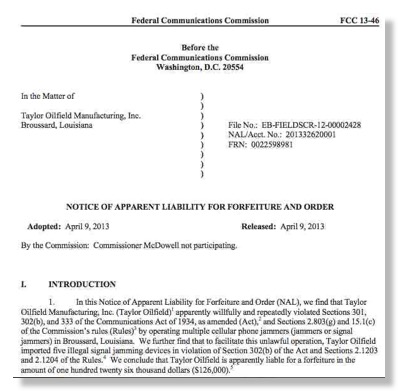
On April 9, FCC approved and released two Notices of Apparent Liability (NAL -- effectively fines) for use of cellular jammers. The one shown above was to Taylor Oilfield Manufacturing, Broussard, Louisiana for $126,000. The other was to The Supply Room, Inc., Oxford, Alabama for $144,000. OUCH!!!
(Now before you sell your stock in these companies your should know that FCC is always in a poor position to collect the full amount of such NALs from anyone able to hire an attorney unless the local US Attorney is really interested in getting fully involved. This can be problematical in many parts of the US.)
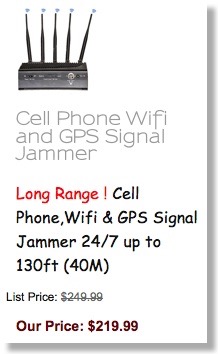
The NALs have the following text
Signal jamming devices operate by transmitting powerful radio signals that overpower,jam, or interfere with authorized communications. While these devices have been marketed withincreasing frequency over the Internet, with limited exception, they have no lawful use in the UnitedStates. (A footnote clarifies that federal agency use is a separate issue.)
Your blogger fully agrees that since FCC has never authorized any jamming, the import and use of such equipment is illegal. However, they also have the following text:
In order to protect the public and preserve unfettered access to emergency and other communications services, the Act generally prohibits the importation, use, marketing, manufacture, and sale of jammers.
This sentence is a more complicated issue and sounds more like CTIA’s interpretation of Section 333, the subject of CTIA’s 2007 petition that FCC has never acted on. (The petition also contained the issue of “cellular boosters” which was addressed and finally resolved in Docket 10-4 a few months ago.)
The issue of what Section 333 of the communications Act really means is also addressed in GTL’s July 2011 petition which is sitting without action in FCC’s petition “black hole”. Thus CTIA has repeatedly stated that Section 333 forbids FCC from even considering authorizing jamming in any context including nonfederal high security prisons. Somehow CTIA and NTIA have concluded this nonobvious reading of Section 333 does not affect NTIA at all. As GTL points out, this ignores the “inconvenient truth” that Section 305 only exempts federal use from Sections 301 and 303 of the Act and also that the analogous terms of 18 USC 1367, dealing with the special case of satellite jamming and passed contemporaneously with Section 333, explicitly excludes jamming by federal agencies while Section 333 is silent on special treatment of federal users.
But there is no question here that the new FCC NALs are consistent with the law.
Why were these 2 small private companies spending money on cellular jammers? Here is some explanation from the texts of the NALs:
The manager also claimed that Taylor Oilfield utilized the jamming devices to prevent its employees from using their cellular phones while working, apparently following a near miss industrial accident that allegedly was partially attributable to employee cell phone use.
The general manager also confirmed that Supply Room utilized the jamming devices to prevent its employees from using their cellular phones while working.
This is typical of the cellular industry’s lack of attention to the unintended consequences of its technology, In 2005 (the then existing) Motorola commissioned a study by Don Norman on “Minimizing the annoyance of the mobile phone: The Annoyance, Irritation, and Frustration of The Mobile Phone -- A Design Challenge”. Unfortunately today’s cellular industry doesn’t seem too interested in such issues. They do not view them as a “design challenge” rather as legal issues that must be acted on to help their industry.
From Comm Law Blog
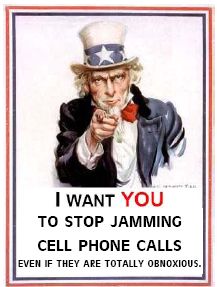
All complex new technologies have unintended consequences. As cellular expands the unintended consequences of these systems are becoming more visible. Shouldn’t the cellular industry address those issues more in addition to demanding more spectrum and more jammer enforcement?
Observations on Cell Phone Carrier Policies Overseas
Having recently rented a cellphone in Japan and bought GSM SIM cards in France and UK for my cheap unblocked cellphone reserved for overseas use, one thing all 3 transactions had in common: personal identification was required.
The US is the outlier in the industrialized countries in allowing purchase and use of cellphones in general without any identification, a topic of recurring discussion here. While there are major societal reasons against imposing a strict identification requirement on all cellphone sales in the US at the moment, the unrestricted sale of bagfuls of prepaid cellphones at Walmart and other large retailers should raise some real questions. Anonymous prepaid cellphones are widely used in criminal acts as the communications media of choice and are feeding the contraband prison cellphone use problem.
While I sincerely hope that the US never has a cellphone-activated IED terrorist incident, the unrestricted availability of anonymous cellphones is a real risk factor.
We have previously written about the Japanese “manner mode”, an easy consistent way to silence all cell phones in Japan - by comparison there is no consistent way to silence all US market cell phones and the root cause of the Marimba/Mahler incident was that the user thought he had silenced the phone but had not realized that silencing all alarm modes was an extra step.
While discussing “manner mode” with a Japanese friend, he mentioned that Japanese cell phones also have “drive mode”. Curious, I Googled for an English manual for a Japanese cell phone and found one from KDDI, a major Japanese cellular carrier:
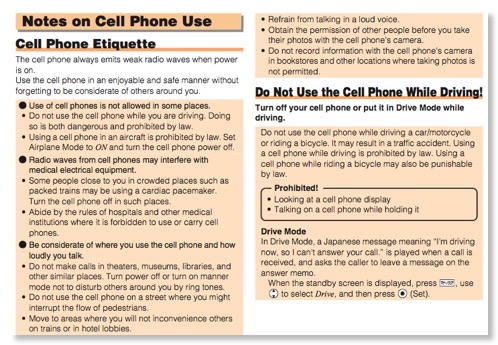
Note the following points that you would never hear from a US carrier:
- Do not use the cell phone while driving
- Be considerate of where you use the cell phone and how loudly you talk.
- Do not make calls in theaters, museums, libraries, and other similar places. Turn off power or turn on manner mode not to disturb others around you by ring tones.
- Do not use the cell phone on a street where you might interrupt the flow of pedestrians.
- Move to area where you will not inconvenience others on trains or in hotel lobbies.
- Refrain from talking in a loud voice.
- Turn off your cell phone or put it in Drive Mode while driving,
While not all readers would agree with all the suggestions in the KDDI manual, I hope many will agree that the US cell phone industry should try some of these ideas to reduce the social friction from today’s cell phone use.
Late in my travels I visited France where I purchased a SIM card from SFR - a major carrier for my minimalist GSM unblocked phone (purchased in Singapore several years ago for about $20). I received with the SIM card a copy of “Mon Mobile et Ma Santé” (My cellphone and my health), a flyer from la Fédération Française des Télécoms, the French trade association of both wireless and wireline carriers, effectively the CTIA counterpart. The content of the brochure is basically the text of the FFT cellphone/health web page. Included is the following text:
Il est conseillé aux femmes enceintes d’éloigner le téléphone du ventre et aux adolescents de l’éloigner du bas ventre.
Without formal qualifications as a French translator (and open to feedback on this topic), let me translate this as
It is advisable for pregnant women to keep mobile phones away from the abdomen and teens away from the lower abdomen.
The brochure also advises costumers to use the cellphone to preferably in areas of good reception since the cell phone reduces transmit power automatically in such places and thus reduces your exposure to radiation. It adds that that is places where the reception is 4-5 bars the phone’s transmissions are weakest and so is your exposure to RF.
The FFT website, but not the brochure they publish, advises
Which I translate asL’utilisateur peut aussi choisir un modèle de téléphone mobile à faible DAS, ce qui lui permet de réduire le niveau maximal de son exposition aux ondes radio.”
The user can also select a phone model low SAR, which reduces the maximum level of exposure to radio waves.
Readers may recall that this point is in contention in the ongoing CTIA/San Francisco litigation and is a point strongly disputed by the US cell phone industry.
I hope readers in the US market will find these observations of foreign cellphone markets thought provoking and starting asking questions about whether US carriers should adopt some of the policies in use in other countries.
Sen. Grassley: Your Recent "Marimba Moment" Was Not All Your Fault - Your friends in the Cellular Industry Made It Inevitable
In January, this blog had a post entitled “Is the Cellular Industry ‘Tone Deaf’ ”? It described a 1/12/12 New York Philharmonic concert of Mahler’s 9th Symphony that was interrupted by an iPhone Marimba ringtone from a front row seat.
At the time I wrote:
The cell phone industry is united against legalizing jamming, but seems unable to do anything about antisocial cell phone usage that inevitably leads to interest by concert halls and restaurants in cellular jamming. As previously stated here, French national law explicitly permits cellular jamming in concert halls. While jamming in such urban locations inevitably will cause other problems and is thus a bad idea (as opposed to jamming in isolated maximum security prisons where the geometry is very different), there seems to have been little interest in the cellular industry in alternative approaches to minimize the antisocial aspects of cell phone use.
The cell phone industry is usually a positive contributor to US society and the US economy. But it continues to have some blind spots as outlined in the previous New Year's Resolutions post here. Maybe it should address them? Maybe FCC leadership should politely point out these issues from time to time and mention the possible impact of neglect?
In my New Year’s Resolutions for the Cellular Industry post I wrote
That post’s 7 issues attracted NO inquiries from the cellular industry which apparently is focusing all its efforts on its appetite for spectrum, not social harmony resulting from its products and services. (In fairness one high CTIA official did reply to an e-mail from me about the post and seemed puzzled why people had trouble turning off their ringers.)2. Social harmony and cell phone use. Does the cellular industry ever wonder why the public rose up in force against the Docket 04-435 proposals to allow cellphones in airplanes or why there is a market for (presently) illegal cell phone jammers? The reason is that there is a lot of obnoxious cellphone use in this country! Airplanes are one of the few places without it and the public outcry was to preserve that. There is an interesting essay by Don Norman that was prepared for a 2005 Motorola Research Visionary Board meeting entitled “Minimizing the annoyance of the mobile phone: The Annoyance, Irritation, and Frustration of The Mobile Phone -- A Design Challenge” that starts off with the quote “Nearly one in three (30%) adults say the cell phone is the invention they most hate but cannot live without”.
What is the industry doing about this? Are they trying to increase sidetone levels so people don’t shout when using cell phones? Are they trying to make it easier to switch the ringer to a vibrate only/ “manners mode” as in Japan where all carriers have voluntarily agreed that a press of the “#” key toggles the unit to and from vibrate only mode? Are they researching ways for theaters and restaurants where people really want a semblance of quiet to use Bluetooth or a similar link to switch phones automatically to vibrate only? Kudos to Motorola for inviting Dr. Norman to talk on this issue. How much of this type of dialogue is going on now in the industry?
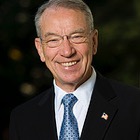
Senator Grassley, don’t feel bad about the incident. These types of things happen all the time because there is no consistent simple way to turn off the ring tone of US cell phones as there is in Japan. The cellular industry is much too busy grabbing spectrum to care about such issues of “unintended consequences”. It feels it can use its position of political strength to stop the sale of cellular jammers which people use illegally in selfdefense of obnoxious cell phone use.
In order to keep this “clear bright line” on jamming in effect, the industry even fights the use of cell phone jammers in isolated prisons where they could be a cost-effective option to enhance public safety. But apparently the cellular industry has never learned from the War on Drugs: to defeat a serious contraband issue you must address BOTH supply and demand. FCC may go through the appearances of being active against the selling of cell phone jammers, but the small and dispirited Enforcement Bureau technical staff doesn’t stand a chance against Chinese Internet marketing unless the demand is moderated also.
Sen. Grassley, at least you handled your moment much better than Sen. McCain handled his a few years ago on the Senate floor:
Is the Cellular Industry "Tone Deaf"?
Visit msnbc.com for breaking news, world news, and news about the economy
Yesterday afternoon, a NYC area college classmate sent me a link to a post entitled “.Wild Night at Philharmonic After Phone Interruption” from the WQXR Blog.
Last night, in one of the quietest parts of the final movement of a gorgeous New York Philharmonic performance of Mahler's Ninth, a cell phone started ringing ... and ringing, and ringing, and ringing. Alan Gilbert, who was on the podium in Avery Fisher Hall, glared in the direction of the phone, but it kept right on going. Then, the music got louder, and we all assumed that whoever owned the phone had done something about it. But minutes later, when the music got softer again the phone was still going (an iPhone marimba ringtone, which sounds like this):
So Gilbert stopped the performance. He then turned around and indicated that the phone should be turned off. It continued. The conductor then said to the phone’s owner, who was sitting in the front, “You have a phone... Fine, we’ll wait.” And we did, with audience members standing up, pointing in the direction of the offender, and shouting things like “Throw him out!” When the phone was finally silenced, Gilbert turned to the audience to apologize.
As of the posting of this item here, the WQXR Blog had 159 comments on this event - not many praising the cellular industry. One of the comments (#322191) stated,
“It's about time someone took a stand on cellphone protocol. What is so hard about turning it off when requested at a concert. I'm surprised no one has invented a way to check for all cellphones turned on. BRAVO Mr. Gilbert!!!!! I applaud your actions!”
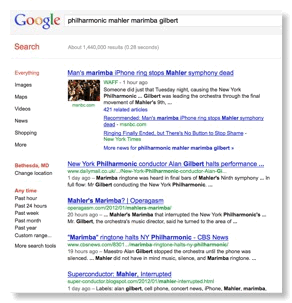
On December 27th, your blogger posted “Some Possible New Year's Resolutions for the Cellular Industry” which included “Social harmony and cell phone use” as item #2. This built on a February 2010 post entitled “Cellphones and Interpersonal Friction”. The 2/10 post, for example, described the Japanese “Manners Mode” built into every cell phone sold in Japan that makes it easy and uniform to disable ring tones - hit the # key! This was not a Japanese government mandate, rather a voluntary standard of the Japanese cell phone industry. Since basically the same suppliers market cell phones in Japan as in the US, one would think that it would be possible here also.
The cell phone industry is united against legalizing jamming, but seems unable to do anything about antisocial cell phone usage that inevitably leads to interest by concert halls and restaurants in cellular jamming. As previously stated here, French national law explicitly permits cellular jamming in concert halls. While jamming in such urban locations inevitably will cause other problems and is thus a bad idea (as opposed to jamming in isolated maximum security prisons where the geometry is very different), there seems to have been little interest in the cellular industry in alternative approaches to minimize the antisocial aspects of cell phone use.
The cell phone industry is usually a positive contributor to US society and the US economy. But it continues to have some blind spots as outlined in the previous New Year's Resolutions post here. Maybe it should address them? Maybe FCC leadership should politely point out these issues from time to time and mention the possible impact of neglect?
I have asked CTIA to comment on the “Mahler incident” and will promptly post any reply.
UPDATE
As you can see from the above YouTube video from a concert in Slovakia, the Mahler/marimba incident was not unique. We patiently await comment from the cellular industry about these incidents and what they are doing to decrease the incidence rate. We know the US cellular industry hates all jamming, any other ideas?


 (Does not include readers using RSS feeds.)


![[Valid RSS]](valid-rss-rogers.png "Validate my RSS feed")


